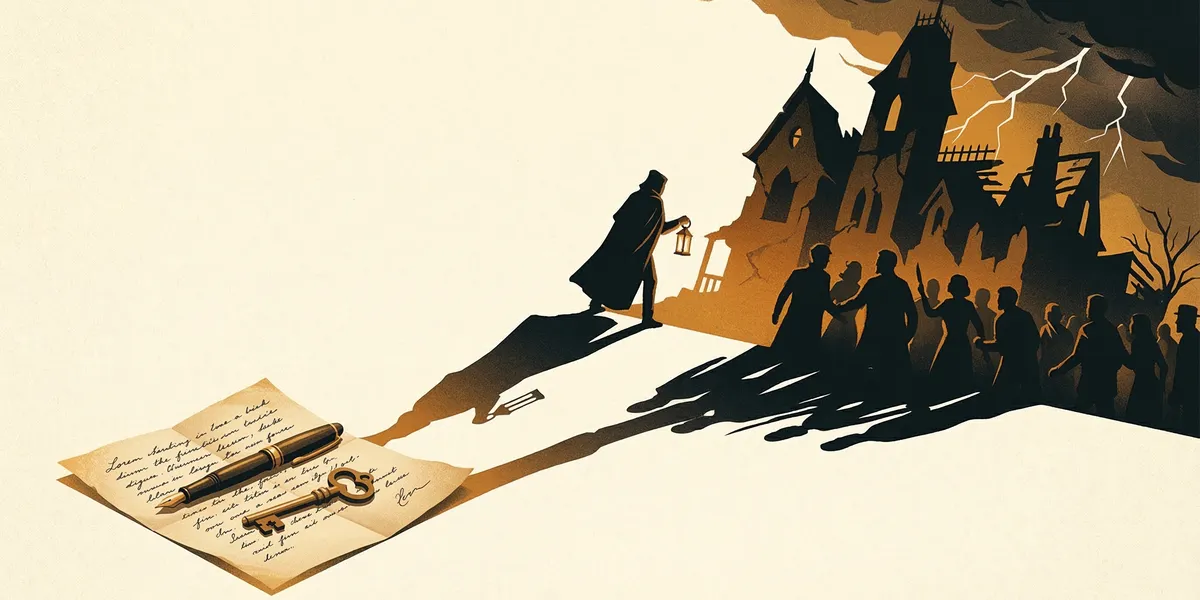
Foreshadowing is a literary device where the author plants hints or clues about events that will happen later in the story. It is the craft of making a reader feel, upon reaching a twist or a tragedy, that they should have seen it coming — and that some part of them, reading back through the breadcrumbs, already did.
What Is Foreshadowing
Foreshadowing works by creating a sense of anticipation. The author embeds a detail — a line of dialogue, a symbol, an offhand observation — that seems minor in the moment but carries weight in retrospect. When the payoff arrives, the reader experiences two things at once: surprise at the event and recognition that the groundwork was laid chapters ago.
This is what separates foreshadowing from prediction. A prediction tells you what will happen. Foreshadowing makes you feel something is coming without telling you what it is. The tension it builds is subconscious. Readers sense the storm before they see the clouds.
Foreshadowing appears in every narrative form — novels, short stories, plays, screenplays, even narrative nonfiction. It is one of the most versatile tools a writer has for creating plot structure that feels both surprising and inevitable.
Types of Foreshadowing
Direct Foreshadowing
Direct foreshadowing is an explicit warning about what is to come. A character says something will happen, a narrator announces danger ahead, or the text states a consequence outright. The audience knows something is coming — the tension lies in watching it unfold.
In Chronicle of a Death Foretold, Gabriel Garcia Marquez opens with: “On the day they were going to kill him, Santiago Nasar got up at five-thirty in the morning.” The death is announced. The entire novel is the reader watching it become unavoidable.
Indirect Foreshadowing
Indirect foreshadowing is subtler. Instead of stating what will happen, the author uses imagery, mood, weather, or symbolic details to create a feeling of unease or anticipation. The reader may not consciously register the hint on a first read, but it shapes their emotional experience of the story.
A storm gathering before a battle. A character humming a song whose lyrics mirror the ending. A cracked mirror in the hallway of a marriage falling apart. These details work below the surface.
Chekhov’s Gun
Anton Chekhov wrote: “If in the first act you have hung a pistol on the wall, then in the following one it should be fired.” Chekhov’s Gun is the principle that every meaningful detail introduced in a story must eventually serve a purpose. It is foreshadowing by presence — the very act of showing something signals that it will matter.
This is not a rule about guns. It is a rule about narrative economy. If you describe a locked cabinet in chapter two, the reader expects it to be opened. If you mention a character’s swimming ability early on, the reader expects water. The detail is a promise. Chekhov’s Gun says you must keep it.
Red Herrings
A red herring is false foreshadowing — a detail planted to mislead the reader into expecting something that does not happen. Mystery and thriller writers use red herrings constantly to misdirect suspicion, create false suspects, or disguise the true resolution.
Agatha Christie was a master of this. In And Then There Were None, nearly every character appears guilty at some point. The real killer hides behind a cascade of misleading clues. Red herrings work because they exploit the reader’s instinct to treat every detail as foreshadowing. The trick is making the false clues feel just as organic as the real ones.
Prophecy and Dreams
Prophecy is one of the oldest forms of foreshadowing. A character has a dream, receives a vision, or hears a prophecy that predicts future events — sometimes literally, sometimes in symbols that only become clear later.
Shakespeare used this form relentlessly. In Julius Caesar, a soothsayer warns Caesar to “beware the Ides of March.” Caesar dismisses the warning. The audience does not. The prophecy creates dramatic irony: the reader knows what the character refuses to believe.
Famous Examples of Foreshadowing
The Shining — Stephen King plants the word REDRUM throughout the novel and film, spoken by Danny in his trances. It is only when the word is seen reflected in a mirror — MURDER — that the foreshadowing clicks into place. The clue was visible the entire time, hidden by perspective.
Of Mice and Men — Early in the novel, Lennie accidentally kills a mouse by petting it too hard. Later, he kills a puppy the same way. These incidents foreshadow the tragic ending where Lennie, unable to control his own strength, accidentally kills Curley’s wife. Steinbeck builds a pattern so that the final death feels both shocking and inevitable.
Romeo and Juliet — The prologue announces that the lovers are “star-cross’d” and “death-mark’d.” Shakespeare tells the audience in the first fourteen lines that both protagonists will die. The foreshadowing is not subtle — it is a thesis statement. The play’s power comes not from surprise but from watching two people walk toward a fate the audience already knows.
Harry Potter — J.K. Rowling layered foreshadowing across seven books. The diary in Chamber of Secrets foreshadows the concept of Horcruxes revealed in Half-Blood Prince. Harry’s scar hurting near Voldemort foreshadows the soul fragment inside him. Trelawney’s prophecy in Prisoner of Azkaban foreshadows events three books later. Rowling rewarded re-readers with details that only made sense on a second pass.
Game of Thrones — The Red Wedding is one of the most famous plot twists in modern fiction, but George R.R. Martin foreshadowed it extensively. The Freys’ anger at Robb’s broken marriage pact, the repeated emphasis on guest right, Daenerys’s vision in the House of the Undying of a wolf-headed king at a feast — the clues were there for readers paying attention.
How to Use Foreshadowing in Your Writing
Plant Seeds Early
The best foreshadowing is placed long before the payoff. A hint dropped in chapter three that pays off in chapter twenty feels earned. A hint dropped in chapter nineteen that pays off in chapter twenty feels rushed. Distance between the seed and the harvest is what gives foreshadowing its power.
This means you often need to add foreshadowing in revision. Write the ending first, then go back and plant the clues. Most authors do not foreshadow perfectly in a first draft — they refine it once they know where the story lands.
Be Subtle
Heavy-handed foreshadowing destroys its own effect. If a character says “I have a bad feeling about this dinner party” and then something terrible happens at the dinner party, the reader feels manipulated rather than surprised. The best hints are ones the reader does not recognize as hints until after the payoff.
Bury your clues in scenes that appear to be about something else. Mention the detail as part of a description, a throwaway line in dialogue, a background element the character barely notices. Let it sit quietly until the moment it detonates.
Reward Re-Readers
Great foreshadowing gives a story two experiences: the first read, where the clues slip past unnoticed, and the re-read, where every page is dense with signals. Write for both readers. The first-time reader should feel surprise. The re-reader should feel admiration.
This is what makes books like Gone Girl or Fight Club so satisfying on a second read. The foreshadowing is everywhere, invisible in plain sight. Every scene holds a double meaning that only emerges once you know the truth.
Balance Obvious and Obscure
There is a spectrum between foreshadowing that is too transparent and foreshadowing that is so buried no one catches it. Neither extreme works. If every reader sees the twist coming, there is no surprise. If no reader catches the clues, there is no satisfaction in the reveal — it feels random rather than earned.
Aim for the middle. Plant some clues that attentive readers will catch and others that only make sense in retrospect. Give your audience credit for being smart, but do not punish them for not solving the puzzle before the last chapter.
Foreshadowing vs Flashforward
Foreshadowing and flashforward are often confused, but they work in opposite ways.
| Foreshadowing | Flashforward | |
|---|---|---|
| Method | Hints and suggestions | Directly shows a future scene |
| Subtlety | Implied, often unnoticed on first read | Explicit, the reader sees the future |
| Reader awareness | Reader may not realize it is foreshadowing | Reader knows they are seeing the future |
| Timeline | Stays in the present moment | Jumps ahead in chronology |
| Example | A cracked mirror suggesting a relationship breaking | A scene showing the character alone five years later |
Foreshadowing whispers. A flashforward shouts. Both are valid narrative tools, but they create different effects. Foreshadowing builds subconscious tension. A flashforward creates a question — how did the characters get from here to there? — and the narrative answers it.
A story can use both. The opening of Breaking Bad shows a flashforward of Walter White in his underwear, holding a gun in a desert. That scene creates a question. The foreshadowing scattered throughout the series — Walt’s growing ruthlessness, his lies compounding, his family eroding — builds the emotional path to that moment.
Common Mistakes
Being too heavy-handed. When foreshadowing calls attention to itself, it stops working. If the camera lingers too long on a knife in a drawer, or a character makes a pointed remark about how “nothing could possibly go wrong,” the reader sees the mechanism instead of the story. Trust your audience. A light touch is almost always better.
Forgetting to pay off. Every piece of foreshadowing is a promise to the reader. If you introduce a mysterious locked room, readers expect to learn what is inside. If you show a character with a hidden skill, readers expect that skill to matter. Unfulfilled foreshadowing creates frustration — the feeling that the author lost track of their own story.
Planting inconsistent clues. Foreshadowing must be consistent with what actually happens. If you foreshadow a betrayal but the clues you planted actually point toward something else entirely, the reveal will feel dishonest. Go back in revision and make sure every hint, no matter how subtle, aligns with the truth.
Confusing foreshadowing with spoiling. Foreshadowing creates anticipation. Spoiling removes it. The difference is specificity. “Something terrible will happen at the wedding” is a spoiler. A brief mention of how the bride’s family never forgets a slight, buried in a scene about something else, is foreshadowing. One removes surprise. The other deepens it.
Foreshadowing is ultimately an act of respect — respect for the story’s internal logic and respect for the reader’s attention. When done well, it makes a narrative feel like it was always heading exactly where it arrived, even when the destination is a shock. Plant the seeds. Trust the soil. Let the reader discover the garden on their own.