Yes, you can get a free book writing template that actually works. The right template gives you a proven chapter structure, section headings, and content prompts so you skip the blank-page paralysis and start writing immediately.
This guide covers the best free book writing templates available right now, organized by genre and book type. You will also learn how to customize any template for your specific project and why AI-powered tools are replacing static templates entirely.
What a book writing template includes
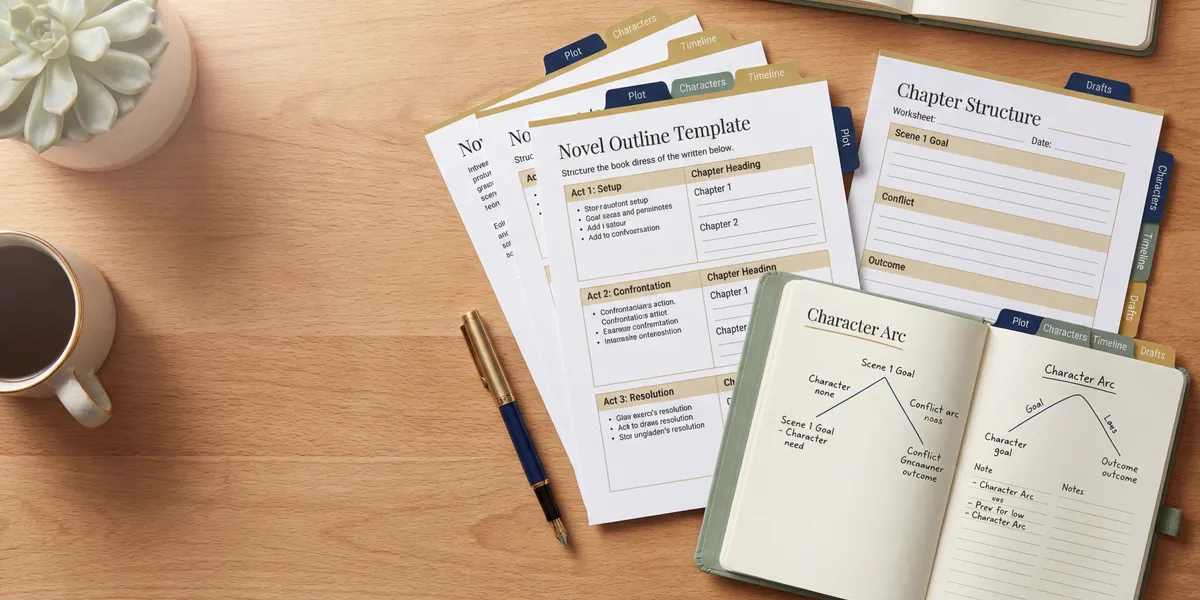
A book writing template is a pre-built document structure that maps out your book before you write it. Most templates include chapter headings, section prompts, and structural guidelines based on what works for a specific genre.
The standard components across most free templates are:
| Component | What it does |
|---|---|
| Chapter outline | Maps the sequence and purpose of each chapter |
| Section headings | Breaks chapters into logical subsections |
| Content prompts | Tells you what to write in each section |
| Word count targets | Sets a goal for each chapter or section |
| Formatting guide | Specifies margins, fonts, and page layout |
Not every template includes all five. Some focus purely on structure (chapter outlines), while others are formatting templates that handle the visual layout of your finished manuscript. Know which type you need before downloading.
Best free book writing templates by genre
Fiction templates
Fiction templates follow narrative structures that readers expect. The most useful ones map plot beats, character arcs, and chapter pacing rather than just giving you blank chapter headings.
Three-act structure template is the most popular starting point for novels. It divides your book into setup, confrontation, and resolution with specific plot beats at each transition. Squibler’s three-act template walks you through the elements of each act and works with Word, Scrivener, or Apple Pages.
The 24-chapter plot outline from Creativindie solves commercial fiction’s biggest problem: the sagging middle. Each of the 24 chapters has a defined purpose and emotional beat, giving you a complete roadmap from opening hook to final resolution.
Reedsy’s fiction templates include character development worksheets, worldbuilding guides, and scene-by-scene outline templates. Their bundle of 40+ templates covers everything from brainstorming to story structure, all free with a Reedsy account.
Nonfiction templates
Nonfiction templates organize ideas, arguments, and information into a structure that teaches or persuades effectively. The right template depends on whether you are writing a how-to guide, a business book, or an expert authority book.
Scribe Media’s nonfiction template is designed for experts and business professionals turning their knowledge into a book. Their free outline template guides you from core premise through chapter-by-chapter arguments, with clear instructions for each section.
The eight-chapter nonfiction model from Plottr follows a proven flow: introduce the subject, build confidence in the reader, deliver the core content across several chapters, and end with a call to action. This structure works for most how-to and self-help books.
Self-Publishing School’s template offers a downloadable Word document with pre-formatted chapters, section breaks, and prompts for front matter and back matter. It includes formatting for both the writing phase and the final manuscript.
Memoir templates
Memoir templates blend fiction structure with nonfiction purpose. You are telling a true story, but it needs the narrative tension and pacing of a novel.
The most effective memoir structure opens with a dramatic moment, then builds the backstory that led there. Jerry Jenkins’s outline method recommends starting at the turning point of your story and working outward, mapping the events that created that moment and the growth that followed.
A solid memoir template includes sections for:
- Opening hook — the scene that pulls readers in
- Backstory chapters — the events leading to your central conflict
- Turning point — the moment everything changed
- Growth and resolution — what you learned and how you changed
- Reflection — connecting your personal story to a universal truth
Where to download free templates
Here are the best sources for free book writing templates, organized by what they offer:
| Source | Template type | Format | Best for |
|---|---|---|---|
| Reedsy | Story structure, character, worldbuilding | Online / PDF | Fiction writers |
| TheGoodDocs | 200+ genre-specific templates | Google Docs, Word | All genres |
| Scribe Media | Nonfiction chapter outline | Word, Google Docs | Nonfiction authors |
| Squibler | Three-act structure | Word, Scrivener | Novel writers |
| BookBaby | Formatting and cover templates | Various | Self-publishers |
| 48 Hour Books | Page layout and trim size templates | PDF, Word | Print formatting |
| Canva | Visual book and cover templates | Online | Design-focused projects |
Most of these templates work with Microsoft Word or Google Docs. If you use Scrivener, check that the template format is compatible before downloading.
How to customize a template for your book
A generic template gets you started, but you will need to adjust it for your specific project. Here is the process:
Step 1: Match the template to your genre. Start with the closest match. A business book author should grab a nonfiction template, not a fiction one. A romance writer needs a template with relationship arc beats, not a general three-act structure.
Step 2: Adjust chapter count. Most templates default to a specific number of chapters. Your book might need more or fewer. A standard novel runs 20 to 30 chapters. A nonfiction book typically has 8 to 15. Adjust the template to match your target word count and scope.
Step 3: Fill in your specifics. Replace generic prompts with your actual content ideas. Instead of “Chapter 3: Rising conflict,” write “Chapter 3: Sarah discovers the letter and confronts her mother.” The more specific your outline, the faster your drafting will go.
Step 4: Add or remove sections. If the template includes a section on worldbuilding and you are writing contemporary fiction set in a real city, delete it. If it lacks a section for research notes and you need one, add it. The template serves you, not the other way around.
Step 5: Set word count targets. Divide your total word count goal by the number of chapters to get a per-chapter target. For a 60,000-word novel with 20 chapters, that is 3,000 words per chapter. Write the target at the top of each chapter section.
The problem with static templates
Free book writing templates solve the blank-page problem, but they create a new one: they are static. A downloaded Word document does not adapt as your book evolves. It does not reorganize chapters when your structure changes. It does not suggest what is missing from a section.
This is where most writers hit a wall. They download a template, fill in the first few chapters, then realize the structure does not quite fit their book. They spend hours reformatting instead of writing.
Static templates also cannot help with the actual writing. They tell you what goes where, but they do not help you figure out what to say. For nonfiction authors especially, the gap between “Chapter 4: Your methodology” and a finished chapter is enormous.
Our Pick — Chapter
Chapter.pub does not give you a static template to fill in. It generates your entire book structure automatically based on your topic, audience, and goals. Tell it what your book is about, and it creates a custom chapter outline, section headings, and content guidance tailored to your specific project.
Best for: Authors who want a complete, custom book structure generated in minutes instead of hours spent customizing a generic template.
Pricing: $97 one-time (nonfiction)
Why we built it: Templates are a starting point, but most authors need more than a blank framework. Chapter generates the structure and helps you write each section, so you go from idea to finished manuscript without stalling.
Over 2,147 authors have used Chapter to create more than 5,000 books. If you have spent more time searching for the perfect template than actually writing, Chapter skips the template step entirely and gets you straight to a finished outline built for your book.
Common mistakes to avoid
- Downloading too many templates. Pick one that is close enough and customize it. Downloading ten templates and comparing them is procrastination disguised as research.
- Following the template rigidly. Templates are guides, not rules. If chapter 7 in the template does not work for your book, change it or remove it.
- Using a fiction template for nonfiction. The structures are fundamentally different. Fiction templates focus on plot and character arcs. Nonfiction templates focus on arguments, evidence, and reader transformation. Use the right type.
- Skipping the customization step. A generic template produces a generic book. Spend 30 minutes adapting the template to your specific project before you start writing.
- Ignoring formatting templates. Structure templates help you plan your book. Formatting templates help you prepare it for publishing. You will eventually need both, so download a formatting template alongside your outline template.
FAQ
What is the best free book writing template for beginners?
Start with a simple chapter outline template rather than a detailed beat sheet. Reedsy’s template bundle is beginner-friendly because it includes instructions with each template and covers every stage from brainstorming to final structure.
Can I use a book writing template in Google Docs?
Yes. TheGoodDocs offers over 200 templates specifically formatted for Google Docs. Most other templates are available in Word format, which Google Docs can open and convert automatically.
How do I choose between a template and AI book writing software?
Templates give you structure. AI tools like Chapter.pub give you structure plus content guidance, automatic reorganization, and help with the actual writing. If you want a simple starting framework, a free template works. If you want a tool that adapts to your book and helps you finish it, AI software is the better investment.
Do I need a different template for fiction and nonfiction?
Yes. Fiction templates are built around narrative arcs, character development, and plot beats. Nonfiction templates organize ideas, arguments, and evidence into a logical teaching or persuasion structure. Using the wrong type will create a structure that fights against what your book needs to accomplish. See our book outline template guide for genre-specific examples.
Are free book writing templates really free?
Most templates listed in this guide are genuinely free. Some sources require an email address to access the download. A few platforms like Reedsy require a free account. None of the templates linked above require a paid subscription to download or use.