The median income for a full-time author in the United States is roughly $12,000 to $15,000 per year from book-related earnings alone. Most working authors earn less than $20,000 annually from their writing.
That number surprises people. It shouldn’t. Writing books has never been a guaranteed path to wealth, and the data consistently shows that a small percentage of authors earn the vast majority of book revenue.
But the data also shows something else: authors who treat writing as a business, who publish strategically and build multiple income streams, earn significantly more than those who write, publish once, and hope for the best.
Here is what the numbers actually look like.
Author income at a glance
| Income Bracket | % of Authors | Annual Earnings |
|---|---|---|
| Below poverty line | ~50% | Under $12,000 |
| Part-time supplement | ~25% | $12,000 - $40,000 |
| Full-time livable | ~15% | $40,000 - $100,000 |
| Six figures and above | ~10% | $100,000+ |
Source: Surveys from the Authors Guild and self-publishing income reports consistently show this distribution. The exact percentages shift slightly year to year, but the shape stays the same.
Income by publishing path
Traditional publishing
The median advance for a debut author with a Big Five publisher is $5,000 to $15,000. Most books never earn out their advance, which means the advance is the total payment the author receives.
Royalty rates for traditionally published authors typically run:
- Hardcover: 10-15% of list price
- Paperback: 6-8% of list price
- Ebook: 25% of net receipts
A traditionally published book that sells 5,000 copies at a $16 list price with a 10% royalty generates $8,000 in royalties. If the advance was $10,000, the author earns nothing beyond the advance.
According to the Bureau of Labor Statistics, the median annual wage for writers and authors was $73,150 in 2023, but that figure includes all writing professions (technical writers, copywriters, content writers), not just book authors.
Self-publishing
Self-published authors keep 35-70% of each sale on platforms like Amazon KDP, depending on pricing and distribution choices. The math works differently here.
A self-published ebook priced at $4.99 with the 70% royalty rate earns $3.49 per sale. Sell 1,000 copies and you earn $3,490. Sell 10,000 copies and you earn $34,900.
The top 1% of self-published authors on Amazon earn over $100,000 per year. The median self-published author earns under $1,000 per year. The gap between those numbers tells the real story: volume and consistency matter more than any single book.
Data from Written Word Media’s survey of indie authors shows that authors with 10+ published books earn an average of 5-7x more than authors with a single title.
Hybrid publishing
Hybrid publishers charge authors upfront fees ranging from $3,000 to $50,000 in exchange for professional editing, design, and distribution. Royalty rates are typically higher than traditional publishing (50-70%), but the author bears the financial risk.
The Independent Book Publishers Association (IBPA) provides criteria for evaluating hybrid publishers, which is worth reviewing before investing.
Income by genre
Not all books sell equally. Genre matters enormously.
| Genre | Avg. Annual Author Income | Notes |
|---|---|---|
| Romance | $10,000 - $50,000+ | Highest-earning indie genre; rapid release works well |
| Thriller/Mystery | $8,000 - $30,000 | Strong readthrough in series |
| Fantasy/Sci-Fi | $5,000 - $25,000 | Loyal readership, slower build |
| Nonfiction (business) | $5,000 - $40,000 | Income often comes from speaking/consulting, not just royalties |
| Nonfiction (self-help) | $3,000 - $20,000 | Broad market, heavy competition |
| Literary fiction | $2,000 - $10,000 | Smallest commercial market |
| Children’s books | $3,000 - $15,000 | Volume-dependent |
These ranges represent the middle 50% of actively publishing authors in each genre, based on aggregated data from the Alliance of Independent Authors and Amazon sales rank analysis.
What separates high-earning authors
The authors earning $50,000+ per year from their writing share several patterns:
They publish frequently. Authors who release 3-4 books per year consistently out-earn those who publish one book every two years. The data from Publisher’s Weekly surveys confirms that backlist depth is the strongest predictor of income.
They write in series. Series create readthrough, where a reader who finishes book one buys books two through seven. A five-book series with 60% readthrough generates far more revenue than five standalone novels.
They build direct relationships with readers. Authors with email lists of 5,000+ subscribers can launch a new book to $5,000-$15,000 in the first week without relying on any platform’s algorithm.
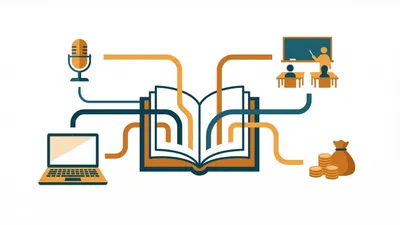
They diversify income. The highest-earning authors don’t rely on book royalties alone. They add courses, speaking, consulting, and coaching built on the authority their books establish.
The realistic timeline
Most authors follow a pattern that looks roughly like this:
- Year 1: Publish first book. Earn $0-$500. Learn what you don’t know.
- Year 2: Publish 2-3 more books. Earn $500-$5,000. Start building an audience.
- Year 3-4: Backlist generates passive income. Earn $5,000-$20,000. Systems start working.
- Year 5+: If publishing consistently, $20,000-$100,000+ is achievable. Not guaranteed, but achievable.
This timeline assumes consistent output and deliberate marketing. Authors who publish one book and stop should not expect ongoing income.
How to increase your author income
Publish more books. This is the single highest-impact action. Every book in your catalog is another entry point for readers and another stream of royalties.
Write in a profitable genre. If income is your priority, write where readers spend money. Romance, thriller, and business nonfiction have the most active buyer markets.
Use tools that speed up production. Chapter helps authors go from idea to finished manuscript faster, which means more books published per year and more revenue generated over time. Over 2,147 authors have used it to produce more than 5,000 books.
Build an email list. Direct access to readers removes your dependence on Amazon’s algorithm or a publisher’s marketing budget.
Create multiple income streams. Use your published book as a platform for speaking, consulting, courses, and coaching. One author, Jim T., turned a single authority book into a $13,200 client engagement.
The bottom line
Most authors don’t earn enough from writing alone to replace a full-time salary. That is the honest truth, and anyone who tells you otherwise is selling something.
But authors who publish consistently, write in commercially viable genres, and build a business around their writing can and do earn full-time incomes. The data shows it is possible. The data also shows it requires years of effort, multiple published works, and a willingness to treat writing as a business rather than purely an art form.
The question is not really “how much do authors make?” The question is “how much are you willing to invest in making your writing career work?”
FAQ
Can you make a living as an author?
Yes, but it typically requires 3-5+ years of consistent publishing, multiple books in print, and income streams beyond royalties alone. Roughly 10-15% of actively publishing authors earn a full-time living from their writing.
How much does a first book earn?
A first traditionally published book typically earns its advance ($5,000-$15,000) and nothing more. A first self-published book typically earns $200-$2,000 in its first year, though outliers exist in both directions.
Do self-published authors make more than traditionally published authors?
The top earners in self-publishing often make more because they keep 70% of each sale rather than 10-25%. But the median self-published author earns less than the median traditionally published author, because traditional publishing provides editorial gatekeeping that filters out many non-commercial works.
How many books do you need to publish to earn a full-time income?
Data consistently shows the inflection point is around 5-10 published titles. Authors with 10+ books earn 5-7x more on average than single-title authors. Each new book also increases sales of your existing books through discoverability and readthrough.
What is the fastest way to increase author income?
Publish your next book. Nothing else — not marketing, not social media, not a better cover — has as large an impact on author income as increasing your catalog size. After that, building an email list is the second highest-leverage activity.