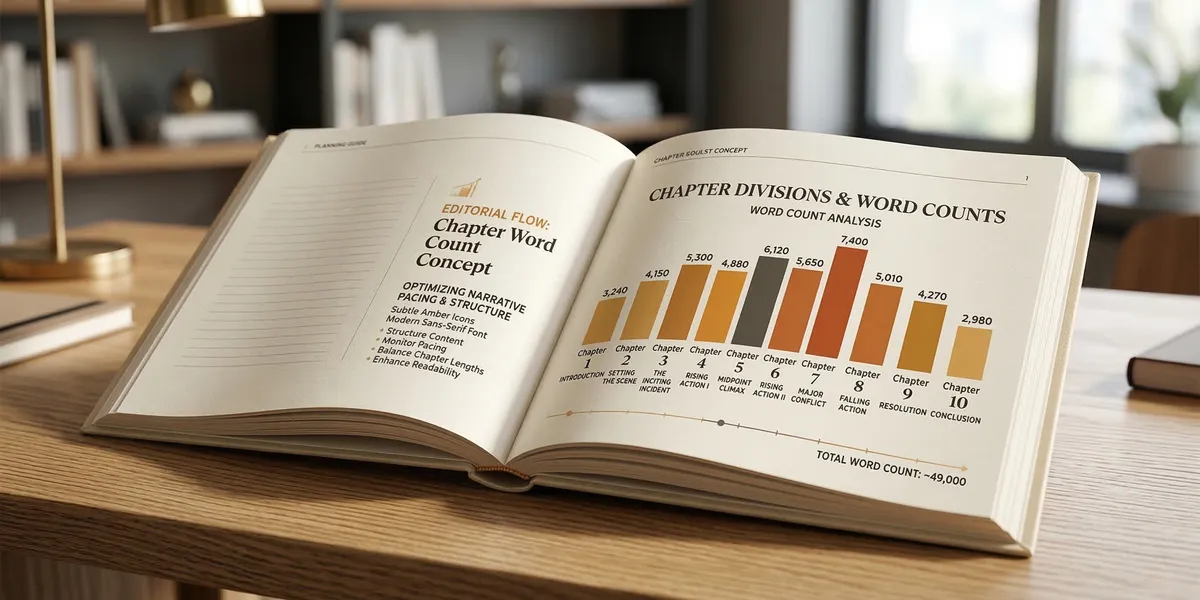
Most book chapters are 1,500 to 5,000 words, with the average falling between 3,000 and 4,000 words. But chapter length varies significantly by genre, audience, and the pacing your story demands.
There is no universal rule. Some published novels have chapters under 500 words. Others run past 10,000. What matters is consistency within your book and a chapter length that serves your story’s rhythm.
Chapter Length by Genre
| Genre | Typical Chapter Length | Notes |
|---|---|---|
| Literary Fiction | 3,000–5,000 words | Longer chapters allow room for prose style and internal reflection |
| Thriller / Suspense | 1,000–3,000 words | Short chapters create urgency and rapid pacing |
| Romance | 2,000–4,000 words | Moderate length balances emotional depth with forward momentum |
| Fantasy / Sci-Fi | 3,000–6,000 words | Longer chapters accommodate world-building and complex plots |
| Nonfiction | 2,000–5,000 words | Length depends on topic density and reader expectations |
| YA (Young Adult) | 2,000–4,000 words | Slightly shorter to match the audience’s reading pace |
| Middle Grade | 1,500–3,000 words | Shorter chapters suit younger readers |
| Mystery / Crime | 2,000–4,000 words | Moderate chapters with cliffhanger endings to maintain suspense |
These ranges reflect published norms, not requirements. Your chapters can fall outside them if your story benefits.
Short Chapters vs. Long Chapters
Chapter length is a pacing tool. Choosing shorter or longer chapters changes how the reader experiences your story.
Short chapters (under 2,000 words) create a feeling of speed. The reader finishes each chapter quickly, which builds momentum and makes the book feel fast-paced even if the plot is not action-heavy. Short chapters also create natural “one more chapter” moments — the reader tells themselves they will stop at the next chapter break, but the chapters keep ending before they expect it.
Thriller writers use this technique relentlessly. James Patterson’s chapters are often under 1,000 words. Dan Brown rarely exceeds 1,500. The effect is a book that feels impossible to put down, not because of the prose but because of the structure.
Long chapters (over 5,000 words) create immersion. The reader settles into a sustained scene or sequence without interruption. This suits literary fiction, where the reading experience values depth over speed, and fantasy, where world-building benefits from extended passages that let the reader fully inhabit the setting.
Long chapters signal to the reader that they should settle in. They are best for stories where the pleasure is in the journey, not the destination.
Mixed-length chapters are more common than most writers realize. Many novels alternate between longer and shorter chapters to vary the pace. A 5,000-word chapter that builds tension followed by a 1,000-word chapter that delivers the payoff creates a rhythm that keeps the reader engaged.
When to Break a Chapter
A chapter break is a signal to the reader. It says: this unit of story is complete. Something has changed. The next chapter will begin from a new starting point — a new scene, a new perspective, a new phase of the story.
Break a chapter when:
- A scene reaches its natural conclusion. The conversation ends, the character leaves the room, the event finishes. The chapter contains a complete dramatic unit.
- The point of view shifts. If your novel uses multiple POV characters, chapter breaks are the cleanest place to switch perspectives.
- Time passes. A gap of hours, days, or weeks between scenes is a natural chapter boundary.
- You want to create a cliffhanger. Ending a chapter at a moment of tension — a revelation, a threat, an unanswered question — pulls the reader into the next chapter. This is the most powerful use of chapter breaks in commercial fiction.
- The pacing needs a reset. After an intense action sequence, a chapter break gives the reader a breath before the next escalation. After a slow, introspective passage, a break signals that the pace is about to change.
Do not break chapters arbitrarily at a word count threshold. A chapter should end because the story demands it, not because you hit 3,000 words.
Consistency Matters More Than Length
The most important principle of chapter length is this: consistency within your book matters more than hitting a specific number.
If your chapters average 3,000 words, the reader develops an unconscious expectation for that rhythm. A chapter that suddenly runs to 8,000 words will feel bloated, and one that ends at 800 will feel abrupt — unless the variation is intentional and serves the story.
Intentional variation works. A thriller that uses 2,000-word chapters for most of the book and then drops to 500-word chapters in the climax signals acceleration. A literary novel that runs long chapters throughout but ends with a single short chapter creates a striking final effect. These choices are deliberate and purposeful.
Unintentional variation — where chapters are different lengths because you did not pay attention — creates an uneven reading experience. The reader may not consciously notice, but they will feel it.
How to Decide Your Chapter Length
If you are unsure what chapter length to use, start with these steps:
Read in your genre. Pick five published books in the genre and category you are writing in. Note their average chapter length. This gives you a baseline for reader expectations.
Consider your pacing goals. A fast-paced story benefits from shorter chapters. A meditative, immersive story benefits from longer ones. Match your chapter length to the experience you want the reader to have.
Write naturally first, then adjust. In a first draft, end chapters where they feel right. After the draft is complete, review the chapter lengths. If one chapter is significantly longer or shorter than the rest without a story-based reason, revise the break points.
Your plot structure will also influence chapter length. Books with many subplots and POV characters tend to have shorter chapters because each scene shift creates a natural break. Books with a single POV and a linear narrative tend to have longer chapters because the story flows without interruption.
If you are wondering how your chapter count will look overall, see our guide on how many chapters in a book for typical ranges by genre.
The Bottom Line
Chapters are containers for scenes, and those containers should be the right size for what they hold. A 2,000-word action sequence does not need padding to reach 4,000 words. A 6,000-word character study does not need to be split in half just because “chapters should be 3,000 words.”
Write the chapter the scene requires. Stay roughly consistent. Use length as a deliberate pacing tool. And remember that no reader has ever put down a book because the chapters were 2,500 words instead of 3,500.
The words inside the chapter are what matter. For guidance on structuring your full book, see how to write a book.