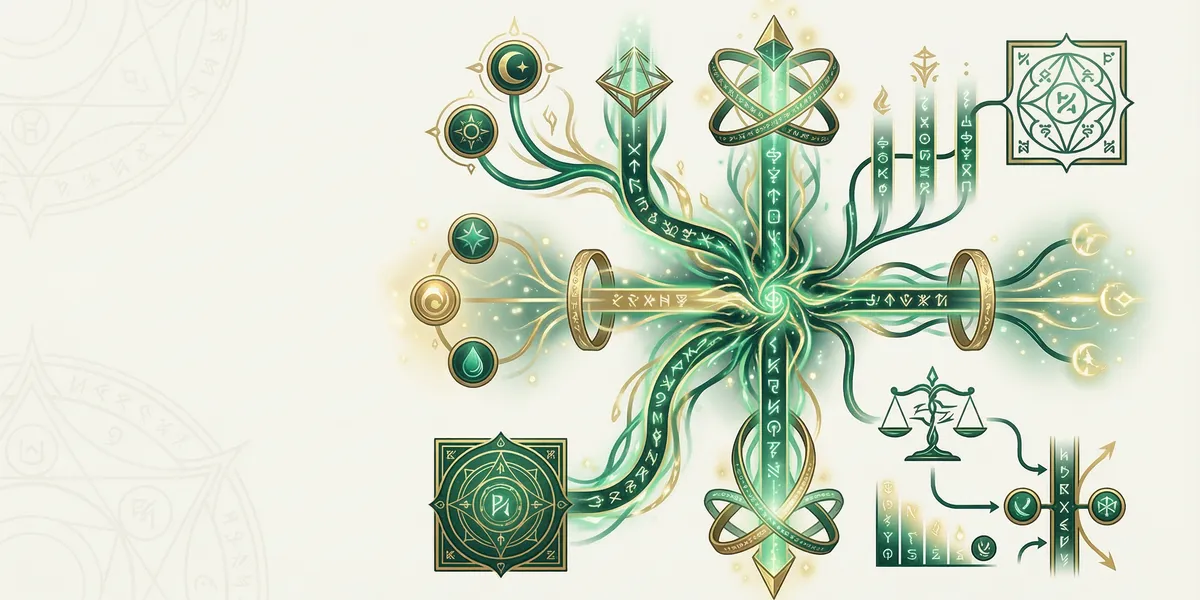
A magic system is the set of rules that governs how supernatural abilities work in your fictional world. Creating a magic system that feels real — one that readers accept as naturally as gravity — is one of the most important tasks in writing a fantasy novel. Get it right, and magic elevates every conflict, twist, and character choice. Get it wrong, and the reader never trusts your story.
Hard Magic vs Soft Magic
Every magic system falls somewhere on a spectrum between hard and soft. Understanding where yours sits is the first and most important decision you will make.
Hard Magic
Hard magic has clearly defined rules that both the characters and the reader understand. The reader knows what the magic can do, what it costs, and what its limitations are. When a character uses hard magic to solve a problem, the solution feels earned because the reader could have predicted it.
Brandon Sanderson’s Mistborn is the textbook example. Allomancy works by ingesting and “burning” specific metals. Each metal grants a specific ability — steel lets you push on metal objects, tin enhances senses, pewter increases physical strength. The rules are explicit. The costs are clear (you run out of metal). When Vin uses steel to launch coins at enemies, the reader understands the mechanics and feels the cleverness of the application.
Hard magic works well when: magic is central to conflict resolution, you want readers to anticipate creative uses, and you are building a system readers can analyze and discuss.
Soft Magic
Soft magic is mysterious, unexplained, and awe-inspiring. The reader does not know the rules — and neither, often, do the characters. Magic feels wondrous precisely because it is not understood. It creates atmosphere and wonder rather than tactical problem-solving.
Tolkien’s The Lord of the Rings is the classic example. Gandalf has powers, but the reader is never given a rulebook. What exactly can he do? It is unclear. Can he defeat the Balrog? He does, but at great cost, and the mechanics are never explained. The magic feels ancient and vast, bigger than any character’s understanding.
Soft magic works well when: magic is a source of wonder, mystery, or threat rather than a tool characters use to solve problems.
The Spectrum
Most fantasy falls between the extremes. Harry Potter leans hard — spells have specific effects and limitations — but includes soft elements like ancient magic, prophecy, and the unexplained power of love. A Song of Ice and Fire leans soft — magic is rare, frightening, and poorly understood — but hardens as the story progresses and characters learn more.
You do not have to pick one end. But you do need to know where you are on the spectrum so you can be consistent.
Sanderson’s Laws of Magic
Brandon Sanderson formalized three principles that are now widely referenced in fantasy writing. They are not rules you must follow, but they are lenses that help you evaluate whether your system works.
First Law
“An author’s ability to solve conflict with magic is directly proportional to how well the reader understands said magic.”
This means: if the reader understands the magic system, you can use magic to resolve problems in satisfying ways. If the reader does not understand the system, using magic to solve problems feels like cheating — a deus ex machina.
Gandalf can use mysterious magic to create atmosphere because Tolkien never uses soft magic to resolve the central conflict. The Ring is destroyed by a hobbit’s willpower, not by a spell. If Gandalf had suddenly cast an unexplained super-spell to destroy Sauron, readers would feel cheated.
Second Law
“Limitations are more interesting than powers.”
What your characters cannot do is more important than what they can do. Superman is boring when he is invincible. He becomes interesting when kryptonite exists, when he faces a moral dilemma, when his power has a cost.
Design your limitations first. The powers will follow naturally as the interesting ways characters work within — or around — those constraints.
Third Law
“Expand what you have before you add something new.”
Before introducing a new type of magic, fully explore the one you already have. Find new applications, unexpected interactions, creative uses that your characters — and readers — have not considered.
In Mistborn, Sanderson does not keep inventing new magic systems. He reveals new applications of Allomancy. Characters discover that pushing on metals in their own bodies lets them heal. The system deepens without widening.
Designing Costs and Limitations
Every interesting magic system has a cost. Without cost, magic becomes a cheat code, and conflict becomes meaningless — why would a character struggle when they can wave a hand and fix everything?
Types of Magical Cost
Physical toll. Using magic damages the body. Blood magic in Dragon Age drains life force. The Stormlight Archive’s Surgebinders consume Stormlight, which is finite and must be replenished. The cost is visible and creates tension — the character is literally spending their health.
Resource scarcity. Magic requires a material component that is rare, expensive, or dangerous to obtain. Allomancy needs metals. Wand magic needs specific ingredients (phoenix feathers, dragon heartstrings). The scarcity creates economic and social stakes around magic.
Moral cost. Magic requires the practitioner to do something ethically questionable. Blood sacrifice. Memory erasure. Bargaining with entities whose motives are suspect. This cost creates character development — every use of magic is a moral choice.
Knowledge and training. Magic is theoretically limitless but practically constrained by what the practitioner has learned. This is the Hogwarts model — the spells exist, but mastering them takes years. It explains why wizards do not solve every problem instantly.
Unintended consequences. Magic solves the immediate problem but creates new ones. Monkey’s paw logic. Every wish has a catch. This cost drives plot because the solution to one conflict becomes the seed of the next.
The best systems combine multiple costs. A spell might require a rare ingredient (resource), cause physical pain (physical toll), and produce side effects the caster cannot predict (unintended consequences). Layered costs create layered storytelling.
Worldbuilding Implications
Magic does not exist in a vacuum. If your world has magic, every aspect of civilization should reflect it. Ask yourself these questions:
Society. Who has access to magic? Everyone, or a select few? If only some people can use magic, how does that affect power structures? Are mages a ruling class, a persecuted minority, a regulated profession? The answer shapes your entire world’s politics.
Economy. If a mage can conjure food, what happens to farmers? If healing magic exists, what happens to doctors? If teleportation exists, what happens to trade routes? Magic disrupts every system it touches. Follow the implications.
Warfare. How does magic change combat? If fireballs exist, do armies still use swords? If shields can block magic, does warfare become a technological arms race between offense and defense? The military applications of your magic system determine the shape of your world’s conflicts.
Religion. Is magic a gift from the gods, a natural phenomenon, or something stolen from higher powers? The cultural interpretation of magic shapes how characters think about using it. A character who believes magic is divine permission behaves differently from one who believes it is a dangerous temptation.
Law. Are there laws governing magic use? Is using certain spells illegal? Who enforces those laws, and how? If mind-control magic exists, does that raise consent issues that the legal system must address?
You do not need to answer every question in the text. But you need to have answered them for yourself. The answers inform your world’s texture, your plot structure, and the conflicts your characters face.
The “One Unique Thing” Approach
If designing a full magic system from scratch feels overwhelming, start with one unique idea and build outward.
What if magic only works during eclipses? What if every spell requires a true statement — you can only cast magic by speaking something honest? What if magic is inherited through trauma — only people who have suffered great loss can access it?
One distinctive concept gives your system an identity. Everything else — the rules, the costs, the limitations — grows from that central idea. Readers remember magic systems with a strong core concept far more than systems that are technically detailed but generically designed.
Fantasy name generators can help you name your magic system’s elements once you have the concept — the spells, the practitioners, the source of power. Naming things makes them feel real.
Common Mistakes
Magic solves everything. If your protagonist can teleport, read minds, and shoot fire, they should never be in danger. And if they are never in danger, there is no tension. The more powerful your magic, the more ruthless your limitations need to be.
No consistency. If a spell does one thing in chapter three and something different in chapter fifteen with no explanation, the reader loses trust. Keep a magic bible — a document that tracks every rule, cost, and limitation. Reference it while writing.
Bolt-on magic. Magic that has no connection to the culture, history, or daily life of your world feels decorative rather than organic. If you removed the magic and the world would function identically, the magic is not integrated deeply enough.
Explaining too much. Hard magic needs rules the reader understands, but it does not need a textbook. Reveal mechanics through action and consequence, not exposition dumps. Show a character hitting their limit, not a professor lecturing about where the limit is.
Forgetting the wonder. Even hard magic should occasionally feel magical. If your system is so thoroughly systematized that it reads like engineering, you have lost the spark that drew readers to fantasy in the first place. Leave room for mystery, even within the rules.
A great magic system is not measured by its complexity. It is measured by whether it makes the story more interesting — whether it creates conflicts worth resolving, choices worth making, and a world worth exploring. Start with one idea, build outward, test every rule against the story, and trust that a system with clear limitations and real costs will generate more compelling fiction than unlimited power ever could.