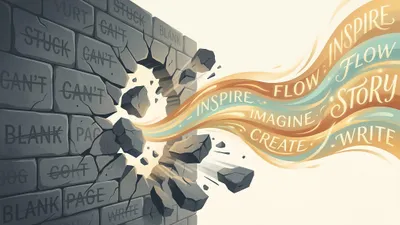
You can absolutely finish a book you started — even if it has been sitting untouched for months or years. According to research from the New York Public Library, roughly 80% of people who start writing a book never finish it. You do not have to be part of that statistic.
In this guide, you’ll learn:
- Why you stopped writing and how to diagnose the real problem
- A step-by-step process for picking up an abandoned manuscript
- How to rebuild momentum without starting over
- Tools and techniques that help you push through to “The End”
Here is exactly how to finish the book you already started.
Why Did You Stop Writing in the First Place?
The reason you stopped writing determines how you restart. Before you open that manuscript again, spend ten minutes identifying what stalled you. Most writers abandon books for one of five reasons — and each one has a different fix.
Perfectionism kept you editing chapter three instead of writing chapter four. The messy middle drained your excitement somewhere around the 30% mark. Life got in the way — a job change, a move, a family event — and you simply lost the habit. You lost confidence and started wondering if the book was worth writing at all. Or a shiny new idea pulled your attention to a different project.
Be honest with yourself. The diagnosis matters because the treatment is different for each one. If you struggle with self-doubt about your ability, read am I good enough to write a book — the answer is almost certainly yes.
How to Pick Up an Abandoned Manuscript
Picking up an abandoned manuscript starts with re-reading — not rewriting. Set aside one or two hours to read your existing draft from the beginning, as if you were reading someone else’s work. Do not edit. Do not fix typos. Just read.
This serves two purposes. First, you reconnect with the voice, the characters, and the story you were building. Second, you discover what actually works — and most writers are surprised to find that their abandoned draft is better than they remembered.
While you read, keep a simple notepad open and jot down three things: what is working, what is not working, and where the story or argument needs to go next. That last note becomes your re-entry point.
How to Create a Finish Line You Can Actually See
The single biggest reason writers quit is that the finish line feels impossibly far away. You need to make it visible and specific. An open-ended goal like “finish my book someday” produces zero urgency.
Instead, calculate a concrete deadline:
- Count your existing words. Open the manuscript and check the word count.
- Estimate your total word count. A typical novel is 70,000-90,000 words. A nonfiction book runs 40,000-60,000. Check our guide on how long it takes to write a book for benchmarks by genre.
- Subtract what you have from what you need. That gap is your remaining work.
- Divide by your daily word target. Even 500 words per day finishes a 30,000-word gap in 60 days.
Write the date on a sticky note and put it where you can see it every day. A visible deadline transforms “someday” into “Tuesday, June 24th.”
How to Build a Writing Schedule That Sticks
Consistency beats inspiration every single time. You do not need to feel motivated to write — you need a schedule that removes the decision of whether to write today.
The most effective approach is time-blocking. Pick the same time every day — even if it is only 20 minutes — and protect it like a meeting you cannot cancel. Research from the European Journal of Social Psychology found that forming a new habit takes an average of 66 days. The sooner you start, the sooner writing becomes automatic.
Practical schedule options:
- Early morning (5:30-6:30 AM): Write before the world makes demands on your attention
- Lunch break (30 minutes): Even 300-400 words per session adds up fast
- Evening wind-down (8:00-9:00 PM): Replace one hour of scrolling with one hour of writing
The specific time matters less than the consistency. Choose a slot you can maintain five or more days per week and commit to it for at least three weeks before evaluating whether it works.
How to Push Through the Messy Middle
The messy middle — roughly chapters 5 through 15 of a novel, or chapters 3 through 8 of a nonfiction book — kills more manuscripts than anything else. You have lost the excitement of starting but cannot see the ending yet. The plot tangles or the argument drifts, and every session feels like trudging through fog.
Here is how to survive it:
Skip ahead to a scene you are excited about
You do not have to write in order. If chapter 12 excites you but chapter 8 feels like pulling teeth, jump to chapter 12. You will come back and fill the gap later. A book written out of order is still a finished book.
Break the middle into mini-milestones
Instead of “finish the book,” set micro-goals: finish this chapter by Friday, complete this subplot by the end of the month, hit 40,000 words by next Tuesday. Each completed milestone gives you a burst of momentum. If you need help structuring your middle, a solid book outline makes the path much clearer.
Lower the bar temporarily
Give yourself permission to write badly. The goal during the messy middle is forward progress, not polished prose. You will fix it during developmental editing later. A terrible first draft is infinitely more useful than a perfect unfinished one.
How to Stop Perfectionism From Killing Your Book
Perfectionism is procrastination wearing a mask of high standards. If you find yourself endlessly revising early chapters instead of writing new ones, perfectionism is your problem.
The fix is a rule: do not edit anything until the first draft is finished. Period. No going back. No re-reading yesterday’s pages. Open the manuscript where you left off and write forward.
This feels uncomfortable at first. Your inner editor will scream. But consider this — every bestselling author writes terrible first drafts. Anne Lamott’s entire chapter on “shitty first drafts” in Bird by Bird has become required reading in writing programs for a reason. The first draft is not supposed to be good. It is supposed to exist.
If you absolutely cannot stop yourself from editing, try a technique called drafting in a new document. Open a blank file each day, write your pages there, then paste them into the main manuscript at the end of the session. You never see the previous chapters, so there is nothing to edit.
How to Handle the “Shiny New Idea” Problem
Every writer gets struck by brilliant new ideas while struggling with a current project. The new idea feels perfect because it is unwritten — it has not yet encountered the messy middle, the plot holes, or the difficult chapters. That is an illusion.
The solution is an idea parking lot. Create a separate document — call it “Future Books” or “Idea Parking Lot” — and whenever a new concept strikes, write it down in 2-3 sentences. Then close the document and go back to your current book.
This works because you are not killing the idea. You are saving it. You are telling your brain: “I hear you, this is great, and we will come back to it after we finish this one.” Most writers find that 90% of their parked ideas no longer feel as exciting once the current book is done — which proves the ideas were escape fantasies, not genuine inspiration.
Can AI Help You Finish a Book You Started?
AI writing tools can genuinely help you finish a stalled manuscript — not by writing the book for you, but by eliminating the blank-page paralysis that keeps you stuck. Over 10,000 authors have used Chapter to write and finish their books.
Here is how AI helps you get unstuck:
- Brainstorm past plot holes: When you do not know what happens next, AI can generate five or six options. You pick the one that fits and keep writing.
- Draft transition scenes: Those connecting passages between the scenes you are excited about? AI can draft them so you do not stall.
- Outline remaining chapters: If your book has no outline, AI can help you create a book outline from your existing draft, giving you a roadmap for the rest.
- Break through writer’s block: Instead of staring at a blank page, give AI a prompt about what you need and use its output as a jumping-off point. Our guide on how to overcome writer’s block covers additional strategies.
Our Pick — Chapter
Chapter is built specifically for book-length writing, not blog posts or marketing copy. It helps you outline, draft, and edit a complete manuscript in one workflow — so you can pick up exactly where you left off and push through to the finish.
Best for: Writers returning to an abandoned manuscript who need structure and momentum Pricing: $97 one time, 2 books included (fiction or nonfiction), 30-day money-back guarantee Why we built it: Because 80% of started books never get finished — and the right tool changes that
How to Stay Motivated When You Want to Quit
Motivation is unreliable. Systems are not. Do not wait until you feel inspired to write — build systems that make writing happen regardless of how you feel.
Track your progress visually. A simple spreadsheet tracking your daily word count does something powerful to your brain. Seeing the numbers climb creates a “don’t break the chain” effect that keeps you going even on difficult days. Some writers tape a piece of paper to the wall and color in one square for every 500 words.
Find an accountability partner. Tell one person your deadline and ask them to check in weekly. The social pressure of having someone expect progress from you is more powerful than any internal motivation. Writers’ groups, both online and local, serve this function well.
Reward yourself at milestones. Finished chapter 10? Take yourself to dinner. Hit 50,000 words? Buy that book you have been eyeing. Small rewards at predictable intervals keep your dopamine system engaged with the project.
Re-read your best passage. When doubt creeps in, go back to the section of your manuscript that you are proudest of. Remind yourself that you wrote that. You are capable of writing well — you just need to keep going.
Should You Start Over or Keep Going?
In almost every case, you should keep going. Starting over feels productive but is usually another form of procrastination. You are telling yourself the same story — “this time it will be perfect from the beginning” — that perfectionism always tells.
There are only two situations where starting over makes sense:
- The core premise is broken. If the fundamental idea, argument, or plot does not work — not the execution, the actual concept — then revision cannot fix it.
- You have grown significantly as a writer. If you started the book five or more years ago and your writing ability has genuinely transformed, a fresh start might produce a better result.
In every other case, push forward with what you have. A completed imperfect draft can be revised into a good book. An abandoned first chapter cannot. For a complete roadmap of the entire writing process, see our guide on how to write a book.
What to Do After You Finish Your First Draft
Finishing the first draft is not the end — but it is the hardest part, and you did it. Here is what comes next:
- Let it rest. Set the manuscript aside for at least two weeks. You need distance before you can see it clearly.
- Read it straight through. Read the entire draft in one or two sittings, taking notes but not editing.
- Revise for structure first. Move, cut, or rewrite chapters as needed. Does the beginning hook? Does the middle sag? Does the ending land?
- Edit for prose second. Once the structure works, go through sentence by sentence to tighten, clarify, and polish.
- Get feedback. Share it with beta readers or a developmental editor who can see blind spots you cannot.
- Prepare for publishing. Whether you choose traditional or self-publishing, you need a plan. Our guide on how to start writing a book covers the full journey from concept to publication.
How Long Does It Take to Finish a Book You Already Started?
How long it takes to finish a book you already started depends on three factors: how much you have written, how much remains, and how consistently you write. Most writers who recommit to a stalled manuscript can finish a first draft in 60-120 days writing 500-1,000 words per day.
Here is a quick reference:
| Words Remaining | 500 words/day | 750 words/day | 1,000 words/day |
|---|---|---|---|
| 20,000 | 40 days | 27 days | 20 days |
| 40,000 | 80 days | 54 days | 40 days |
| 60,000 | 120 days | 80 days | 60 days |
These numbers assume five writing days per week. If you write seven days per week, you will finish even faster. The key insight from our article on how long it takes to write a book is that small daily consistency dramatically compresses timelines.
Common Mistakes to Avoid
- Re-reading from the beginning every session. Start where you left off. Re-reading is editing in disguise.
- Waiting for the perfect time to write. There is no perfect time. There is only the time you have.
- Telling everyone about your book instead of writing it. Research from NYU psychology suggests that publicly announcing goals can reduce motivation by giving you a premature sense of accomplishment.
- Comparing your first draft to published books. Published books have been through multiple rounds of editing. Your first draft is not supposed to match them.
- Changing your concept mid-draft. Finish the current version first. You can revise the concept afterward.
FAQ
How do you finish a book you started writing?
To finish a book you started writing, re-read your existing draft without editing, identify why you stopped, set a concrete deadline with daily word count targets, and write forward without going back to revise. Most writers finish stalled manuscripts in 60-120 days by writing just 500 words per day.
Why can’t I finish writing my book?
The most common reasons you can’t finish writing your book are perfectionism, losing momentum in the messy middle, getting distracted by new ideas, and lacking a consistent writing schedule. Identifying which specific obstacle is blocking you lets you apply the right fix instead of relying on willpower alone.
Is it normal to struggle to finish a book?
Yes, it is completely normal to struggle to finish a book. Research suggests that roughly 80% of people who start writing a book never complete it. Struggling does not mean you lack talent — it means you are doing something genuinely difficult. The writers who finish are the ones who build systems, not the ones who wait for inspiration.
How do I get motivated to finish my book?
To get motivated to finish your book, stop relying on motivation and build systems instead: track your daily word count visually, find an accountability partner, set milestone rewards, and commit to a fixed writing schedule. Motivation fluctuates, but a consistent writing habit produces finished books regardless of how you feel on any given day.
Can AI help me finish writing a book?
Yes, AI can help you finish writing a book by generating ideas when you are stuck, drafting transitional scenes, and creating outlines for remaining chapters. Tools like Chapter are designed specifically for book-length writing and have helped over 10,000 authors complete their manuscripts. AI works best as a brainstorming partner, not a ghostwriter.