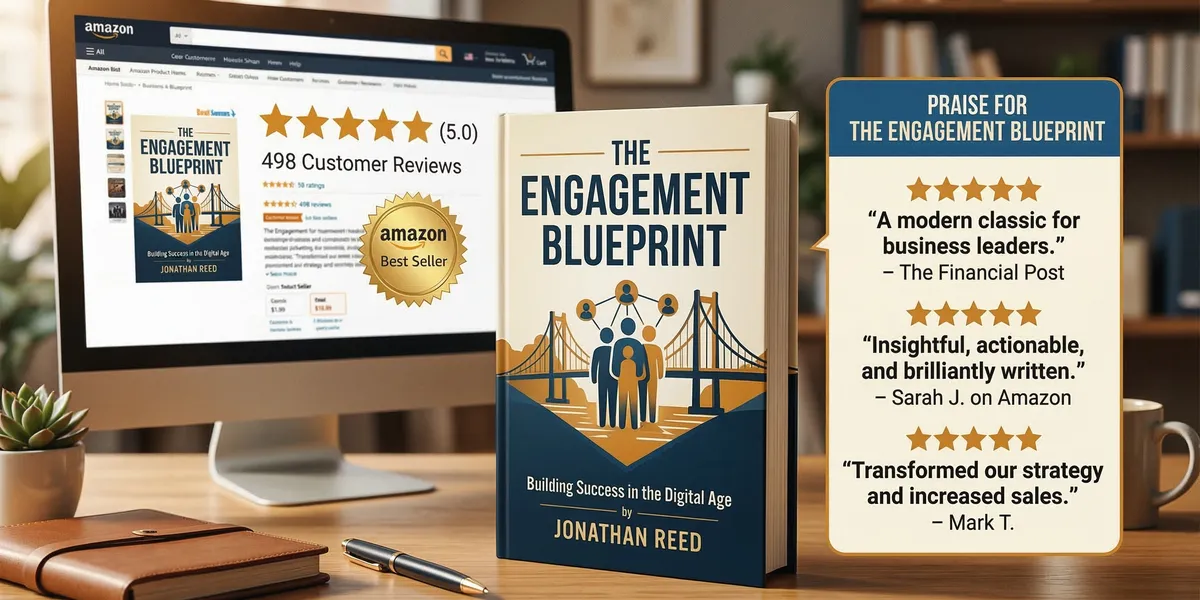
Getting book reviews on Amazon is the single most impactful thing you can do after publishing. Reviews drive sales, improve your book’s visibility in Amazon’s search algorithm, and give new readers the confidence to click “Buy.”
A book with 0 reviews sits invisible. A book with 10+ reviews starts to get noticed. A book with 50+ reviews has real momentum. And a book with 100+ reviews has social proof that compounds with every new reader.
This guide covers 10 ethical strategies to get reviews on Amazon — without breaking Amazon’s rules, buying fake reviews, or annoying your audience.
What this guide covers
- Why reviews matter so much
- Amazon’s review rules
- 10 ethical strategies to get reviews
- The review milestone roadmap
- Common mistakes to avoid
- FAQ
Why Amazon reviews matter more than you think
Amazon reviews serve three functions that directly impact your book’s success:
Social proof
Readers trust other readers. A 2024 BrightLocal consumer survey found that 87% of consumers read online reviews before making a purchase. Books are no different. A reader choosing between two similar books — one with 3 reviews and one with 47 — picks the one with 47 almost every time.
Amazon’s algorithm
Amazon’s A10 algorithm uses reviews as a ranking signal. Books with more reviews (and higher ratings) appear higher in search results and are more likely to appear in “Customers also bought” and “Recommended for you” sections. According to Kindlepreneur’s analysis, books that cross the 50-review threshold see a measurable increase in organic visibility.
Conversion rate
Reviews increase your book’s conversion rate — the percentage of people who view your book page and actually buy. Amazon’s own seller research indicates that products with reviews convert at 3.5x the rate of products without reviews. On a book page, reviews are often the last thing a buyer reads before making a decision.
Amazon’s review rules: what is and is not allowed
Before pursuing any review strategy, you need to understand Amazon’s Community Guidelines. Violating these rules can result in reviews being removed, your book being suppressed, or your entire KDP account being suspended.
What is allowed
- Asking readers to leave an honest review
- Sending free advance reader copies (ARCs) in exchange for an honest review
- Including a review request at the back of your book
- Asking your email list subscribers to review the book
- Using ARC distribution services like BookSprout or NetGalley
- Requesting reviews on social media
What is NOT allowed
- Paying for reviews. Offering money, gift cards, or products in exchange for a review violates Amazon’s terms. This includes services that promise “guaranteed reviews” for a fee.
- Review swaps. “I’ll review your book if you review mine” is explicitly prohibited.
- Family and close friends reviewing your book. Amazon actively detects and removes reviews from people with close personal relationships to the author. They track shared IP addresses, shipping addresses, and social connections.
- Incentivizing positive reviews. You can ask for an honest review, but you cannot ask for a positive review or offer rewards for 5-star ratings.
- Creating fake accounts to review your own book. Amazon detects this through device fingerprinting and will permanently ban your account.
- Review manipulation services. Any service that guarantees a specific number of reviews or a specific star rating is operating outside Amazon’s guidelines.
The rule is simple: you can ask people to leave an honest review. You cannot pay, bribe, trade, or manipulate reviews in any way.
10 ethical strategies to get book reviews
1. Back-of-book review request
The most effective review strategy is also the simplest: ask readers who just finished your book to leave a review.
Add a brief note on the last page:
“If you enjoyed this book, I would be incredibly grateful if you would leave a short review on Amazon. Even a sentence or two makes a huge difference for independent authors. Thank you for reading.”
Keep it short, sincere, and pressure-free. Readers who loved the book are the most likely to follow through, and you are catching them at the moment of highest enthusiasm.
2. Advance reader copies (ARCs)
Send free copies of your book to readers before (or immediately after) your launch in exchange for an honest review. This is the standard practice in publishing — traditional publishers have done it for decades.
How to build an ARC team:
- Ask your email list subscribers to opt in
- Post on social media: “I need 20 beta readers willing to read and review my book before launch”
- Use your existing network: colleagues, peers, and readers who have engaged with your content
Send them a PDF, EPUB, or physical copy 2-4 weeks before launch. Follow up after 1 week with a gentle reminder and a direct link to your Amazon review page.
3. Email list outreach
If you have an email list — even a small one — it is your most valuable review asset. These are people who already trust you enough to share their email address.
Send a specific, personal email:
- Remind them about the book
- Share a direct link to the Amazon review page (not the book page — the actual “Write a review” link)
- Tell them even a 1-2 sentence review helps
- Thank them regardless of whether they review
A list of 200 subscribers that produces 10 reviews is excellent. Do not expect high conversion rates — aim for 3-5% of your list.
4. Launch team
A launch team is a dedicated group of 10-30 people who commit to reading your book and leaving a review during launch week. This is different from ARCs because the timeline is compressed and the team is specifically recruited for launch support.
Building a launch team:
- Recruit 4-6 weeks before launch
- Give them the book at least 2 weeks early
- Create a private group (Facebook, Slack, or email thread) for coordination
- Set clear expectations: read the book, post an honest review on Amazon by launch day
- Provide the exact Amazon link and simple instructions for leaving a review
A strong launch team can deliver 10-20 reviews in your first week. That initial burst of reviews creates momentum that attracts organic reviews from regular buyers.
5. BookSprout
BookSprout is an ARC management platform that connects authors with readers who want to review books. It automates the distribution process and sends reminders to readers who have not yet posted their review.
How it works:
- You upload your book to BookSprout
- Readers claim a copy and agree to leave an honest review
- BookSprout sends automated follow-ups
- You track who reviewed and who did not
BookSprout offers a free tier for authors distributing ARCs to a small group. Paid plans ($10-$25/month) support larger distributions.
6. Goodreads
Goodreads is the largest social platform for readers and a significant source of book reviews. While Goodreads reviews do not appear on Amazon directly (Amazon owns Goodreads but keeps reviews separate), a strong Goodreads presence drives awareness and credibility.
Strategies:
- Create or claim your Goodreads Author Profile
- Run a Goodreads Giveaway (physical books) to generate buzz
- Join groups in your genre and participate genuinely — do not spam
- Add your book to relevant Goodreads lists
Readers who discover your book on Goodreads often buy on Amazon and leave reviews on both platforms.
7. Social media requests
Post about your book on social media — but do it right. A generic “please review my book” post is invisible. Instead:
- Share a specific reader testimonial or review, then ask “Have you read it? I would love to hear your thoughts on Amazon.”
- Post a milestone: “We just hit 25 Amazon reviews! Can we get to 50? If you’ve read the book, your review would mean the world.”
- Share a behind-the-scenes moment from the writing process, then mention the book is live and reviews help.
Be authentic, not desperate. One genuine social media request per week is plenty.
8. Book bloggers and bookstagrammers
Book bloggers, bookstagrammers (Instagram), and BookTokers (TikTok) review books as a hobby or side business. A positive review from a blogger with an engaged audience generates both reviews and sales.
How to find and approach them:
- Search Instagram for hashtags like #bookstagram, #[yourgenre]books, #bookreview
- Search Google for “[your genre] book blog reviews”
- Look at who reviewed comparable books on Amazon and check if they have a blog or social presence
- Send a brief, personalized pitch offering a free copy for an honest review
Most book bloggers are happy to receive free books. Respect their time — do not follow up aggressively.
9. NetGalley
NetGalley is a professional platform used by publishers, librarians, and reviewers to discover and review books before publication. It is more expensive than other options ($450+ for a listing), but it reaches professional reviewers, librarians, and avid readers who write detailed reviews.
Best for: Authors who are investing seriously in their launch and want high-quality, detailed reviews from experienced reviewers. NetGalley reviewers often cross-post to Amazon, Goodreads, and their own blogs.
10. Direct reader outreach
When readers email you, message you on social media, or mention your book in conversation, ask them personally if they would be willing to leave a review on Amazon.
This personal ask is the highest-converting review strategy available. A reader who liked your book enough to contact you will almost always leave a review when asked directly.
The script: “Thank you so much — that really means a lot. If you have a minute, an Amazon review would be incredibly helpful. Even a sentence or two makes a big difference. Here’s the link: [direct review link].”
The review milestone roadmap
Not all review counts are equal. Here are the milestones that matter and what they unlock:
| Milestone | What it unlocks |
|---|---|
| First 10 reviews | Your book looks legitimate. Browsers start considering it. Amazon’s algorithm begins tracking engagement. |
| 25 reviews | You qualify for most BookBub and promotional service requirements. Amazon begins recommending your book more actively. |
| 50 reviews | The credibility threshold. Books with 50+ reviews are taken seriously by readers, bloggers, and media. Organic discovery increases significantly. |
| 100 reviews | Your book has established social proof. Amazon’s algorithm gives it strong visibility. You are now competitive with traditionally published titles. |
| 250+ reviews | Category authority. Your book dominates its niche and becomes the default recommendation. |
The first 10 reviews are the hardest. Everything after that gets easier because the book’s visibility increases, which generates organic reviews from readers who bought the book through normal browsing.
Timeline expectations
| Strategy | Reviews expected | Timeline |
|---|---|---|
| Back-of-book request | 1-3 per 100 readers | Ongoing |
| ARC team | 5-15 reviews | Launch week |
| Email list | 3-5% of subscribers | 1-2 weeks after launch |
| Launch team | 10-20 reviews | Launch week |
| BookSprout | 5-15 reviews | 2-4 weeks |
| Social media | 2-5 reviews per campaign | Ongoing |
| Book bloggers | 1-3 per outreach batch | 4-8 weeks |
| Direct reader outreach | 1 review per ask | Ongoing |
Common mistakes to avoid
- Asking family and close friends to review. Amazon actively detects these reviews and removes them. Worse, getting caught can flag your account for extra scrutiny. Keep family out of it.
- Responding defensively to negative reviews. A 3-star review is not a disaster. Responding publicly with a defensive comment makes you look unprofessional. Thank every reviewer — or say nothing.
- Buying reviews from Fiverr or review mills. Amazon uses machine learning to detect fake reviews. Purchased reviews are removed within weeks, and repeat offenders get their books — and accounts — permanently suspended. The FTC also considers fake reviews illegal and has prosecuted companies and individuals for this practice.
- Only asking for 5-star reviews. This violates Amazon’s terms and makes readers uncomfortable. Ask for honest reviews. A mix of 4-star and 5-star reviews looks more authentic than a wall of perfect scores.
- Giving up after the first month. Review accumulation is a long game. Some of your best reviews will arrive 3-6 months after launch from readers who finally got around to finishing the book. Keep the back-of-book request in place and continue gentle outreach.
FAQ
How many reviews do I need to start seeing a sales impact?
The first meaningful threshold is 10 reviews. At this point, your book looks credible enough for browsers to consider purchasing. The biggest impact comes between 25 and 50 reviews, when Amazon’s algorithm begins recommending your book more aggressively in search results and “also bought” sections.
Can Amazon remove legitimate reviews?
Yes. Amazon’s review detection systems occasionally flag legitimate reviews, especially from new Amazon accounts or reviews posted from the same Wi-Fi network as the author. If a legitimate review is removed, the reviewer can contact Amazon customer support to have it reinstated.
Do ratings (without written reviews) count?
Yes. Amazon counts both written reviews and star-only ratings toward your total. A star-only rating takes a reader about 5 seconds, making it a lower-friction ask. Some authors specifically ask for ratings rather than reviews to increase participation.
Should I enroll in KDP Select to get more reviews?
KDP Select gives you access to Kindle Countdown Deals and Free Book Promotions, which can generate downloads that lead to reviews. The trade-off is exclusivity — your ebook can only be sold on Amazon for the 90-day enrollment period. If Amazon is your primary sales channel, KDP Select can accelerate review accumulation.
What is a good average star rating?
Most successful books maintain a 4.0-4.5 average rating. A perfect 5.0 with few reviews actually looks suspicious to buyers. A 4.2 with 87 reviews is far more convincing than a 5.0 with 4 reviews. Do not obsess over your average — focus on volume.
For a complete guide to getting your book on Amazon in the first place, see our step-by-step KDP publishing guide. If you are still in the writing phase, check out our self-publishing guide for the full process from manuscript to marketplace.