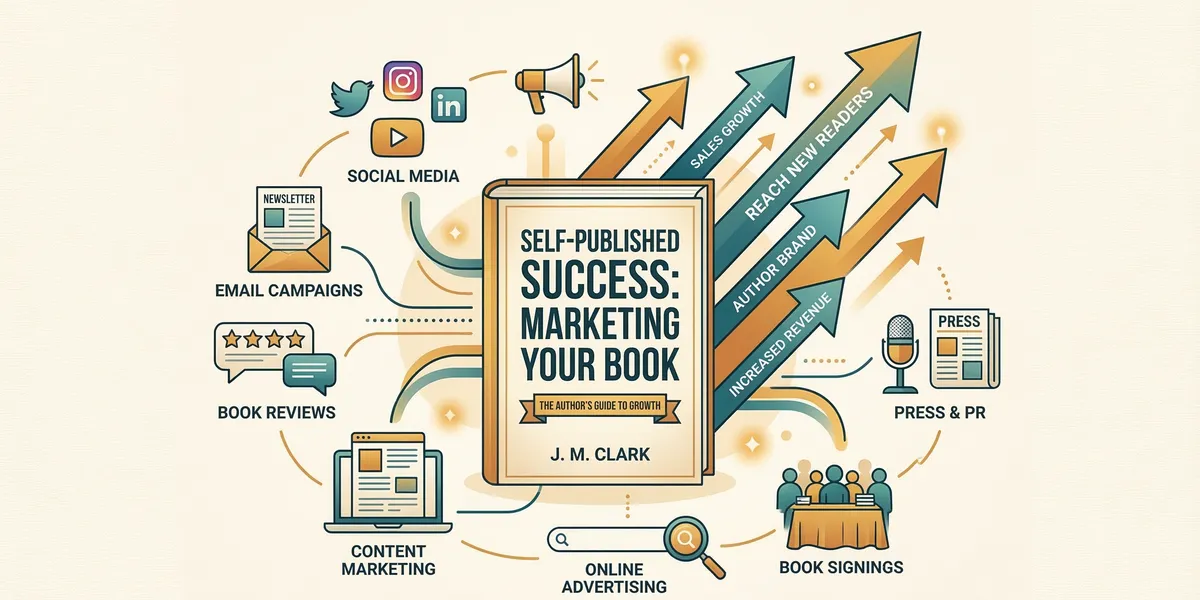
Marketing a self-published book is half the job. Writing it was the first half. Most self-published authors spend months crafting their manuscript, hit publish, and then wonder why nobody buys it. The answer is almost always the same: no marketing plan.
The good news is that you do not need a massive budget to market a self-published book effectively. The strategies that move the most copies are either free or low-cost. This guide covers everything from free Amazon optimization to paid advertising, organized by budget level so you can start wherever you are.
Start here: optimize before you spend
Before spending a dollar on marketing, make sure your Amazon listing is converting the traffic you already get. Sending paid traffic to a weak listing is like pouring water into a bucket with holes.
Your Amazon listing checklist
- Cover: Looks professional and matches genre expectations. Test by placing it as a thumbnail next to the top 10 books in your category. Does it compete?
- Title and subtitle: Clear, keyword-rich, and compelling. Your subtitle should communicate the benefit or hook.
- Book description: Follows the hook-problem-solution-proof-CTA formula. Formatted with HTML (bold, line breaks, bullets).
- Categories: You are in 2 categories where you can realistically reach the top 20.
- Keywords: All 7 backend keyword slots are filled with relevant search terms.
- Reviews: You have at least 10 reviews with a 4.0+ average rating.
- Look Inside: The first pages hook the reader. Your opening chapter should be your strongest.
Fix these before doing anything else. A BookBub Featured Deal sending 10,000 people to a listing with no reviews and a bad cover will not save your book.
Free marketing strategies
These cost nothing but time. Start with all of them.
Amazon SEO
Amazon is a search engine. Readers find books by typing keywords into the search bar. Your job is to appear in those results.
- Research keywords using Amazon’s autocomplete. Type your topic and note what Amazon suggests.
- Fill all 7 backend keyword slots in your KDP dashboard with relevant phrases readers actually search for.
- Include keywords naturally in your title, subtitle, and book description.
- Choose categories strategically — smaller categories are easier to rank in and still give you a bestseller badge.
Amazon’s algorithm also weighs sales velocity, reviews, and conversion rate. Every other strategy in this guide feeds back into your Amazon ranking.
Goodreads
Goodreads has 150 million members and is still the largest reader community online. Set up your Author Profile, claim your books, and start engaging.
- Run a Goodreads Giveaway (ebook giveaways are affordable and generate “want to read” adds)
- Join and participate in genre-specific reading groups
- Add your book to relevant listopia lists
- Ask readers who enjoyed your book to rate it on Goodreads
Goodreads reviews influence buying decisions, even though they are separate from Amazon reviews. Many readers check Goodreads before purchasing.
Social media (organic)
Pick one or two platforms and commit to them. Spreading yourself across five platforms guarantees you will be mediocre on all of them.
Best platforms by genre:
| Platform | Best for | Why |
|---|---|---|
| TikTok/BookTok | Fiction, especially romance, fantasy, thriller | BookTok drives massive sales — a single viral video can sell thousands of copies |
| Instagram/Bookstagram | Fiction, memoir, lifestyle nonfiction | Visual platform, great for cover reveals and reader engagement |
| Business, professional, self-help nonfiction | Your professional network is your first audience | |
| YouTube | How-to nonfiction, writing advice, educational | Long-form content builds deep trust and authority |
| Facebook Groups | All genres | Niche groups with engaged readers who buy |
What to post (and what not to):
- Do: Behind-the-scenes writing content, short excerpts, reader testimonials, topic expertise
- Do: Engage authentically in reader communities
- Do not: Post “buy my book” five times a day
- Do not: Spam Facebook groups with promotional links
Cross-promotion with other authors
Find 3 to 5 authors in your genre with similar audience sizes. Swap newsletter mentions, co-write blog posts, do joint social media lives, or create a multi-author box set. This gives you access to their audience for free, and they get access to yours.
Where to find cross-promotion partners:
- StoryOrigin (fiction)
- BookFunnel (fiction and nonfiction)
- Facebook groups for authors in your genre
- Writing conferences and communities
Book bloggers and BookTok creators
Reach out to reviewers who cover your genre. Send a personalized email (never mass emails), a free copy, and no pressure. Most bloggers receive dozens of requests weekly, so stand out by being specific about why your book fits their audience.
Find reviewers through:
- Google: “[your genre] book blog accepting review copies”
- The Book Blogger List
- TikTok search: ”#[yourgenre]booktok”
Low-cost strategies ($10 to $100/month)
Amazon Advertising
Amazon ads are the most direct path to book sales because you are targeting people who are already shopping for books.
Getting started with Sponsored Products:
- Create an automatic targeting campaign with a $10/day budget
- Let it run for 2 weeks to gather keyword data
- Review the Search Term Report to find keywords that convert
- Create manual campaigns targeting your best-performing keywords
- Pause keywords with high spend and no sales
Target ACoS (Advertising Cost of Sales):
- Under 50%: Profitable for most ebook pricing
- 50-70%: Break-even territory — acceptable if building reviews
- Over 70%: Losing money — pause and optimize
Start small. A $5 to $10 daily budget teaches you the system without burning through cash.
Newsletter promotion sites
These services email your book deal to their subscriber lists. Costs range from free to $500+ depending on the service and your genre.
| Service | Cost | Reach | Best for |
|---|---|---|---|
| BookBub Featured Deal | $200-$2,000+ | Massive (millions) | The gold standard — free/cheap books |
| Freebooksy | $80-$160 | Large | Free ebook promotions |
| Robin Reads | $30-$75 | Medium | Budget-friendly promotions |
| Bargain Booksy | $40-$100 | Medium-large | $0.99-$3.99 deals |
| eReader News Today | Varies | Large | Free and discounted books |
BookBub Featured Deals are the most effective promotion in self-publishing, but they are notoriously selective. Apply regularly — most accepted books were rejected multiple times first.
Email list building
Your email list is the only marketing channel you fully own. Social media algorithms change. Amazon can alter its ranking formula. But your email list goes directly to your readers.
How to build your list from zero:
- Create a reader magnet (a free short story, bonus chapter, or useful resource related to your book)
- Add a call-to-action in your book’s back matter: “Get [free resource] at [your website]”
- Use your author website to collect emails with a simple signup form
- Offer the reader magnet on BookFunnel or StoryOrigin to reach new readers
Tools that work well for authors:
- MailerLite — Free up to 1,000 subscribers, easy automation
- ConvertKit — Built for creators, powerful tagging
- Mailchimp — Free tier, widely used
A list of 500 engaged readers who open your emails is more valuable than 50,000 social media followers who never see your posts.
Medium-budget strategies ($100 to $500/month)
Facebook and Instagram ads
Meta ads let you target readers by interest, behavior, and demographics. You can target fans of specific authors, genres, or reading habits.
Best practice for book ads on Meta:
- Use your book cover as the primary image
- Target fans of comparable authors (your comp titles)
- Start with a $5/day budget on 3 to 5 different ad sets
- Test different audiences and ad copy for 7 days before scaling winners
- Drive traffic to Amazon (direct link) or your landing page (for email capture)
Facebook and Instagram ads have a longer learning curve than Amazon ads, but they reach readers who are not actively shopping — which means you can create demand, not just capture it.
BookBub Ads (self-serve)
Separate from BookBub Featured Deals, BookBub’s self-serve ad platform lets you place ads in front of BookBub’s millions of reader subscribers. These are CPM (cost per thousand impressions) ads, so they are best for building visibility.
- Target fans of specific authors in your genre
- Use your book cover as the ad creative (no additional design needed)
- Start with a $50 test budget
- Track click-through rate — above 1% is good
Newsletter swaps
Trade email newsletter mentions with authors who have similar list sizes. You promote their book to your list, they promote yours. This is free in theory, but you need a list to swap, which takes the initial investment of building one.
Find swap partners on:
- StoryOrigin Newsletter Swaps
- BookFunnel
- Facebook author groups
Content marketing: the long game
Start a blog or YouTube channel
Write about the topics your book covers. If your book is about productivity, write blog posts about productivity tips. If your book is a fantasy novel, write about worldbuilding or fantasy tropes.
This builds organic search traffic that drives book sales for years. A blog post ranking on page 1 of Google sends free traffic to your book every single day.
BookTok and Reels
Short-form video is the highest-leverage content format for authors right now. A 30-second BookTok video can sell more copies than a month of tweets.
Content ideas that work:
- “Books I wrote vs books people think I wrote”
- Reading a dramatic excerpt from your book
- The story behind why you wrote the book
- Reacting to your own reviews
- “If you liked [popular book], read mine because…”
You do not need a professional setup. A phone, decent lighting, and an authentic personality are enough.
Building your author platform
Your author platform is the sum of your online presence, email list, social media following, and reputation. It compounds over time.
The minimum viable author platform:
- An author website with your bio, book listings, and email signup
- An email list you send to at least monthly
- One active social media account where you engage consistently
- An Amazon Author Central profile with your photo and bio
- A Goodreads Author Profile
Everything else — podcasts, YouTube channels, speaking gigs — is bonus. Get the basics right first.
Common mistakes to avoid
- Spending money before optimizing your listing. Ads driving traffic to a listing with no reviews and a weak description will lose money every time.
- Trying to be everywhere at once. Pick one or two marketing channels and do them well. Add more only after the first ones are working.
- Stopping after launch week. Book marketing is not a one-time event. The authors who sell consistently are the ones who market consistently.
- Ignoring your backlist. If you have multiple books, every new reader is a potential buyer of everything you have written. Make sure your back matter links to your other books.
- Not tracking what works. Use Amazon’s advertising reports, email open rates, and social media analytics to measure which efforts drive actual sales. Double down on what works, drop what does not.
Writing your next book: the best marketing strategy
Here is the uncomfortable truth about book marketing: the single most effective thing you can do is write another book. Authors with a backlist of 3 or more titles earn exponentially more than single-title authors. Each new book markets your entire catalog.
If the writing is the bottleneck, Chapter helps you get from idea to finished manuscript faster. Over 2,147 authors have used Chapter to create more than 5,000 books — many of them building the kind of backlist that makes every marketing strategy more effective.
FAQ
How much should I spend on book marketing?
Start with $0. Optimize your listing, build your launch team, and use free strategies first. Once your listing converts, start with $5 to $10/day on Amazon ads. Most successful self-published authors spend 20 to 30% of their book revenue on marketing.
When should I start marketing my book?
Start building your audience 3 to 6 months before your book launches. Share your writing journey, build your email list, and connect with readers in your genre. Do not wait until publish day to start telling people your book exists.
Do Amazon ads actually work for books?
Yes, when your listing is optimized and you have reviews. Amazon ads are the most direct paid marketing channel for books because you are reaching people who are actively shopping. Start with automatic campaigns, learn from the data, and build manual campaigns around converting keywords.
How do I market a book with no email list and no following?
Focus on Amazon optimization (categories, keywords, description), reach out to book bloggers for reviews, participate in reader communities on Goodreads and social media, and start building your email list with a reader magnet in your back matter. Every author started with zero followers.
Is it too late to market a book published months ago?
No. Books do not expire. Many bestselling self-published titles took months or years to gain traction. Update your listing, run a price promotion, apply for a BookBub Featured Deal, and relaunch with fresh marketing. The book is permanent — your marketing can restart at any time.