You can outline a complete cookbook in a single afternoon — before you test one recipe or shoot one photo — by treating the outline as a blueprint with fixed math instead of a wish list of dishes.
In this guide, you’ll learn:
- The five chapter architectures every cookbook uses, and how to pick the right one for your concept
- The page budget formula that tells you exactly how many recipes your book can hold
- How to run a recipe inventory and gap analysis so no chapter ends up thin
- A copy-and-paste cookbook outline template you can fill in today
Here’s the process, starting with what a cookbook outline actually needs to contain.
What Is a Cookbook Outline?
A cookbook outline — a structural document that lists your chapters in reading order, assigns every planned recipe to a chapter, and fixes the page count before drafting begins.
It is not a list of recipes you like. That’s an inventory, and it comes later.
The difference matters because a cookbook has a constraint most books don’t: physical page math. Every recipe consumes a predictable number of pages, so your chapter structure and your printing budget are the same decision.
Get the outline right and the writing becomes assembly. Get it wrong and you discover at recipe 74 that your dessert chapter has four entries while breakfast has thirty-one.
Why Outline a Cookbook Before Writing Recipes?
Outline first because recipe testing is the most expensive part of cookbook production, and an outline prevents you from testing recipes that won’t make the final book.
A single tested recipe costs you groceries, three to five kitchen sessions, and a photo shoot. Cookbook author David Lebovitz has written about the real workload behind a finished cookbook, and testing thirty recipes you later cut is a genuinely painful waste of it.
There’s a second reason, and it’s commercial. If you ever pitch a publisher, the annotated table of contents is the proposal’s spine — a literary agent interviewed by Forbes described a cookbook proposal as an overview, a marketing section, a table of contents listing most or all recipes, and sample recipes with full headnotes.
Two of those four sections are your outline. You cannot pitch without one.
This is the same principle behind outlining any long-form nonfiction — see our guide on how to outline a nonfiction book for the general framework this adapts.
Step 1: Write Your Concept Statement First
Before any chapter list, write one sentence that names your book’s angle, its reader, and its constraint. Every later structural decision gets tested against this sentence.
A weak concept: “A collection of my family’s Italian recipes.”
A strong concept: “Weeknight Southern Italian cooking for people who get home at 6:30 and refuse to order takeout — nothing over 40 minutes.”
The strong version already tells you things. It rules out braises. It implies a chapter on pantry setup. It caps recipe complexity. It even suggests your chapter architecture should be organized by time or by course, not by region.
Write your concept sentence at the top of your outline document and leave it there. When you’re debating whether a recipe belongs, you’ll read that sentence and know.
If your concept still feels fuzzy, our complete guide to writing a cookbook covers concept development in depth.
Step 2: Choose Your Chapter Architecture
Every cookbook uses one of five organizing structures. Pick one and commit — mixing them is the single most common outlining failure.
By course — Appetizers, Soups, Mains, Sides, Desserts. The default. Intuitive for readers, easy to browse, and safe for a first book. Best for general-audience collections.
By meal or time of day — Breakfast, Lunchbox, Weeknight Dinner, Weekend Project. Excellent for family and practical cookbooks, because it matches how people actually decide what to cook.
By main ingredient — Chicken, Beans, Eggs, Greens. Strong for budget cooking, single-subject books, and anything aimed at cooks working from what’s in the fridge.
By season — Spring, Summer, Autumn, Winter. Beautiful and highly giftable, but it forces you to fill four roughly equal chapters, which is harder than it sounds in a climate with a short growing season.
By technique — Braise, Roast, Ferment, Grill. The most authoritative-feeling structure and the best for teaching books, but it demands genuine expertise and a reader willing to learn.
Food writing authority Dianne Jacob has catalogued the many ways to organize a cookbook, including narrative and thematic structures beyond these five. Those work — but only once you have a track record. For a first book, pick one of the five.
The intuitive test: Hand your chapter list to someone who cooks but hasn’t read your concept. Ask them to guess which chapter a specific dish lives in. If they hesitate, your architecture isn’t intuitive enough.
Step 3: Run the Page Budget Math
Calculate your recipe count from your target page count, not the other way around. This is the step almost every first-time cookbook author skips, and it’s where budgets break.
Here’s the formula. In a standard photographed cookbook, one recipe with a facing full-page photo consumes two pages. A recipe without a photo consumes roughly one page — sometimes 1.5 for long ingredient lists or multi-stage methods.
So:
| Photo ratio | Pages per recipe | 80 recipes | 100 recipes |
|---|---|---|---|
| Every recipe photographed | 2.0 | 160 pages | 200 pages |
| Half photographed | 1.5 | 120 pages | 150 pages |
| Quarter photographed | 1.25 | 100 pages | 125 pages |
| No photos | 1.0 | 80 pages | 100 pages |
Then add front and back matter. Budget 16 to 24 pages for the title page, copyright, table of contents, introduction, pantry or equipment section, index, and acknowledgments. The index alone typically runs 4 to 8 pages in a 100-recipe book.
A worked example: you want a 176-page photographed cookbook. Subtract 20 pages of front and back matter, leaving 156 recipe pages. At two pages per recipe, that’s 78 recipes. Round to 80 and you have your number before you’ve written anything.
This matters financially because print-on-demand color printing is priced per page. Our breakdown of cookbook printing costs and self-publishing budgets shows how a 40-page overrun changes your unit economics — and therefore your retail price.
Step 4: Set Your Recipe Count and Chapter Balance
Distribute your total recipe count across chapters so no chapter is more than twice the size of the smallest. Uneven chapters read as an unfinished book.
On totals, the industry consensus sits in a fairly narrow band. The Institute of Culinary Education and most agents point to 70 to 100 recipes for a standard trade cookbook, with 8 to 12 chapters. Compendium-style reference cookbooks run 200 or more. A focused digital or niche cookbook works fine at 30 to 60.
First-time authors should aim low — closer to 60 or 70. Every recipe you add is another testing cycle, and reviewers punish an untested recipe far more harshly than they punish a short book.
Here’s an 80-recipe distribution across a course-based architecture:
| Chapter | Recipes | Recipe pages |
|---|---|---|
| 1. Pantry & Basics | 8 | 12 |
| 2. Small Plates | 12 | 24 |
| 3. Soups & Stews | 10 | 20 |
| 4. Weeknight Mains | 18 | 36 |
| 5. Weekend Mains | 10 | 20 |
| 6. Sides & Salads | 12 | 24 |
| 7. Desserts | 10 | 20 |
| Total | 80 | 156 |
Note the deliberate asymmetry — Weeknight Mains gets 18 because the concept promises weeknight cooking. Your biggest chapter should be the one your concept is actually about. If it isn’t, either your concept or your outline is wrong.
Also note that Pantry & Basics gets fewer pages per recipe. Basics are usually short and rarely photographed, which buys you page budget elsewhere.
Step 5: Build the Recipe Inventory
Now list every recipe you might include — far more than you need — and assign each to a chapter. Aim for 150% of your target count so you can cut to the strongest.
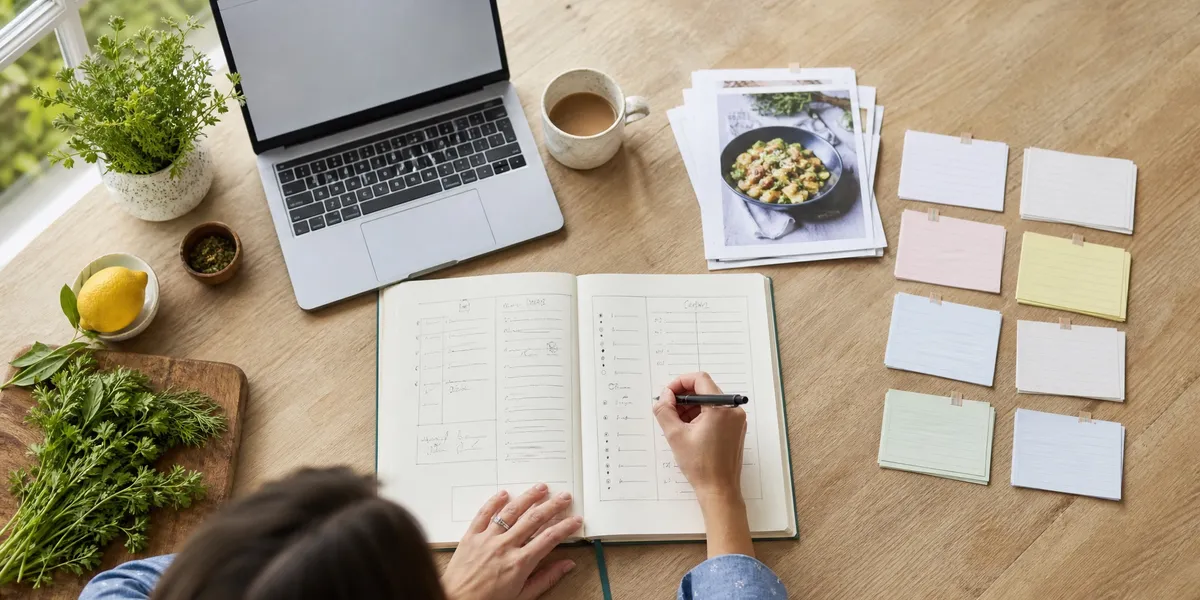
Use a simple table with five columns: working title, chapter, status, photo needed, and notes. Status moves through idea → drafted → tested once → tested final.
Building wide and cutting hard is standard practice — Reedsy’s cookbook writing guide makes the same point about generating far more recipes than the book can hold, then keeping only the ones that serve the concept.
Do this in a spreadsheet rather than a document. You’ll be sorting and re-sorting by chapter constantly, and you’ll want to count rows per chapter at a glance.
A few rules for the inventory stage:
- Write working titles as the reader would search for them, not as clever names. “Brown Butter Sage Gnocchi” beats “Nonna’s Autumn Pillows.”
- Flag every recipe that shares a core technique with another. Three braises in one chapter is repetition, not a theme.
- Mark any recipe that requires an ingredient your reader won’t already own. Too many of these and your book becomes aspirational rather than usable.
- Note which recipes you have already cooked many times. These become your sample recipes for a proposal, because they’re the ones you can write with confidence.
For a ready-made structure to drop this into, our free recipe book template includes an inventory sheet alongside the layout files.
Step 6: Run a Gap Analysis
Read your inventory chapter by chapter and look for holes — missing dietary options, missing difficulty levels, missing seasons, and missing time commitments. Fix them now, while a gap costs you nothing.
Check each chapter against these five axes:
- Time spread — Does each chapter contain at least one recipe under 30 minutes? A chapter of nothing but two-hour projects is a chapter readers skip.
- Difficulty spread — Every chapter needs an easy entry point. Readers try the easiest recipe in a chapter first, and if it works they trust you.
- Dietary coverage — At least a few vegetarian options per chapter, unless your concept explicitly excludes them.
- Ingredient overlap — Recipes should share pantry ingredients. If your reader has to buy 60 unique specialty items to cook your book, they’ll cook three recipes and shelve it.
- Seasonality — If your book isn’t seasonally organized, make sure it isn’t accidentally seasonal. A “year-round weeknight” book with 40 tomato recipes is a summer book wearing a disguise.
This step is the highest-leverage hour in the entire outlining process. Gaps found now cost a line edit. Gaps found after testing cost weeks.
Step 7: Place Your Front and Back Matter
Slot your non-recipe pages into the outline as numbered items, not as an afterthought. They’re roughly 12% of your book and they carry most of its personality.
A standard cookbook running order:
Front matter — Title page, copyright page, dedication, table of contents, introduction, and a “how to use this book” or pantry/equipment section.
Back matter — Conversion charts, sources or suppliers, acknowledgments, index, and author bio.
Two placement decisions are worth thinking about. First, the pantry section: put it in front matter if your recipes genuinely depend on it, and in back matter if it’s reference. Readers won’t cook a recipe that assumes a pantry they haven’t read about yet.
Second, the introduction. It’s the single most-read non-recipe page in your book and the thing browsers sample in a bookstore. Our guide to writing a cookbook introduction covers the five elements it needs.
Budget the index seriously. A proper cookbook index cross-references by recipe name, main ingredient, and often by dietary tag — which is why it runs 4 to 8 pages and usually costs money to have done professionally.
Step 8: Turn the Outline Into a Table of Contents
Rewrite your working outline as an annotated table of contents — chapter names as a reader would see them, plus a one-to-two-sentence description of each chapter’s promise.
This is the deliverable. If you’re self-publishing, it becomes your manuscript’s skeleton. If you’re pitching, it’s the section agents read most closely.
Cookbook author Katie Parla’s guide to writing a cookbook proposal recommends an annotated table of contents with chapter names and descriptions, plus around ten fully written sample recipes. Note that the chapter descriptions are annotations for the publisher — they don’t appear in the finished book.
One terminology note that matters more than it should: call them chapters. Not sections, not parts. Editors notice.
Cookbook Outline Template
Copy this structure into a document and fill it in:
CONCEPT STATEMENT
[One sentence: angle + reader + constraint]

SPECIFICATIONS
Target page count: ___
Trim size: ___
Photo ratio: ___
Calculated recipe count: ___
Chapter count: ___

FRONT MATTER
- Title page, copyright, dedication
- Table of contents
- Introduction (___ pages)
- How to use this book / pantry (___ pages)

CHAPTER 1: [Name]
Promise: [What this chapter delivers, 1-2 sentences]
Recipe count: ___
Recipes:
  1. [Working title] — status: ___ — photo: Y/N
  2. ...

CHAPTER 2: [Name]
...

BACK MATTER
- Conversion charts
- Acknowledgments
- Index (___ pages)
- About the author

PAGE BUDGET CHECK
Recipe pages: ___
Front + back matter: ___
Total: ___ (must match target)
The final page budget check is the part people skip. Do it — it’s the only thing standing between you and a manuscript that’s 40 pages over budget.
How to Outline a Cookbook With AI
You can use AI to generate chapter architectures, stress-test your recipe distribution, and draft the annotated table of contents in minutes, then apply your own judgment to what it produces.
The tasks AI genuinely accelerates at the outlining stage:
- Architecture options — Ask for your concept organized five different ways, then pick. Seeing the alternatives side by side clarifies which fits.
- Gap analysis — Paste your recipe inventory and ask what’s missing on time, difficulty, dietary coverage, and ingredient overlap. This is pattern-matching, which AI does well.
- Chapter descriptions — Turning a recipe list into a one-sentence chapter promise is a rewriting task, not a creative one.
- Index term extraction — Pulling every ingredient and technique across 80 recipes into a draft index list.
Our Pick — Chapter
Chapter builds your full book structure from a concept description, holds the whole outline in context as you draft, and exports a formatted manuscript — so your outline and your chapters stay in one place instead of scattered across documents.
Best for: Nonfiction authors who want the outline and the draft in a single workflow Pricing: $97 one-time Why we built it: Most authors abandon books at the structure stage, and 10,000+ authors have now used Chapter to get past it —.
What AI should not do at this stage is invent recipes. A recipe you haven’t cooked is a liability, and an untested recipe in a published cookbook is the fastest way to lose a reader permanently. Use AI on the structure; test the food yourself.
For the broader workflow, see our guide to using an AI cookbook generator.
Common Cookbook Outlining Mistakes to Avoid
- Mixing chapter architectures. A book with Breakfast, Chicken, Summer, and Desserts as chapters has no logic. Readers can’t predict where anything lives.
- Outlining recipes you haven’t cooked. Every untested recipe in your outline is a placeholder that may collapse during testing and leave a hole in a chapter.
- Ignoring the page budget. Discovering you’re 40 pages over after formatting means cutting recipes you already photographed.
- Front-loading your best material. Spread your strongest recipes across all chapters. A book that peaks in chapter two feels like it’s ending early.
- Treating the index as optional. It’s how readers actually navigate a cookbook after the first read, and it needs pages allocated in the outline.
- Writing clever chapter names with no descriptor. “Fire” is not a chapter. “Fire: Grilling and Live-Coal Cooking” is.
How Long Does It Take to Outline a Cookbook?
Outlining a cookbook takes four to eight hours of focused work for a first draft, spread over one or two sessions. The concept statement and page budget math take under an hour; building the recipe inventory takes the longest.
Expect to revise it twice more — once after your first ten test recipes reveal what actually works, and once before formatting.
How Many Recipes Should Be in Each Chapter?
Each chapter should contain 8 to 15 recipes in a standard 70-to-100 recipe cookbook, with no chapter exceeding twice the size of the smallest. Your largest chapter should be the one your concept centers on.
Chapters under six recipes feel unfinished and are often better merged. Chapters over twenty are usually two chapters that haven’t been separated yet.
Do You Need an Outline to Self-Publish a Cookbook?
You don’t technically need an outline to self-publish, but skipping it almost always costs more than writing one. Without a page budget, you can’t price your book, and print-on-demand color printing charges per page.
The outline is also what makes your cookbook layout and formatting straightforward, because the designer or template needs to know chapter count and recipe count up front.
FAQ
How do you outline a cookbook?
You outline a cookbook by writing a one-sentence concept statement, choosing a single chapter architecture (course, meal, ingredient, season, or technique), calculating your recipe count from your target page budget, assigning every planned recipe to a chapter, and running a gap analysis before you test anything.
How many chapters should a cookbook have?
A cookbook should have 8 to 12 chapters for a standard 70-to-100 recipe book. Fewer than six chapters makes browsing difficult; more than fourteen fragments the book. Always call them chapters rather than sections — it’s the term editors and agents expect in a proposal.
How many recipes do you need for a cookbook?
Most trade cookbooks contain 70 to 100 recipes, while reference compendiums run 200 or more and focused digital cookbooks work at 30 to 60. First-time authors should target the lower end, since every additional recipe requires full testing cycles that determine whether readers trust the book.
Should you outline a cookbook before testing recipes?
Yes — outline before testing, because recipe testing is the most expensive stage of cookbook production. An outline built on a fixed page budget tells you exactly how many recipes to test, preventing you from spending weeks on dishes that get cut for space.
What goes in a cookbook table of contents?
A cookbook table of contents lists chapter names in reading order with page numbers, plus front matter and back matter entries. For a publisher proposal, use an annotated version that adds a one-to-two-sentence description of each chapter’s promise and lists most or all planned recipes.
Can AI outline a cookbook for you?
AI can generate chapter architectures, run gap analysis on your recipe inventory, and draft an annotated table of contents in minutes. What AI should never do is invent recipes you haven’t cooked — untested recipes are the fastest way to lose a cookbook’s credibility with readers.