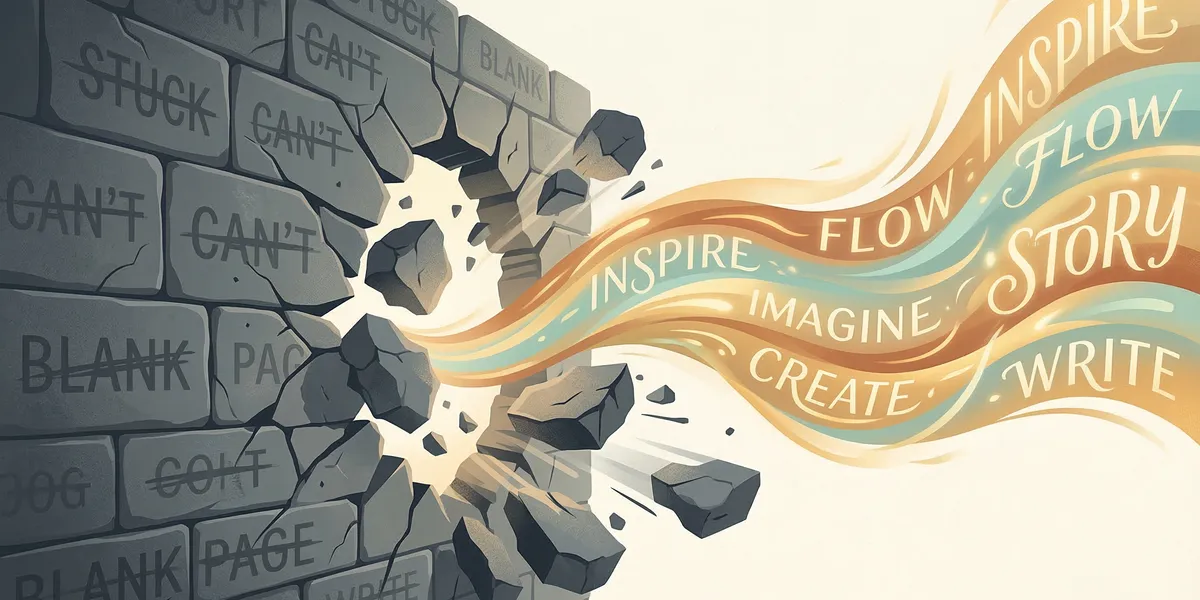
Writer’s block is real, it is miserable, and it is beatable. Whether you have been staring at a blank page for twenty minutes or twenty days, here are twelve methods to overcome writer’s block and start writing again — from quick fixes you can try right now to long-term strategies that prevent it from coming back.
What Writer’s Block Actually Is
Writer’s block is not laziness. It is not a lack of talent. And it is not evidence that you should quit.
In most cases, writer’s block is one of three things: perfectionism (the fear that what you write will not be good enough), fear (of judgment, failure, or even success), or burnout (you have pushed too hard for too long and your creative well is dry).
Understanding which flavor of block you are dealing with helps you pick the right solution. A perfectionist needs permission to write badly. A burned-out writer needs rest, not more discipline. A fearful writer needs to lower the stakes.
Here are twelve methods that work across all three types.
1. Write Badly on Purpose
Give yourself explicit permission to produce garbage. Open a document, set a timer for ten minutes, and write the worst possible version of your scene. Cliches encouraged. Purple prose welcome. Grammar optional.
This works because writer’s block is often perfectionism in disguise. Your inner editor has locked the door between your brain and the page. Writing badly on purpose fires that editor. You cannot fail at something you are intentionally doing wrong.
The remarkable thing is that even intentionally bad writing usually contains a few sentences worth keeping. A bad draft is infinitely more useful than no draft.
2. Change Your Environment
If you always write at the same desk, move. Go to a coffee shop, a library, a park bench, your kitchen table. Sit on the floor if you have to. Physical change triggers mental change.
Your brain associates your usual writing spot with the stuck feeling. A new environment breaks the loop. You are the same writer with the same story, but the fresh surroundings give your brain permission to approach the work differently.
3. Skip Ahead
You do not have to write in order. If the scene you are stuck on feels like wading through concrete, skip it. Jump to a scene that excites you — the confrontation, the kiss, the revelation you have been planning since chapter one.
Writing out of sequence solves two problems. It gets words on the page, which builds momentum. And it often clarifies the scene you skipped, because now you know where the story needs to arrive, and the bridge between here and there becomes obvious.
4. Set a Tiny Goal
“Write a chapter” is paralyzing. “Write 100 words” is manageable.
One hundred words is a paragraph. It takes five minutes. And once you write a hundred words, you almost always write more — because starting is the hard part. The writing itself, once it begins, tends to sustain itself.
This is the principle behind starting a book at all. Lower the bar until you can step over it.
5. Use Writing Prompts
When you cannot find words for your own story, borrow someone else’s starting point. Writing prompts give you a constraint and a direction. You do not have to worry about whether the idea is good — someone else already provided it. You just have to write.
Even prompts unrelated to your project can be useful. The act of writing — anything — loosens the creative muscles. Think of it as stretching before the workout.
6. Talk Your Story Out Loud
Close the laptop. Open a voice memo app. And talk through what happens next in your story as if you are telling a friend.
“So at this point, Maria has just found out that Theo lied about the letter, and she is furious but also confused because she still has feelings for him, and the next thing that needs to happen is they have to be in the same room together at the fundraiser…”
Something about speaking out loud bypasses the perfectionism filter that locks up your fingers. You do not edit yourself when you talk the way you edit yourself when you type. Record it, play it back, and transcribe the parts that work.
7. Read in Your Genre
Read a book similar to what you are writing. Not to copy, but to absorb the rhythm. When you have been inside your own story for too long, you lose perspective on how stories work. Reading someone else’s prose reminds you what good pacing feels like, how dialogue flows, how scenes transition.
Pay attention to how other authors start their stories. Notice the choices they make. Then return to your own work with fresh ears.
8. Exercise or Walk
Physical movement is one of the most consistently effective unblocking tools. Walk for twenty minutes. Run. Do yoga. Anything that gets blood moving.
Research supports this. A Stanford study found that walking increased creative output by an average of 60%. The effect persisted even after the walk ended. Your brain continues processing the story while your body moves, and solutions often arrive unbidden — in the shower, on the sidewalk, at the gym.
9. Set a Timer and Sprint
The Pomodoro Technique works for writing: set a timer for twenty-five minutes, write without stopping, then take a five-minute break.
The timer creates urgency. You cannot spend twenty-five minutes staring at the screen because the clock is ticking. There is no time to be precious about word choice. There is only time to write. The artificial deadline tricks your brain into treating the session as finite and manageable rather than an open-ended obligation.
10. Lower the Stakes
“Nobody has to read this.” Say it. Mean it.
Writer’s block intensifies when the stakes feel enormous. This draft has to be brilliant. This chapter has to work perfectly. This book has to justify the time you have invested. The weight of those expectations crushes the work.
Strip the stakes. Write as if no one will ever read it. Write for yourself, as an exercise, as practice. Remove the audience from the room and write for the empty page. You can invite readers back later, once the words exist.
11. Re-read What You Have Already Written
Go back to the beginning of your manuscript — or at least the beginning of the current section — and read what you have already written. Read it as a reader, not as a critic.
Two things usually happen. First, you remember that you can actually write. The evidence is on the page. Second, the momentum of the existing story carries you forward past the stuck point. You read the last paragraph you wrote, and the next sentence simply appears because the story’s logic demands it.
This method also helps you catch continuity issues and reconnect with your characters’ voices, which may have drifted during the time you spent not writing.
12. Use AI to Generate a Rough Draft You Can React To
Sometimes the hardest part is not writing — it is facing the blank page. An AI writing tool can generate a rough draft of your scene, and then your job shifts from creating to reacting. “No, my character would never say that.” “This pacing is wrong, it should be slower here.” “The emotion is missing — let me add it.”
Reacting is easier than creating from nothing. The AI draft gives you something to push against, and pushing against it often clarifies what you actually want to write.
Tools like Chapter can generate scenes that match your characters and story context, giving you a starting point that is already tailored to your book rather than generic output. But any AI tool works for this purpose — the point is to replace the blank page with something you can edit, reject, or rebuild.
When to Push Through and When to Rest
Not every block requires force. Sometimes the block is your subconscious telling you that something in the story is wrong — a plot structure problem, a character acting against their nature, a scene that does not belong. The block is not preventing you from writing; it is preventing you from writing the wrong thing.
If you have tried multiple methods and nothing works, step back and ask: is the story going in the right direction? Sometimes the fix is not writing harder but rethinking what comes next.
And if the answer is burnout, rest. Not every problem is solved by more output. Read. Walk. Live. The words will come back when you do.
Writer’s block is a wall, not a cliff. Every method on this list is a different way over, under, around, or through it. Try one. Try five. The only strategy that does not work is waiting for inspiration to strike on its own. Sit down, pick a method, and write — even badly, even briefly, even sideways. The wall always breaks.