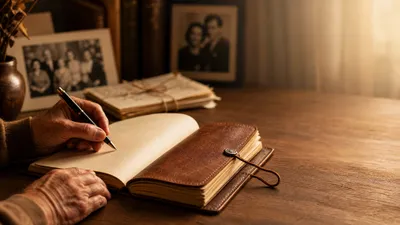
You start writing a memoir by choosing one specific theme from your life, listing the key scenes that prove it, and drafting the single scene you can’t stop thinking about — not by beginning at your birth. You do not need a famous life or a perfect memory. You need one true story and the willingness to start the first sentence today.
In this guide, you’ll learn:
- How to find the one theme that holds your whole memoir together
- The first scene to write (and why it’s almost never your childhood)
- A simple memory-mapping method to surface the moments worth telling
- How to structure, draft, and revise without getting stuck
Here’s exactly how to begin, step by step.
What Is a Memoir, and How Is It Different From an Autobiography?
A memoir is a true story that focuses on one theme, period, or relationship from your life — not your entire timeline. An autobiography covers a whole life from birth to the present in order. A memoir zooms in on a slice and mines it for meaning.
That distinction matters before you write a word. If you try to cover everything, you’ll write a flat list of events. If you choose one thread — a marriage, a year of grief, a season of reinvention — you’ll write something readers actually feel.
For a deeper breakdown, see our guides on the difference between a memoir and an autobiography and the full memoir definition.
Step 1: Find Your “Why” Before Your “What”
Before you choose a story, get clear on why you’re telling it. Your reason becomes the compass that keeps you writing on the days the draft fights back.
Ask yourself a simple question: What do I want a stranger to understand by the time they finish? Maybe it’s that grief and joy can share a room. Maybe it’s that you survived something and someone else can too.
Your “why” isn’t marketing copy. It’s a private sentence you keep taped above your desk. When a scene doesn’t serve that sentence, you’ll know to cut it.
Example: A writer recovering from addiction might write, “I want readers to see that recovery is boring, daily, and unglamorous — and that’s exactly why it works.” Every scene then earns its place by proving that idea.
Keep your “why” short enough to say in one breath. A bloated mission statement is easy to ignore; a single sharp sentence is hard to forget. You can refine it as you draft — but write something down before you start, because a memoir without a reason quickly becomes a diary.
Step 2: Choose One Specific Theme — Not Your Whole Life
The single biggest mistake new memoirists make is trying to tell everything. Pick one theme and let it organize the entire book.
A theme is the meaning beneath the events. Resilience. Belonging. Forgiveness. Reinvention. The events are what happened; the theme is what it meant.
A useful test: can you finish the sentence “This is a book about a person who learned that ___”? If you can, you have a theme. If you’re still listing events, you have an autobiography.
Most strong memoirs cover a window of a few months to a few years. Wild covers one hike. The Year of Magical Thinking covers one year. You can reference moments outside that window, but the spine stays narrow.
Step 3: Map Your Memories (the Method Most Guides Skip)
Before you outline, do a memory map — a fast, unfiltered inventory of the moments your theme already lives inside. This is where you find the raw material no one else can write.
Take a blank page and draw your theme in the center. Around it, jot every memory that connects, in any order: a smell, an argument, a phone call, a room. Don’t judge them. Don’t write full sentences. Just capture fragments.
Aim for 30 to 50 fragments in one sitting. You’re not writing yet — you’re mining. The fragments that give you a small jolt of emotion when you read them back are your scenes.
Why this beats brainstorming a list: a linear list pulls obvious, surface memories. A radial map pulls sensory, sideways memories — the cracked vinyl seat, the wrong-number call — and those specific details are exactly what make memoir feel true.
For more ways to surface raw material, our roundup of memoir writing prompts gives you targeted questions to fill the page faster.
Step 4: Pick the First Scene to Write
Don’t start at the beginning. Start with the scene you can’t stop thinking about — the one that keeps surfacing while you do the dishes.
That involuntary memory is your subconscious telling you where the heat is. It’s almost always more alive on the page than a dutiful “I was born in…” opening. You can write the actual chapter one later, once you know what the book is really about.
Write that scene in real time, moment by moment, the way a film shows action rather than summarizing it. Put the reader in the room. You’ll be surprised how much the rest of the structure reveals itself once one true scene exists.
Example: Instead of “My father and I had a difficult relationship,” write the Tuesday he didn’t show up to the recital, the empty third-row seat, the smell of the auditorium. Scene beats summary every time.
Step 5: Choose a Structure That Fits Your Story
Even though every word is true, your memoir still needs a shape. The three most common structures give you a frame to hang your scenes on.
| Structure | How it works | Best for |
|---|---|---|
| Chronological | Events unfold in the order they happened | Clear before-and-after journeys |
| Thematic | Chapters organized by idea, not date | Reflective books spanning years |
| Vignette | Standalone scenes that accumulate meaning | Fragmented memory, grief, identity |
You don’t have to decide forever right now. Pick the one that feels closest, draft into it, and adjust. Many writers draft scenes first and discover their structure afterward.
For a deeper look at your options, read our guide to memoir structure types and how to build a memoir outline.
Step 6: Build a Loose Outline From Your Best Scenes
Now turn your memory map into a working outline. Choose the 15 to 20 strongest scenes that prove your theme and arrange them into a rough arc.
Use classic story shape as a guide: an inciting moment that disrupts your normal, rising tension as stakes build, a turning point where everything changes, and a resolution where you (and the reader) understand something new.
Keep the outline loose. It’s a map, not a contract. As you draft, scenes will move, merge, and disappear — that’s the outline doing its job.
A memoir outline template can save you hours here by giving you a fill-in-the-blank frame instead of a blank page.
Step 7: Write a First Draft Fast — and Don’t Edit Yet
Give yourself permission to write a messy first draft. Your only job in draft one is to get the story out of your head and onto the page.
Resist editing as you go. Editing and drafting use different parts of your brain, and switching between them is what stalls most memoirs. Write forward. Leave brackets like [check the year] and keep moving.
Set a deadline. Stephen King suggests a first draft should take no longer than one season — about 90 days. A concrete finish line turns “someday” into a schedule.
A simple cadence: if you have 18 scenes and 90 days, that’s one scene every five days. Suddenly an entire book is just a series of small, doable writing sessions.
Step 8: Write an Opening That Hooks From Line One
Your opening has one job: make a reader unable to stop. Begin in motion — inside a moment of tension, change, or vivid detail — not with throat-clearing background.
Drop readers into a specific scene and let context arrive naturally. A concrete image (“The day the levee broke, my mother was baking bread”) beats an abstract summary every time.
Don’t agonize over this early. You can write a placeholder opening now and craft the real one after the draft, when you finally know what the book is about. Many memoirists write their first page last.
Step 9: Add Sensory Detail and Honest Emotion
Two things separate a flat memoir from one readers can’t put down: sensory detail and emotional honesty. Both are choices you make scene by scene.
For sensory detail, don’t just describe what a place looked like. Add how it smelled, what you heard, the temperature of the room. Specifics are what make a memory feel real to someone who wasn’t there.
For honesty, lean toward the moments you’d rather skip. Readers connect to vulnerability, not perfection. The scenes that make you wince are usually the ones that make the book matter.
If your story touches painful or sensitive ground, our guide on writing about trauma in a memoir covers how to do it safely and ethically.
Step 10: Revise, Get Feedback, and Edit
When the draft is done, step away for two to four weeks. Distance lets you read your own pages like a stranger — which is the only way to revise well.
When you return, read the whole thing start to finish before changing anything. Look for where the theme blurs, where scenes summarize instead of show, and where emotion is told instead of felt.
Then get outside eyes. A trusted reader or writing group will spot the gaps you’re too close to see. Revision isn’t failure — it’s where a memoir actually becomes good.
Work in passes rather than trying to fix everything at once. One pass for structure (are the scenes in the right order?), one for clarity (does each scene show, not summarize?), and a final one for line-level polish. Layering your edits keeps revision from feeling overwhelming and protects the honest voice that made the draft worth writing.
How to Start Writing a Memoir With AI
You can start a memoir faster by using AI as a drafting and interviewing partner — to ask you the right questions, expand rough scene notes into prose, and keep your theme consistent across chapters. The judgment, honesty, and lived truth stay yours; the tool just removes the friction of the blank page.
This is exactly the gap we built Chapter to close.
Our Pick — Chapter
Chapter is an AI book-writing platform built for full-length, structured books — including memoir and life-story projects. It interviews you about your memories, helps you outline scenes around a theme, and turns your answers into draft chapters you then shape into your own voice.
Best for: First-time memoirists who have the stories but stall at the blank page. Pricing: $97 one-time (nonfiction) — no subscription. Why we built it: 10,000+ authors later, the number-one thing that stops people writing their life story isn’t lack of material — it’s not knowing where to start. Chapter starts for you, then gets out of the way.
If you’d rather see the workflow in detail, read how to write a memoir with AI and our library of AI prompts for writing a memoir.
Common Mistakes to Avoid When Starting a Memoir
- Trying to tell your whole life. Pick one theme and one window of time. Breadth kills memoir.
- Starting at birth. Begin with the scene that has heat, not the earliest fact.
- Editing while drafting. It’s the fastest way to stall. Draft first, polish later.
- Summarizing instead of showing. “It was a hard year” is a label. Show one hard Tuesday instead.
- Waiting to feel ready. You start a memoir by writing one scene today, not by preparing forever.
How Long Does It Take to Start (and Finish) a Memoir?
You can start writing a memoir today — the first scene takes one sitting. A complete first draft typically takes three to six months of consistent writing, depending on your length and pace.
Most memoirs run 60,000 to 90,000 words. At one to two scenes a week, that’s a realistic six-month draft. Revision usually adds another two to four months. For a full breakdown, see how long a memoir should be.
Do You Need a Famous Life to Write a Memoir?
No — you do not need a famous or dramatic life to write a memoir. You need a specific story told honestly. Some of the most beloved memoirs cover ordinary lives illuminated by a clear theme and vivid, truthful detail.
What readers respond to is emotional truth, not celebrity. A quiet story about a single year, told with specificity and courage, will always beat a famous life told without insight.
How Do You Write a Memoir When the Memories Are Painful?
You write a memoir about painful memories by pacing yourself, writing in small bursts, and choosing what to include intentionally rather than reliving everything at once. Honesty matters, but so does your wellbeing — you control the dose.
Take breaks during hard scenes. Write the difficult material in a rough form first, then decide later how much belongs on the page. Our guide to ethical memoir writing also covers how to handle real people and sensitive truths with care.
FAQ
How do I start writing a memoir if I don’t know where to begin?
Start writing a memoir by choosing one theme from your life, then drafting the single scene you can’t stop thinking about. Skip the chronological beginning. That one vivid, emotionally charged scene reveals what your book is really about and pulls the rest of the structure into focus.
What is the first thing to write in a memoir?
The first thing to write in a memoir is a single scene with heat — a moment of change, tension, or strong emotion — written in real time. It does not need to be chapter one. Drafting one true scene gives you momentum and shows you the theme your memoir will explore.
How is starting a memoir different from starting an autobiography?
Starting a memoir means choosing one theme, period, or relationship and going deep, while an autobiography covers your whole life in chronological order. A memoir trades breadth for emotional depth, which is why you start by narrowing your focus, not by beginning at birth.
Can I write a memoir if I have a bad memory?
Yes — you can write a memoir with an imperfect memory. Memoir relies on emotional truth and specific sensory detail, not photographic recall. Use a memory map to surface fragments, reconstruct scenes honestly, and signal uncertainty where it exists. Readers trust honesty over perfect accuracy.
How many words should I write each day to start a memoir?
There’s no required daily count to start a memoir, but 500 to 1,000 words a day is a sustainable pace for most writers. Consistency beats intensity. Even one scene a week builds a full draft within months — the key is to start and keep showing up.
Your memoir already exists in fragments — the arguments, the rooms, the phone calls you still replay. Starting just means writing one of them down today. Pick your theme, map your memories, and draft the scene you can’t stop thinking about. The rest of the book will follow.