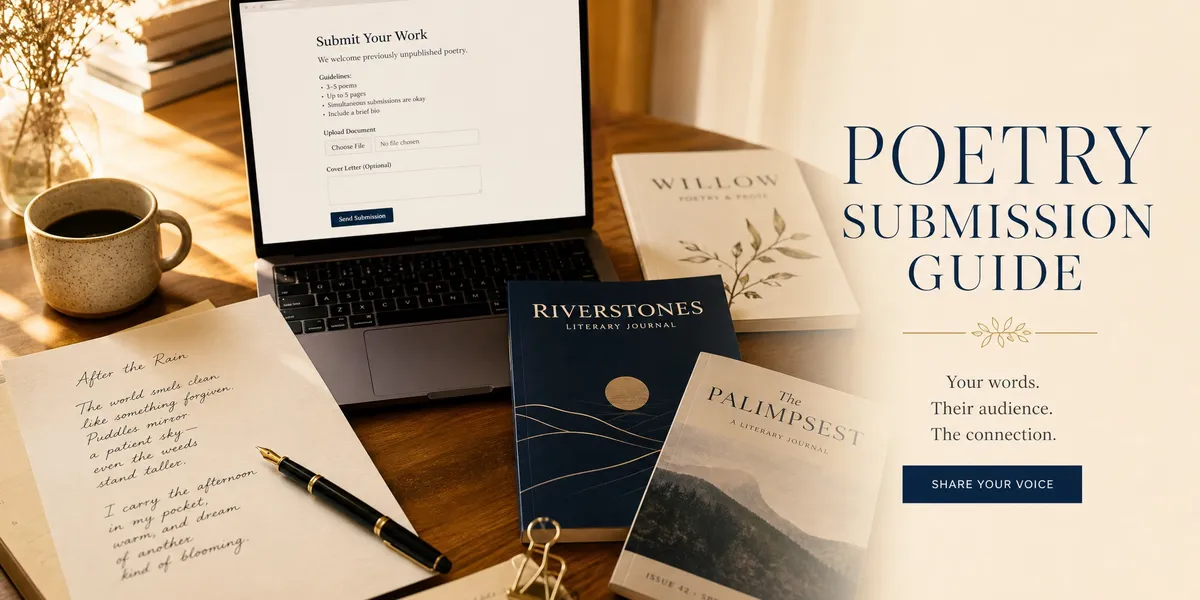
You can get your poetry published in literary magazines — even without a single publication credit to your name. Thousands of journals actively seek new voices, and the submission process is more accessible than ever.
In this guide, you’ll learn:
- How to find the right literary magazines for your poetry
- The exact formatting and submission process editors expect
- How to write a cover letter that gets your poems read
- A tracking system to manage simultaneous submissions
Here’s the step-by-step process to get your poetry into print.
How Do You Find the Right Literary Magazines for Your Poetry?
Finding the right literary magazines for your poetry means matching your style and voice to journals that publish similar work. Submitting blindly wastes your time and the editor’s. A targeted approach dramatically improves your acceptance rate.
Start with these free databases that list hundreds of active poetry journals:
- Poets & Writers Literary Magazine Database — searchable by genre, payment, and reading period
- CLMP (Community of Literary Magazines and Presses) — lists calls for submissions from member journals
- Duotrope — a paid tracker with response-time data and acceptance rates
- The Submission Grinder — a free alternative to Duotrope with similar tracking features
Read Before You Submit
This is the step most poets skip — and it’s the most important one. Before you send a single poem to a magazine, read at least three to five poems that journal has published recently.
You’re looking for patterns. Does the magazine favor narrative poetry or experimental work? Long-form or short? Political themes or personal ones? Your goal is to answer one question: would my poem feel at home alongside the work they’ve already published?
Many journals offer free online archives or sample issues. Some require a subscription, which is worth the investment for your top-choice publications. Editors notice — and respect — writers who engage with their journal beyond the submission portal.
Build a Tiered Submission List
Organize your target journals into three tiers:
- Reach journals — prestigious, competitive publications like Poetry Magazine, The New Yorker, or Ploughshares
- Mid-tier journals — respected regional or university-affiliated magazines with moderate acceptance rates
- Emerging journals — newer publications actively building their contributor base
Submit to all three tiers simultaneously. Your reach journals might surprise you, and your emerging journal submissions build your publication credits while you wait.
What Are the Submission Guidelines You Need to Follow?
Every literary magazine publishes specific submission guidelines — and ignoring them is the fastest way to get rejected without your poems being read. Editors receive hundreds of submissions per reading period. Anything that doesn’t follow the rules gets set aside.
Here’s what to check before every submission:
| Guideline | What to Look For |
|---|---|
| Reading period | Many journals only accept submissions during specific months |
| Poem count | Typically 3-5 poems per submission (varies by journal) |
| Simultaneous submissions | Whether you can submit the same poems elsewhere at the same time |
| Previously published work | Most journals only accept unpublished poems |
| Submission method | Online portal (Submittable, Moksha), email, or postal mail |
| Genre/theme | Some issues have specific themes or only accept certain styles |
| Length limits | Maximum line count or page count per poem |
The Simultaneous Submission Rule
Most literary magazines now accept simultaneous submissions — meaning you can send the same poems to multiple journals at the same time. This is standard practice and editors expect it.
The critical rule: if a poem gets accepted somewhere, you must immediately withdraw it from every other journal where it’s still under consideration. Failing to do this burns bridges with editors and can get you blacklisted from future submissions.
Always note in your cover letter that your submission is simultaneous. A simple line works: “These poems are submitted simultaneously and I will notify you promptly of acceptance elsewhere.”
What Counts as “Previously Published”?
This trips up many poets. Most literary magazines define “previously published” as any work that has appeared in:
- Another print or online journal
- A personal blog or website (yes, your WordPress site counts)
- A social media post (even an Instagram poem)
- A self-published book or chapbook
- A contest anthology
Work shared in a private writing workshop or critique group typically does not count as published. When in doubt, ask the editor directly before submitting.
How Do You Format Your Poetry Submissions?
Proper formatting signals professionalism and respect for the editor’s time. Format your poems in a standard, clean layout — no decorative fonts, colored text, or unusual spacing unless it’s integral to the poem itself.
Here’s the standard formatting checklist:
- Font: Times New Roman or Georgia, 12-point
- Spacing: Single-spaced within stanzas, double-spaced between stanzas
- Margins: 1-inch on all sides
- Header: Your last name and page number on each page
- Title: Centered, in regular (not bold) type
- File format: .doc, .docx, or .pdf (check the journal’s preference)
One Poem Per Page
Place each poem on its own page, even if a poem is only four lines long. This is standard practice and makes it easier for editorial teams to discuss individual poems during selection meetings.
If a poem runs longer than one page, indicate the continuation with your last name, the poem title, and “continued” in the header of the following page.
Special Formatting Considerations
If your poem relies on visual formatting — concrete poetry, shaped text, unusual indentation — submit as a PDF. Word documents can shift formatting across different computers and operating systems. A PDF preserves your layout exactly as you intended.
For poems with non-standard characters, diacritical marks, or non-English text, mention this in your cover letter so the editor knows the formatting is intentional.
How Do You Write a Poetry Submission Cover Letter?
A poetry submission cover letter should be brief, professional, and no longer than 150 words. Editors care about your poems, not your life story. The cover letter exists to provide context, not to sell.
Here’s a template that works:
Dear [Editor’s Name],
Please consider the enclosed [number] poems — “[Title 1],” “[Title 2],” and “[Title 3]” — for publication in [Magazine Name].
[One to two sentences of relevant bio: publications, awards, or relevant background. If you have no credits yet, skip this entirely.]
This is a simultaneous submission. Thank you for your time and consideration.
Sincerely, [Your Name]
What to Include
- The editor’s name — find it on the journal’s website or masthead. “Dear Poetry Editor” works if you can’t find a specific name.
- Poem titles — list every poem you’re submitting
- Brief bio — two to three sentences maximum. Mention your most relevant publication credits.
- Simultaneous submission notice — if applicable
What to Leave Out
- Your entire publication history (three credits maximum)
- An explanation of what your poems mean
- Flattery about the magazine (“I’ve been a loyal reader for years…”)
- Apologies (“I know you’re busy, but…”)
- Your full CV or academic credentials
If you have zero publication credits, that’s perfectly fine. Many editors actively seek fresh voices. Simply skip the bio paragraph and let your poems speak for themselves.
How Do You Use Online Submission Portals?
Most literary magazines now accept submissions through online portals like Submittable or Moksha. These platforms standardize the process and make it easier to track your submissions in one place.
Here’s how the typical online submission process works:
- Create an account on the portal (Submittable is the most common — one account works across thousands of journals)
- Find the journal’s submission page — usually linked from their website
- Select the correct category — choose “Poetry” rather than “Fiction” or “General”
- Upload your poems — either as a single combined document or individual files (check the journal’s preference)
- Paste your cover letter into the designated field
- Pay the submission fee if applicable (typically $2-5, sometimes free)
- Submit and wait — response times range from two weeks to six months
About Submission Fees
Submission fees are a debated topic in the poetry world. Many journals charge $2-5 per submission to offset operational costs. Others never charge fees on principle.
A few guidelines:
- $3-5 is standard and generally reasonable for established journals
- Fees over $10 are uncommon and worth questioning
- Free submissions exist — many excellent journals charge nothing
- Fee waivers are available from some journals if cost is a barrier (check their guidelines or email to ask)
Never pay a fee to a journal you haven’t researched. Legitimate literary magazines use fees to fund operations, not to profit from aspiring writers.
How Do You Track Your Poetry Submissions?
Tracking your submissions prevents embarrassing mistakes — like forgetting to withdraw an accepted poem from other journals or accidentally submitting the same poem to the same magazine twice. Use a submission tracker spreadsheet or dedicated tool to stay organized.
Your tracker should record:
- Journal name
- Poems submitted (list each title)
- Date submitted
- Expected response time (check the journal’s stated timeline)
- Status (pending, accepted, rejected, withdrawn)
- Response date
- Notes (personal rejections, editor feedback, resubmission invitations)
Free Tracking Options
- Submittable’s built-in tracker — automatically logs everything you submit through the platform
- The Submission Grinder — free web-based tracker with community response-time data
- A simple spreadsheet — Google Sheets or Excel works perfectly for most poets
The Follow-Up Timeline
If you haven’t received a response within the journal’s stated timeframe (plus a two-week buffer), it’s appropriate to send a polite follow-up email. Keep it brief:
“Dear [Editor], I submitted [number] poems on [date] and wanted to confirm they are still under consideration. Thank you for your time.”
Wait at least five to six months before following up unless the journal states a shorter response period.
Poetry Contest Submissions vs. Magazine Submissions
Poetry contest submissions and magazine submissions serve different purposes and follow different rules. Contests offer prizes, prestige, and sometimes publication. Regular magazine submissions build your publication record and connect you with editorial communities.
Here are the key differences:
| Factor | Magazine Submissions | Contest Submissions |
|---|---|---|
| Cost | Free to $5 | $15-30 entry fee |
| Timeline | Rolling or seasonal | Fixed deadline |
| Reward | Publication + contributor copies | Cash prize + publication |
| Judging | Editorial staff | Guest judge (often a notable poet) |
| Competition | Moderate | High (hundreds to thousands of entries) |
| Feedback | Occasionally (personal rejections) | Rarely |
When to Enter Contests
Contests make sense when you have poems you’re especially confident about and the entry fee is within your budget. Target contests judged by poets whose work you admire — your aesthetic alignment improves your chances.
Watch for reputable contests from organizations like the Academy of American Poets, regional arts councils, and university presses. Avoid contests with excessive fees or vague judging criteria.
For a deeper look at the contest landscape, check out our guide on how to get published as a poet.
Best Poetry Publishers and Journals to Submit To
The best poetry publishers for you depend on your style, experience level, and goals. A first-time submitter and a poet with twenty credits need different target lists.
For First-Time Submitters
These journals are known for welcoming emerging poets:
- Rattle — one of the most widely-read poetry journals, publishes accessible work
- PANK Magazine — values bold, risk-taking poetry
- Tinderbox Poetry Journal — dedicated to publishing debut and early-career poets
- Up the Staircase Quarterly — free to submit, publishes diverse styles
- Glass: A Journal of Poetry — specifically seeks work from underrepresented voices
For Building Your Publication Record
Mid-tier journals with strong reputations:
- The Cincinnati Review
- Copper Nickel
- Hayden’s Ferry Review
- Southern Indiana Review
- Palette Poetry
For Reaching the Top Tier
These are highly competitive but worth submitting to regularly:
- Poetry Magazine (the oldest English-language poetry journal)
- The New Yorker (accepts unsolicited poetry submissions)
- Ploughshares
- The Paris Review
- New England Review
For a more comprehensive look at publishers, see our guide on how to publish a poem and how to get a book published.
Common Mistakes to Avoid When Submitting Poetry
Even experienced poets make these errors. Avoid them and you’ll stand out to editors for the right reasons:
- Submitting without reading the journal — this is the number-one reason for mismatched submissions and instant rejections
- Ignoring submission guidelines — wrong file format, too many poems, submitting outside the reading period
- Writing a long cover letter — editors scan cover letters in seconds. Keep it under 150 words.
- Submitting first drafts — revise ruthlessly before sending. Let poems sit for at least two weeks before submitting.
- Taking rejection personally — even the best poets get rejected regularly. A rejection means “not right for this issue,” not “your poetry is bad.”
- Forgetting to withdraw accepted poems — this damages your reputation with editors
- Posting poems on social media before submission — most journals consider this “previously published”
How Long Does It Take to Hear Back From a Literary Magazine?
Response times for poetry submissions typically range from two weeks to six months, depending on the journal’s size, reading volume, and editorial process. Some journals respond faster, and a few notoriously take up to a year.
Here’s a rough timeline:
- Online-only journals: 2-8 weeks
- University-affiliated journals: 3-6 months
- Major national journals: 3-12 months
- Contest results: Usually announced on a specific date listed in the guidelines
A personal rejection — where the editor adds a note like “please send more” or comments on a specific poem — is a genuinely positive sign. It means your work stood out from the pile and the editor wants to see more from you.
Check response-time data on The Submission Grinder or Duotrope before submitting so you know what to expect from each journal.
Can You Use AI to Help With Your Poetry Submissions?
AI tools can help with specific parts of the poetry submission process — though the poems themselves should always be your own original work. Most literary magazines explicitly require that submitted poetry be written by the submitting author, and many journals have policies about AI-generated content.
Where AI can legitimately help:
- Drafting and refining your cover letter — get feedback on tone and length
- Organizing your submission tracker — automate spreadsheet formatting
- Researching journals — find magazines that match your style
- Polishing your author bio — tighten language in your bio blurb
If you’re working on a full poetry collection or chapbook, tools like Chapter can help you organize and structure the manuscript — from ordering poems thematically to writing the collection’s introduction and acknowledgments section.
For more on writing poetry and the craft of writing poems, explore our poetry writing guides.
How Many Poems Should You Submit at Once?
Most literary magazines accept three to five poems per submission. Sending exactly the number requested gives editors a meaningful sample of your range without overwhelming them.
A few tips on choosing which poems to group together:
- Vary your themes and forms — show your range rather than sending five sonnets about the ocean
- Lead with your strongest poem — editors often decide within the first poem whether to keep reading
- Consider thematic cohesion — a loose thread connecting your poems (without being heavy-handed) can help editors envision them in the same issue
- Match the journal’s aesthetic — if the journal publishes short, tight lyrics, don’t send your 10-page epic
When a journal says “up to five poems,” you don’t need to send exactly five. Three strong poems beat five mediocre ones every time.
From Magazine Publication to a Poetry Book
Publishing individual poems in literary magazines builds the foundation for a full poetry book. Most poetry book publishers — both traditional and independent — expect your manuscript to include previously published poems. Journal credits demonstrate that your work has been vetted by editors and resonates with readers.
Here’s the typical path:
- Publish 15-30 individual poems across multiple journals
- Compile your strongest published and unpublished work into a chapbook (20-30 pages) or full-length collection (48-80 pages)
- Submit your manuscript to poetry book contests and open reading periods
- Include your publication credits in the book’s acknowledgments page
Many poets use this progression over two to five years. There’s no rush — the journal publications build your audience and refine your voice along the way.
For detailed guidance on that next step, read our complete guide on how to publish a poetry collection.
FAQ
How do you submit poetry to literary magazines?
To submit poetry to literary magazines, you research journals that match your style, read their submission guidelines, format your poems according to their requirements, write a brief cover letter, and upload through their online submission portal (usually Submittable). Most journals accept 3-5 poems per submission and respond within two to six months.
Do literary magazines pay for poetry?
Yes, many literary magazines pay for poetry, though rates vary widely. Top-tier journals like Poetry Magazine pay up to $300 per poem. Mid-tier journals typically pay $25-100 or offer contributor copies. Many smaller journals offer publication credit only, which still builds your resume for future opportunities.
Can you submit the same poem to multiple magazines?
You can submit the same poem to multiple magazines if those journals accept simultaneous submissions — and most do. Always disclose simultaneous submissions in your cover letter. The critical rule: withdraw your poem immediately from all other journals once it’s accepted somewhere.
How long does it take for a literary magazine to respond?
Literary magazines typically respond to poetry submissions within two weeks to six months. Online-only journals tend to respond fastest (2-8 weeks), while major national publications may take up to a year. Check response-time databases like The Submission Grinder for journal-specific timelines.
Do you need publication credits to submit to literary magazines?
You do not need publication credits to submit to literary magazines. Many editors actively seek new and emerging voices and evaluate submissions solely on the quality of the work. Skip the bio paragraph in your cover letter if you don’t have credits yet — let your poems stand on their own merit.