You can self-publish a poetry book and hold your own collection in your hands — without waiting for a publisher to say yes. Poetry book sales have surged over 100% since 2020, and self-publishing now accounts for roughly 40% of all new poetry titles.
In this guide, you’ll learn:
- How to organize and sequence your poems into a cohesive collection
- The exact formatting and trim size specs for poetry books
- How to design a cover that sells on Amazon and in bookstores
- Where to publish, how to price your book, and how to get your first readers
Here’s the step-by-step process to take your poems from scattered drafts to a published book.
How to Organize a Poetry Collection
Organizing a poetry collection means selecting your strongest poems, finding a unifying thread, and arranging them in an order that creates an emotional arc for the reader. Most published poetry books contain 30 to 100 poems — but quality matters far more than quantity.
Start by gathering every poem you’ve written. Print them out or spread them across a table. You need to see them all at once.
Find Your Theme
Your collection needs a center of gravity. It doesn’t have to be a single topic, but your reader should feel a through-line. Common approaches include:
- Chronological arc — poems that track a period of your life (grief, growth, a relationship)
- Thematic cluster — poems united by a subject (motherhood, place, identity, nature)
- Formal unity — poems that share a style or constraint (all sonnets, all prose poems)
- Emotional journey — poems arranged to take the reader from one emotional state to another
Read through your work and pull out every poem that speaks to your chosen thread. Be ruthless. A 40-poem collection where every piece earns its place beats an 80-poem collection padded with filler.
Sequence Your Poems
Sequencing is what separates a collection from a pile of poems. Think of it like a playlist — the order creates meaning.
Place your strongest, most accessible poem first. It sets the tone and hooks your reader. Your second-strongest poem goes last — it’s the final impression.
Group related poems into sections of 8 to 15 pieces. Use section breaks (numbered parts or titled sections) to give your reader breathing room. Many poets use a single standout poem as an epigraph or prologue before the first section begins.
If you’re writing your first collection, our guide to writing a poetry collection walks through the creative process in more detail.
How to Format a Poetry Book
Formatting a poetry book requires specific trim sizes, margins, and layout decisions that differ from prose books. Poetry needs more whitespace, and your line breaks are part of the art — the format must preserve them exactly.
Choose Your Trim Size
The standard trim size for poetry books is 5.5 x 8.5 inches (also called “digest size”). This is the most common format you’ll see on bookstore shelves and works well for most line lengths.
Other popular options:
| Trim Size | Best For |
|---|---|
| 5 x 8 in | Shorter poems, chapbooks |
| 5.5 x 8.5 in | Standard poetry collections (most common) |
| 6 x 9 in | Longer-line poetry, prose poems |
| 5 x 7 in | Intimate, gift-style collections |
Set Your Margins and Layout
Poetry margins should be generous. For a 5.5 x 8.5 book, use at least 0.75 inches on the outside edges and 0.875 inches on the inside (gutter) to account for the binding.
Key formatting rules:
- One poem per page (or per spread) unless poems are very short
- Start each poem on a right-hand (recto) page for a professional feel
- Preserve your line breaks exactly — never let auto-formatting rewrap your lines
- Use consistent indentation for continuation lines (typically 0.5 inches)
- Choose a readable serif font — Garamond, Palatino, or Baskerville at 11-12pt are industry standards
For the full formatting walkthrough including front matter, back matter, and export settings, see our complete book formatting guide.
Chapbook vs. Full Collection
Not sure how many poems you need? Here’s the distinction:
- Chapbook: 15-30 poems, typically 20-40 pages. Cheaper to produce, great for a debut.
- Full collection: 40-80+ poems, typically 60-120 pages. The standard for established poets.
If you have fewer than 30 strong poems, a chapbook might be your best starting point. You can always publish a full collection later.
Poetry Book Cover Design Ideas
Your cover is your most important marketing asset. Poetry readers browse by cover more than almost any other genre — a striking visual can make the difference between a sale and a scroll-past.
What Works for Poetry Covers
Poetry covers tend toward the artistic and minimalist. Here’s what sells:
- Abstract art or photography — textured backgrounds, watercolors, nature close-ups
- Bold typography — the title itself becomes the design element
- Minimal composition — one strong image, clean font, plenty of whitespace
- Muted or earthy color palettes — cream, navy, dusty rose, sage, charcoal
Avoid busy, cluttered designs. Poetry readers expect visual sophistication. Look at recent collections from Graywolf Press, Copper Canyon Press, or Penguin Poets for inspiration.
Cover Design Options and Costs
| Option | Cost | Best For |
|---|---|---|
| DIY with Canva or KDP Cover Creator | Free - $30 | Tight budget, simple designs |
| Pre-made cover from a marketplace | $50 - $200 | Quick, professional-looking result |
| Custom freelance designer | $200 - $800 | Unique design tailored to your collection |
| Professional book cover studio | $500 - $1,500+ | Premium, competition-ready design |
Whatever route you choose, your cover must be at least 300 DPI and meet your publishing platform’s size specifications. Amazon KDP provides free cover templates based on your trim size and page count.
For a deeper dive into design principles and where to find designers, read our guide to designing a book cover.
How to Edit and Polish Your Manuscript
Even the most talented poets benefit from a second pair of eyes. Editing a poetry collection involves two layers: individual poem editing and collection-level editing.
Poem-Level Editing
Read each poem aloud. Listen for:
- Unnecessary words — poetry demands economy. Cut every word that doesn’t earn its place.
- Rhythm breaks — are your stressed syllables landing where you want them?
- Image clarity — can your reader see what you’re describing?
- Line break logic — does each break create tension, surprise, or emphasis?
Collection-Level Editing
Once individual poems are polished, read the entire manuscript in order. Check for:
- Repetition — are you using the same metaphor or image in multiple poems? Cut or revise.
- Pacing — do you have too many heavy, emotional poems in a row? Alternate intensity.
- Tonal consistency — does the collection feel like one voice, or a disjointed anthology?
Professional Editing Options
A professional poetry editor typically charges $200 to $600 for a full manuscript review. This is lower than prose editing because poetry collections are shorter. Look for editors who specialize in poetry — a novel editor may not understand the conventions.
If you’re working with AI writing tools to draft or refine poems, make sure a human eye reviews the final manuscript. AI can help with brainstorming and first drafts, but poetry’s precision demands human judgment.
Where to Self-Publish Your Poetry Book
You have several strong platforms for self-publishing poetry. Each has different strengths depending on your goals.
Our Pick — Chapter
Chapter helps you organize and write your book with AI assistance, then export a clean manuscript ready for any publishing platform. It’s especially useful for structuring your collection and generating polished drafts.
Best for: Writing and organizing your poetry manuscript before publishing Pricing: $97 one time, 2 books included (fiction or nonfiction), 30-day money-back guarantee Why we built it: To give authors a faster path from idea to finished manuscript
Amazon KDP (Kindle Direct Publishing)
Amazon KDP is the most popular self-publishing platform for poets. You can publish both ebook and paperback editions with zero upfront cost using print-on-demand.
- Royalties: 35% or 70% on ebooks, 60% minus printing cost on paperbacks
- Reach: Instant access to Amazon’s massive marketplace
- Turnaround: Books go live within 24-72 hours
For a detailed KDP walkthrough, see our complete Amazon KDP guide.
IngramSpark
IngramSpark gives you access to bookstore and library distribution — something KDP alone can’t do. Many serious poets use both platforms.
- Setup fee: Varies (often waived with promotions)
- Distribution: 40,000+ retailers, libraries, and bookstores worldwide
- Best for: Poets who want bookstore placement and wider distribution
For a detailed comparison, read our IngramSpark vs KDP breakdown.
Other Options
- Blurb — great for high-quality, art-book-style poetry editions
- Lulu — another print-on-demand option with flexible formats
- Draft2Digital — strong for ebook-only distribution to non-Amazon retailers
Many poets publish on KDP for Amazon reach and IngramSpark for bookstore distribution. This “wide” strategy gives you the best of both worlds. Our comparison of self-publishing platforms covers all your options.
How to Price a Poetry Book
Pricing a poetry book requires balancing reader expectations, production costs, and your royalty goals. Poetry books are typically priced lower than prose because they’re shorter — but you still need to cover costs and earn from your work.
Recommended Price Ranges
| Format | Price Range | Sweet Spot |
|---|---|---|
| Ebook | $2.99 - $6.99 | $4.99 |
| Paperback | $9.99 - $15.99 | $12.99 |
| Hardcover | $18.99 - $28.99 | $22.99 |
Amazon’s 70% royalty rate kicks in at $2.99 for ebooks, making that your effective minimum. For paperbacks, your print cost on KDP depends on page count and trim size — a 100-page, 5.5 x 8.5-inch book costs roughly $3.50 to print, so a $12.99 price gives you about $5.30 per sale.
Pricing Strategy Tips
- Check comparable titles — search Amazon for poetry books similar to yours. Note their prices and page counts.
- Don’t underprice — a $0.99 poetry ebook signals low quality. Price competitively, not cheaply.
- Consider a launch price — start at $0.99 or $2.99 for the first week to build reviews, then raise to your target price.
- Bundle strategically — if you have multiple chapbooks, consider a collected edition at a higher price point.
For a full cost breakdown of the entire self-publishing process, check our guide to self-publishing costs.
How to Launch and Market Your Poetry Book
Publishing your book is only half the battle. You need a launch strategy to get your first readers and reviews.
Pre-Launch (2-4 Weeks Before)
- Build anticipation on social media — share individual poems, cover reveals, behind-the-scenes process
- Set up a pre-order on Amazon KDP (available for ebooks)
- Create an author page on Amazon Author Central and Goodreads
- Reach out to poetry bloggers and reviewers — send advance copies
Launch Week
- Post across all platforms — Instagram, TikTok (#BookTok and #PoetryTok are massive), and X
- Host a virtual or in-person reading — even a simple Instagram Live counts
- Ask friends and family to buy and review in the first 48 hours (Amazon’s algorithm rewards early sales velocity)
- Submit to poetry newsletters and community boards
Ongoing Marketing
Poetry has unique marketing advantages that prose doesn’t:
- Share individual poems as standalone content — each poem is a micro-marketing asset
- Attend open mic nights and poetry slams — hand-sell copies to an engaged audience
- Submit individual poems to literary magazines with a bio linking to your book — see our guide on how to publish a poem
- Build an email list — even a small one (50-100 people) can drive meaningful launch-day sales
Nearly 80% of poetry buyers under 35 discover new poets through Instagram and TikTok, according to recent industry data. If your audience skews younger, social media isn’t optional — it’s your primary marketing channel.
How to Get an ISBN for Your Poetry Book
You don’t strictly need to buy your own ISBN. Amazon KDP provides a free one. But there’s a trade-off.
- Free KDP ISBN: Amazon is listed as the publisher. Your book can only be sold on Amazon.
- Your own ISBN: You’re listed as the publisher. You can distribute anywhere — including bookstores and libraries via IngramSpark.
If you plan to distribute beyond Amazon, buy your own ISBN from Bowker (the only official US source). A single ISBN costs $125, but a block of 10 costs $295 — much better value if you plan to publish more books.
You’ll need separate ISBNs for each format (ebook, paperback, hardcover). For the full breakdown, read our ISBN guide.
Common Mistakes to Avoid
- Publishing before the manuscript is ready — rushing to publish unpolished work is the fastest way to earn bad reviews
- Ignoring the cover — a homemade-looking cover kills sales before anyone reads a single poem
- Skipping the copyright page — include your copyright notice, ISBN, and publishing year in the front matter
- Setting the wrong trim size — 6 x 9 is too big for most poetry. Stick with 5.5 x 8.5 unless you have a specific reason
- Not building an audience first — even a small social media following or email list dramatically improves your launch
How Much Does It Cost to Self-Publish a Poetry Book?
Self-publishing a poetry book costs between $0 and $4,500, depending on how much you DIY versus outsource. Most poets spend $500 to $1,500 for a professional-looking result.
Here’s a realistic breakdown:
| Expense | DIY Cost | Professional Cost |
|---|---|---|
| Editing | $0 (self-edit) | $200 - $600 |
| Cover design | $0 (Canva) | $200 - $800 |
| Formatting | $0 (self-format) | $100 - $300 |
| ISBN | $0 (free KDP) | $125 - $295 |
| Proof copies | $15 - $30 | $15 - $30 |
| Marketing | $0 (organic) | $100 - $500 |
| Total | $15 - $30 | $740 - $2,525 |
Print-on-demand means you don’t pay for a print run upfront. Your per-copy cost on KDP is roughly $3 to $4 for a standard poetry paperback, deducted from each sale.
How Long Does It Take to Self-Publish a Poetry Book?
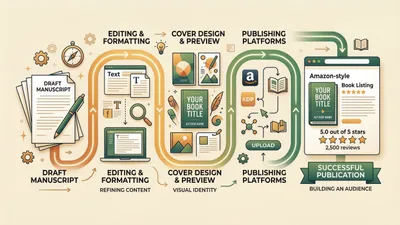
Most poets take 3 to 6 months from finished manuscript to published book. Here’s a typical timeline:
- Editing and revisions: 2-6 weeks
- Cover design: 1-3 weeks
- Formatting and layout: 1-2 weeks
- Upload and proof review: 1-2 weeks
- Pre-launch marketing: 2-4 weeks
If your poems are already written and polished, you can move faster. Some poets compress the process to 4-6 weeks. The key bottleneck is usually cover design — start that early.
FAQ
Can You Self-Publish a Poetry Book on Amazon?
Yes, you can self-publish a poetry book on Amazon using Kindle Direct Publishing (KDP). KDP lets you publish both ebook and paperback editions at no upfront cost. You upload your manuscript, set your price, and your book goes live within 24-72 hours. Amazon pays royalties of up to 70% on ebooks and 60% minus printing costs on paperbacks.
How Many Poems Do You Need for a Poetry Book?
A poetry book typically contains 30 to 100 poems, though the range varies by format. A chapbook runs 15-30 poems (20-40 pages), while a full collection contains 40-80+ poems (60-120 pages). Focus on quality over quantity — every poem should earn its place in the collection.
Do Poetry Books Sell Well?
Poetry books can sell well, especially in the self-publishing space. Poetry book sales have grown over 100% since 2020, driven by social media platforms like Instagram and TikTok. While most poetry books sell between 200 and 2,000 copies, breakout hits can reach much larger audiences. Self-published poets earn 5x higher royalties per copy than traditionally published poets.
Do You Need an Agent to Publish a Poetry Book?
No, you do not need a literary agent to publish a poetry book. Self-publishing lets you publish without any gatekeepers. Most literary agents don’t represent poetry collections because the traditional advance is too small to justify their commission. Self-publishing gives you full creative control and significantly higher per-copy royalties.
How Do You Copyright a Poetry Book?
Your poetry is automatically copyrighted the moment you write it — no registration required. However, registering with the U.S. Copyright Office ($65 online) gives you legal advantages if someone copies your work. Include a copyright notice on your book’s copyright page. For the full process, see our guide to copyrighting a book.