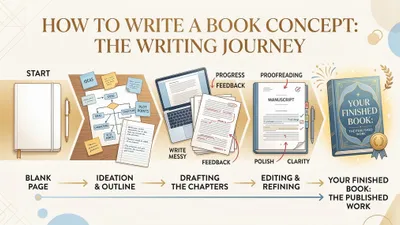
You can turn your idea into a finished book — even if you have zero writing experience. Thousands of first-time authors do it every year, and the process is more straightforward than you think.
In this guide, you’ll learn:
- How to test whether your idea is strong enough to carry an entire book
- The step-by-step process for going from vague concept to detailed outline
- How to write your first draft without getting stuck
- Where AI tools like Chapter fit into the workflow
Here is exactly how to do it.
Can You Really Turn Any Idea Into a Book?
Yes — but not every idea is ready to become a book in its current form. Most book ideas start as a feeling, a question, or a single concept. That is normal. The difference between people who finish books and people who don’t isn’t the quality of their initial idea. It is whether they develop that idea through a structured process.
The good news is that your idea doesn’t need to be completely original. It needs to be yours — shaped by your perspective, experience, and voice. A memoir about grief isn’t unique as a concept, but your specific story of loss and recovery is unlike anyone else’s.
If you have an idea that keeps nagging at you, that you find yourself thinking about in the shower or explaining to friends at dinner, you have enough to start.
Step 1: Write Your Idea as a Single Sentence
The first step to turning your idea into a book is distilling it into one clear sentence. This is your premise — and it will guide every decision you make from here.
A premise isn’t a topic. “Leadership” is a topic. “Mid-level managers can double their team’s output by replacing weekly status meetings with async check-ins” is a premise.
Here is the formula:
[Who] + [does what / learns what] + [with what result or stakes]
Examples:
- Fiction: A retired detective returns to solve the one case that ended her career, only to discover her own partner was the killer.
- Nonfiction: First-time entrepreneurs can launch a profitable side business in 90 days by following a validated step-by-step framework.
- Memoir: A woman raised in a survivalist compound learns to trust the outside world after escaping at age nineteen.
Write yours now. If you can’t get it to one sentence, your idea might actually be two or three books — and that is fine. Pick the one that excites you most.
If you are struggling to land on your concept, try brainstorming book ideas with AI to explore different angles quickly.
Step 2: Validate Your Book Idea
Before you invest months of writing, spend an hour making sure your idea has legs. Validation isn’t about guaranteeing a bestseller. It is about confirming that an audience exists and your concept can sustain 40,000 to 80,000 words.
The three-question validation test:
-
Does someone need this? Search Amazon and Google for books on your topic. If similar books exist and sell well, that is a good sign — it means there is demand. If nothing exists, ask yourself whether you are filling a real gap or chasing a topic nobody wants.
-
Can you sustain it? Open a blank document and write down every subtopic, story, chapter idea, or point you could make. If you can list 10 to 15 items in five minutes, your idea has depth. If you stall at three, you may need to broaden your scope.
-
Are you the right person to write it? You don’t need a PhD, but you need either lived experience, professional expertise, or a deep passion that will carry you through the hard days. Readers can tell when an author genuinely cares about their subject.
If your idea passes all three questions, you are ready to move forward. If you need more help choosing a direction, check out our guide to book ideas for aspiring authors.
Step 3: Decide What Type of Book You Are Writing
Your book type determines everything — structure, length, voice, and audience expectations. Nail this down before you outline.
| Book Type | Typical Length | Key Structure |
|---|---|---|
| Novel (fiction) | 70,000-90,000 words | Three-act structure, chapters |
| Memoir | 60,000-80,000 words | Thematic or chronological arc |
| Self-help / how-to | 40,000-60,000 words | Problem-solution chapters |
| Business book | 40,000-55,000 words | Framework + case studies |
| Children’s book | 500-10,000 words | Age-appropriate structure |
Fiction vs. nonfiction is the biggest fork in the road. Fiction requires plot, characters, and a narrative arc. Nonfiction requires a clear promise to the reader and organized expertise. If you are unsure which path to take, read our guides on how to write a fiction book and how to write a nonfiction book.
Your idea might naturally lean one way. A personal story with universal lessons could be a memoir. A system you have developed at work could be a business book. A “what if” scenario that keeps you up at night is probably a novel.
Step 4: Develop Your Core Concept
Now you take your one-sentence premise and expand it into a foundation you can build on. This step looks different depending on your book type.
For fiction:
- Characters: Who is your protagonist? What do they want, and what stands in their way? Write a one-paragraph profile for your main character and antagonist.
- Setting: Where and when does your story take place? Even a contemporary setting needs specific details — a small-town diner is more vivid than “a restaurant.”
- Conflict: Every novel needs a central conflict that drives the story forward. Name it explicitly.
- Theme: What is your story really about beneath the surface plot? Love versus duty? The cost of ambition? This doesn’t need to be heavy-handed, but knowing it keeps your story cohesive.
For nonfiction:
- Core promise: What will the reader be able to do after reading your book that they couldn’t do before?
- Target reader: Be specific. “Anyone interested in productivity” is too broad. “Remote workers who manage teams across time zones” is a reader you can write directly to.
- Unique angle: What makes your approach different from the five other books on this topic? Your proprietary framework, personal experience, or contrarian take is your differentiator.
- Key takeaways: List the three to five biggest ideas you want the reader to remember. These often become your chapter anchors.
Spend a few hours on this step. Write it all down in a document you will reference throughout the process. You can use a book planning template to keep everything organized.
Step 5: Create Your Book Outline
An outline is the bridge between “I have an idea” and “I am writing a book.” It transforms your concept into a concrete roadmap.
You don’t need a perfect, chapter-by-chapter outline to start. But you do need enough structure to know where you are going. As our guide to outlining a book explains, there are several approaches that work.
The simple method (works for any book type):
- Write your premise at the top of a document.
- List 10 to 15 major points, scenes, or chapters you want to include.
- Put them in logical order (chronological for memoir, problem-to-solution for how-to, narrative arc for fiction).
- Under each item, write 2 to 3 bullet points describing what happens or what you will cover.
- Identify gaps — what is missing? What questions would a reader still have?
For fiction specifically, you might prefer a story outline template or the three-act structure:
- Act 1 (25%): Introduce your character, their world, and the inciting incident that disrupts it.
- Act 2 (50%): Rising action, complications, midpoint shift, and the darkest moment.
- Act 3 (25%): Climax, resolution, and new normal.
For nonfiction, a chapter-based outline works best. Each chapter should answer one clear question or teach one distinct skill. Check out our book outline template for a ready-made starting point.
Our Pick — Chapter
Chapter’s AI book writing tool can generate a structured outline from your premise in minutes. You describe your idea, and Chapter builds a chapter-by-chapter framework you can rearrange and refine. It is especially useful when you have too many ideas and need help organizing them.
Best for: First-time authors who want structure without spending weeks on pre-planning Pricing: $97 one time, 2 books included (fiction or nonfiction), 30-day money-back guarantee Why we built it: Most people get stuck between “idea” and “outline” — Chapter bridges that gap with AI.
Step 6: Set Up Your Writing System
Before you write a single word of your manuscript, set up a system that makes daily writing sustainable. Most books fail not because the idea was bad but because the author never built a writing habit.
Your writing system needs three things:
- A schedule: Pick a time of day and block it on your calendar. Thirty minutes daily beats eight-hour weekend marathons. Consistency matters more than volume.
- A word count target: For a first draft, 500 to 1,000 words per day is realistic. At 500 words per day, you will have a 50,000-word draft in about three months.
- A writing space: Physical or digital, you need a consistent environment. Some authors write at the same desk every morning. Others write in coffee shops. Find what works and stick with it.
Track your progress. A simple spreadsheet with your daily word count creates accountability. Watching the numbers climb is surprisingly motivating.
If you want a deeper dive into building your writing routine, read our guide on the writing process from idea to finished book.
Step 7: Write Your First Draft
This is where most aspiring authors stall. The gap between “planning” and “writing” feels enormous. Here is how to close it.
The most important rule of first drafts: do not edit as you go. Your first draft is a conversation between you and your idea. It is supposed to be rough, unpolished, and imperfect. Editing while drafting is the number one reason people never finish their books.
Practical strategies for getting words on the page:
- Start with the section you are most excited about. You don’t have to write chapter one first. If chapter seven is burning a hole in your brain, start there.
- Use the “two-minute rule.” Tell yourself you only need to write for two minutes. Almost every time, you will keep going once you start.
- Lower your standards dramatically. Give yourself permission to write badly. You can fix bad writing. You can’t fix a blank page.
- End each session mid-sentence. When you come back the next day, you will know exactly where to pick up. Hemingway famously used this technique.
If you are writing your first book as a complete beginner, know that every published author felt exactly what you feel right now. The fear of the blank page is universal.
AI can help here, too. Tools like Chapter let you generate draft sections from your outline, then refine the AI output with your own voice and expertise. Over 10,000 authors have used Chapter to write books, and many of them started exactly where you are — with an idea and no manuscript.
Step 8: Push Through the Middle
The beginning is exciting. The end is motivating. The middle is where books go to die. Around the 20,000 to 40,000-word mark, nearly every author hits a wall.
Why the middle is hard:
- The novelty of your idea has worn off.
- You can see problems you didn’t anticipate.
- The finish line feels impossibly far away.
How to push through:
- Revisit your premise. Go back to that one-sentence summary from Step 1. Remind yourself why this book matters.
- Skip ahead. If a particular chapter or scene is stuck, jump to the next one. You can fill gaps later.
- Talk to someone about your book. Explaining your idea out loud often breaks through mental blocks. Their questions will show you what is interesting about your story.
- Lower the bar further. If 500 words feels impossible, aim for 100. One hundred words a day is still progress.
For more strategies, read our guide on how to finish a book you started. The authors who finish are the ones who keep showing up, even on the bad days.
Step 9: Revise and Edit Your Manuscript
You’ve finished your first draft. Congratulations — you have done something most people only talk about. Now comes the part that turns a draft into a book.
The three-pass revision process:
Pass 1: Structural edit (big picture) Read your entire manuscript and ask: Does the overall structure work? Are there chapters that should be moved, combined, or cut? Does the book deliver on its premise? This pass is about architecture, not grammar.
Pass 2: Line edit (paragraph level) Now tighten your prose. Cut filler words. Strengthen weak verbs. Break up long paragraphs. Make sure each paragraph earns its place. Read sections out loud — your ear will catch problems your eyes miss.
Pass 3: Copyedit (sentence level) Fix grammar, spelling, punctuation, and formatting. Check facts and citations. Ensure consistency in names, dates, and terminology.
Should you hire a professional editor? If you plan to publish, yes. Self-editing catches about 80% of issues. A professional editor catches the other 20% — and that 20% is often the difference between an amateur book and a professional one.
Common Mistakes When Turning an Idea Into a Book
Avoid these pitfalls that trip up most first-time authors:
- Trying to write the perfect first draft. Perfection is a trap. Get the words down first, then refine.
- Skipping the outline. Writing without a roadmap leads to meandering manuscripts and abandoned projects. Even a rough outline saves you weeks of rewriting.
- Waiting for inspiration. Professional authors write on a schedule, not when the muse strikes. Inspiration follows action, not the other way around.
- Not reading in your genre. If you want to write a thriller, read thrillers. If you want to write a business book, study what works in that category. Reading is research.
- Telling everyone about your book too early. Studies suggest that announcing a goal prematurely can reduce your motivation to achieve it. Share selectively until you have a solid draft.
How Long Does It Take to Turn an Idea Into a Book?
How long it takes to turn an idea into a book depends on the type of book, your writing schedule, and whether you use any AI writing tools to speed up the process. Most first-time authors take 6 to 12 months to go from idea to finished manuscript.
Here is a realistic timeline:
| Phase | Traditional Timeline | With AI Assistance |
|---|---|---|
| Concept development | 1-2 weeks | 2-3 days |
| Outlining | 1-3 weeks | 1-5 days |
| First draft | 3-6 months | 1-3 months |
| Revision and editing | 1-3 months | 1-2 months |
| Total | 6-12 months | 2-5 months |
Authors using platforms like Chapter have finished complete manuscripts in as little as 30 days. The AI handles the heavy lifting of drafting, while you focus on shaping the content with your unique voice and knowledge.
Do You Need Writing Experience to Write a Book?
No, you do not need writing experience to write a book. Many successful authors published their first book with no formal training. What you need is a clear idea, a structured process, and the willingness to learn as you go.
Your unique perspective and expertise matter more than polished prose. A business leader writing about their industry brings decades of real-world knowledge that no MFA program can teach. A parent writing a children’s book understands their audience better than most professional writers.
If you feel underqualified, start with our guide for how to start writing a book with no experience. You will see that the bar is lower than you think — and the tools available today make it even more accessible.
What If You Get Stuck and Can’t Finish?
Getting stuck is part of the process, not a sign that you should quit. Every author gets stuck. The difference is that published authors have strategies for getting unstuck.
Try these approaches:
- Change your environment. Write in a different location for a day.
- Work on a different section. You don’t have to write linearly.
- Re-read what you have written. Often, the momentum of your existing words pulls you forward.
- Use AI as a brainstorming partner. Tools like Chapter can help you generate ideas for the next section when you hit a wall.
- Take a short break — but set a return date. A three-day break is healthy. A three-month break usually becomes permanent.
If this sounds familiar, you are not alone. Read our post on what to do when you want to write a book but don’t know where to start.
FAQ
How do you turn an idea into a book?
To turn an idea into a book, start by writing your concept as a single sentence (your premise), then validate it by researching whether an audience exists. Next, create a structured outline that breaks your idea into chapters, then write your first draft following a daily writing schedule. Revise in three passes: structural, line-level, and copyediting.
How many words does a book need to be?
A book typically needs 40,000 to 90,000 words depending on the genre and type. Novels average 70,000 to 90,000 words. Nonfiction books like self-help or business titles range from 40,000 to 60,000 words. Memoirs typically fall between 60,000 and 80,000 words. Children’s books can be as short as 500 words.
Can AI help you write a book from an idea?
Yes, AI can help you write a book from an idea by assisting with brainstorming, outlining, and drafting. Tools like Chapter generate structured outlines and draft sections from your premise. Over 10,000 authors have used Chapter to create books. AI works best as a collaborator — you provide the ideas and expertise while AI handles the initial drafting.
What is the fastest way to turn an idea into a book?
The fastest way to turn an idea into a book is to combine a clear outline with AI writing tools and a consistent daily writing schedule. Authors using AI-assisted workflows have completed full manuscripts in 30 days or less. The key is starting with a strong one-sentence premise, building a detailed outline, and writing every day without editing as you go.
How do you know if your book idea is good enough?
You know your book idea is good enough if it passes three tests: someone needs it (similar books exist and sell), you can sustain it (you can list 10+ subtopics in five minutes), and you are the right person to write it (you have experience, expertise, or deep passion for the subject). A good idea doesn’t need to be completely original — it needs your unique perspective.