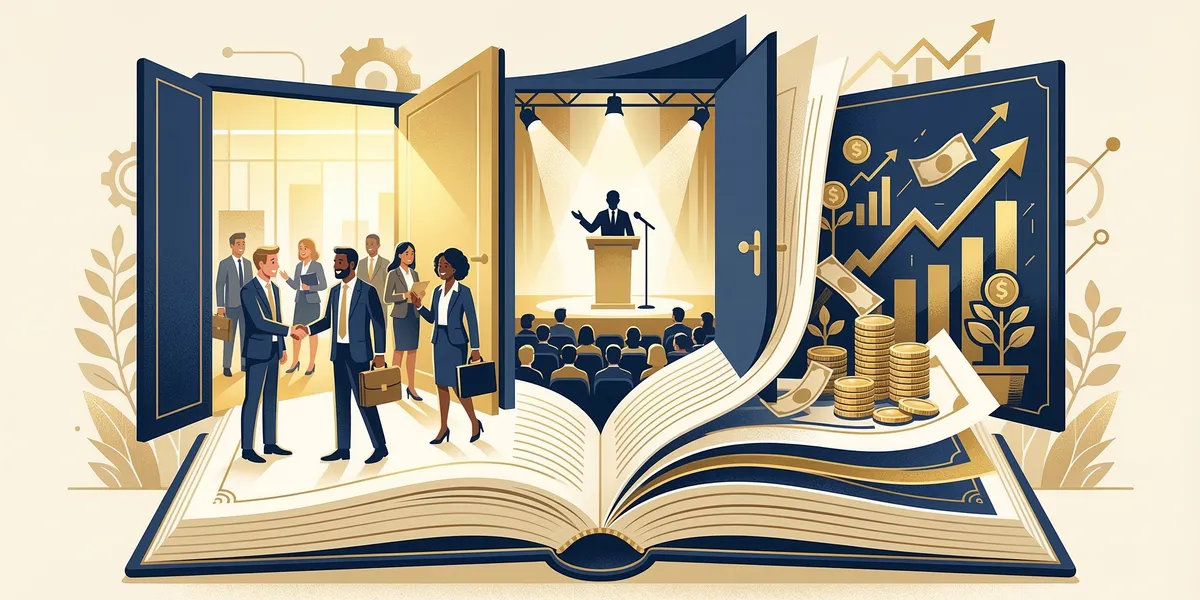
A published book does what no amount of social media posts, cold emails, or networking events can do. It makes strangers trust you enough to buy. A business consultant in Chicago published a short book about his methodology. A stranger read it, reached out, and hired him for $13,200 on the spot.
That consultant is Jim T., and his book works 24/7 without being asked. This guide shows you exactly how to use a book to grow your business, from writing it to turning every copy into a client conversation.
The book advantage
Most businesses compete on the same playing field: websites, social media, ads, SEO. A published book puts you on a different field entirely. Here is why:
Instant credibility. “Published author” carries weight that “consultant” or “coach” does not. When a prospect sees your book on Amazon, they process it as third-party validation. You wrote a book. A publisher (even you, self-publishing) put it out. Readers reviewed it. That sequence signals competence in a way no website ever can.
Deep engagement. A social media post gets 3 seconds of attention. A book gets hours. A reader who finishes your book has spent more time with your ideas than most prospects spend across your entire marketing funnel. By the time they reach the last chapter, they already understand your methodology, trust your expertise, and know whether they want to work with you.
Passive lead generation. Your book sits on Amazon reaching readers while you sleep. It does not require your time after the initial creation. Every month, new readers discover it through Amazon search, and the best prospects self-select by reaching out.
Media and speaking access. Podcast hosts, conference organizers, and journalists seek out published authors. A book makes you bookable in ways a LinkedIn profile never will.
Kerri-Anne K. saw this play out at scale:
“A speaking gig for 20,000 people.”
Her book opened a door that years of traditional marketing had not.
5 ways to use your book for business growth
1. Give it to prospects before sales conversations
This is the highest-converting use of a business book. Before a discovery call, send the prospect a copy of your book. Physical copies work best for impact, but digital copies work for speed.
What happens:
- The prospect reads your methodology before the call
- They arrive understanding your approach and agreeing with your framework
- The call becomes about implementation details, not proving your credibility
- Close rates increase because the book already did the selling
Jim T.’s $13,200 client never had a traditional sales call. The book did the work:
“A stranger read my book and reached out: ‘I need your help. What does it cost?’ I said $13,200. He started the same day.”
How to implement: Order 50-100 author copies through Amazon KDP (roughly $3-5 each). Ship one to every qualified prospect before your first call. Include a handwritten note referencing their specific situation.
2. Build an Amazon presence for passive discovery
Amazon is a search engine with 300 million+ active customer accounts. When someone searches for a topic in your niche, your book can appear.
Unlike Google SEO, ranking a book on Amazon is achievable with basic optimization:
- Title and subtitle: Include the specific problem you solve
- Book description: Write sales copy, not a summary
- Categories: Select the most specific subcategories relevant to your audience
- Keywords: Use all 7 keyword slots with phrases your ideal client would search
- Reviews: Ask every client and reader to leave a review
A well-positioned nonfiction book in a specific niche can generate 50-200+ sales per month on autopilot. Each buyer is a potential client.
For a step-by-step Amazon publishing guide, see how to publish a book on Amazon.
3. Use it as an event handout
Speaking at conferences, running workshops, or hosting webinars? Give every attendee a copy of your book.
This does three things:
- Positions you above every other speaker who handed out a business card
- Gives attendees something to take home that reinforces your message long after the event
- Includes your contact information, website, and call-to-action in a format that does not get thrown away like a brochure
Pro tip: Order a bulk run of paperbacks for events. At $3-5 per copy through Amazon KDP, 100 books cost $300-500. If one attendee becomes a client worth $5,000+, the ROI is extraordinary.
4. Create an email opt-in around the book
Offer a free chapter, a companion workbook, or the entire digital version as an email opt-in on your website. This builds your list with people who are specifically interested in your area of expertise.
A strong book-based opt-in sequence:
- Landing page: “Get Chapter 1 of [Book Title] free”
- Email sequence (5-7 emails): Expand on key concepts from the book, share case studies, build toward a consultation offer
- Call-to-action: Invite readers to a free strategy call or discovery session
This approach outperforms generic lead magnets because the book establishes your authority before the email sequence even begins.
For more on book-based lead generation, see our guide on using a book as a lead magnet.
5. Include it in your media kit
When pitching to podcasts, media outlets, or event organizers, include your book in the pitch. “Published author of [Title]” carries more weight than any other credential you can list.
Journalists and podcast hosts prefer interviewing published authors because:
- The book provides ready-made talking points
- It signals the person has organized their expertise into a structured framework
- It reduces the risk that the interview will be shallow or promotional
Include a high-resolution image of your book cover, a one-paragraph summary, and 3-5 potential interview topics in your media kit.
What to write about
The most effective business books share three characteristics:
1. They focus on your methodology. Not the entire industry. Not general advice. Your specific process for getting results. If you are a financial planner, do not write “Introduction to Financial Planning.” Write “The Retirement Acceleration Method for Corporate Executives Over 50.”
2. They speak to your ideal client directly. Every sentence should make your target reader think: “This person understands my exact problem.” Specificity beats breadth every time.
3. They demonstrate results without giving away the implementation. Show enough of your framework that readers believe it works. Hold back enough that the smartest readers realize they need your help to execute it properly.
The structure that converts readers to clients
| Section | Purpose | Length |
|---|---|---|
| The Problem | Show you understand their pain better than they do | 1-2 chapters |
| Your Method | Introduce your framework with enough detail to be credible | 3-5 chapters |
| Case Studies | Prove the method works with real results | 2-3 chapters |
| Implementation Overview | Show the steps without hand-holding the execution | 1-2 chapters |
| Work With Me | Clear call-to-action for readers who want help | 1 chapter |
Total: 80-200 pages. That is the sweet spot for an authority book that converts readers into clients.
How to write your business book fast
The traditional path to writing a business book takes 6-18 months and costs $5,000-$25,000 if you hire a ghostwriter. AI book writing tools have changed the economics entirely.
Chapter generates a complete nonfiction manuscript of 80-250 pages in about 60 minutes. You provide your expertise, methodology, and target audience. The AI creates the structured manuscript. You edit and add personal touches.
The timeline:
| Step | Time |
|---|---|
| Define your topic and audience | 1-2 hours |
| Generate manuscript with Chapter | ~60 minutes |
| Review and edit | 2-4 days |
| Format and publish | 1 day |
| Total | 3-7 days |
The cost: $97 one-time
Compare that to Adam W.’s alternative:
“Saved $25K on a ghostwriter.”
The $97 investment removes the two biggest barriers to writing a business book: time and money. If the book generates even one client, the ROI is measured in thousands of percent.
The ROI of a business book
Here is the math, using conservative numbers:
| Metric | Conservative estimate |
|---|---|
| Book creation cost | $97 (Chapter) |
| Monthly Amazon sales | 50 copies ($172 royalty at $3.44/book) |
| Clients acquired per year from book | 3-5 |
| Average client value | $5,000-$15,000 |
| Annual revenue from book | $17,064 - $77,064 |
| ROI on $97 investment | 17,490% - 79,345% |
These numbers are not hypothetical. Jim T. earned $13,200 from a single reader. Arek Z. generated $60,000 in 48 hours from his book-driven funnel. Kerri-Anne K. landed a speaking gig in front of 20,000 people.
The question is not whether a book can grow your business. It is whether you can afford not to have one while your competitors figure it out.
FAQ
How long should a business book be?
80 to 200 pages (20,000-50,000 words). Long enough to establish authority and demonstrate your methodology. Short enough that busy executives will actually finish it. See our authority book guide for detailed structural advice.
Should I self-publish or pursue traditional publishing?
Self-publish. Traditional publishing takes 12-24 months, gives you less control, and pays lower royalties. For a business book designed to generate clients, speed and control matter more than the prestige of a traditional publisher. Our self-publishing guide covers the process.
Will people take a self-published book seriously?
Yes. The stigma around self-publishing is largely gone. Your prospects care about the content and whether it demonstrates expertise, not who published it. Over 300 million books have been self-published through Amazon KDP, and readers rarely check or care about the publisher name.
Do I need to be a good writer?
No. AI book writing tools like Chapter handle the prose. You need expertise in your topic. The book succeeds based on the quality of your ideas and methodology, not on your writing craft. Editing polishes the rest.
What if my competitors already have books?
Then you need one even more. A competitor with a book and you without one means they win the credibility contest every time. A well-positioned book focused on your specific methodology and audience can outperform a competitor’s generic industry overview. Specificity beats breadth.