You can absolutely write a board book — and if you pick the right concept, you can turn it into a steady income stream in one of publishing’s most resilient niches. Board books account for a massive share of children’s book sales, and the format rewards simplicity over literary complexity.
In this guide, you’ll learn:
- The exact specifications publishers expect (word count, page count, trim size)
- How to write age-appropriate text that toddlers and parents love
- Where to find illustrators and how to art-direct your board book
- Every publishing path available — from traditional to self-publishing
Here’s how to create a board book from concept to finished product.
What Is a Board Book?
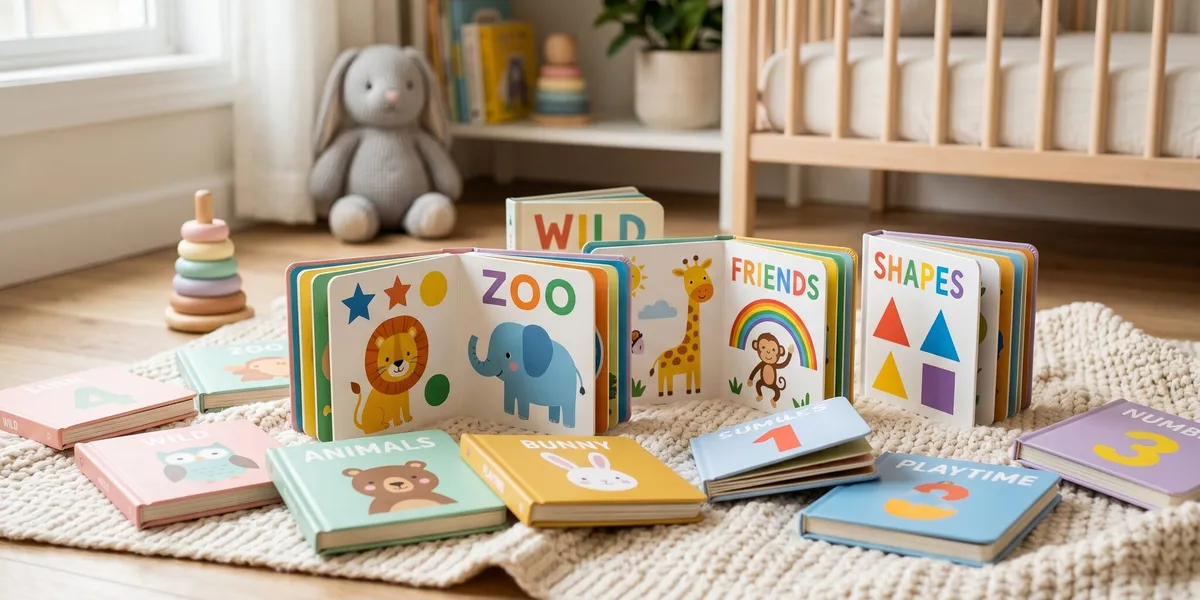
A board book is a durable children’s book printed on thick cardboard pages, designed for babies and toddlers ages 0 to 3. Unlike standard picture books with paper pages, board books use heavy laminated cardstock that resists tearing, drooling, and chewing.
Board books are a child’s first introduction to reading. They teach page-turning, object recognition, and cause-and-effect through simple images and minimal text. The format has been a staple of early childhood development since the 1980s, and iconic titles like Goodnight Moon, Brown Bear, Brown Bear, What Do You See?, and Roger Priddy’s First 100 Words series have sold tens of millions of copies.
If you’re wondering whether the board book market is worth entering — it is. Parents buy board books by the stack, and backlist titles sell for years without promotion.
Board Book Specifications: Word Count, Page Count, and Trim Size
Before you write a single word, you need to understand the physical constraints of the format. Board books are not picture books printed on thick paper — they have their own rules.
| Specification | Standard Range |
|---|---|
| Target age | 0-3 years old |
| Word count | 50-200 words (300 absolute max) |
| Page count | 10-24 pages (always in multiples of 2) |
| Spreads | 5-12 double-page spreads |
| Trim size | 6” x 6”, 7” x 7”, or 5” x 7” |
| Sentence length | 3-8 words per sentence |
The most common trim size is 7 inches by 7 inches, though square 6x6 formats are also popular. Some publishers use rectangular formats (5” x 7” or 5.5” x 6.5”) for variety.
Word count is where most first-time board book writers go wrong. You’re aiming for 100 words or fewer in most cases. The best-selling board books — titles like Dear Zoo and Where’s Spot? — use fewer than 150 words total. Every word needs to earn its place.
How to Choose a Board Book Concept That Sells
Your concept determines whether your board book gets picked up or passed over. The most successful board books fall into a few proven categories.
Concept categories that work
- First words and vocabulary — Animals, foods, vehicles, colors, body parts
- Counting and ABCs — Simple number or letter books with bold visuals
- Routines and daily life — Bedtime, bathtime, mealtimes, getting dressed
- Sensory and interactive — Touch-and-feel, lift-the-flap, peek-a-boo
- Simple stories — One problem, one resolution, minimal plot
- Emotional concepts — Love, family, feelings, kindness
Before settling on your idea, search Amazon’s board book category and study what’s selling. Look at the top 100 board books and note which concepts repeat. If you see dozens of animal-themed board books dominating the charts, that tells you the demand is real — but your version needs a fresh angle.
The “one concept per book” rule
A board book should teach or explore one thing. Not animals and colors and numbers. Just animals. Or just colors. Toddlers process information slowly, and the best board books respect that by staying focused.
Roger Priddy’s First 100 Words works because it does exactly one thing — shows 100 common objects with labels. Sandra Boynton’s Moo, Baa, La La La! works because it explores one concept — animal sounds — with humor and rhythm.
How to Write Board Book Text
Writing a board book is an exercise in extreme economy. You have roughly 100 words to create something memorable, rhythmic, and engaging for a child who doesn’t yet understand language.
Use simple, concrete words
Favor familiar nouns your audience already recognizes or is learning: ball, cat, tree, baby, sun, cup. Skip abstract concepts. A toddler doesn’t understand “perseverance” but absolutely knows “jump.”
Good: “Dog runs. Cat sleeps. Bird sings.”
Bad: “The animals in the neighborhood engage in their daily activities.”
Build with rhythm and repetition
The most beloved board books use repetition as a structural device. Repeating a phrase or pattern on every page gives toddlers something predictable to latch onto. It also makes the book easier for parents to read aloud.
Eric Carle’s Brown Bear, Brown Bear follows the same pattern on every spread: “[Animal], [Animal], what do you see? I see a [animal] looking at me.” That repetition is the entire engine of the book.
Try these repetition structures:
- Question and answer — Same question every page, different answer
- Cumulative — Each page adds one new element to a growing list
- Call and response — One line sets up, the next line resolves
- Sound patterns — Onomatopoeia that repeats with variation
Write for the ear, not the eye
Parents read board books aloud dozens (sometimes hundreds) of times. Your text needs to sound good spoken. Read every draft out loud. If you stumble over a phrase, rewrite it. If a sentence feels clunky at 10 PM when you’re exhausted, it will feel worse to a parent reading it for the 47th time.
Rhyme is optional but powerful. If you rhyme, commit fully — near-rhymes and forced rhymes are worse than no rhyme at all. Dr. Seuss made rhyming look effortless, but each of his board books went through dozens of revisions.
Include interactive elements in your text
Board books that invite physical participation outperform passive ones. Write text that prompts actions:
- “Can you clap your hands?”
- “Touch the bunny’s nose!”
- “Where is the duck hiding?”
These prompts turn reading into a game, which keeps toddlers engaged longer and makes parents more likely to re-read the book.
How to Structure a Board Book Page by Page
A standard board book has 12 pages (6 spreads). Here’s a proven structure you can adapt.
| Page | Purpose | Example |
|---|---|---|
| Cover | Hook with title + strong visual | ”Goodnight, Farm!” with barn illustration |
| Pages 1-2 | Introduce the concept or character | ”The sun is setting on the farm.” |
| Pages 3-8 | Explore the concept through repetition | Each spread shows a different animal going to sleep |
| Pages 9-10 | Build toward the ending | ”Everyone is sleepy now…” |
| Pages 11-12 | Satisfying close | ”Goodnight, farm. Goodnight, you.” |
| Back cover | Author bio, barcode, ISBN | Brief description + purchase info |
Each spread (two facing pages) should work as a complete visual unit. The left and right pages work together, so plan your text and illustrations to flow across both pages rather than treating them as separate.
Create a dummy book
Before finalizing your manuscript, create a physical dummy. Fold 6 sheets of paper in half, staple them together, and write your text on each page. This shows you exactly how the pacing feels and where you need more or less text.
This step catches problems that reading a manuscript on screen never will. You’ll discover that page 4 has too many words, or that your ending feels rushed, or that the rhythm breaks on spread 3.
How to Work With an Illustrator
Board books are illustration-driven. The art does 80% of the storytelling, and your text supports the visuals — not the other way around. Unless you’re also an illustrator, you’ll need to hire one.
Where to find board book illustrators
- Reedsy — Curated marketplace with vetted children’s book illustrators
- Behance and Dribbble — Portfolio sites where you can search by style
- Society of Children’s Book Writers and Illustrators (SCBWI) — Professional directory
- Instagram — Search hashtags like #boardbookillustrator or #kidlitart
- Fiverr and Upwork — Budget options, but quality varies widely
What to look for
Your illustrator should have experience with the board book format specifically. Picture book illustration and board book illustration are different skills. Board book art needs:
- Bold, simple compositions that read clearly at small sizes
- High-contrast colors that grab a toddler’s attention
- Consistent character design across every page
- Age-appropriate style — rounded, friendly, non-threatening
Budget expectations
Professional board book illustration typically costs between $2,000 and $10,000 for a full book, depending on the illustrator’s experience, style complexity, and page count. A 12-page board book with simple, bold illustrations might run $2,500-$4,000. Detailed, painterly illustrations from an established artist can run $8,000-$15,000.
Don’t skimp on illustration. In children’s books, the art sells the book. Parents flip through board books in stores and buy based on how the illustrations look and feel.
How to Self-Publish a Board Book
Self-publishing a board book is different from self-publishing a novel or standard picture book. The biggest difference: Amazon KDP does not print board books. The print-on-demand model that works for paperbacks and hardcovers doesn’t support the specialized printing process board books require.
That means you’ll need to work with a specialty printer and manage inventory yourself.
Board book printing services
| Printer | Minimum Order | Price Range | Best For |
|---|---|---|---|
| Print Ninja | 250 copies | $3-6 per unit | First-time self-publishers |
| Pint Size Productions | 520 copies | $2-5 per unit | Larger production runs |
| BookBaby | 25 copies | $8-15 per unit | Small test runs |
| Mixam | 1 copy | $15-30 per unit | Proof copies |
| QinPrinting | 500 copies | $1.50-4 per unit | Cost-efficient bulk orders |
For a first print run, 250-500 copies is the sweet spot. It’s enough to test demand without a massive upfront investment. At $3-5 per unit for a 500-copy run, you’re looking at $1,500-$2,500 total. If your board book retails for $9.99-$12.99, you can recoup your printing costs after selling roughly 200-300 copies.
Selling your board book on Amazon
Since KDP won’t print board books, you have two options for Amazon distribution:
-
Fulfillment by Amazon (FBA) — Ship your inventory to Amazon’s warehouse. They handle storage, packing, and shipping. You pay storage and fulfillment fees, but your book gets Prime eligibility.
-
Merchant Fulfilled Network (MFN) — You store and ship books yourself. Amazon handles the transaction. You need to ship within 24 hours of each order.
FBA is the better option for most self-publishers. The Prime badge alone can double your conversion rate on Amazon. Factor in FBA fees when pricing your book — typically $3-4 per unit for a board book.
Other sales channels
Don’t limit yourself to Amazon. Board books sell well through:
- Your own website (Shopify, WooCommerce) — highest margins
- Etsy — strong market for unique children’s products
- Independent bookstores — approach local stores with consignment offers
- Gift shops and boutiques — board books are popular gift items
- Book fairs and craft markets — face-to-face selling builds a reader base
How to Get a Board Book Traditionally Published
If you’d rather skip the printing logistics, traditional publishing handles everything — printing, distribution, marketing, and retail placement. The trade-off is lower royalties and less creative control.
How to submit your board book manuscript
-
Write a polished manuscript — No illustrations unless you’re also the illustrator. Publishers pair writers with their own illustrators.
-
Research publishers — Look for publishers with active board book lines. Scholastic, HarperCollins Children’s, Random House Children’s, and Workman Publishing all publish board books. Smaller presses like Gibbs Smith, Familius, and Sourcebooks Kids are also worth targeting.
-
Check submission guidelines — Some publishers accept unsolicited manuscripts. Many require literary agent representation. Each publisher’s website lists their current submission policy.
-
Query literary agents — If your target publishers require agents, query agents who represent children’s book authors. SCBWI’s directory and QueryTracker are good starting points.
-
Be patient — Response times range from 3 months to a year. Board book manuscripts are often reviewed differently than novel manuscripts because the publisher needs to envision the final illustrated product.
What publishers look for
Publishers want board book manuscripts that demonstrate:
- A fresh take on a proven concept (not another generic ABC book)
- Strong commercial potential — will parents buy this as a gift?
- Text that demands illustration — the words should suggest vivid visuals
- Series potential — can this concept extend to 3-5 books?
- A distinct voice that makes reading aloud enjoyable
Common Mistakes to Avoid When Writing Board Books
- Writing too many words — If your manuscript is over 200 words, cut ruthlessly. Every extra word makes the book harder for toddlers to engage with.
- Writing for adults, not children — Your audience can’t read yet. Write for their ears, not for their parents’ literary sensibilities.
- Skipping the read-aloud test — If you haven’t read your text aloud 20+ times, you haven’t revised enough.
- Choosing an overly complex concept — One idea per book. If you need a subtitle to explain your concept, it’s too complicated.
- Ignoring the illustration relationship — Your text should leave room for the art to tell the story. Don’t describe what the illustration will show.
- Forcing rhyme — Bad rhyme is worse than no rhyme. If you can’t make it perfect, write in prose.
Can You Use AI to Write a Board Book?
You can use AI tools to brainstorm board book concepts, generate rhyming options, and test different structural approaches. AI is particularly useful for the ideation phase — generating dozens of concept variations that you can refine.
Our Pick — Chapter
Chapter helps you brainstorm, outline, and draft your book manuscript with AI-powered writing assistance. While board books require specialized illustration and printing, Chapter streamlines the writing and planning process that every book starts with.
Best for: Brainstorming concepts, drafting text, and organizing your board book project Pricing: $97 one-time (nonfiction) Why we built it: Over 10,000 authors have used Chapter to create books — including children’s book authors who use the platform for concept development and manuscript drafting.
AI won’t replace the creative instinct that makes a board book feel magical, but it can accelerate the process of finding the right words, testing rhythms, and exploring concept variations. Tools like Chapter work best when you treat them as brainstorming partners rather than ghostwriters.
For a deeper look at using AI in your writing process, check out our guide on AI book writing for beginners.
How Much Does It Cost to Make a Board Book?
The total cost to self-publish a board book depends on your illustration budget and print run size. Here’s a realistic breakdown.
| Expense | Estimated Cost |
|---|---|
| Illustration (12 pages + cover) | $2,500-$10,000 |
| ISBN | $0-$125 (free options exist) |
| Printing (500 copies) | $1,500-$2,500 |
| Barcode | $0-$25 |
| Design and layout | $200-$500 |
| Total | $4,200-$13,150 |
At the low end, a self-published board book costs roughly $4,000-$5,000 to produce 500 copies. That’s a real investment, but board books have strong profit margins. A book that costs $3-5 to print and sells for $9.99-$12.99 generates $5-10 profit per copy.
If you sell 500 copies at $9.99 with an average profit of $5 per copy after fees, you’ve earned $2,500 — enough to fund a second print run. Successful board books sell thousands of copies over their lifetime, especially if they gain traction on Amazon or get picked up by retailers.
How Long Does It Take to Write a Board Book?
Writing a board book manuscript takes 1 to 4 weeks for the text alone. The words come quickly — your first draft might take an afternoon. But revising 100 words until every syllable works takes much longer than revising 100 pages.
The full production timeline looks like this:
| Phase | Timeline |
|---|---|
| Concept and research | 1-2 weeks |
| Writing and revising | 2-4 weeks |
| Finding an illustrator | 2-4 weeks |
| Illustration | 6-12 weeks |
| Design and layout | 1-2 weeks |
| Printing | 4-8 weeks |
| Total | 4-8 months |
The illustration phase is the longest part. Plan for at least 2-3 months from the time you hire an illustrator to receiving final artwork. Rush jobs cost more and often result in lower quality.
What Makes a Board Book a Bestseller?
The best-selling board books share a few traits you can study and apply.
Giftability. Board books are the default baby shower and first birthday gift. Titles that feel like gifts — beautiful covers, universal themes, emotional resonance — outsell utilitarian ones.
Re-readability. Parents read board books hundreds of times. Books with rhythm, humor, or interactive elements stay in rotation longer than books that feel like a chore after the fifth read.
Series potential. Sandra Boynton has sold over 85 million board books. She did it by creating a recognizable style and releasing dozens of titles. If your first book works, plan a series.
Shelf appeal. In bookstores, board books are displayed face-out. Your cover needs to grab attention from across the room. Invest in cover design that pops.
FAQ
How many words should a board book have?
A board book should have 50 to 200 words, with most successful titles using 100 words or fewer. The target audience — babies and toddlers ages 0 to 3 — has limited attention spans, so every word must serve a clear purpose. Shorter is almost always better.
What size should a board book be?
The standard board book size is 7 inches by 7 inches, though 6” x 6” and 5” x 7” are also common trim sizes. Square formats are the most popular because they’re easy for small hands to hold and they display well on retail shelves.
Can you self-publish a board book on Amazon KDP?
No, Amazon KDP does not currently print board books. The specialized thick-cardstock printing process isn’t compatible with KDP’s print-on-demand system. To sell a board book on Amazon, you’ll need to print through a specialty printer like Print Ninja or BookBaby and use Amazon’s FBA or Merchant Fulfilled programs.
How much does it cost to publish a board book?
Publishing a board book costs between $4,000 and $13,000 for a self-published first run of 500 copies. The biggest expense is illustration ($2,500-$10,000), followed by printing ($1,500-$2,500). Traditional publishing eliminates these upfront costs but offers lower per-copy royalties.
Do board books need an ISBN?
Yes, board books sold through retailers need an ISBN (International Standard Book Number). You can purchase ISBNs from Bowker or get a free ISBN through certain distributors. If you’re only selling direct to consumers through your own website, an ISBN is optional but recommended for credibility and discoverability.
Start Writing Your Board Book Today
Board books are one of publishing’s most rewarding formats. The constraints — minimal text, simple concepts, durable construction — make them accessible to first-time authors. And the market rewards quality: a single well-executed board book can generate passive income for years.
Start with one concept. Write your 100 words. Build a dummy. Find an illustrator. And if you need help brainstorming or drafting, Chapter can help you get from idea to manuscript faster.
Your board book could be the next one a parent reads 47 times in a row — and loves every single read.
Related guides: