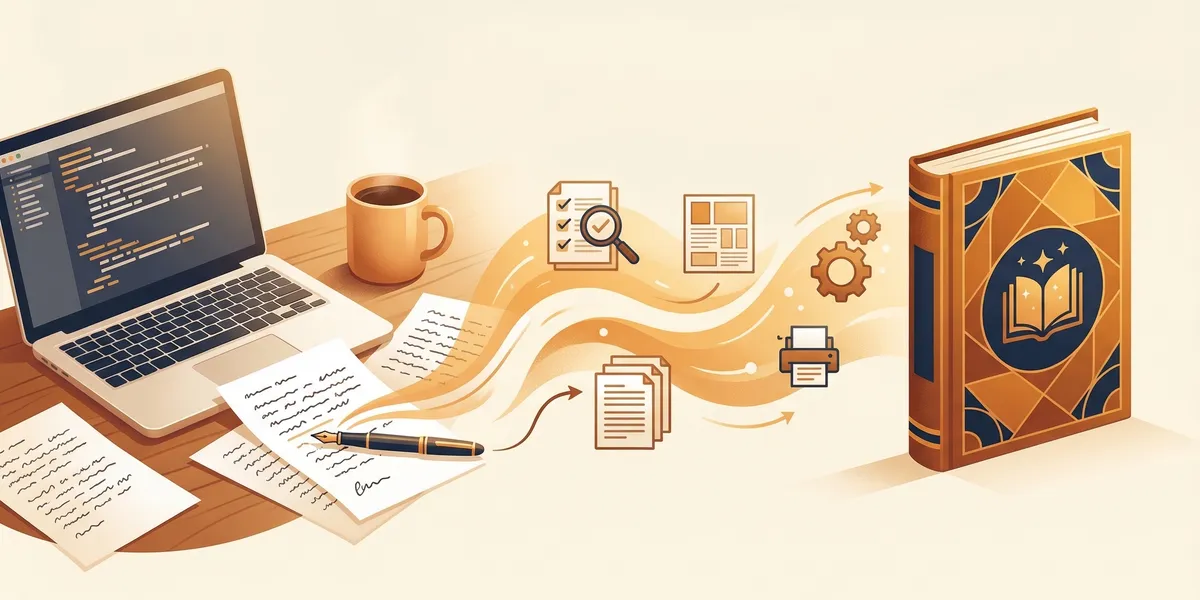
You can absolutely write a book and get it published — and in 2026, you have more paths to publication than at any point in history. Over four million books were published in the United States in 2025 alone, with self-published titles accounting for more than 3.5 million of them. Whether you pursue a traditional publishing deal or publish independently, the process starts the same way: with a finished manuscript worth reading.
This guide walks you through the entire journey, from the first spark of an idea to holding a published book with your name on it.
What this guide covers
- Find and validate your book idea
- Plan and outline your book
- Write the first draft
- Revise and self-edit
- Hire a professional editor
- Choose your publishing path
- Traditional publishing: how it works
- Self-publishing: how it works
- Design your book cover
- Format your interior
- Distribute and sell your book
- Launch and market your book
- FAQ
Find and validate your book idea
Every book starts with a question: what do I want to write about, and who will want to read it?
For nonfiction, your idea needs to solve a specific problem for a specific reader. A book on “business” is too broad. A book on “how freelance designers can land their first five clients” is focused enough to attract a real audience. Browse Amazon’s bestseller lists in your category, read the one-star reviews of competing titles, and look for gaps you can fill.
For fiction, the idea should excite you enough to sustain months of writing. Test your concept by writing a one-paragraph pitch. If you can clearly state who the main character is, what they want, and what stands in their way, you have the foundation for a story. If you cannot explain it simply, the idea may need more development.
Validation does not require a crystal ball. Check how many books already exist in your niche (competition means there are buyers), search for relevant keywords on Amazon, and talk to people in your target audience. The goal is not to confirm a bestseller — it is to confirm that someone besides you wants this book to exist.
Plan and outline your book
Sitting down to write a book without a plan is the fastest route to abandoning it at chapter four. An outline gives you a map.
For nonfiction, list every question your reader needs answered, then arrange those questions into a logical sequence. Each question becomes a chapter. Each chapter should stand on its own while building toward the book’s larger promise. Our book outline guide breaks this process down step by step.
For fiction, sketch your major plot points before you write scenes. At minimum, know your opening situation, the central conflict, the midpoint shift, the climax, and the resolution. You do not need to outline every scene — some writers prefer to discover details as they draft — but knowing the structural landmarks keeps you from writing 40,000 words into a dead end.
If outlining feels overwhelming, AI tools can help you build a structure quickly. Chapter generates complete book outlines based on your concept, letting you reorganize and refine before you write a single chapter. Over 2,147 authors have used it to structure and draft more than 5,000 books.
Write the first draft
The first draft is where most aspiring authors stall. The solution is simpler than it sounds: write consistently, and lower your standards.
Set a daily word count. Even 500 words per day produces a 45,000-word manuscript in three months. A pace of 1,000 words daily gets you a full-length book in under two months. Block the same time each day, silence your phone, and write. Consistency beats inspiration every time.
Write forward, not backward. Do not stop to edit what you wrote yesterday. The draft is raw material. Rewriting mid-draft is the primary reason books take years instead of months. Give yourself permission to write badly — you will fix it later.
Use tools that match your workflow. Some writers use Scrivener or Google Docs. Others use AI-assisted tools to move faster without sacrificing their voice.
Our Pick — Chapter
Chapter.pub helps authors draft full-length books chapter by chapter with AI assistance. You provide the direction, outline, and voice — Chapter handles the heavy lifting of getting words on the page. It works for both nonfiction and fiction, and authors have used it to create over 5,000 books.
Best for: Authors who want to finish a complete manuscript in weeks instead of months Pricing: $97 one-time (nonfiction) | Varies (fiction) Why we built it: Because the hardest part of publishing a book is finishing the writing — and most people never do.
For a detailed breakdown of the entire writing process, read our full guide on how to write a book.
Revise and self-edit
Once the draft is done, step away for at least one to two weeks. Distance gives you fresh eyes.
When you return, focus on three revision passes:
Pass 1 — Structure. Read the entire manuscript and ask: Does the book deliver on its promise? Are chapters in the right order? Is anything missing or redundant? For fiction, check pacing. For nonfiction, check whether each chapter actually answers the question it claims to address.
Pass 2 — Clarity. Go chapter by chapter. Cut sentences that repeat the same point. Replace vague language with specific details. Delete filler words like “really,” “very,” “just,” and “actually.” Read dialogue aloud to check whether it sounds natural.
Pass 3 — Polish. Fix grammar, spelling, and punctuation. Check formatting consistency (heading styles, list formatting, chapter titles). Ensure names, dates, and facts are accurate throughout.
Self-editing will not replace professional editing, but it dramatically improves the manuscript your editor receives — and saves you money on their time.
Hire a professional editor
Professional editing is not optional if you want a published book readers take seriously. Even experienced authors have blind spots.
There are four main types of editing, and you may not need all of them:
| Editing Type | What It Covers | Typical Cost (80K words) |
|---|---|---|
| Developmental edit | Structure, plot/argument, pacing, character | $3,200–$5,600 |
| Line edit | Sentence-level style, voice, flow | $3,500–$7,000 |
| Copyedit | Grammar, consistency, syntax | $1,600–$3,100 |
| Proofread | Final typos, formatting errors | $960–$1,500 |
Rates based on 2026 Editorial Freelancers Association survey data.
Most self-published authors need at minimum a copyedit and proofread. If you are unsure about your book’s structure, a developmental edit is worth the investment. You can find vetted editors through Reedsy, the EFA directory, or by asking for referrals from other authors.
For a deeper look at structural editing specifically, see our guide on developmental editing.
Choose your publishing path
This is the biggest decision you will make after writing the book. There are two primary routes, and each has legitimate advantages.
| Factor | Traditional Publishing | Self-Publishing |
|---|---|---|
| Time to publication | 1–3 years after finding an agent | 2–8 weeks after final edits |
| Upfront cost to author | $0 (publisher pays) | $500–$5,000+ (editing, cover, formatting) |
| Royalty rate | 8–15% print, up to 25% ebook | 35–70% depending on platform |
| Creative control | Limited (publisher decides cover, title, pricing) | Complete |
| Distribution | Bookstores, libraries, major retailers | Primarily online, with print-on-demand options |
| Advance payment | $5,000–$50,000 typical for debut | None |
| Acceptance rate | Under 1% for unsolicited manuscripts | Anyone can publish |
Choose traditional publishing if you want bookstore placement, do not mind waiting years, want an advance payment, and are willing to query agents and handle rejection.
Choose self-publishing if you want speed, higher royalties per sale, full creative control, and are willing to invest in professional production yourself.
Many successful authors do both. The Alliance of Independent Authors reports that median indie author income reached $13,500 in 2025 — higher than the typical traditionally published author’s earnings of $6,000–$8,000.
Traditional publishing: how it works
If you choose the traditional route, here is the typical path:
Write a query letter
A query letter is a one-page pitch to literary agents. It includes your book’s genre, word count, a brief synopsis (not the ending), comparable titles, and a short author bio. Jane Friedman’s query letter guide is the gold standard resource for learning this format.
Keep the letter under 400 words. Your goal is to make the agent request your full manuscript — not to tell the whole story.
Find and query agents
Research agents who represent your genre using QueryTracker or agent wish lists on social media. Send personalized queries — never mass emails. Most agents respond within 4–12 weeks, and rejection is the norm. Many successful authors queried 50 to 100 agents before landing representation.
The submission and deal process
Once an agent signs you, they submit your manuscript to editors at publishing houses. If an editor wants the book, they make an offer. Your agent negotiates the contract, including advance, royalty rate, rights, and publication timeline.
From signed deal to published book typically takes 12–24 months. The publisher handles editing, cover design, interior layout, printing, and distribution. You will have input on some decisions but not final say on most.
For authors writing nonfiction, you will need a book proposal before querying agents — typically submitted instead of a full manuscript.
Self-publishing: how it works
Self-publishing puts you in charge of the entire process, but that also means you are responsible for quality. Here is the step-by-step path:
- Finish and edit your manuscript (see sections above)
- Design a professional cover (see next section)
- Format your interior for ebook and print
- Upload to publishing platforms (Amazon KDP, IngramSpark, etc.)
- Set your price and categories
- Launch and market
The biggest advantage of self-publishing is speed and royalties. You can go from finished manuscript to published book in two to eight weeks. Amazon KDP pays 35–70% royalties on ebooks compared to the 8–25% typical in traditional deals.
The biggest risk is cutting corners on quality. Readers do not care how your book was published — they care whether it reads well and looks professional. Invest in editing and cover design, or your book will struggle regardless of how good the writing is.
For the complete self-publishing walkthrough, see our how to self-publish a book guide.
Design your book cover
Readers judge books by their covers — literally. Your cover is the single most important marketing asset your book has.
For traditional publishing, the publisher’s design team handles the cover. You will see options and give feedback, but the publisher typically has final say.
For self-publishing, you need to hire a professional cover designer or use a specialized tool. Expect to pay $300–$1,500 for a professional custom cover. Budget options exist through pre-made cover marketplaces, but a generic cover in a competitive genre will hurt sales.
What makes a strong cover:
- Genre-appropriate design. Romance covers look different from thrillers, which look different from business books. Study the top sellers in your category and match the visual language readers expect.
- Readable at thumbnail size. Most readers first see your cover as a small image on a screen. If the title is unreadable at that size, the design needs work.
- Professional typography. Amateur font choices are the fastest way to signal an amateur book. Hire a designer who understands type.
For AI-assisted cover design options, check our roundup of AI book cover generators.
Format your interior
Interior formatting determines how your book looks on the page or screen. Poor formatting — inconsistent margins, wrong font sizes, broken page breaks — screams “self-published” in the worst way.
Ebook formatting requires your manuscript to be converted to EPUB and/or MOBI format. Most publishing platforms accept EPUB files, and Amazon’s KDP can convert from Word documents (though dedicated formatting produces cleaner results).
Print formatting requires proper trim size, margins, gutters, headers/footers, page numbers, and front/back matter. Standard trim sizes for most genres are 5” x 8,” 5.5” x 8.5,” or 6” x 9.”
Tools for formatting include:
- Vellum (Mac only) — The industry favorite for both ebook and print formatting
- Atticus — Cross-platform alternative to Vellum
- Amazon KDP’s free formatting tools — Basic but functional
- Chapter.pub — Exports formatted manuscripts ready for publication
For a detailed walkthrough of Kindle formatting specifically, see our guide on how to format a book for Kindle.
Distribute and sell your book
Where your book is available determines who can buy it.
Amazon KDP dominates with roughly 65–70% of the ebook market. Publishing on KDP is free, and you can publish both ebook and paperback editions. You will choose between KDP Select (exclusive to Amazon, access to Kindle Unlimited) or going wide on multiple platforms.
IngramSpark is the primary route to get your print book into bookstores and libraries. Ingram is the largest book distributor in the world, and their print-on-demand service means you do not need to order thousands of copies upfront.
Other platforms include Apple Books, Barnes & Noble Press, Kobo, and Google Play Books. Aggregators like Draft2Digital can distribute to multiple platforms from a single upload.
Going wide vs. staying exclusive is one of the biggest strategic decisions in self-publishing. Amazon exclusivity through KDP Select gives you access to Kindle Unlimited readers (a significant revenue source in genres like romance and sci-fi), but locks your ebook out of every other store for 90 days at a time. Going wide sacrifices that KU income for broader reach and reduced platform dependence.
For a full comparison of where to publish, read our guide to the best self-publishing platforms.
Launch and market your book
Publishing your book is not the finish line — it is the starting line for sales. Even traditionally published authors are expected to actively market their work.
Before launch:
- Build an email list (even a small one matters more than social media followers)
- Set up an author website
- Line up advance readers for reviews
- Prepare your Amazon listing with strong descriptions, categories, and keywords
During launch week:
- Coordinate a price promotion or free period (for ebooks)
- Ask advance readers to post reviews on launch day
- Announce on every platform where you have an audience
- Consider Amazon ads to boost visibility in your category
After launch:
- Keep writing. The single best marketing tool for any book is the next book.
- Run periodic promotions and experiment with pricing
- Engage with readers who leave reviews or reach out
- Track which marketing channels produce actual sales, not just clicks
For more on book marketing strategy, see our guides on how to market a self-published book and Amazon ads for authors.
Realistic timeline
How long does it actually take to go from idea to published book? Here is a realistic breakdown:
| Phase | Traditional Publishing | Self-Publishing |
|---|---|---|
| Planning and outlining | 2–4 weeks | 2–4 weeks |
| Writing the first draft | 3–6 months | 1–6 months (faster with AI tools) |
| Revision and self-editing | 2–4 weeks | 2–4 weeks |
| Professional editing | 2–6 weeks | 2–6 weeks |
| Querying agents | 6–18 months | N/A |
| Publisher process (editing, design, production) | 12–24 months | N/A |
| Cover design and formatting | Handled by publisher | 2–4 weeks |
| Upload and publish | Handled by publisher | 1–2 weeks |
| Total | 2–4 years | 3–9 months |
These are not guarantees. Some authors write faster, some slower. But the contrast between the two paths is stark. Self-publishing can take you from idea to published book in under six months. Traditional publishing rarely takes less than two years.
FAQ
How much does it cost to write and publish a book?
Writing itself costs nothing beyond your time. Self-publishing a professional-quality book typically costs $1,000–$5,000 for editing, cover design, and formatting. Traditional publishing costs the author nothing upfront — the publisher invests in production and pays the author an advance and royalties.
Can I publish a book with no money?
Yes, but quality will suffer. You can write for free, format using free tools, create a basic cover with Canva, and upload to Amazon KDP at no cost. However, skipping professional editing and cover design significantly reduces your chances of sales and positive reviews.
How many copies does the average book sell?
Most self-published books sell fewer than 250 copies. Most traditionally published books sell between 2,000 and 5,000 copies. These averages are skewed by the sheer volume of books published — authors who invest in quality and marketing consistently outperform these numbers.
Do I need a literary agent to get published?
For traditional publishing with a major publisher (Penguin Random House, HarperCollins, Simon & Schuster, etc.), yes — nearly all require agent submissions. Some smaller independent presses accept direct submissions. For self-publishing, you do not need an agent at all.
Is it better to self-publish or traditionally publish?
Neither is universally better. Traditional publishing offers prestige, bookstore distribution, and upfront advances. Self-publishing offers higher royalties, creative control, and speed. Your choice depends on your goals, timeline, and how involved you want to be in the business side. Many authors start with self-publishing to build an audience, then pursue traditional deals from a position of leverage.
Can AI help me write and publish a book?
Yes. AI tools like Chapter.pub can help with outlining, drafting, and structuring a full-length book. AI can also assist with cover design concepts, formatting, and marketing copy. The key is using AI as a tool to accelerate your process while maintaining your unique voice and vision. Over 5,000 books have been created using Chapter alone.
How long should my book be?
Word count depends on genre. Most novels run 70,000–90,000 words. Memoirs are typically 60,000–80,000. Business and self-help books range from 30,000–60,000. Children’s picture books can be under 1,000 words. Check the typical length for your specific category before finalizing your target.
What rights do I keep when I publish?
With self-publishing, you retain all rights. With traditional publishing, you typically license specific rights (print, ebook, audio, foreign) to the publisher for a set period. Read contracts carefully — some publishers request broad rights. An agent can help negotiate favorable terms.