A cliffhanger is an unresolved moment of tension at the end of a chapter, scene, or book that compels the reader to keep going. It is the reason someone reads “just one more chapter” at midnight and surfaces three hours later, bleary-eyed and sixty pages deeper. Here is how to write a cliffhanger that keeps readers turning pages — without frustrating them.
The 7 Types of Cliffhangers
Not all cliffhangers work the same way. Each type creates a different kind of tension, and the best writers rotate between them to keep the reader off-balance.
1. The Revelation
A piece of information drops that changes everything the reader thought they knew. The chapter ends the moment the revelation lands, before the characters — or the reader — can process its implications.
The letter was not from her mother. The handwriting belonged to the man they buried six years ago.
Revelation cliffhangers work because they create an instant, overwhelming need for context. The reader cannot stop because they need to understand what this new information means for everything they have already read.
2. The Danger
A character is placed in immediate physical peril. The chapter ends with the threat present but the outcome unknown. Will they survive? Will they escape? The reader has to turn the page to find out.
The floor gave way beneath her. She caught the edge with one hand, the darkness below swallowing her scream.
Danger cliffhangers are the most visceral type. They trigger the reader’s survival instinct on behalf of a character they care about. The simpler and more immediate the danger, the more effective the cliffhanger — complexity can wait for the next chapter.
3. The Decision Point
A character faces a choice with significant consequences, and the chapter ends before they choose. The tension is not physical but moral, emotional, or strategic. Two doors, and the reader does not know which one the character will walk through.
He held out the envelope. “Open it, and you can never go back.” She reached for it. Then stopped.
Decision cliffhangers work because they engage the reader’s judgment. The reader starts debating what the character should do, which means they are invested. They need to see the choice to test their own prediction.
4. The Disappearance
A character vanishes — physically, emotionally, or from the narrative. They were present, and now they are not. The absence itself is the cliffhanger.
The apartment was empty. Her coat was gone. The note on the table said only: “Don’t look for me.”
Disappearance cliffhangers create a vacuum. The reader fills the vacuum with worst-case scenarios, which is more powerful than any specific threat the author could describe. What the reader imagines is always worse than what the author states.
5. The Betrayal
A character the reader trusted does something that shatters that trust. The chapter ends with the betrayal revealed but its consequences unexplored.
She turned the corner and saw him — sitting across the table from the man he swore he had never met, laughing like they were old friends.
Betrayal cliffhangers are devastating because they attack the reader’s emotional investment. The reader trusted this character too. The need to understand why — and to see the fallout — is irresistible.
6. The Ticking Clock
A deadline is established, and the chapter ends with time running out. The character must achieve something before the clock strikes zero, and the reader does not know if they will make it.
Forty-seven minutes. That was all they had before the system reset and the evidence disappeared forever. She stared at the encrypted file. The progress bar read 12%.
Ticking clock cliffhangers create urgency. The reader feels the pressure alongside the character. The tension is not just about what will happen but about whether there is enough time for it to happen.
7. The Unanswered Question
The chapter ends by raising a question — directly or by implication — that the reader cannot answer without reading further. No immediate danger, no dramatic revelation. Just a question that burrows into the reader’s mind and will not let go.
“There’s one more thing you should know,” he said. “About the night your father died.”
Unanswered question cliffhangers are the most flexible type. They work at any point in the story, in any genre, and at any emotional temperature. The question itself is the hook.
Chapter-Ending vs Book-Ending Cliffhangers
These follow different rules, and mixing them up is a common mistake.
Chapter-Ending Cliffhangers
Use them frequently. Every chapter ending is an opportunity to make the reader choose between sleep and your book. You do not need a cliffhanger at the end of every single chapter — some chapters earn a quieter close — but most chapters should end with some form of unresolved tension.
The key to chapter-ending cliffhangers is that you will resolve them. The reader trusts that the next chapter will address what just happened. This trust is what makes them willing to be left hanging — they know the payoff is pages away, not books away.
Vary the type. If every chapter ends with physical danger, the pattern becomes predictable and the effect dulls. Alternate between revelation, decision, danger, and unanswered question. Keep the reader guessing not just about the story, but about how the next cliffhanger will work.
Book-Ending Cliffhangers
Use them carefully. A book-ending cliffhanger asks the reader to wait months or years for resolution. That is a much bigger ask than “turn the page.”
The rules for book-ending cliffhangers in a series:
Resolve the book’s central conflict. A book-ending cliffhanger should not leave the main plot of this installment unresolved. The reader bought this book, read this book, and deserves this book’s story to reach a conclusion. The cliffhanger should introduce a new threat, question, or complication that launches the next book.
Make it feel like a beginning, not an interruption. The difference between a satisfying book-ending cliffhanger and a frustrating one is whether the reader feels the book ended or was simply cut short. End the book’s story, then open the next one with your final line.
Earn it with this book’s quality. A book-ending cliffhanger only works if the reader wants to read the next book. If this book was unsatisfying, the cliffhanger is not a hook — it is an annoyance. The reader will not buy book two to get closure. They will leave a one-star review about how book one was incomplete.
When to Use Cliffhangers
At chapter endings — this is the natural home of the cliffhanger. The white space between chapters is a decision point: keep reading or put the book down. The cliffhanger tips the scale toward reading.
At scene breaks — within a chapter, a cliffhanger at a scene break creates micro-tension that pulls the reader through the next scene.
Before point-of-view switches — in multi-POV novels, ending one character’s chapter on a cliffhanger before switching to another character creates compounding tension. The reader is now anxious about one character while following another. Game of Thrones uses this relentlessly.
At the midpoint — a strong cliffhanger at the story’s midpoint prevents the sagging middle that kills many novels. The midpoint twist resets the stakes and gives the second half its own momentum. This aligns with plot structure principles — the midpoint is where the story should shift.
Sparingly at the end of books — as discussed above. Use with care and only within a series.
How to Resolve a Cliffhanger
The resolution matters as much as the cliffhanger itself. A brilliant setup followed by a weak payoff is worse than no cliffhanger at all.
Do Not Cheat
The resolution must be earned. If a character is dangling from a cliff at the end of chapter twelve, they cannot be casually sitting in a coffee shop at the start of chapter thirteen with no explanation. The reader will feel betrayed.
Similarly, do not resolve a cliffhanger with a deus ex machina — an unexpected rescue, a coincidence, a new character who appears solely to fix the problem. The resolution should emerge from established elements: the character’s skills, previously introduced resources, or consequences of earlier choices.
Delay, Do Not Dodge
You can delay resolution by switching to another character’s point of view or another timeline. This is effective — it extends the tension. But you must eventually return and resolve. Delaying is not the same as dodging. If the reader never gets the resolution, the cliffhanger becomes a broken promise.
Let the Resolution Create New Tension
The best resolutions do not simply answer the cliffhanger’s question — they raise new ones. The character escapes the danger, but in doing so reveals a secret. The betrayal is confronted, but the explanation is worse than the reader imagined. Each resolution seeds the next escalation, creating the rising action that drives the story forward.
Famous Cliffhangers
Breaking Bad — Vince Gilligan ended nearly every episode with a cliffhanger, rotating between types with precision. The danger cliffhanger of Hank discovering Gale’s notebook with Walt’s handwriting. The revelation cliffhanger of the lily of the valley plant. The ticking clock of the train heist. Each type created different tension, keeping the audience perpetually off-balance.
Harry Potter — J.K. Rowling was a master of chapter-ending cliffhangers. Harry Potter chapter endings frequently use the revelation type: a name is spoken, a connection is made, a previously trusted character does something suspicious. The cliffhangers are small enough to resolve quickly but compelling enough to prevent the reader from stopping.
A Game of Thrones — George R.R. Martin’s multi-POV structure means every chapter switch is a cliffhanger by default. The reader leaves one character’s crisis to enter another’s, creating layered, compounding tension. Ned’s arrest, Daenerys entering the pyre, Tyrion’s trial — each chapter ends at the moment of maximum uncertainty.
The Hunger Games — Suzanne Collins ends chapters with relentless frequency on cliffhangers. The tracker jacker hallucination. The rule change announcement. Peeta’s berry gambit. The first-person present tense amplifies the effect — the reader experiences the cliffhanger in real time with Katniss.
Common Mistakes
Overuse. If every chapter ends with someone dangling from a cliff (literal or metaphorical), the effect numbs. The reader stops feeling urgency because the pattern is too predictable. Vary your chapter endings — some should resolve quietly, some should build, some should punch. The cliffhangers hit harder when they are not constant.
Fake-out cliffhangers. Ending a chapter on what appears to be a fatal danger, then opening the next chapter with “it was just a dream” or “actually, she was fine.” This is the fastest way to destroy reader trust. One fake-out teaches the reader that your cliffhangers are not real stakes. They will stop caring.
Never resolving. Serialized stories — particularly web fiction and ongoing series — sometimes introduce cliffhangers that are never addressed. The character disappears and is never found. The question is asked and never answered. Every cliffhanger is a contract with the reader. Break enough contracts, and the reader leaves.
Predictable placement. If every chapter is exactly ten pages and every chapter ends on a cliffhanger, the reader sees the mechanics. Vary your chapter lengths. Let some chapters end at six pages and others at fifteen. The irregular rhythm makes cliffhangers land harder because the reader does not see them coming.
Mistaking shock for tension. A character dying suddenly is not automatically a cliffhanger. Shock fades. Tension lingers. The best cliffhangers leave something unresolved — a question, a threat, a choice — that keeps working on the reader’s mind even after they close the book.
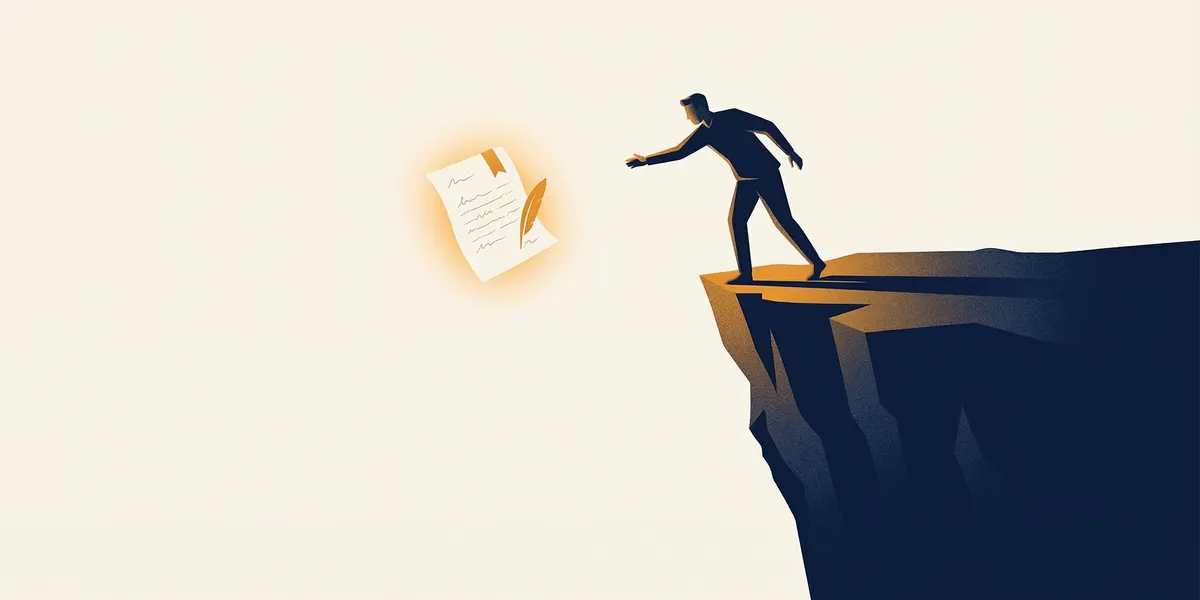
A cliffhanger is not a trick. It is a promise: keep reading, and this will be worth it. Make that promise honestly, deliver on it consistently, and your readers will follow you to the end of every chapter, every book, and every series. The edge of the cliff is where the story lives. Write the twist they did not see coming, the question they cannot stop thinking about, the danger they need to see resolved — and then stop. Let the white space do its work.