Writing a college textbook is one of the most impactful things a professor or subject matter expert can do — and one of the most financially rewarding publishing projects in academia. A successful textbook generates royalties for years, establishes you as a definitive authority in your field, and shapes how thousands of students learn your subject.
In this guide, you’ll learn:
- How to decide if your textbook idea has market potential
- The proposal process for academic publishers
- How to structure textbook content for effective learning
- What publishers expect in terms of ancillary materials
- Your publishing options: traditional academic press vs. self-publishing
Here’s how the textbook writing process works.
Is There a Market for Your Textbook?
Before investing 1-3 years in writing, validate demand.
Check Existing Textbooks
Search your subject on Amazon, publisher catalogs, and your campus bookstore. If there are already 15 popular textbooks covering your exact topic at the same level, the market may be saturated. But if existing books have gaps — outdated content, poor pedagogy, missing perspectives, or no coverage of emerging subfields — there’s an opening.
Talk to Colleagues
Ask professors at other institutions what textbook they use and what they wish existed. If you hear the same complaints repeatedly (“nothing covers X properly” or “they’re all too theoretical”), you’ve found your angle.
Define Your Differentiator
Successful textbook proposals answer: “Why does this book need to exist when [existing textbook] already covers this subject?” Your answer might be:
- A new pedagogical approach (problem-based, case-study driven, flipped classroom compatible)
- Coverage of emerging topics the field has outgrown existing texts on
- An interdisciplinary angle competitors don’t address
- A more accessible writing style for a specific student population
How to Write a Textbook Proposal
Academic publishers don’t accept finished manuscripts cold. They want a proposal first.
What the Proposal Includes
- Overview (2-3 pages) — Your book’s thesis, approach, and what makes it necessary
- Market analysis — Who will adopt this textbook and for which courses
- Competitive analysis — How your book differs from 4-6 existing texts
- Table of contents — Detailed chapter outline with brief descriptions
- Sample chapter — One complete chapter demonstrating your writing and pedagogy
- Author bio — Your credentials, teaching experience, and relevant publications
- Ancillary plans — Test banks, slides, instructor guides, online resources
Which Publishers to Approach
Major academic publishers by field:
- Sciences: Pearson, McGraw-Hill, Cengage, Wiley, Oxford University Press
- Humanities: Oxford University Press, Cambridge University Press, W.W. Norton
- Business: McGraw-Hill, Pearson, Cengage, SAGE
- Specialized fields: Check which publisher dominates your discipline’s textbook market
Submit to 2-3 publishers simultaneously unless their guidelines prohibit it.
How to Structure Textbook Content
Learning Objectives First
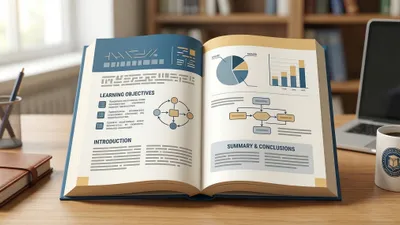
Every chapter starts with 3-5 clear, measurable learning objectives. These aren’t vague aspirations — they’re specific skills: “After this chapter, students will be able to calculate compound interest on variable-rate loans.”
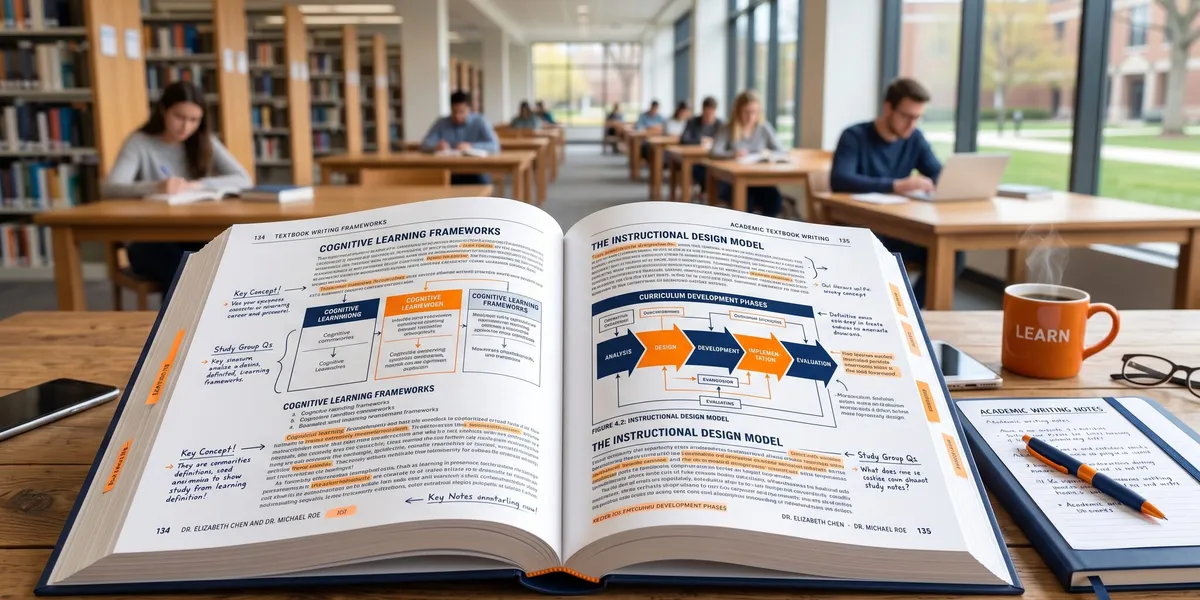
The Standard Textbook Chapter Structure
- Chapter opener — Real-world scenario or case study that hooks students
- Learning objectives — What students will accomplish
- Core content — Organized in 3-5 major sections with clear headings
- In-chapter features — Callout boxes, examples, self-check questions
- Visual aids — Figures, tables, diagrams that clarify concepts
- Chapter summary — Key takeaways aligned with learning objectives
- Review questions — Conceptual and application-level questions
- Practice problems — Homework-ready exercises with varying difficulty
Writing for Student Comprehension
- Define every term when first introduced. Bold it and include it in a glossary.
- Use examples before definitions. Show students what a concept looks like in practice before explaining the theory behind it.
- Write at the appropriate level. An intro textbook reads differently than an advanced one. Match your vocabulary and assumed knowledge to your target course.
- Include scaffolding. Each chapter should build on previous ones. Explicitly reference earlier material when building on it.
Ancillary Materials
Publishers increasingly require ancillary materials alongside the textbook. Plan for:
- Test bank — 50-100 questions per chapter (multiple choice, short answer, essay)
- Instructor’s manual — Teaching notes, suggested activities, discussion questions
- PowerPoint slides — Lecture-ready presentations for each chapter
- Online homework platform integration — Compatibility with publisher platforms
- Student resources — Practice quizzes, flashcards, supplementary readings
Ancillary development is significant work. Factor it into your timeline — it often takes as long as writing the textbook itself.
The Review Process
Academic textbook publishing includes rigorous peer review.
How It Works
- You submit your proposal
- The publisher sends it to 5-10 subject matter experts (usually professors)
- Reviewers evaluate content accuracy, market need, and pedagogical approach
- You receive feedback and revise
- After acceptance, you write the full manuscript
- Additional reviews occur during and after manuscript completion
Responding to Reviews
Treat reviewer feedback seriously even when you disagree. Write a detailed response explaining which suggestions you incorporated and why you declined others. Publishers value authors who engage thoughtfully with the review process.
Timeline and Compensation
How Long Does It Take?
| Phase | Duration |
|---|---|
| Proposal writing | 2-4 months |
| Review and revision | 3-6 months |
| Full manuscript writing | 12-24 months |
| Production (editing, design, proofing) | 6-12 months |
| Total | 2-4 years from start to publication |
What Do Textbook Authors Earn?
Textbook royalties typically range from 10-18% of net revenue (what the publisher actually receives, not the list price). On a $150 textbook with typical discounting:
- Net revenue per copy: ~$75-$100
- Author royalty per copy: ~$8-$18
- Annual adoptions of 2,000 copies: ~$16,000-$36,000/year
Successful introductory textbooks adopted at multiple institutions can earn $50,000-$200,000+ annually. Specialized upper-division texts sell fewer copies but often have less competition.
Self-Publishing a Textbook
Self-publishing is increasingly viable for college textbooks, especially in fields where OER (Open Educational Resources) momentum is strong.
Advantages
- Higher royalties (60-70% on Amazon KDP)
- Lower student costs (a competitive advantage for course adoption)
- Faster publication timeline
- Full control over updates and revisions
Disadvantages
- No publisher sales force visiting campuses
- No ancillary development support
- Less institutional prestige
- You handle editing, design, and production yourself
Our Pick — Chapter
Chapter helps nonfiction authors structure and write complex manuscripts with AI assistance. For professors writing textbooks, it accelerates the drafting process — turning lecture notes and course materials into organized chapters. Over 10,000 authors have used the platform.
Best for: Professors turning course expertise into structured manuscripts Pricing: $97 one-time
For more on academic and nonfiction publishing, see our guides on publishing nonfiction and writing a book about your profession.
FAQ
How do you write a college textbook?
Write a college textbook by first validating market demand and identifying gaps in existing texts. Submit a proposal with sample chapter to academic publishers. Structure chapters around clear learning objectives with examples, visuals, review questions, and practice problems. Budget 2-4 years from proposal to publication.
How much do college textbook authors make?
College textbook authors earn 10-18% royalties on net revenue. A textbook adopted at multiple institutions generating 2,000+ annual sales can earn $16,000-$36,000 per year. High-adoption introductory texts in popular subjects earn $50,000-$200,000+ annually. Royalties continue for as long as the book remains in print and adopted.
Can you self-publish a college textbook?
Yes, self-publishing a college textbook is increasingly viable through Amazon KDP and direct sales. Self-published textbooks offer lower student pricing (a competitive advantage for adoption), higher author royalties (60-70%), and faster updates. The trade-off is no publisher sales team and less institutional prestige.
How long does it take to write a college textbook?
Writing a college textbook typically takes 2-4 years from proposal to publication. The proposal and review phase takes 5-10 months, manuscript writing takes 12-24 months, and production takes 6-12 months. Active professors usually write during summers and sabbaticals, extending the timeline.