You can publish your dissertation as a book — and you don’t need to wait years to do it. Whether you pursue a university press, a commercial publisher, or self-publish, the process starts with one critical step: revising your dissertation into something readers actually want to read.
In this guide, you’ll learn:
- How to transform your thesis into a book manuscript that publishers want
- The step-by-step process for writing an academic book proposal
- Which publishing path fits your career goals (university press vs. self-publishing)
- How to handle copyright, embargoes, and previously published chapters
Here’s exactly how to go from defended dissertation to published book.
Is Your Dissertation Worth Turning Into a Book?
Not every dissertation should become a book. Before you invest months revising, answer three honest questions.
Does your topic have an audience beyond your committee? A book needs at least 500 potential readers — far more than the handful who read most dissertations. Search Amazon and Google Scholar for similar titles. If books on your topic exist and sell, that’s a strong signal.
Does your argument have broader significance? Dissertations prove you can do original research. Books need to say something that matters to a field. Your work should advance a debate, challenge a consensus, or offer a framework others can use.
Is your field one where books matter? In the humanities and social sciences, a published monograph is often essential for tenure. In STEM fields, journal articles carry more weight. Know your discipline’s expectations before committing to a two-year revision process.
If you answered yes to all three, your dissertation is book-worthy. If you’re unsure, talk to your advisor and a few senior colleagues in your department.
How to Turn a Thesis Into a Book: The Revision Process
A dissertation is not a book — and academic publishers know the difference immediately. Your committee wanted proof of rigorous methodology. Your readers want clear arguments and engaging prose.
Here’s what needs to change.
Cut the Literature Review
Your dissertation’s 40-page lit review proved you’d read everything. Your book doesn’t need that. Weave relevant scholarship into your argument naturally instead of front-loading it into a single chapter. Most successful dissertation-to-book revisions cut the lit review by 60-80%.
Restructure for Narrative Flow
Dissertations follow a predictable formula: introduction, literature review, methodology, findings, conclusion. Books don’t. Reorganize your chapters around ideas, themes, or a narrative arc that pulls readers forward. Each chapter should make a distinct argument that builds on the last.
Rewrite the Introduction
Your dissertation introduction stated a research question. Your book introduction needs to answer it — then spend the rest of the book showing how you got there. Lead with your argument, not your methodology. Tell readers what you discovered and why it matters in the first two pages.
Change Your Voice
Dissertations use hedged, cautious language (“this study suggests that perhaps…”). Books make confident claims. Remove the passive voice, cut the jargon, and write like you’re explaining your ideas to a smart colleague over coffee.
William Germano’s From Dissertation to Book — the definitive guide on this topic — recommends targeting around 100,000 words (roughly 300 pages including notes). Most dissertations need to be cut by 20-30%.
Use AI to Speed Up the Revision
Revising a dissertation into a book manuscript is one of the most tedious parts of the process. AI writing tools can help you restructure chapters, simplify dense academic prose, and identify sections that need cutting.
Our Pick — Chapter
Chapter’s AI writing assistant helps you transform academic manuscripts into readable book prose. Upload your dissertation chapters and use AI to restructure arguments, simplify language, and generate revised drafts while keeping your original research intact.
Best for: Academics revising dissertations into book manuscripts Pricing: $97 one-time (nonfiction) Why we built it: Turning research into published books shouldn’t take years of solo rewriting.
You can also use AI tools for writing book proposals to draft your submission materials faster.
How to Write an Academic Book Proposal
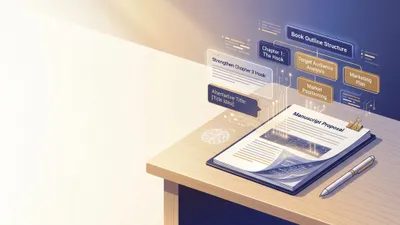
Your book proposal is the single most important document in the publishing process. A strong proposal can land a contract before you’ve finished revising — a weak one gets rejected regardless of how good your research is.
What Every Academic Book Proposal Needs
Most university presses expect these core elements:
- Working title and subtitle — Descriptive, not clever. Signal your topic, audience, and contribution clearly.
- Overview (1-3 pages) — What the book is about, why it matters now, and how it goes beyond your dissertation. This is your pitch.
- Chapter outline — A structured table of contents with 3-6 sentence summaries for each chapter. Show the arc of your argument.
- Target audience — Be specific. “Scholars of postcolonial literature” is better than “academics and general readers.”
- Competitive analysis — Name 3-5 similar books and explain how yours differs. Don’t say your book “fills a gap” — editors hear that constantly.
- Sample chapters — Usually your introduction and one strong middle chapter, revised in book voice. Two to three chapters is ideal.
- Your qualifications — A brief bio plus your CV.
- Technical details — Estimated word count, number of illustrations, timeline for completion.
Tips That Make Your Proposal Stand Out
Lead with your argument, not your topic. “This book examines nineteenth-century labor movements” is a topic. “This book argues that nineteenth-century labor movements invented the modern concept of work-life balance” is an argument. Editors want arguments.
Show you’ve already revised. Describe the specific changes you’ve made or plan to make. Editors know an unrevised dissertation when they see one — and they reject it.
Keep it under ten pages. Your proposal must be tight, polished, and error-free. A sloppy proposal signals a sloppy manuscript.
For a detailed framework, check out our nonfiction book proposal template or the book proposal template to get started quickly.
Choosing the Right Publisher for Your Dissertation Book
You have three main publishing paths. Each serves different goals.
University Presses (Best for Tenure and Academic Credibility)
University presses remain the gold standard for academic books — especially if you need the publication for tenure. They provide peer review, professional editing, and distribution to academic libraries worldwide.
Top university presses for dissertation-based books:
| Press | Strengths | Typical Timeline |
|---|---|---|
| Cambridge University Press | Global reach, rigorous peer review | 18-24 months |
| Oxford University Press | Prestige, extensive backlist | 18-24 months |
| University of Chicago Press | Strong in humanities and social sciences | 12-18 months |
| Duke University Press | Cultural studies, critical theory | 12-18 months |
| Stanford University Press | Interdisciplinary, digital humanities | 12-18 months |
How to approach them: Contact acquisitions editors at conferences or by email. Many prefer to be involved early — before you’ve finished revising — so they can guide your revisions. You can submit proposals to multiple presses simultaneously, but you can only submit the full manuscript to one press at a time.
Commercial Academic Publishers
Publishers like Routledge, Palgrave Macmillan, and Springer publish academic books outside the university press system. They typically have faster timelines and broader distribution but may carry slightly less prestige for tenure committees in some fields.
Self-Publishing Your Dissertation as a Book
Self-publishing gives you complete control over timeline, pricing, and distribution. You can have your book available in weeks rather than years. The tradeoff: self-published academic books typically don’t count toward tenure at most institutions.
Self-publishing makes sense when you:
- Have already earned tenure and want to reach a broader audience
- Work in a field where books aren’t required for advancement
- Want to publish a revised version alongside your traditionally published edition
- Need your research available quickly for policy or public impact
If you go this route, our complete self-publishing guide walks you through every step from manuscript to market. You can also explore the best self-publishing platforms to find the right fit.
Copyright, Embargoes, and Previously Published Chapters
Copyright is one of the most misunderstood parts of dissertation publishing. Here’s what you need to know.
You Own Your Dissertation’s Copyright
Under U.S. copyright law, you automatically own the copyright to your dissertation the moment you write it. Depositing with ProQuest doesn’t transfer your rights — you retain full ownership and can publish your work however you choose.
One critical exception: If your dissertation includes previously published journal articles as chapters, you may have transferred copyright for those articles to the journal publisher. Review every publishing agreement you’ve signed. You may need permission to reuse that material in your book.
For a deeper dive, read our guide on book copyright registration.
Should You Embargo Your Dissertation?
An embargo delays public access to your dissertation’s full text — typically for 6 months to 6 years. Many graduate schools offer this option specifically to protect future book publication.
Do you need an embargo? The evidence is mixed. A 2013 study found that over 90% of university presses will still consider a book based on an openly accessible dissertation. But some editors — particularly at top presses — do prefer working with embargoed manuscripts.
The safe play: If you plan to pursue a university press, request a 2-year embargo. It costs you nothing and removes a potential objection. If you’re self-publishing, an embargo is unnecessary.
Does Open Access Hurt Your Publishing Chances?
Short answer: probably not. Most academic publishers have stated that open access availability of a dissertation doesn’t disqualify a book manuscript — as long as the book represents substantial revision beyond the original dissertation. The key word is substantial. A lightly edited dissertation available for free online is a hard sell. A thoroughly revised book manuscript based on an openly available dissertation is a different product entirely.
How Long Does It Take to Publish Your Dissertation as a Book?
The timeline depends on your publishing path and how much revision your dissertation needs.
| Path | Revision Time | Publishing Process | Total Timeline |
|---|---|---|---|
| University Press | 12-18 months | 12-24 months (peer review + production) | 2-4 years |
| Commercial Academic Publisher | 12-18 months | 6-12 months | 1.5-2.5 years |
| Self-Publishing | 6-12 months | 1-3 months | 7-15 months |
For academics with full-time teaching loads, three to four years from defense to published book is typical for the university press route. Self-publishing can cut that timeline dramatically — especially if you use AI manuscript tools to accelerate the revision process.
How to Market Your Academic Book
Publishing your book is only half the work. You need readers to find it.
Build Your Author Platform Early
Start before your book is published. Create an author website, share your research on academic social media (especially Google Scholar and ResearchGate), and present at conferences where your target readers gather.
Write articles based on your book chapters. Publishing journal articles or op-eds that draw from your book creates multiple discovery paths. Each publication drives readers back to the book. Our book marketing plan guide covers the full strategy.
Leverage Your Institution
Your university’s press office, department newsletter, and alumni network are free marketing channels most academic authors ignore. Ask your department to announce the book. Request a brief feature in the alumni magazine. These audiences are already interested in your field.
Target Course Adoption
If your book is relevant to undergraduate or graduate courses, course adoption is where the real sales volume lives. Send desk copies to professors who teach relevant courses. Write a brief “how to use this book in class” guide. Contact publishers’ textbook reps.
For more strategies, explore our guide to book marketing for authors at every stage.
Common Mistakes When Publishing a Dissertation as a Book
Submitting an unrevised dissertation. This is the most common reason for rejection. Academic editors can identify a dissertation manuscript within the first five pages. Revise thoroughly before submitting.
Targeting the wrong publishers. Research each press’s catalog before submitting. If they don’t publish books in your field, don’t waste your time or theirs. Look at where scholars you admire have published.
Writing a proposal that describes your topic instead of your argument. Publishers want to know what your book argues, not just what it’s about. Lead every section of your proposal with your central claim.
Ignoring the audience question. “Everyone interested in my topic” isn’t an audience. Name specific courses that would assign it, professional organizations whose members would read it, and adjacent fields that might engage with it.
Waiting too long to start. The best time to begin revising is within a year of defending. Your ideas are fresh, your motivation is high, and you haven’t yet accumulated the teaching and service obligations that slow everything down.
How Much Does It Cost to Publish a Dissertation as a Book?
University press route: Generally free to the author. University presses cover editing, design, and production costs. You may need to pay for indexing ($3-5 per page, roughly $800-1,500 for a typical book) and any permissions fees for images or extended quotations.
Self-publishing route: Budget $2,000-5,000 for professional editing, cover design, formatting, and distribution setup. You can reduce costs significantly by using AI editing tools and book formatting software to handle tasks that would otherwise require hiring professionals.
Hybrid publishers: Charge $3,000-15,000+ for a package that includes editing, design, and distribution. Be cautious — some hybrid publishers are essentially vanity presses. Research thoroughly before signing anything. Our guide on how to get published covers how to evaluate different publishing models.
What Happens After Your Book Is Published?
Your book’s publication date isn’t the finish line — it’s the starting point for building your scholarly reputation around the work.
Pursue book reviews. Contact journal editors in your field and offer review copies. Academic book reviews drive library acquisitions, which drive sales. Most scholarly journals have a book review editor — find them and reach out directly.
Present at conferences. Propose panels and talks based on your book’s argument. Many academic presses will ship books to conference book exhibits if you coordinate with their marketing team.
Plan your next project. The best thing you can do for your first book’s sales is to start your second one. Each new publication raises your profile and drives readers back to your earlier work.
FAQ
How long does it take to turn a dissertation into a book?
Turning a dissertation into a book typically takes 2-4 years through a university press, including 12-18 months of revision and 12-24 months for peer review, editing, and production. Self-publishing reduces the total timeline to roughly 7-15 months since you control the revision and production schedule directly.
Can I publish my dissertation as a book without major revisions?
You generally cannot publish your dissertation as a book without substantial revisions. Academic publishers reject unrevised dissertations because they’re written for committees, not readers. You’ll need to cut the literature review, restructure chapters for narrative flow, rewrite the introduction with your argument upfront, and shift from cautious academic prose to confident book-length writing.
Does publishing my dissertation online hurt my chances with publishers?
Publishing your dissertation online through open access repositories generally does not hurt your chances with academic publishers. Over 90% of university presses will consider a book manuscript based on an openly available dissertation — as long as the book represents a substantially revised version that goes well beyond the original document.
How do I find the right academic publisher for my dissertation book?
To find the right academic publisher, start by examining where respected scholars in your field publish their books. Check university press catalogs for titles similar to yours. Attend academic conferences where press editors acquire new projects. Submit proposals to 3-5 presses simultaneously, but only submit your full manuscript to one press at a time.
Is it better to self-publish or use a university press for a dissertation book?
Whether to self-publish or use a university press depends on your career goals. If you need the publication for tenure or academic advancement, a university press provides the peer review and prestige that tenure committees expect. If you prioritize speed, control, and reaching a broader audience, self-publishing lets you get your book to market in months rather than years.