Cozy fantasy is fantasy without the world-ending stakes. No chosen ones fighting dark lords. No apocalyptic battles. Instead, cozy fantasy focuses on community, comfort, personal growth, and small-scale problems that still carry real emotional weight. If you want to write in fiction’s fastest-growing subgenre, this guide covers everything you need.
What Cozy Fantasy Actually Is
Cozy fantasy is a subgenre of fantasy where the stakes are personal rather than epic. The world is not ending. Nobody needs to defeat an ancient evil. Instead, the story centers on characters building a life, finding community, and navigating everyday challenges — just in a world where magic exists.
The key distinction: cozy fantasy is not low-effort fantasy. The “cozy” refers to the reading experience, not the writing process. These books require just as much craft as any other subgenre. The worldbuilding still needs to be sharp. The characters still need arcs. The plot still needs momentum.
What changes is the scale and the tone. A cozy fantasy protagonist might be opening a bakery in a town of retired adventurers, not saving the kingdom. The conflict comes from personal goals, relationships, and self-discovery rather than external threats.
Why Cozy Fantasy Is Exploding
Three forces are driving cozy fantasy’s rise.
Reader burnout on grimdark. After a decade of increasingly dark, violent, and nihilistic fantasy, readers are actively seeking the opposite. They want stories where the world is not terrible and people are generally kind. The pendulum has swung hard toward comfort.
The comfort read movement. Post-2020, “comfort reads” became a legitimate category. Readers started talking openly about wanting books that made them feel safe and warm. Cozy fantasy delivers exactly that — escapism without the stress.
BookTok and social media. Platforms like TikTok amplify cozy fantasy because these books are easy to recommend in short clips. “If you want a fantasy that feels like a warm hug” is a pitch that resonates instantly. Travis Baldree’s Legends & Lattes went from self-published to a Big Five deal largely through word-of-mouth on social media.
The Key Ingredients
Every cozy fantasy shares a set of core elements. Miss one and the book stops feeling cozy.
A Warm, Inviting Setting
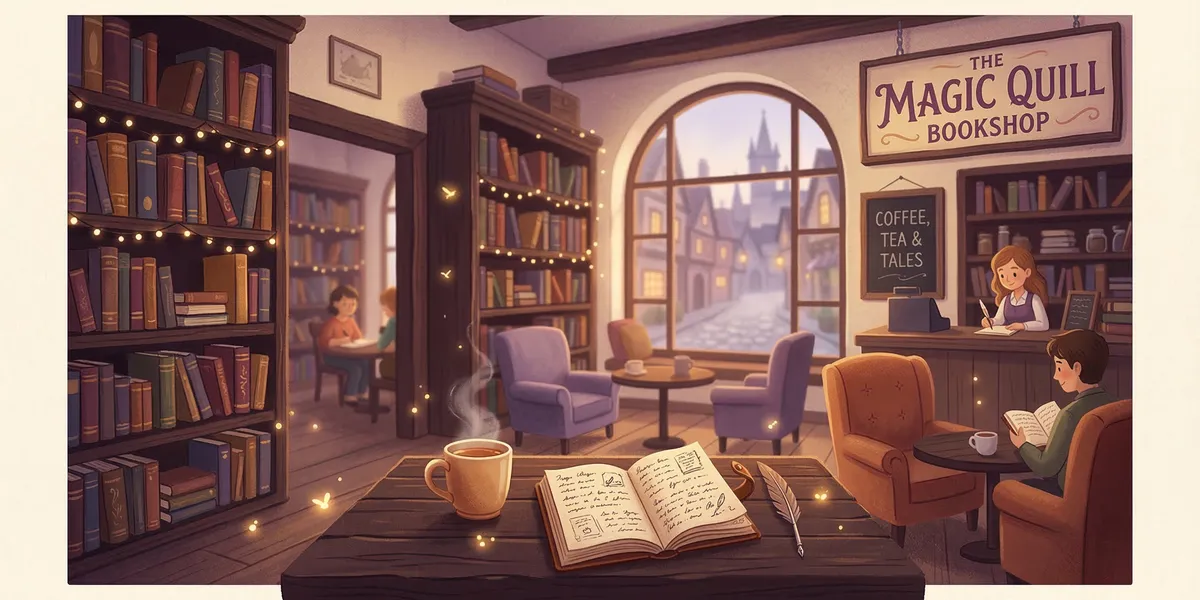
The setting in cozy fantasy is not just a backdrop — it is practically a character. The most successful cozy fantasies center on a specific place readers want to visit: a bakery, a bookshop, a tea house, a garden, a small village, a magical library.
Build the setting with sensory details that create warmth. The smell of fresh bread. The sound of rain on a thatched roof. The glow of enchanted lanterns at dusk. Readers should feel like they could curl up inside your world.
Found Family
Cozy fantasy thrives on relationships. Not romance necessarily (though romance is welcome), but the gradual building of a community. Strangers become friends. Rivals become allies. Lonely characters find their people.
This is often the emotional core of the entire book. The protagonist arrives somewhere new, meets a cast of quirky and kind characters, and slowly builds bonds that become the real stakes of the story. If those relationships are threatened, readers care — not because the world is ending, but because this small, warm community matters.
Low External Stakes, High Emotional Stakes
Nothing world-ending happens. Nobody dies in battle. But that does not mean the stakes are nonexistent.
The stakes in cozy fantasy are deeply personal. Will the protagonist’s café succeed? Will they repair a broken friendship? Will they find the courage to pursue what they actually want? Will they forgive themselves for a past mistake?
These stakes work because readers connect to them. Most people will never fight a dragon. Everyone has struggled with self-doubt, loneliness, or starting over.
Magic That Is Wondrous, Not Threatening
Magic in cozy fantasy is a source of wonder and delight, not danger. A spell that makes flowers bloom. A potion that changes the flavor of tea based on your mood. An enchanted broom that sweeps by itself (cheerfully, not ominously).
The magic system does not need to be hard or rigorously defined. Soft magic works perfectly here. What matters is that the magic enhances the cozy feeling rather than introducing tension or threat.
Gentle Pacing
Cozy fantasy moves at the speed of life, not the speed of action. Scenes breathe. Characters have conversations that are not just exposition dumps. A chapter might focus on a character learning a new recipe or taking a walk through the market.
This does not mean nothing happens. It means the pacing matches the tone. Readers picked up a cozy fantasy because they wanted to slow down — honor that.
Famous Examples to Study
Read widely in the subgenre before you write in it. These are the books that define cozy fantasy.
| Book | Author | Why It Works |
|---|---|---|
| Legends & Lattes | Travis Baldree | An orc barbarian retires to open a coffee shop. The blueprint for modern cozy fantasy. |
| The House in the Cerulean Sea | T.J. Klune | Found family at its finest. A bureaucrat discovers joy at an orphanage for magical children. |
| A Psalm for the Wild-Built | Becky Chambers | A tea monk meets a robot in a post-industrial world. Philosophical and deeply gentle. |
| Under the Whispering Door | T.J. Klune | A ghost learns what it means to live. Warm, funny, and emotionally devastating in the best way. |
| Witchmark | C.L. Polk | Edwardian-inspired fantasy with a cozy mystery undercurrent. |
What to Avoid
Certain elements will break the cozy contract with your reader. If someone picks up a cozy fantasy and encounters any of these, they will feel betrayed.
- High body counts. If characters die violently, it is not cozy. Period.
- Grimdark tone. Cynicism, nihilism, and moral bleakness are the opposite of cozy.
- World-ending threats. If the fate of civilization hangs in the balance, you are writing epic fantasy.
- Graphic violence or horror. Cozy fantasy can have conflict, but not violence that makes readers flinch.
- Cruelty between main characters. Banter is fine. Genuine cruelty undermines the warmth.
This does not mean your story has no conflict. It means the conflict fits the tone. A rival baker trying to steal your customers is conflict. A dark sorcerer trying to destroy the village is not cozy conflict.
Structure: It Is Not Plotless
The biggest misconception about cozy fantasy is that it does not need a plot. It does. The plot is just internal and relational rather than external and action-driven.
A strong cozy fantasy plot structure follows a pattern like this:
- Arrival or new beginning. The protagonist starts something new — a business, a move, a fresh chapter of life.
- Building connections. They meet the community and form relationships.
- The obstacle. Something threatens what they are building. Not a villain necessarily, but a genuine problem. Financial trouble. A misunderstanding. A painful piece of their past resurfacing.
- Deepening bonds. The community rallies. Relationships are tested and strengthened.
- Resolution. The problem is solved through connection, kindness, and personal growth — not through fighting.
The emotional arc matters more than the plot arc. Your protagonist should end the story as a different person than they started — more confident, more connected, more at peace.
Common Mistakes
No plot at all. Vibes are not a substitute for story. Your character needs to want something and face obstacles to getting it. “A person hangs out in a nice place” is a mood board, not a novel.
Accidentally writing high fantasy with a café. If your cozy bakery story has an assassin subplot, a prophecy, and a war brewing on the horizon, you are not writing cozy fantasy. You are writing epic fantasy with a cozy setting. Readers will notice the tonal mismatch.
Flat characters. Because the stakes are personal, the characters need to be exceptionally well-drawn. In epic fantasy, a weak character can be carried by plot momentum. In cozy fantasy, the characters ARE the story. Give them depth, flaws, and genuine character development.
Making it saccharine. Cozy does not mean nothing bad ever happens. It means the tone remains warm and the story ultimately trends toward hope. Characters can struggle, feel sad, argue, and face real problems. What they cannot do is suffer grimdark-level trauma in a book marketed as cozy.
Ignoring the “fantasy” half. The magic and worldbuilding still need to be interesting. “Contemporary life but with one minor spell” is not enough. Build a world readers want to inhabit. The fantasy elements should enhance the coziness, not be an afterthought.
FAQ
How long should a cozy fantasy novel be? Most cozy fantasies fall between 60,000 and 90,000 words. Shorter than epic fantasy, but long enough to build the world and relationships. Legends & Lattes is about 75,000 words — a solid target.
Can cozy fantasy have romance? Absolutely. Many cozy fantasies include a romance subplot, and some are primarily romance with a cozy fantasy setting. The romance should match the gentle tone — slow burn works better than instant passion.
Does cozy fantasy sell? Yes. The subgenre has exploded in both traditional and self-publishing. Legends & Lattes spent weeks on the New York Times bestseller list. T.J. Klune’s books consistently chart. Publishers are actively acquiring cozy fantasy.
Can I write a cozy fantasy series? Cozy fantasy is ideal for series. Readers fall in love with the setting and characters and want more time in that world. Both standalone sequels (same world, different characters) and continuing series work well.
Cozy fantasy rewards writers who can create worlds readers never want to leave. The genre is wide open and growing fast. If you have a story about a magical place where good people build something together, you are sitting on exactly what readers are looking for.
Writing a full cozy fantasy novel is a big undertaking, but Chapter can help you develop your world, outline your plot, and draft your manuscript — from that first warm scene to the satisfying final page.