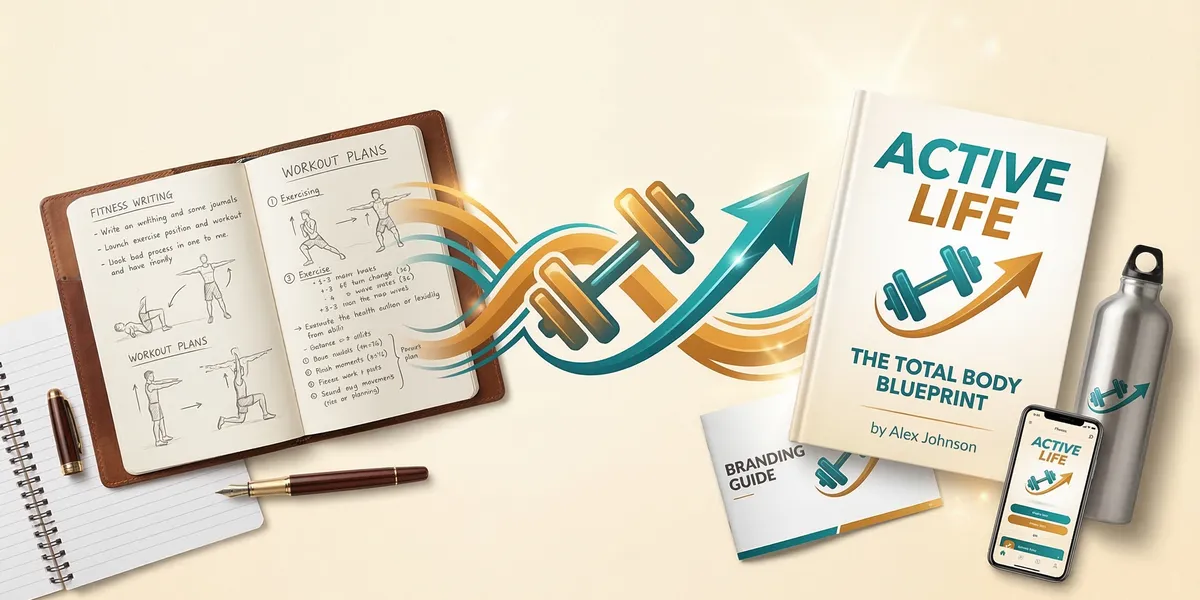
A fitness book turns your training expertise into something that works while you sleep. If you have a methodology that gets results, putting it into a book gives you authority, passive income, and a client funnel that never stops running.
This guide covers how to choose the right angle, structure your fitness book for maximum impact, handle the unique challenges of writing about exercise and nutrition, and publish it where your audience will find it.
Why fitness professionals need a book
Personal trainers, gym owners, and online coaches all face the same problem: your time is the bottleneck. You can only train so many people per day. A book breaks that ceiling in three ways.
Authority positioning. A published book separates you from every other trainer with an Instagram page. When a potential client sees “author of The 30-Day Strength Reset” in your bio, the conversation shifts. You are no longer competing on price. According to Forbes, coaches and consultants who publish books report significantly higher rates and client trust than those who rely on social media alone.
Passive income and lead generation. A $15 book on Amazon works as a permanent advertisement. Readers who finish your book and get results become warm leads for your premium coaching, online programs, and courses. The book pays for itself many times over, even before royalties.
Scalable impact. You can train 20 people a day. A book can reach thousands. If your methodology genuinely helps people, a book is the fastest way to get it into more hands.
Jim T., a consultant who used Chapter to write his book, landed a $13,200 client within days of publishing. The pattern is the same for fitness professionals: a book demonstrates expertise before you ever get on a sales call.
Choosing your angle
The fitness space is crowded. “Get fit” is not a book — it is a category. You need a specific angle that matches your unique expertise and speaks to a defined audience.
Your proprietary methodology. If you have developed a training system that gets consistent results, that is your book. Name it, systematize it, and teach it step by step. Think “The 5-3-1 Method” or “Metabolic Resistance Training for Women Over 40.”
A specific population. The more specific your audience, the easier the book sells. “Strength training for postpartum women,” “Mobility work for desk workers,” or “Athletic performance for high school basketball players” all carve out territory that a generic fitness book cannot touch.
A transformation story. If you or a client went through a dramatic physical transformation, that story becomes the hook. The book combines memoir elements with the practical program that produced the results.
A program people already ask about. If clients constantly ask you to write down what you do with them so they can follow it on their own, that is your book screaming to be written.
The key test: can you describe your book’s promise in one sentence? “This book will help [specific person] achieve [specific result] in [specific timeframe].” If you can fill in those blanks, you have a viable fitness book.
Structure that works for fitness books
Fitness books follow a particular rhythm that differs from other nonfiction. Your reader needs motivation, education, and a concrete program. Here is the framework.
| Section | Purpose | Example |
|---|---|---|
| The why | Motivate and establish your credibility | Your story, the science behind your approach, why this method works |
| The foundation | Teach the principles before the program | Movement fundamentals, nutrition basics, mindset preparation |
| The program | The actual workout plan | Week-by-week or phase-by-phase training program |
| The nutrition | Fuel the program | Meal frameworks, macro guidelines, sample meal plans |
| The mindset | Address the mental game | Consistency strategies, habit formation, dealing with setbacks |
| The 30-day plan | Tie it all together | A day-by-day action plan that combines workouts, meals, and habits |
Start with the why
Your first chapter answers two questions: why should the reader trust you, and why does this approach work? Share your background briefly — certifications matter less than results. If you have trained 500 clients and 480 of them hit their goals, say that. If you transformed your own body using this method, show that.
Then explain the science or philosophy behind your methodology. Not a textbook lecture — a clear, accessible explanation of why your approach produces results when others do not. The American College of Sports Medicine publishes evidence-based guidelines that can support your claims.
Build the program section carefully
This is the core of your fitness book and where most authors either shine or fail. Your workout programming needs to be:
- Progressive. Start where your reader actually is, not where you wish they were. Week 1 should feel achievable. Week 12 should feel like a stretch.
- Complete. Every workout needs sets, reps, rest periods, and tempo if relevant. Do not assume your reader knows what “3x8” means — spell it out the first time.
- Adaptable. Include modifications for beginners and progressions for advanced readers. A simple “Beginner / Intermediate / Advanced” column in your workout tables works well.
Handle nutrition without overstepping
Unless you are a registered dietitian, frame nutrition content as general guidelines rather than prescriptive meal plans. The Academy of Nutrition and Dietetics draws clear lines on scope of practice. Phrases like “here is what has worked for my clients” and “consult a registered dietitian for personalized nutrition advice” protect you legally while still delivering value.
Focus on frameworks rather than rigid plans: how to build a balanced plate, how to estimate portions without a food scale, how to adjust calories for training days versus rest days.
Formatting workouts and programs
Fitness books have unique formatting challenges. Workout tables, exercise descriptions, and program calendars need to be clear on the page.
Use tables for workout programming. A clean table with exercise, sets, reps, rest, and notes columns is the clearest format. Readers will photograph these pages or bookmark them.
Write exercise descriptions in a consistent format. For every exercise:
- Name of the exercise
- Equipment needed
- Setup position
- The movement (step by step)
- Common mistakes to avoid
- Modification and progression options
Include a master program calendar. A one-page overview showing what the reader does each week for the entire program duration. This becomes the most-referenced page in your book.
Consider a glossary. Terms like “superset,” “AMRAP,” “RPE,” and “deload” are second nature to you. They are foreign language to many readers. A glossary at the back of the book solves this without cluttering your chapters with definitions.
Photography and illustration
Fitness books benefit from visual instruction more than almost any other genre. You have several options.
Photographs. The gold standard for exercise demonstration. You do not need a professional studio — good natural lighting, a clean background, and a decent camera (even a phone) work. Show the start position, the midpoint, and the end position for each exercise.
Line drawings or illustrations. More affordable than photography and easier to reproduce in both print and digital formats. Services like Fiverr have illustrators who specialize in exercise diagrams.
No visuals. If your budget is tight, excellent written descriptions with common-mistake callouts can work. Many successful fitness books, especially those focused on programming rather than exercise instruction, use no images at all.
If you include images, keep them in a consistent style throughout the book. Mixing photos, illustrations, and stock images looks unprofessional. The National Strength and Conditioning Association exercise library is a good reference for how to demonstrate movements clearly.
Disclaimers and legal protection
Every fitness book needs a disclaimer page. This is not optional. A standard fitness book disclaimer includes:
- The content is for informational purposes only
- It is not a substitute for professional medical advice
- Readers should consult a physician before starting any exercise program
- The author and publisher are not liable for injuries
Have an attorney review your specific disclaimer language. The American Council on Exercise provides guidance on scope of practice that can help you understand where the lines are.
Beyond the disclaimer page, weave appropriate cautions into your content. If an exercise has higher injury risk, say so. If a nutrition strategy is contraindicated for certain conditions, mention it. This is not just legal protection — it is responsible coaching.
Publishing for your specific audience
Fitness books have more distribution channels than most nonfiction. Think beyond Amazon.
Amazon (print and Kindle). The obvious choice and the largest marketplace. A Kindle version lets readers access your book during workouts on their phone. A paperback gives you a physical product to sell at events and in your gym. The Kindle Direct Publishing platform makes self-publishing straightforward.
Sell at your gym or studio. If you have a physical location, stack copies at the front desk. A signed copy handed to a new member is a powerful onboarding tool.
Use it as a lead magnet. Offer a free digital copy in exchange for an email address. This builds your list for online program launches, supplement partnerships, and coaching offers. Learn more about this approach in our guide on using a book as a lead magnet.
Bulk sales to corporate wellness programs. Companies buy books in bulk for employee wellness initiatives. A fitness book positioned as a workplace wellness resource opens a revenue channel most authors never consider.
Bundle with online programs. Sell the book alongside a video library where readers can watch demonstrations of every exercise. The book provides the programming and the science; the videos provide the visual instruction.
Writing it faster than you think
Most fitness professionals delay writing their book because they imagine months of staring at a blank screen. The truth is that you already have the content — it is in your training programs, your client communications, and your head.
Chapter helps fitness professionals turn their methodology into a structured book of 80 to 250 pages in about an hour. You bring your expertise, your program design, and your unique approach. Chapter generates the structured draft. You refine the voice, add your specific workout tables, and customize the content for your audience. At $97 one-time, it removes the blank-page problem entirely.
The fitness professionals who sell the most books are not the best writers. They are the ones who actually publish.
Common mistakes to avoid
- Writing for other trainers. Your audience is the general public or your specific niche population, not exercise science graduates. Write for the person who does not know what a hip hinge is.
- Including too many exercises. A focused program with 15 to 20 core movements is more useful than an encyclopedia of 200 exercises. Depth beats breadth.
- Skipping the nutrition section. Readers expect it, even if it is brief. Leaving it out makes your book feel incomplete.
- No progression model. A static program that never changes is a magazine article, not a book. Show your reader how to progress over weeks and months.
- Forgetting the mindset component. The reason most fitness programs fail is not programming — it is adherence. Address the psychological barriers your readers will face.
FAQ
How long should a fitness book be?
Most fitness books land between 30,000 and 50,000 words (roughly 120 to 200 pages), not counting workout tables and images. A focused program book can be shorter — 20,000 words with extensive tables and visuals. Do not pad for length. If your program and explanation are complete at 25,000 words, that is the right length.
Do I need certifications to write a fitness book?
No certification is legally required to write a fitness book, but recognized credentials from organizations like NASM, ACE, or NSCA add credibility. If you lack formal certifications, lean heavily on your track record — years of experience, number of clients trained, and documented results carry significant weight with readers.
Should I include a meal plan?
Include a meal framework rather than a rigid meal plan, unless you are a registered dietitian. Show readers how to build balanced meals that support your program, provide sample days as illustrations, and recommend they consult a nutrition professional for personalized plans.
Can I use my fitness book to sell coaching?
Absolutely, and this is one of the primary reasons to write one. Include a call to action at the end directing readers to your coaching services, online programs, or website. A book reader who implements your program and sees results is the highest-quality lead you can get. For more on this strategy, see our guide on building authority with a book.
A fitness book takes what you already know and puts it to work at scale. Start with your methodology, structure it using the framework above, and get it published. For step-by-step guidance on the publishing process, see our complete guide on how to self-publish a book.