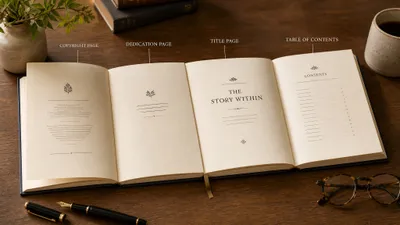
A foreword is a short endorsement written by someone other than the author — usually a respected expert or well-known figure — that vouches for the book and its author before the reader begins.
In this guide, you’ll learn:
- A simple, repeatable structure for writing a foreword that builds trust fast
- A fill-in-the-blanks foreword template you can adapt in an afternoon
- The exact difference between a foreword, a preface, and an introduction
- How long a foreword should be, who should write it, and common mistakes to avoid
Here’s how to write a foreword readers actually find credible.
What Is a Foreword in a Book?
A foreword is a short opening section written by someone other than the author — typically an expert, peer, or notable figure — that lends credibility to the book and explains why it matters.
The key detail is who writes it. A foreword is always written by a guest, not the author. That outside voice is the whole point: it’s a third party telling your reader, “This book is worth your time, and here’s why I trust the person who wrote it.”
Forewords sit in the front matter of a book, usually after the table of contents and before the author’s own preface. They’re most common in nonfiction — business books, memoirs, self-help, and academic titles — where a trusted endorsement carries real weight.
You’ll notice the word is foreword, not “forward” or “foreward.” It literally means the words that come before (fore) the main word (text). Spelling it correctly is the first sign you know what you’re doing.
How to Write a Foreword Step by Step
To write a foreword, introduce yourself and your connection to the author, explain why the book matters, share a personal story or insight, endorse the author’s expertise, and close by inviting the reader in. Keep it to one or two pages.
That’s the whole arc in one sentence. Below, each step is broken out with what to write and why it works.
Step 1: Open With a Hook, Not Your Résumé
Don’t start with “I am honored to write this foreword.” Every reader has seen that line a hundred times, and it tells them nothing.
Open with a story, a surprising claim, or a question that pulls the reader straight into the book’s subject. You want them curious before they even reach chapter one.
For example, a foreword to a book on resilience might open: “The first time I watched Maria walk back into the building that had nearly ended her career, I understood something about courage I’d missed for forty years.”
Step 2: Establish Your Connection to the Author
In two or three sentences, tell the reader who you are and how you know the author. This is what makes a foreword different from a blurb — it’s personal and specific.
Did you mentor them? Compete against them? Watch them solve a problem nobody else could? Your relationship is your credential. It explains why your endorsement should be believed.
Keep it human. “I’ve known David for fifteen years, and I’ve watched him talk struggling founders off ledges at 2 a.m.” beats “David is a thought leader in the startup space.”
Step 3: Explain Why This Book Matters Now
State clearly why the reader should care about this specific book at this specific moment. What gap does it fill? What problem does it solve that nothing else does?
This is where you make the case for the book’s value. Be concrete. Name the reader’s pain and promise that the pages ahead address it.
A line like “There are a hundred books on productivity. This is the first one I’ve read that admits most of them are wrong” does more work than a paragraph of praise.
Step 4: Vouch for the Author’s Credibility
Now endorse the person, not just the pages. Speak to the author’s expertise, character, or hard-won experience — the things a reader can’t verify on their own.
This is the emotional core of a foreword. You’re transferring your own credibility to the author. Readers trust you, so they extend that trust to them.
Be honest and specific. One genuine detail (“she rebuilt this method after it failed her in public”) is worth more than five generic superlatives.
Step 5: Close by Handing the Reader Over
End by stepping aside. Your job is to open the door, not to walk through it. A strong closing line invites the reader forward and gets out of the way.
Something like: “I’ll stop here, because the rest belongs to her. Turn the page — you’re in good hands.” Then sign off with your name, and optionally your title and the date.
Foreword Template (Copy and Adapt)
Use this template as scaffolding, then rewrite every line in your own voice. A foreword that sounds templated defeats the purpose.
[Hook] — Open with a short story, vivid image, or bold claim tied to the book’s theme.
[Connection] — “I first met [Author] when…” Explain your relationship and how long you’ve known them or their work.
[Why it matters] — “What you’re holding is…” Make the case for why this book is needed and what it does differently.
[Endorsement] — “If anyone is qualified to write this, it’s [Author], because…” Vouch for their expertise and character with a specific detail.
[Handoff] — “I’ll let [Author] take it from here…” Invite the reader in and step aside.
— [Your Name], [Your Title or Credential], [City, Year]
The whole thing should run 500 to 1,000 words. If you’re a guest writer drafting one for an author, ask them what they hope the foreword accomplishes before you start — it will sharpen every paragraph.
A Short Foreword Example (Annotated)
Here’s how the five steps come together in practice. This is a foreword for an imagined business book, The Quiet Pivot, written by the author’s former mentor.
I almost talked Jordan out of writing this book. [Hook]
When we first worked together in 2014, I told them the market was crowded and the timing was wrong. Eight years and three failed launches later, Jordan called me on a Tuesday to say the method finally worked — and that they’d been quietly rebuilding it the entire time. [Connection]
There are plenty of books that tell you to “embrace failure.” This isn’t one of them. This is a book about what you actually do on the Wednesday after everything falls apart, written by someone who lived every page of it. [Why it matters]
I’ve watched Jordan coach founders through their worst weeks for nearly a decade. What makes them rare isn’t optimism — it’s honesty. They will tell you the hard thing, and then they’ll help you fix it. That’s exactly what this book does. [Endorsement]
I’ll step aside now, because the rest is theirs. Read it slowly, and keep a pen handy. [Handoff]
— Sam Reyes, founder of Northlight Ventures, Austin, 2026
Notice what it doesn’t do: it never summarizes the book’s chapters, never lists generic praise, and never makes the writer the hero. It tells one true story, vouches for one real trait, and gets out of the way in under 200 words.
Foreword vs. Preface vs. Introduction
A foreword is written by someone other than the author, a preface is written by the author about the book’s backstory, and an introduction is written by the author about the book’s content. They are three different sections, not synonyms.
This is the single most confused point in book front matter, so here’s the clean breakdown:
| Section | Written By | Purpose |
|---|---|---|
| Foreword | Someone else (guest) | Endorses the book and author; builds trust |
| Preface | The author | Explains why and how the book was written |
| Introduction | The author | Sets up the book’s content and main argument |
A book can include all three, but most don’t. If you’re writing about your own book and your own journey, you want a preface or an introduction — not a foreword. A foreword only works when a different person writes it.
For the full sequence and where each piece sits, see the complete guide to the front matter of a book.
How Long Should a Foreword Be?
A foreword should be 500 to 1,000 words, or roughly one to two printed pages. Anything shorter feels like a blurb; anything longer starts competing with the book itself and risks losing the reader before chapter one.
The sweet spot is around 750 words. That’s long enough to tell one good story and make a genuine case for the book, but short enough that readers finish it and feel eager to continue rather than impatient to skip ahead.
If your draft is running long, cut the throat-clearing. Most overlong forewords spend their first two paragraphs explaining how honored the writer is. Delete those and start with the story.
Who Should Write the Foreword?
The ideal foreword writer is someone respected by your target reader who has a genuine connection to you or your subject. Credibility and relevance matter far more than raw fame.
Strong choices include:
- A recognized expert in your field whose name signals authority to your reader
- A mentor, colleague, or peer who can speak honestly about your work and character
- A bestselling author in your genre, if you have a real relationship with them
- A client or beneficiary whose results prove your method works (common in business and self-help)
A relevant micro-expert your readers respect beats a famous name with no connection to your topic. A wellness book endorsed by a trusted doctor outperforms one endorsed by a celebrity who’s never met you. Authenticity is the currency here.
When you approach someone, make it easy to say yes: explain why you chose them, offer to send the manuscript, suggest a word count, and give a clear deadline. Many guest writers will even ask you to draft a version they can edit — which is perfectly normal.
Do You Need a Foreword at All?
A foreword is optional — no publisher requires one, and plenty of successful books skip it entirely. It’s most valuable when you’re a newer author who needs borrowed credibility, or when a well-known endorser can meaningfully expand your audience.
If you’re well established in your field, your own author bio and track record may carry enough weight on their own. And if you can’t find someone whose endorsement is both genuine and relevant, no foreword is better than a hollow one.
For fiction, forewords are rare — readers want the story, not a preamble. They’re far more at home in nonfiction, where trust in the author directly affects whether the advice gets taken.
Common Foreword Mistakes to Avoid
Even experienced writers stumble on a few predictable traps. Watch for these:
- Making it about the writer, not the book. A foreword that’s really a victory lap for the endorser does nothing for the reader. Keep the spotlight on the book and author.
- Spoiling the content. Tease the book’s value; don’t summarize its conclusions. You’re the trailer, not the movie.
- Generic praise. “This is a must-read for anyone” is filler. Specific, honest detail is what builds trust.
- Going too long. Past 1,000 words, you’re stealing attention the book needs. Be generous with praise, stingy with length.
- Forgetting to sign off. A foreword needs the writer’s name — and ideally their title and credential — at the end. The signature is what gives the endorsement its weight.
Can AI Help You Write a Foreword?
Yes — AI writing tools can help you draft and structure a foreword, especially when you’re a guest writer staring at a blank page. The trick is to feed it real, specific details so the result sounds human, not generic.
If you (or your endorser) are drafting a foreword, tools like Chapter can turn a few honest notes — how you know the author, one memorable story, why the book matters — into a structured first draft you then rewrite in your own voice.
Our Pick — Chapter
Chapter is an AI book-writing platform built for nonfiction authors, with structured front-matter support that includes forewords, prefaces, and introductions. Give it your raw notes and it returns a draft in the right shape, ready for you to make it personal.
Best for: nonfiction authors and guest writers who want a strong first draft fast Pricing: $97 one time, 2 books included (fiction or nonfiction), 30-day money-back guarantee Why we built it: more than 10,000 authors have used Chapter to write and structure their books, and the front matter — including the foreword — is where many of them get stuck.
A word of caution: never let AI invent the personal connection or the story. Those have to be true. Use the tool for structure and flow, but the substance — the specific reasons you vouch for this author — has to come from you. That’s what makes a foreword believable.
FAQ
What is a foreword in a book?
A foreword in a book is a short opening section written by someone other than the author — usually an expert or notable figure — that endorses the book and lends it credibility. It appears in the front matter, before the author’s preface, and is most common in nonfiction. Forewords typically run 500 to 1,000 words.
What is the difference between a foreword and a preface?
The difference is who writes it and why. A foreword is written by someone other than the author to endorse the book and vouch for the author’s credibility. A preface is written by the author to explain the book’s backstory, scope, and how it came to be. A book can include both, placed back to back in the front matter.
How long should a foreword be?
A foreword should be 500 to 1,000 words, or about one to two printed pages, with roughly 750 words being ideal. It needs enough room for one good story and a genuine endorsement, but should stay short enough that readers finish it eager to start the book rather than impatient to skip ahead.
Who should write a foreword?
A foreword should be written by someone respected by your target reader who has a real connection to you or your subject — an expert, mentor, peer, or well-known author in your field. Relevance and credibility matter more than fame: a trusted micro-expert your readers know beats a celebrity with no link to your topic.
Is a foreword written by the author?
No — a foreword is never written by the author. It is always written by a guest, such as an expert or notable figure, which is precisely what gives it value as a third-party endorsement. If you want to write the opening section yourself, you need a preface or an introduction, both of which are authored by you.
Where does a foreword go in a book?
A foreword goes in the front matter of a book, typically after the table of contents and before the author’s preface or introduction. It comes near the start so readers encounter the endorsement before they begin the main text. For the full sequence, see our complete guide to book front matter.