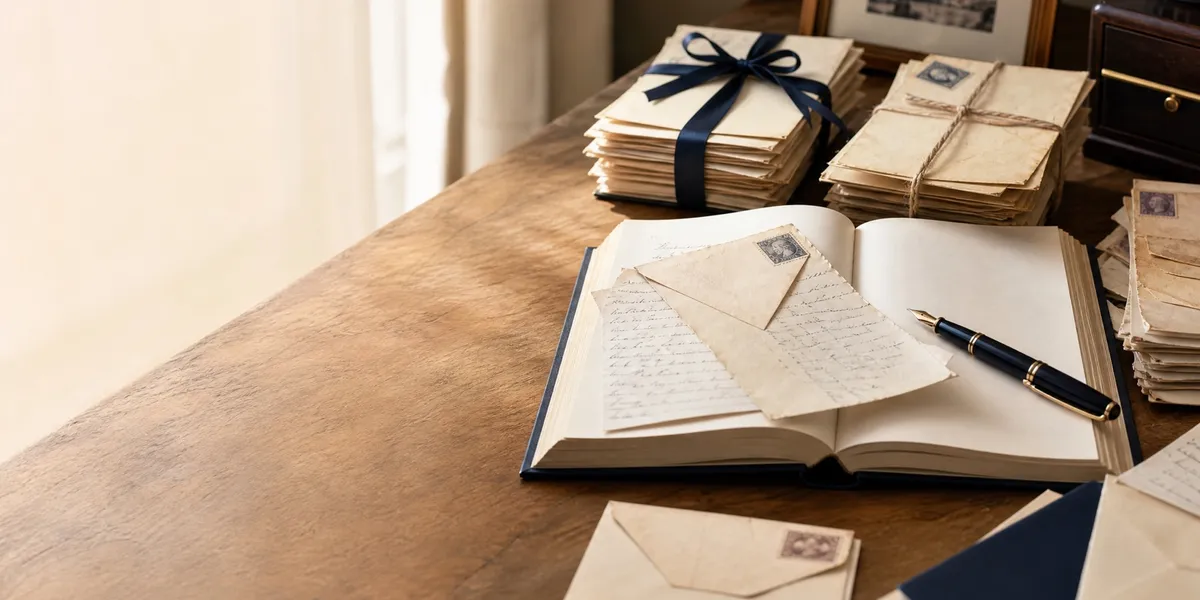
You can write a letter collection in two ways — by writing original letters to a specific person or audience, or by compiling letters that already exist into an edited book. Both are real publishing formats, and both come down to the same skill: selection.
In this guide, you’ll learn:
- The difference between an original letter book and a compiled letter collection
- How many letters you need and how to sequence them so the book has an arc
- How to write headnotes and connective tissue that make scattered letters read as one story
- Who actually owns the copyright in a letter (it is not who you think)
- How to format, print, and publish the finished collection
Here is the process, start to finish.
What Is a Letter Collection?
Letter collection — A book that gathers real letters by one or more writers and presents them as a single edited work, usually with an introduction, notes, and a deliberate sequence.
Unlike an epistolary novel, which invents letters to tell a fictional story, a letter collection belongs to nonfiction. Wikipedia’s definition of the form frames it as life writing: correspondence that has already served its original purpose, republished as a group.
The editor matters as much as the letter writer. Which letters go in, which get cut, what order they appear in, and what the notes tell you — all of that shapes how the collection reads.
That is the mindset shift most first-time compilers need. You are not transcribing. You are curating.
The Two Kinds of Letter Collection
Before you write a word, decide which book you are making. The workflows barely overlap.
| Original letter book | Compiled letter collection | |
|---|---|---|
| Source material | Letters you write now, for the book | Letters that already exist |
| Typical subject | Your child, your grandchildren, a future reader, a version of yourself | A family archive, a soldier’s wartime mail, a public figure’s correspondence |
| Main craft challenge | Sustaining voice and avoiding repetition | Selection, transcription, and permissions |
| Legal work required | Minimal — you wrote them | Significant — see the permissions section below |
| Common titles | Letters to My Daughter, Letters to You | The Letters of Sylvia Plath, Vincent van Gogh: The Letters |
Original letter books are the keepsake end of the market. Prompted journals like Letters to You, which gives parents one letter per year from ages one to eighteen, sell steadily because the format solves a real problem: people want to say things they cannot say out loud.
Compiled collections are archival. You are the editor of someone else’s voice, which brings both a craft duty and a legal one.
Some books are both. A grandmother’s wartime letters, compiled by her granddaughter, with new letters written back to her — that hybrid is one of the most publishable versions of this format, and almost nobody does it.
Step 1: Decide Who the Collection Is For
Every strong letter collection has an obvious reader. Vague ones die in the drafting.
Ask yourself one question: does this book exist to be read by the recipient, by a family, or by strangers?
A book for the recipient can be intimate and unexplained — she knows who Aunt Ruth is. A book for strangers needs context on every page, because the reader has no shared history to lean on.
That single decision determines your word count, your headnote length, and whether you need a family tree at the front. Get it wrong and you either over-explain to your own daughter or under-explain to a bookstore browser.
If you are writing for descendants rather than a general audience, the framing in our legacy book guide and ethical will writing guide will help you decide how much to spell out.
Step 2: Gather or Generate Your Raw Material
For a compiled collection, this is a physical job before it is a writing job.
Pull every box, album, and folder. Photograph or scan each letter at 300 DPI or higher before you handle it further — old paper does not survive repeated sorting. Then transcribe.
Transcribe more than you will use. A ratio of three collected letters to one published letter is normal, and it gives you the freedom to cut without gutting the book.
Log four fields for every letter as you go: writer, recipient, date, and place. Undated letters are the single biggest headache in this format, so date them by internal evidence (a mentioned birth, a stamp, a wartime posting) and mark your guesses as guesses.
For an original collection, generate material on a schedule instead. One letter a week for a year gives you fifty-two — plenty. Writing all of them in a single weekend produces fifty-two versions of the same letter.
Step 3: Choose Your Organizing Spine
The four standard structures for a letter collection are chronological, thematic, by recipient, and by occasion. Chronological is the default and creates a life arc. Thematic groups letters by subject and works better when the dates are patchy. Both can be combined by using themes as parts and chronology within them.
Here is how to choose:
- Chronological — Best when the letters span years and the writer visibly changes. This is why The Letters of Sylvia Plath runs in date order: the interest is in watching a voice develop.
- Thematic — Best when dates are missing or the appeal is subject-based (letters about grief, about work, about faith). Sections carry the structure instead.
- By recipient — Best when one writer corresponded with several distinct people. Each section becomes a relationship portrait.
- By occasion — Best for original collections. Birthdays, milestones, and hard days give you built-in prompts and a natural sequence.
Whichever you pick, apply the poetry-collection test: read the sequence straight through and ask whether the order creates an experience or just a list. Our poetry collection guide covers sequencing in more depth, and the principles transfer directly.
Vary intensity, too. Three devastating letters in a row will numb a reader. Put a short, funny, ordinary letter between them.
Step 4: Write the Connective Tissue
Raw letters do not make a book. The apparatus around them does.
A publishable letter collection needs four kinds of writing that are not letters:
- An introduction (1,500–3,000 words) explaining who the writer was, how you came to the letters, and what you are claiming the collection shows.
- Section or part introductions (200–500 words) setting up the period or theme that follows.
- Headnotes (30–80 words) before individual letters, giving the reader the one fact they need to understand it.
- Footnotes or endnotes identifying people, places, and events mentioned in passing.
Headnotes are where amateur collections fail. The rule is simple: supply what the original recipient already knew and the new reader does not.
A letter that opens “I’ve decided to go through with it” needs a headnote. A letter about the weather does not.
Keep your own voice out of the letters themselves. Argue in the introduction, explain in the headnotes, then get out of the way.
Step 5: Edit Without Silencing the Voice
This is the ethical center of the format, and there is a famous cautionary tale.
Before the scholarly edition existed, the only published Plath correspondence was Letters Home, selected and edited by her mother, Aurelia. Critics later found that she had cut expressions of anger and illness, and merged and misdated letters — reviewers accused the edition of silencing Plath’s voice.
The lesson is not that you must publish everything. It is that your cuts must be visible and honest.
Three rules keep you safe:
- Mark every omission. Use ellipses in brackets — […] — for cuts inside a letter, and say in the introduction what categories of material you removed and why.
- Never merge letters. Two letters presented as one is a fabrication, even when the words are all authentic.
- Fix silently only what does not change meaning. Standardizing a date format is fine. Correcting a spelling that reveals the writer’s education is an editorial choice you should disclose.
Handle living people with the same care you would in a memoir. Our guides to ethical memoir writing and memoir disclaimers apply almost unchanged here — a letter naming a living third party carries privacy and defamation exposure regardless of who owns the copyright.
Who Owns the Copyright in a Letter?
The writer of a letter owns the copyright, not the recipient. Owning the physical paper gives you the object, not the right to publish the words. To publish someone else’s letter, you generally need permission from the letter’s author or their estate — and in practice, from the recipient as well.
This is the step that stops most compiled collections, and almost nobody expects it.
Writer’s Digest lays it out plainly: a letter is copyrighted the moment it is written down, and that copyright belongs to the letter writer. The Society of American Archivists makes the same distinction — a donor owns copyright in letters they wrote, but not in letters they received.
Three consequences follow:
Archive access is not publication permission. Finding a letter in a university library gets you the text. It does not get you the right to print it, unless the writer assigned copyright to the library. The Association of University Presses permissions guidance is explicit that unpublished letters need clearance from the writer or estate, not the archive.
Whole letters rarely qualify as fair use. A letter is a complete work in itself. Quoting two lines for criticism is one thing; reprinting the whole letter is another. Rights of Writers has a detailed rundown of the boundaries, and the practical takeaway is that whole-letter reproduction almost always needs permission.
Professional correspondence may belong to an employer. Letters written by an employee in the course of their job are often work-for-hire, which means the institution holds the rights, not the person who signed the letter.
The practical impact is real. When Dear Genius collected the letters of legendary children’s editor Ursula Nordstrom, the replies from her correspondents were left out — clearing rights with dozens of separate authors and estates was simply not workable.
Two things make this manageable:
- Check whether the letters are already in the public domain. Duration rules for unpublished works differ from published ones, and the US Copyright Office duration FAQ is the place to start. Letters by a writer who died well over seventy years ago are usually clear.
- Use a written permission request. Jane Friedman publishes a sample permissions letter you can adapt. Send it early — estates are slow, and you do not want to discover a refusal after layout.
None of this is legal advice. If your collection includes letters by anyone who died within the last seventy-five years and is not a direct relative who has signed off, talk to a publishing attorney before you print.
Original letter collections skip this section entirely. You wrote the letters, so you own them.
Step 6: Format and Publish the Collection
Letter collections have specific formatting demands that generic book templates handle badly.
Set these conventions before layout and apply them consistently:
- Letter openers — Date and place flush right or centered above the salutation, in a distinct style from body text.
- Signatures — Italicized and indented, so the reader always sees where a letter ends.
- A visual break between letters — An ornament or generous white space. Running letters together destroys readability.
- Headnotes in a contrasting treatment — Smaller size or a tinted block, so editorial voice never gets mistaken for the letter writer’s.
- Facsimile images — One or two scans of actual handwriting, placed early, do more for the emotional weight of the book than fifty.
Front matter should include a note on the text explaining your transcription rules. Back matter should include an index of correspondents if the collection has more than a handful.
For print, the standard trim sizes and file requirements are the same as any nonfiction title — our guides to formatting a book for KDP and self-publishing a book cover the mechanics. If the collection is a private keepsake for the family, a short print run of hardcovers beats a paperback every time.
Do not skip the dedication page. In a letter collection it carries unusual weight, because the whole book is already an act of address.
How Many Letters Do You Need for a Collection?
A letter collection typically needs 40 to 120 letters, depending on length. A keepsake or gift-format book works at 20 to 40 short letters. A full trade or archival collection usually runs 80 to 200, and multi-volume scholarly editions run far higher.
For scale: the annotated Van Gogh edition contains 819 letters Vincent wrote plus 83 he received, spread across six volumes. That is the ceiling of the format, not the target.
Count words rather than letters when you are estimating. A 200-page book needs roughly 45,000 to 55,000 words of letters plus apparatus. Fifty letters averaging 700 words each gets you there.
Can You Use AI to Write a Letter Collection?
AI cannot write your letters — the entire value of the format is that the words are real. But it is genuinely useful for the surrounding 40% of the work most people underestimate.
Where it helps: drafting headnotes from your transcription notes, proposing thematic groupings across a hundred letters, writing section introductions, generating the prompt list for an original collection, and turning a messy pile of transcripts into a structured manuscript.
Our Pick — Chapter
Chapter is built for exactly this shape of nonfiction project: you supply the real material and the structure, and it drafts the connective tissue, section introductions, and framing around it — then exports a formatted manuscript.
Best for: Compiled family and legacy collections where the letters exist but the book around them does not. Pricing: $97 one-time (nonfiction) Why we built it: Most people with a box of letters never publish them, and the blocker is almost never the letters — it is the 20,000 words of introduction, headnotes, and structure nobody wants to write.
More than 10,000 authors have used Chapter to build books. If you want the full workflow, our memoir with AI guide walks through the same approach applied to life writing.
Keep the letters themselves untouched. That line is not negotiable in this genre.
Letter Collection Ideas That Actually Work
If you know you want to write one but not what it is about, these formats have proven readers:
- Letters to a child at each age, sealed and given at eighteen or at a wedding
- A wartime or emigration correspondence from a family archive, with historical context supplied
- Letters to your younger self, one per decade or per turning point
- Letters to the dead — a widely used grief-writing structure, and one we cover in the grief book guide
- Professional letters to the next generation in your field — mentorship in book form
- Letters between two people, published as a two-voice conversation, which is the most under-used version of the format
- An unsent-letters collection, where the point is precisely that they were never delivered
If you have already been writing in public, a newsletter can be converted into a book with much the same editorial process.
Common Mistakes to Avoid
- Publishing everything. A complete archive is a research resource, not a book. Cut hard.
- Under-explaining for outside readers. If a stranger cannot follow who is who by page ten, the collection only works inside your family.
- Editing out the unflattering parts. This is the Letters Home error, and readers detect it.
- Skipping permissions. Discovering the copyright problem at proof stage has killed real projects.
- Presenting letters in raw transcription. Inconsistent dates, unexplained names, and no visual breaks read as an unfinished file, not a book.
- Writing all your original letters in one sitting. They will all sound the same, because you were the same person all week.
How Long Does It Take to Write a Letter Collection?
A compiled letter collection typically takes six to eighteen months. Transcription is the largest block — expect 20 to 40 minutes per handwritten letter. Permissions add two to six months when third-party letters are involved, and that clock runs in parallel with editing, so start it first.
An original letter collection is faster in effort but slower in calendar time. Writing one letter a week for a year is roughly 30 hours of writing spread across 12 months, and the spacing is the point.
If you are working from a family archive, budget a full month at the start just for scanning, sorting, and dating before you make a single editorial decision.
Do You Need a Publisher for a Letter Collection?
No — most letter collections are self-published or privately printed. Trade publishers take letter collections almost exclusively when the writer is already of public interest. For family archives, personal correspondence, and keepsake books, self-publishing or a private hardcover run is the normal and appropriate route.
The exception is a historically significant archive. If your letters document a notable event or community, university presses and regional historical societies actively acquire this material, and their permissions departments will help you clear rights.
FAQ
Can you publish a collection of letters someone wrote to you?
You can publish a collection of letters written to you only with the letter writer’s permission. Owning the physical letter gives you the paper, not the copyright. The writer or their estate holds the publishing rights, and permission from the recipient is typically needed as well.
What is the difference between a letter collection and an epistolary novel?
A letter collection is nonfiction built from real letters that already served a purpose, while an epistolary novel is fiction told through invented letters. Both use the same form on the page, but the collection is edited and the novel is written. See our epistolary novel guide for the fiction version.
How many letters should be in a letter collection book?
Most letter collections contain 40 to 120 letters, or roughly 45,000 to 55,000 words including editorial apparatus. Keepsake and gift formats work well at 20 to 40 short letters, while archival and scholarly editions can run to several hundred across multiple volumes.
How do you organize letters in a book?
Organize letters chronologically, thematically, by recipient, or by occasion. Chronological order is the default and creates a life arc. Thematic order works better when dates are missing. Many collections combine both, using themes as parts and chronology within each part.
Do you need permission to publish old family letters?
You need permission if the letter writer died within roughly the last 70 years, since copyright in unpublished letters generally lasts for the author’s life plus 70 years. Letters by long-deceased ancestors are often in the public domain, but check the Copyright Office duration rules and get written consent from living relatives regardless.
Should you correct spelling and grammar in old letters?
Correct spelling and grammar only when errors obscure meaning, and disclose your policy in a note on the text. Most editors preserve original spelling because it carries the writer’s voice, education, and era. Silent correction that changes how a writer sounds is an editorial intervention readers deserve to know about.
Related Reading
- How to Write a Short Story Collection — the same selection and sequencing problems, applied to fiction
- Family Memoir Template — a structure for turning family material into a full narrative instead of a collection
- How to Structure a Memoir — if the letters are yours and you want prose around them
- How to Create a Guided Journal — if you want readers to write the letters, not you