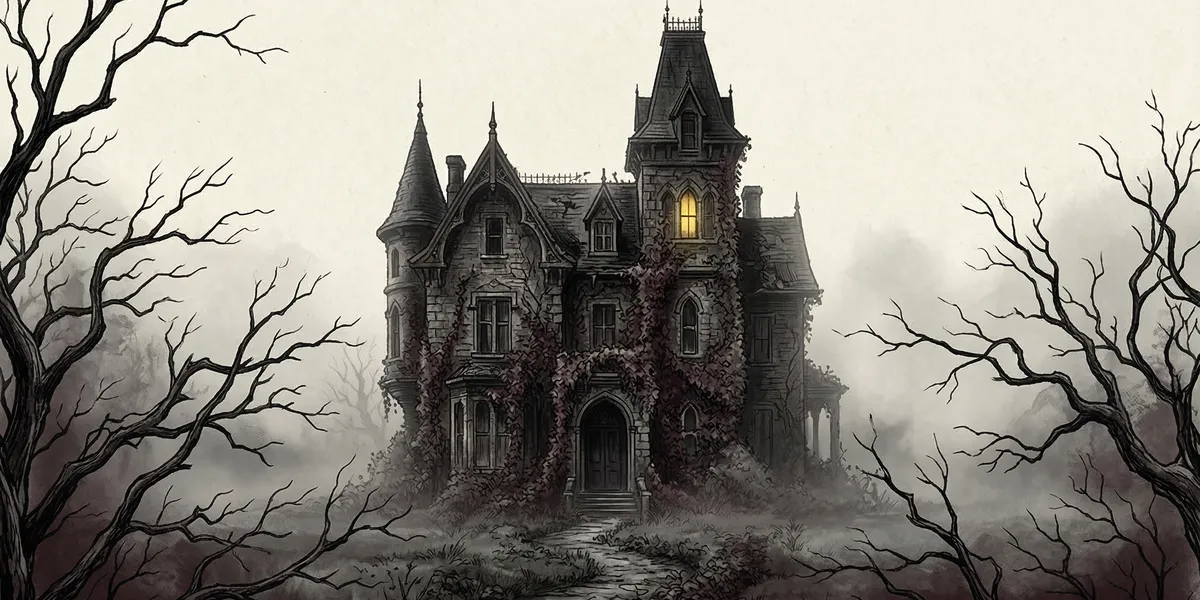
Gothic fiction is built on atmosphere, buried secrets, and the creeping sense that something is deeply wrong. It is not horror — it does not aim to scare you. It aims to unsettle you, to create a dread that lingers in the walls of a decaying house and in the silence between characters who know more than they are saying. If you want to write a gothic novel, you need to master mood before anything else.
What Makes Fiction Gothic
Gothic fiction has a specific DNA that separates it from horror, thriller, and literary fiction. These are the defining traits:
Atmosphere over action. A gothic novel is not about what happens — it is about how things feel. Every scene drips with mood. The weather reflects the characters’ emotional states. The house groans. The fog thickens at precisely the wrong moment. The reader should feel uneasy before anything threatening actually occurs.
A haunted or decaying setting. The setting is not background decoration — it is functionally a character. A crumbling manor. An isolated institution. A house on a cliff. The building has history, secrets, and possibly a will of its own. The setting physically manifests the psychological state of the story.
Secrets and family trauma. Every gothic novel has something buried — literally or figuratively. A family secret. A dead spouse. A locked room. A forbidden wing. The plot is driven by the slow excavation of what has been hidden, and the consequences of its discovery.
The uncanny. That feeling when something familiar becomes strange. A portrait whose eyes seem to follow you. A door that was locked this morning now standing open. The gothic trades in the uncanny — things that are almost normal, but wrong enough to make your skin prickle.
Unreliable perception. The protagonist cannot fully trust their own senses. Are they seeing a ghost, or are they losing their mind? Is the house actually malevolent, or is their grief distorting reality? This ambiguity is central to the gothic experience.
Gothic vs Horror
This distinction matters for your writing and your reader expectations.
| Element | Gothic | Horror |
|---|---|---|
| Primary emotion | Dread, unease | Fear, terror |
| Pacing | Slow build, lingering | Can be fast, shock-based |
| Violence | Implied or restrained | Often explicit |
| Ambiguity | Central — is it real? | Usually resolved — the threat is real |
| Focus | Psychology, atmosphere | Threat, survival |
| Setting role | Setting IS the story | Setting is where the story happens |
Gothic fiction asks “what is wrong with this place?” Horror asks “how do we survive this place?” You can blend them — many great books do — but understand which mode you are primarily writing in.
The Setting as Character
In gothic fiction, you build the setting with the same depth and care as any protagonist. The house, the manor, the institution — it has a personality, a history, and it exerts influence over everyone inside it.
Building a Gothic Setting
Give it history. The building was not always decaying. What happened? Who built it, and why did they leave or die? The history of the house should mirror or illuminate the central mystery. A manor built by a patriarch who bricked up a wing after his wife’s death tells you something before a single character speaks.
Make it responsive. The setting should seem to react to events. This can be supernatural (doors slamming, cold spots, whispers) or naturalistic (the house settling, drafts from old windows, the way candlelight makes shadows move). Either way, the building should feel alive.
Use architecture as metaphor. Locked rooms represent secrets. Crumbling walls represent a family’s decline. Labyrinthine hallways represent confusion and entrapment. A tower represents isolation. Gothic architecture is never just architecture — it is the emotional landscape made physical.
Restrict freedom. The protagonist should feel trapped, even if they are technically free to leave. Isolation — geographical, social, or psychological — is essential. A house on a moor. An island. A snowbound estate. The gothic needs claustrophobia, even in vast spaces.
The Gothic Protagonist
The classic gothic protagonist is someone who enters a space where they do not belong and gradually discovers its secrets. They are often:
- An outsider. A new wife arriving at her husband’s ancestral home. A governess at a remote estate. A young woman inheriting a house from a relative she barely knew. The protagonist needs to be new to the setting so they can discover its secrets alongside the reader.
- Isolated. They have limited allies and limited escape routes. Even in a house full of people, the gothic protagonist is fundamentally alone — surrounded by others who know things they do not.
- Perceptive but doubted. They notice things others dismiss. They ask questions others deflect. Their observations are correct, but the environment — and sometimes the narrative itself — encourages them (and the reader) to doubt their own perceptions.
Give your protagonist an unreliable narrator quality. Not necessarily full unreliability, but enough uncertainty that the reader questions what is real. Grief, illness, medication, sleeplessness — any of these can cloud perception and create the gothic ambiguity you need.
Buried Secrets: The Engine of Gothic Plot
The plot structure of a gothic novel is fundamentally an excavation. Something is buried — a truth, a crime, a body, a betrayal — and the protagonist digs it up, piece by piece.
Layer your revelations. Do not give away the secret in one dramatic scene. Reveal it in fragments: a torn letter, a servant’s evasion, a photograph with a face scratched out, a room that smells of something the protagonist cannot identify. Each fragment raises more questions than it answers.
Let the house resist. The setting itself should seem to fight against discovery. Doors are locked. Keys go missing. Evidence is destroyed. People who know the truth die or disappear. The deeper the protagonist digs, the harder the world pushes back.
Connect the past to the present. The buried secret should not be merely historical. It should have consequences in the present. The crime committed thirty years ago should directly threaten someone alive today. The ghost is not just haunting — it is warning, or threatening, or demanding justice.
Gothic Subgenres
Gothic fiction is broader than crumbling English manors. Choose the variation that fits your story.
Southern Gothic. The decaying plantation instead of the English manor. Spanish moss instead of fog. Family dysfunction rooted in the specific history of the American South — slavery, poverty, religious extremism. Think Flannery O’Connor, William Faulkner, and the modern work of Jesmyn Ward.
Domestic Gothic. The horror is inside the marriage, the family, the home. No supernatural elements needed. A spouse who controls, a house that confines, a family secret that poisons everything. Shirley Jackson’s work lives here.
Gothic Romance. Romance and dread intertwined. The love interest is also potentially the threat. “Is this person my salvation or my destruction?” is the central question. Daphne du Maurier’s Rebecca is the template.
New Gothic / Contemporary Gothic. Gothic conventions transplanted to modern settings. A smart home that monitors its inhabitants. A tech billionaire’s isolated compound. A social media presence that haunts. The principles remain — atmosphere, secrets, entrapment — but the walls are glass and steel instead of stone.
Famous Examples to Study
| Book | Author | What to Learn |
|---|---|---|
| Rebecca | Daphne du Maurier | The greatest gothic novel of the 20th century. Perfect first-person unreliability. The house (Manderley) is the most famous setting in gothic fiction. |
| Mexican Gothic | Silvia Moreno-Garcia | How to transplant gothic conventions to a new cultural context. The house is literally poisonous. |
| The Turn of the Screw | Henry James | The gold standard for ambiguity — are the ghosts real or is the governess mad? Never answered. |
| Jane Eyre | Charlotte Bronte | Gothic romance done right. The locked room, the secret wife, the house that burns. |
| We Have Always Lived in the Castle | Shirley Jackson | Domestic gothic. Two sisters, a poisoned family, a house under siege. Voice-driven and deeply unsettling. |
| The Haunting of Hill House | Shirley Jackson | How to make a house feel alive and malevolent. The architecture of dread. |
Gothic Techniques
Pathetic Fallacy
The weather and environment mirror the emotional state of the story. A storm breaks during the climactic confrontation. Fog rolls in when the protagonist is most confused. The garden blooms when a secret is finally exposed. Use this deliberately — gothic readers expect the world to reflect the inner drama.
Unreliable Narration
The reader should not be entirely certain what is real. Use first person or deep third to keep us locked in the protagonist’s potentially distorted perspective. Plant details that could be interpreted two ways: “I heard footsteps in the hallway” — real footsteps, or the house settling? Foreshadowing in gothic fiction should always carry this dual possibility.
Claustrophobic Prose
Match your sentence structure to the feeling. When the protagonist is trapped or anxious, shorten your sentences. Fragment them. Stack clauses. When the atmosphere is oppressive, let sentences stretch and coil, subordinate clause after subordinate clause, until the reader feels the walls pressing in.
Doubling and Mirrors
Gothic fiction loves doubles. The protagonist and their dark reflection. The current wife and the first wife. The living child and the dead one. Two portraits. Two locked rooms. Use mirrors, portraits, and parallels to create the unsettling sense that everything repeats.
Common Mistakes
- All atmosphere, no plot. Mood without momentum is just description. Your protagonist needs a goal, obstacles, and escalating tension.
- Explaining the mystery too early. Gothic dread requires sustained ambiguity. If you reveal the ghost is real in chapter four, you have thirty chapters of horror, not gothic. Hold the uncertainty as long as possible.
- Modern characters acting like Victorian ones. If your gothic novel is set in 2026, your protagonist should use a phone, call the police, and Google the house’s history. Create reasons why those modern tools do not solve the problem — do not just pretend they do not exist.
- Overwriting. Gothic prose should be atmospheric, not purple. There is a fine line between “the house exhaled a draft of cold air” and “the house, in its infinite and malevolent sentience, breathed forth a miasma of chill despair.” Stay on the right side of it.
- Forgetting the human story. The house and the atmosphere are tools. The story is about people — their grief, their guilt, their secrets, their capacity for cruelty and love. Never let the setting overwhelm the characters.
Gothic fiction rewards patience, restraint, and a deep understanding of what makes people uneasy. The genre is alive and thriving — from Silvia Moreno-Garcia to T. Kingfisher to Paul Tremblay. Readers are hungry for stories that unsettle them slowly and linger long after the last page.
If you are ready to build your gothic world and write the novel hiding in the walls, Chapter can help you develop your atmosphere, structure your mystery, and draft your manuscript from the first creak of the floorboards to the final revelation.