A great heist novel gives readers the thrill of a seemingly impossible job pulled off by brilliant people — and then pulls the rug out with a twist they did not see coming. The genre is a puzzle box wrapped in a thriller, and writing one requires you to think like both a storyteller and an architect. Here is how to build a heist that works.
What Makes a Great Heist
Every memorable heist — on the page or on screen — shares five elements:
A seemingly impossible target. The vault is uncrackable. The museum has laser grids. The casino has three levels of security. The target needs to feel genuinely beyond reach. If the job looks easy, there is no tension. The fun of a heist is watching smart people solve a problem that should not be solvable.
A brilliant plan. The protagonist (or the team leader) must be smart enough to devise a plan that accounts for the target’s defenses. The plan should feel clever without being incomprehensible. Readers need to follow the logic, even if they cannot see the full picture yet.
A team of specialists. Heists are ensemble stories. Each member brings a specific skill — the hacker, the grifter, the muscle, the driver, the inside person. The team dynamic is as important as the heist itself.
Things going wrong. The plan must not go perfectly. The complications are where the story lives. A guard changes shifts early. A team member has a personal crisis. The vault has a defense nobody knew about. How the team adapts reveals character.
A twist the reader did not see coming. The best heist stories have a reveal at the end that recontextualizes everything the reader just experienced. The double-cross. The long con. The secret the protagonist kept from the team — and from the reader.
The Heist Structure
Heist novels follow a specific plot structure that readers expect. Deviate from it intentionally, not accidentally.
Act 1: The Setup
The hook. Why does this heist need to happen? The motivation should be personal, not just financial. Revenge against the target. A debt that will get someone killed. Righting an injustice. The “why” makes readers root for criminals.
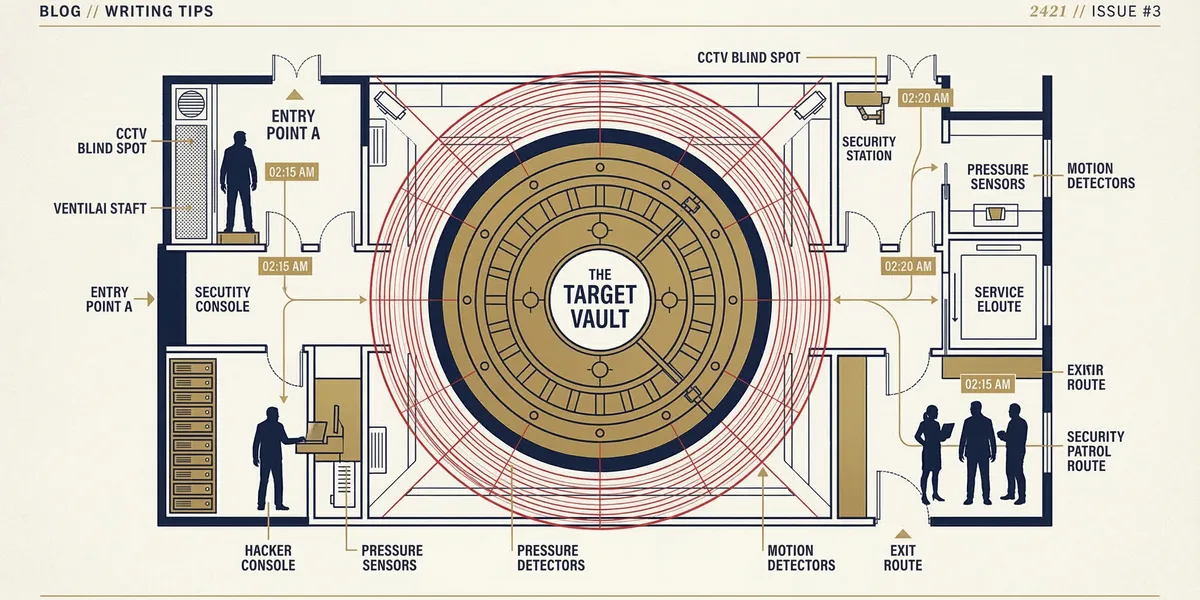
The target. Establish what they are stealing and why it matters. Give the reader a clear picture of the target — a diamond, a painting, a data file, a person — and make its value (financial, emotional, or political) unmistakable.
The obstacle. Show why the target is almost impossible to reach. The security system. The location. The timeline. The reader needs to feel the difficulty before the plan begins.
Act 2: The Assembly and the Plan
Assembling the team. Introduce each member through a recruitment scene that demonstrates their skill. The forger who creates a perfect passport in twenty minutes. The driver who evades three police cars in a stolen sedan. Show, do not tell.
The interpersonal dynamics. The team should not get along perfectly. Old grudges. Competing egos. Romantic tension. A member nobody trusts. These frictions generate subplot and make the team feel real.
The plan. This is the most technically demanding part to write. You need to show enough of the plan for readers to follow the heist, but hide enough for the final twist to surprise them. More on this below.
Act 3: The Execution
The heist itself. Execute the plan on the page, step by step. This is where pacing matters most. Alternate between tense action and quiet precision. Give each team member their moment to shine.
The complications. Things go wrong. Multiple things. The complications should escalate — the first problem is minor, the second is serious, the third nearly derails everything. Each complication forces improvisation and reveals character under pressure.
The twist. The reveal that changes everything. The reader realizes that what they thought was going wrong was actually going right — or that the real heist was not the one they were watching. The twist should be surprising but fair — when readers think back, the clues were there.
Resolution
The aftermath. Show the consequences. Who got what they wanted? Who got more than they bargained for? Who betrayed whom? A good heist ending is rarely clean. Someone pays a price.
Writing the Team
Heist novels are ensemble fiction, and the team is the heart of the story.
Give Each Member a Unique Role
Every team member should have a skill that no one else possesses. If two members can do the same thing, you do not need both. Classic roles include:
| Role | Function | Personality Archetype |
|---|---|---|
| The Mastermind | Plans the heist, sees the big picture | Controlled, secretive, carries the weight |
| The Grifter | Social engineering, disguise, manipulation | Charming, adaptable, possibly untrustworthy |
| The Hacker/Tech | Bypasses digital security, surveillance | Introverted, brilliant, socially awkward |
| The Muscle | Physical security, intimidation, extraction | Protective, blunt, possibly gentle underneath |
| The Thief | Lock-picking, safecracking, physical infiltration | Precise, cool under pressure, ego-driven |
| The Driver | Getaway, vehicle logistics | Calm, competent, usually the voice of reason |
| The Inside Person | Access, intelligence, betrayal risk | Conflicted, divided loyalties |
Create Interpersonal Tension
The team should have internal conflicts that are independent of the heist. A member who owes the mastermind a debt. Two members with romantic history. Someone who joined for reasons they are not sharing. These tensions keep scenes interesting even when the plot is not advancing the heist directly.
Make Readers Care Before the Heist Starts
If readers do not care about the team as people, the heist is just mechanics. Give each member at least one scene that reveals who they are beyond their skill set. The safecracker who calls his daughter every night. The grifter who steals from the rich but anonymously pays a stranger’s medical bills. Character development is what separates a great heist novel from a clever plot summary.
Writing the Plan: Show and Hide
This is the hardest part of heist writing. You need to reveal enough of the plan for readers to follow the heist, but conceal enough for the twist to land.
Strategy 1: Show the plan, then break it. Reveal the full plan to the reader, then systematically destroy it during execution. The fun comes from watching the team improvise. Ocean’s Eleven uses a version of this — you see the plan, but the execution reveals layers you did not see.
Strategy 2: Show part of the plan. The reader sees the broad strokes but not the details. “We go in through the roof” — but you do not explain what happens after they reach the vault. The missing pieces become the twist.
Strategy 3: Do not show the plan at all. Drop the reader into the heist and let them piece together what is happening in real time. This is harder to pull off but creates maximum surprise. The plot twist lands because the reader had no expectations to violate — they were genuinely discovering the plan alongside the complications.
The golden rule: Whatever you hide from the reader, you must plant clues for. A twist that contradicts established facts is not clever — it is cheating. Readers should be able to reread the book and find the seeds of the twist planted throughout.
The Double-Cross
Almost every heist novel has a betrayal or reveal that reshapes the story. The most common patterns:
- The team member who was working for the target all along. The inside person was a double agent. This works if you planted genuine reasons for suspicion early.
- The real heist was something else. The diamond heist was a distraction. The actual target was the data in the safe next to the diamond. The reader was watching the wrong thing.
- The mastermind planned for everything — including the betrayal. The double-cross was expected. The mastermind let it happen because it was part of a larger play.
- The job was personal all along. The heist was never about the money. It was about revenge, exposure, or justice. The revelation reframes every character’s motivation.
The key to a good double-cross: it must change the meaning of what came before. If the twist is “and then someone stole the diamond from the team,” that is just another event. If the twist is “the person who stole the diamond was the one who proposed the heist in the first place, and the whole operation was designed to frame the target,” that is a revelation.
Famous Examples to Study
| Work | Creator | What to Learn |
|---|---|---|
| Six of Crows | Leigh Bardugo | How to write a heist with deep character backstories. Every team member has trauma that drives their decisions during the job. |
| The Lies of Locke Lamora | Scott Lynch | A heist novel disguised as fantasy. The long con, the con-within-a-con, and what happens when the plan truly falls apart. |
| Ocean’s Eleven (film) | Steven Soderbergh | The masterclass in show-the-plan-then-reveal-the-real-plan. Study the structure, not just the style. |
| The Italian Job (1969 & 2003) | Various | Ensemble dynamics and the getaway as the real set piece. |
| Mistborn: The Final Empire | Brandon Sanderson | Fantasy-heist hybrid. Proof that heist structure works in any genre. |
Common Mistakes
- The plan is too complex for the reader to follow. If readers cannot understand what the team is trying to do, they cannot feel tension when it goes wrong. Simplify the plan. Complexity comes from complications, not from the blueprint itself.
- No personal stakes. “We are stealing a diamond because it is valuable” is not enough. Why does each team member need this job? What happens if they fail — not to the job, but to their lives? Money alone is not compelling. Debt, revenge, freedom, loyalty — these are compelling.
- The twist contradicts what the reader saw. If you showed the safecracker opening the vault on page 200 and then reveal on page 300 that “actually, she swapped the diamond with a fake during the opening” — the reader needs to be able to reread page 200 and see how the swap was possible. If it was not possible based on what you wrote, the twist is a cheat.
- Every team member is likable. Real ensemble tension requires at least one person who grates on the others. The person who is necessary but difficult. The person whose loyalty is genuinely in question. Friction makes teams interesting.
- Forgetting the aftermath. The heist’s end is not the story’s end. Show consequences. Who changed? Who got away? Who did not? The best heist novels have endings that are bittersweet — the job succeeded, but it cost something.
FAQ
Can a heist novel work with a solo protagonist? Yes, but it is harder. Solo heist stories lean heavily on the protagonist’s intelligence and improvisation. Patricia Highsmith’s Ripley novels are essentially solo con-artist heists. You lose the ensemble dynamic but gain intimate focus.
How do I keep the twist fair? Plant three clues minimum. At least one should be in dialogue, one in action, and one in a detail the reader might overlook. When they reread, they should think “it was right there” — not “that came from nowhere.”
What genre pairs well with heist structure? Almost anything. Fantasy heists (Six of Crows, Mistborn), sci-fi heists (The Stars Are Legion), romance heists (The Lady’s Guide to Celestial Mechanics has heist energy), historical heists. The structure is genre-agnostic.
The heist novel is one of fiction’s most satisfying structures — a puzzle that rewards both the writer and the reader. Get the team right, get the plan right, and deliver a twist that makes your reader flip back to the beginning to find the clues they missed.
Building a heist novel with its layered plot, ensemble cast, and hidden twists is a serious undertaking. Chapter can help you outline the plan, develop your team, and draft every chapter — from recruitment to the big reveal.