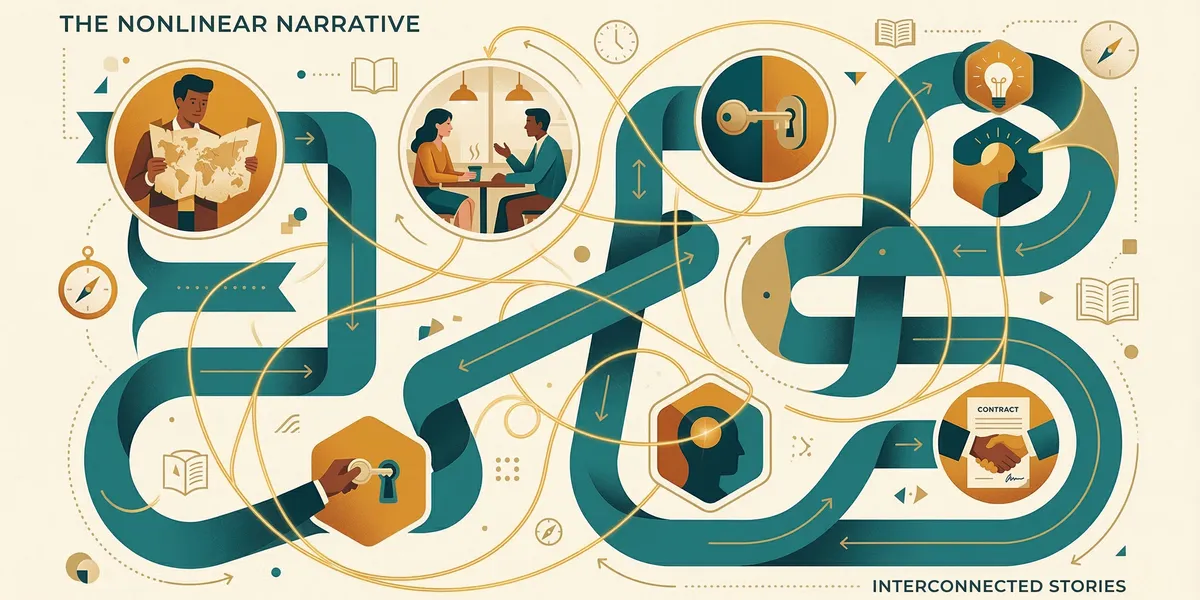
A nonlinear narrative tells a story out of chronological order. Events are rearranged — jumping forward, looping back, splitting into parallel tracks — so the reader assembles the full picture from fragments rather than following a straight timeline from beginning to end.
When it works, nonlinear structure transforms a story. It creates mystery where none existed, forces the reader into active participation, and reveals meaning through juxtaposition rather than sequence. When it doesn’t work, it’s confusing for the sake of confusion.
The difference is purpose. Every disruption of chronology should serve the story in a way that chronological order cannot.
Types of Nonlinear Structure
Nonlinear isn’t a single technique. It’s a family of structures, each creating different effects.
Reverse Chronology
The story moves backward through time. The reader knows the ending and watches the causes unfold in reverse, each scene explaining how the previous one became possible.
Martin Amis’s Time’s Arrow tells the life of a Nazi doctor entirely in reverse. Meals are un-eaten. Words are un-spoken. The Holocaust is experienced as creation rather than destruction. The reverse structure doesn’t just rearrange events — it transforms their meaning entirely.
Reverse chronology works best when the “why” is more interesting than the “what.” If the reader already knows the outcome, going backward lets you build tension through cause rather than consequence.
Parallel Timelines
Two or more storylines unfold simultaneously, set in different time periods. The reader alternates between them, and the connections between timelines gradually emerge.
Kate Atkinson’s Life After Life follows the same character through multiple lives, each beginning with the same birth and diverging based on small differences. David Mitchell’s Cloud Atlas weaves six storylines across centuries, connected by theme and echo rather than direct causation.
Parallel timelines work when the resonance between time periods creates meaning that neither timeline could achieve alone. If the timelines don’t illuminate each other, they’re just two stories awkwardly stapled together.
Frame Narrative
A story within a story. A character in the “present” tells or discovers a story from the past. The present-day frame gives context, stakes, and often a reason for the past story to matter now.
Mary Shelley’s Frankenstein uses nested frames: an explorer’s letters contain a scientist’s confession, which contains the monster’s testimony. Each layer of framing adds perspective and moral complexity.
Frame narratives work when the framing device does more than just introduce the inner story. The frame should have its own stakes, its own arc, and should change how the reader interprets the story it contains.
Fragmented / Mosaic
The story is delivered in pieces — scenes, vignettes, documents, memories — without a clear connecting thread. The reader assembles the narrative from fragments, and the act of assembly is part of the experience.
Jennifer Egan’s A Visit from the Goon Squad uses fragmented structure to explore time, memory, and music across decades. Each chapter functions as a self-contained story while contributing to a larger mosaic. Susanna Clarke’s Piranesi uses journal entries that gradually reveal a reality the narrator doesn’t yet understand.
Mosaic structure works when the gaps between fragments are as meaningful as the fragments themselves. What’s left unsaid, what the reader must infer — these become part of the story’s texture.
Circular Narrative
The story ends where it began, creating a loop. The opening scene is revisited at the close, but the reader now understands it differently because of everything that happened between.
Circular narratives work when the return to the beginning creates irony, tragedy, or revelation. The reader sees the same moment with new eyes. The structure argues that understanding transforms experience, even when the experience itself doesn’t change.
When to Break Chronology
Nonlinear structure should solve a problem that chronological order creates. If the story works perfectly well told straight, telling it out of order adds complexity without payoff.
Break Chronology When:
The mystery is more interesting than the sequence. If knowing the outcome first creates tension (how did we get here?), starting at the end or middle and working backward can be more compelling than starting at the beginning.
The opening of Breaking Bad — Walter White in his underwear in the desert, holding a gun, with sirens approaching — drops the viewer into a crisis with zero context. The desire to understand how a chemistry teacher ended up here drives the entire pilot. Chronological order would have started with a man getting a cancer diagnosis. Dramatically inferior.
Thematic connections matter more than temporal ones. When two scenes from different time periods illuminate each other — when a childhood memory and an adult choice rhyme in a way that reveals character — placing them side by side is more powerful than separating them by 200 pages of chronological distance.
Dramatic irony serves the story. When the reader knows something a character doesn’t — because they’ve seen the future — every scene becomes charged with additional meaning. A love scene hits differently when the reader knows the relationship ends in betrayal. A promise hits differently when the reader has already seen it broken.
The character’s experience of time is fractured. Trauma, memory loss, grief, and altered states of consciousness all disrupt linear time perception. A nonlinear structure can mirror the character’s subjective experience, putting the reader inside a mind that doesn’t process events in order.
Don’t Break Chronology When:
Chronological order is already compelling. If the story builds naturally from cause to effect, and each scene’s power depends on what came before it, chronological order is your best structure. Don’t fix what isn’t broken.
You’re hiding a weak plot behind structural complexity. If the story’s events are bland and you’re rearranging them to create artificial intrigue, the reader will notice. Structure should amplify a strong story, not disguise a weak one.
The nonlinear structure serves only the writer. Sometimes a writer wants to open with their best scene rather than their best opening scene. That’s a drafting instinct, not a structural choice. The first scene in the final draft should be the one that serves the reader best, not the one that was most fun to write.
How to Keep Readers Oriented
The biggest risk of nonlinear storytelling is losing the reader. If they can’t track where (and when) they are, the story’s meaning dissolves into confusion. Here are the practical techniques that work.
Clear Timestamps or Headers
The simplest solution. Date stamps, chapter headings that indicate the time period, or explicit markers (“Three years earlier”) tell the reader exactly when they are.
This works especially well in parallel timeline structures. Audrey Niffenegger’s The Time Traveler’s Wife uses dates and character ages as headers, giving the reader an anchor in every scene despite constant time-jumping.
Don’t be subtle about orientation cues. Readers would rather have a clear “1987” at the top of a chapter than spend three paragraphs trying to figure out when a scene takes place.
Distinct Voice per Timeline
If your nonlinear story follows different time periods, give each one a distinguishable voice, tone, or style. The reader should be able to identify the timeline from the prose itself within a few sentences.
A childhood timeline might use shorter sentences and simpler vocabulary. A war timeline might use clipped, tense prose. A present-day timeline might use a more reflective, measured voice. The stylistic differences serve as constant, subtle reminders of when the reader is.
Anchor Points
Create specific moments, images, or objects that recur across timelines. A pocket watch. A specific phrase. A location. These anchors give the reader connective tissue between fragmented scenes.
In Cloud Atlas, recurring birthmarks, musical compositions, and character echoes connect six disparate storylines. The anchors aren’t heavy-handed — they’re woven into the narrative naturally — but they give the reader the sense that the timelines belong together, that a larger pattern is at work.
Consistent Internal Logic
Your nonlinear structure needs rules, and those rules need to be consistent. If you establish that the story alternates between 1985 and 2020, don’t suddenly jump to 1942 without preparation. If each chapter moves one year further into the past, maintain that pattern.
Readers are remarkably good at detecting and following structural patterns. They’ll track a complex structure willingly — as long as the rules are consistent and the pattern is discernible.
Famous Examples and What They Teach
| Work | Structure Type | What It Teaches |
|---|---|---|
| Slaughterhouse-Five (Vonnegut) | Fragmented/time-unstuck | Nonlinearity can mirror psychological reality (PTSD, trauma) |
| Cloud Atlas (Mitchell) | Nested parallel timelines | Thematic echoes can connect unrelated storylines |
| Pulp Fiction (Tarantino) | Shuffled chronology | Rearranging scenes changes what they mean |
| The Time Traveler’s Wife (Niffenegger) | Involuntary time travel | Clear orientation cues (dates) enable constant timeline-jumping |
| Piranesi (Clarke) | Journal fragments with unreliable timeline | Gaps in knowledge create mystery |
| Station Eleven (Mandel) | Parallel timelines (pre/post-apocalypse) | Two timelines illuminate each other thematically |
The Pulp Fiction Lesson
Quentin Tarantino’s Pulp Fiction is perhaps the most famous example of chronological rearrangement in popular storytelling. The film’s scenes are shuffled so that a character who dies midway through the story appears alive in the final scene.
This structural choice transforms the film’s meaning. A chronological cut would end on a death — dark, nihilistic. The shuffled version ends on a moment of grace — a hitman choosing mercy. The exact same events, rearranged, tell a fundamentally different story about whether redemption is possible. That’s the power of nonlinear structure when it serves thematic purpose.
Common Mistakes
Confusing without purpose. If the reader is disoriented and the disorientation doesn’t serve the story — if it’s just hard to follow for no reason — you’ve failed. Every moment of confusion should pay off in understanding later.
Too many timelines. Three is usually the maximum before the reader’s cognitive load becomes a barrier to emotional engagement. Some exceptional works manage more (Cloud Atlas, for instance), but they require extraordinary craft. If you’re early in your career, start with two.
Structural gimmick without substance. Nonlinear structure should be invisible in the best sense — the reader should feel its effects without being conscious of its mechanics. If the structure calls attention to itself as a trick, it’s a gimmick. If it creates meaning, revelation, or emotion, it’s craft.
Neglecting the emotional through-line. Even when events are shuffled, the emotional arc of the reading experience should still build. The reader should feel a mounting sense of understanding, tension, or revelation as the fragments accumulate. If the emotional experience is as scattered as the timeline, the structure isn’t working.
Using nonlinearity to withhold information cheaply. There’s a difference between strategic revelation (placing information where it has the most impact) and cheap withholding (hiding a key fact from the reader just to create a gotcha moment). The former respects the reader. The latter insults them.
How to Draft a Nonlinear Narrative
Step 1: Write It Chronologically First
This is counterintuitive, but most successful nonlinear narratives are drafted in chronological order and then rearranged. Writing the full timeline lets you understand the story’s cause-and-effect chain before you start disrupting it.
You need to know the chronological story cold before you can break it effectively. What happens in what order? What causes what? Which moments are the hinges? You can’t strategically rearrange a puzzle you haven’t assembled yet.
Step 2: Identify the Rearrangement Logic
Ask: what order of revelation serves the story best? Not what order the events occurred in, but what order the reader should discover them in.
Map each scene on an index card. Note what information it reveals and what emotional effect it creates. Then experiment with different orderings. Which scene, read first, creates the most compelling question? Which scene, read last, provides the most satisfying answer?
Step 3: Test for Clarity
After rearranging, read the nonlinear version as a reader would — front to back, in order. At each transition between timelines, check: does the reader know when they are? Do they understand why the story jumped? Is the connective tissue (anchors, cues, thematic links) strong enough?
If you’re lost in your own narrative, the reader will be too. Add orientation cues until the structure feels navigable.
Step 4: Verify the Emotional Arc
The chronological plot has an emotional arc. The nonlinear reading order also has an emotional arc — and it’s different. Map the emotional experience of the reading order. Does it build? Does it escalate? Does it culminate in a moment that carries the weight of everything the reader has assembled?
If the emotional arc of the reading order is flat or random, rearrange again until it builds toward something.
When Linear Is Better
Sometimes the most honest thing a writer can do is tell the story straight. Not every narrative benefits from structural complexity, and recognizing when yours doesn’t is as important as knowing how to execute nonlinear structure.
Tell the story chronologically when:
- The cause-and-effect chain IS the story’s power
- The plot structure builds naturally to a climax that depends on cumulative investment
- The character’s linear journey from point A to point B is the emotional engine
- Adding structural complexity would distance the reader from an experience that needs intimacy
Nonlinear narrative is a tool, not a virtue. The best stories use whatever structure serves them — and sometimes that structure is the simplest one available. The craft lies in knowing which tool to reach for, and having the skill to use it well.