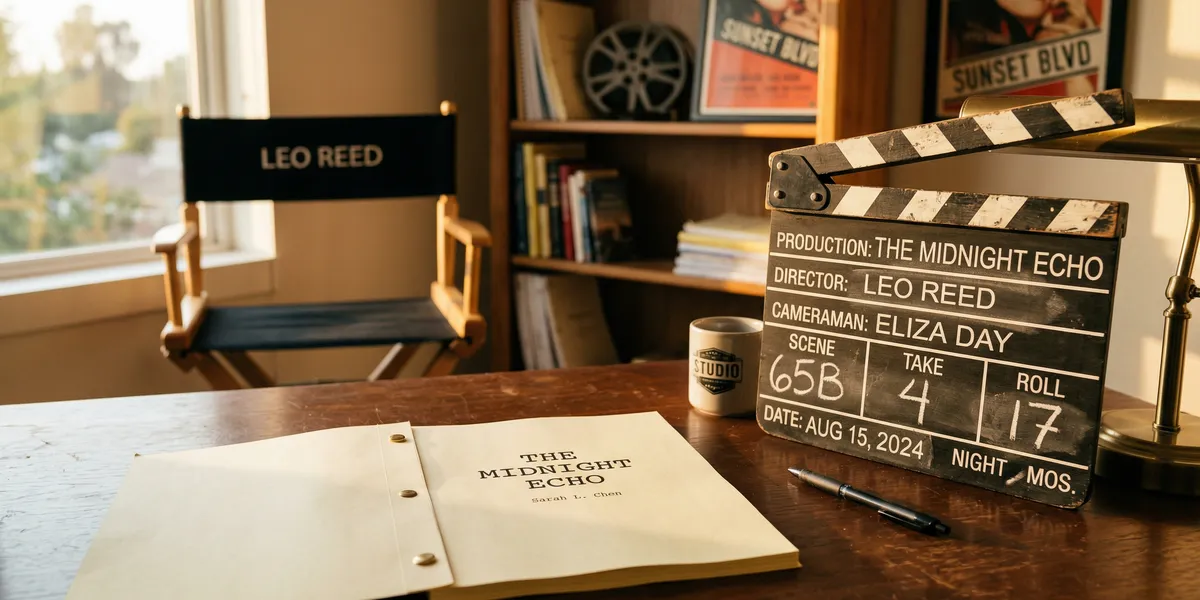
If you want to know how to write a screenplay, you need three things: an understanding of screenplay format, a grasp of story structure, and the willingness to write badly before you write well. This guide covers all the fundamentals for beginners.
Screenwriting is a specific craft with strict formatting conventions and structural expectations. Unlike novel writing, every page of a screenplay roughly equals one minute of screen time. A feature film script runs 90 to 120 pages. A TV pilot runs 30 to 60 pages.
That constraint shapes everything.
What a Screenplay Actually Is
A screenplay is a blueprint for a film or television show. It contains:
- Scene descriptions (called “action lines”) — What the audience sees and hears
- Dialogue — What characters say
- Scene headings — Where and when each scene takes place
- Transitions — How scenes connect (used sparingly in modern scripts)
A screenplay is not a novel. It doesn’t describe internal thoughts, backstory paragraphs, or lengthy descriptions. Everything on the page must be something the audience can see or hear.
Screenplay Formatting Standards
Screenplay format is rigid. Producers, agents, and readers expect it. Deviating from standard format signals amateur status faster than weak dialogue.
Here’s how a properly formatted screenplay scene looks:
INT. COFFEE SHOP - MORNING

SARAH (30s, sharp eyes, wrinkled blazer) sits alone at a
corner table. Two coffees. She checks her phone. Checks
the door.

MARCUS (30s, out of breath) slides into the seat across
from her.

                    MARCUS
          Sorry. Train thing.

                    SARAH
          You said that last time.

                    MARCUS
          Last time it was a bus thing.

Sarah pushes the second coffee toward him. It's cold.

                    SARAH
          I ordered this forty minutes ago.

Marcus takes a sip. Doesn't flinch.

                    MARCUS
          I've had worse.
Key Formatting Rules
| Element | Format |
|---|---|
| Scene heading (slug line) | ALL CAPS: INT./EXT. LOCATION - TIME OF DAY |
| Action lines | Present tense, standard case, brief |
| Character name (before dialogue) | ALL CAPS, centered |
| Dialogue | Centered under character name, narrower margins |
| Parentheticals | Sparingly, in parentheses under character name |
| Transitions | RIGHT-ALIGNED, use rarely (CUT TO:, FADE OUT.) |
| Font | Courier 12-point, always |
The industry standard font is Courier 12-point. This isn’t aesthetic — it’s functional. At Courier 12pt, one page of properly formatted screenplay equals approximately one minute of screen time.
Software for Formatting
You can write in any of these screenwriting tools:
- Final Draft — Industry standard, used by most Hollywood studios
- WriterSolo — Free, browser-based
- Highland — Clean Mac app by screenwriter John August
- Fade In — Professional-grade, one-time purchase
Don’t format a screenplay manually in Word or Google Docs. The margin calculations alone will consume hours you should spend writing.
The Three-Act Structure
Nearly every successful screenplay follows a three-act structure. It’s not a formula — it’s the underlying architecture of most compelling stories.
Act One: Setup (Pages 1–25)
Establish the world, the main character, and the central conflict. By the end of Act One, something happens that pushes the protagonist into the main story. This is the inciting incident.
In Jaws, the inciting incident is the first shark attack. In The Matrix, it’s Neo choosing the red pill.
What to include in Act One:
- Introduce your protagonist in their ordinary world
- Establish what they want (the goal)
- Introduce the antagonist or central obstacle
- End with a turning point that launches the main conflict
Act Two: Confrontation (Pages 25–75)
The longest act. Your protagonist pursues their goal and faces escalating obstacles. Every scene should either move the plot forward or deepen character.
The midpoint (around page 50-55) shifts the story’s direction. New information, a betrayal, a setback — something changes the protagonist’s approach.
Common Act Two pitfalls:
- Sagging middle (repetitive scenes without escalation)
- Subplots that don’t connect to the main story
- Characters who react instead of driving action
Act Three: Resolution (Pages 75–110)
The climax and aftermath. Your protagonist faces the central conflict head-on. The tension peaks, the question posed in Act One gets answered, and the story resolves.
What makes a strong Act Three:
- The protagonist makes a choice that defines their character
- The stakes are at their highest
- Loose plot threads tie together (or intentionally don’t)
- The resolution feels earned, not convenient
Building Characters That Work on Screen
Screenwriting characters are defined by what they do, not what they think. You can’t write “she felt a wave of guilt” in a screenplay. You have to show guilt through behavior.
Character Development Checklist
External goal: What does the character want? (A job, a relationship, survival, revenge)
Internal need: What does the character actually need? (Self-acceptance, forgiveness, courage). Often different from the external goal.
Flaw: What personal limitation holds them back? (Pride, fear, dishonesty)
Voice: How do they talk? A burned-out detective doesn’t speak like a wide-eyed college freshman. Dialogue should be distinguishable by character even without names attached.
Arc: How does the character change from page 1 to page 110? The best characters end up somewhere different internally, even if they’re in the same physical place.
The Character Introduction
How you introduce a character on the page matters. You get one or two lines.
Bad: “JOHN (40s) enters.”
Better: “JOHN (40s, pressed suit, unpolished shoes) enters. He straightens his tie in the elevator reflection — then stops, catching himself.”
The second version tells us something about who this person is. One detail about appearance. One detail about behavior. That’s usually enough.
Writing Strong Dialogue
Screenplay dialogue is not how people actually talk. It’s a compressed, purposeful version of natural speech.
Rules for Better Dialogue
Every line should do at least one of these things: Advance the plot, reveal character, or create conflict. If a line does none of these, cut it.
Subtext over text. Characters rarely say exactly what they mean. A couple arguing about whose turn it is to do dishes is never really arguing about dishes.
Cut greetings and small talk. “Hi, how are you?” / “Fine, you?” doesn’t belong in a screenplay unless it’s doing double duty (revealing awkwardness, establishing a power dynamic, etc.).
Read dialogue aloud. If it sounds stilted coming out of your mouth, it’ll sound stilted coming from an actor.
Give each character a distinct voice pattern. Vocabulary, sentence length, verbal tics, topics they return to. One character might speak in short fragments. Another might over-explain everything.
Scene Construction
Every scene in a screenplay needs three things:
- A purpose — What does this scene accomplish for the story?
- Conflict — What tension exists in this scene?
- Movement — How does the story’s situation change by the scene’s end?
Enter scenes late, leave them early. Don’t show a character arriving at a location, parking, walking in, greeting people, sitting down, and then starting the important conversation. Start with the conversation.
A masterclass on scene construction from the BBC is available free through their Writers’ Room, which also hosts produced scripts you can study.
Screenplay Types: Features, TV, and Shorts
Not every screenplay is a feature film. The format varies depending on what you’re writing.
Feature film screenplay. 90–120 pages. Three-act structure. Tells one complete story. This is what most people mean when they say “screenplay.”
TV pilot. 30 pages (half-hour comedy) or 55–65 pages (one-hour drama). A pilot introduces the world, characters, and central premise while also telling a complete episodic story. The key difference from film: a pilot must establish a concept that can sustain 100+ episodes, not just resolve one conflict.
Short film screenplay. 5–15 pages. Short films are the proving ground for new screenwriters. They demand economy — every page counts even more than in a feature. Film festivals like Sundance and SXSW program short films alongside features, and many working directors started with shorts.
Limited series / miniseries. A contained story told across 4–10 episodes. Think of it as a long feature broken into chapters. Each episode typically runs 45–60 pages and ends with a reason to watch the next one.
Choosing Your Format
If you’re new to screenwriting, start with a short film (5–10 pages) or a TV pilot. Features are a significant commitment — 100+ pages of tightly structured storytelling. A short film lets you practice format, dialogue, and scene construction at a manageable scale. A TV pilot lets you demonstrate your voice and concept-building ability, which is what staffing agents and showrunners look for.
Common Screenwriting Mistakes
Over-directing. Don’t write camera angles (CLOSE UP ON, PAN TO) unless you’re also directing. Write the story, not the shot list.
On-the-nose dialogue. Characters explaining their feelings directly: “I’m angry because you lied to me.” Real people rarely do this. Show the anger through action and sharp dialogue instead.
Too much description. Action lines should be lean. Three to four lines maximum per paragraph. White space on the page signals a readable, well-paced script.
No visual storytelling. Film is a visual medium. If every important moment in your screenplay is delivered through dialogue, you’re writing a play, not a movie. Show key emotional beats through action, setting, and image.
Ignoring genre expectations. Audiences for horror, comedy, and drama expect different things. Study produced scripts in your genre. The Internet Movie Script Database and Script Slug host thousands of free, produced screenplays.
From Screenplay to Other Storytelling Forms
The skills that make a good screenwriter also make a good novelist:
- Understanding structure and pacing
- Writing dialogue that reveals character
- Building scenes with purpose and conflict
- Knowing when to show, not tell
Many writers move between screenwriting and book writing. If you have a story that works better as a novel or nonfiction book — or if you want to develop a screenplay idea by first writing it as prose — the transition is natural.
Chapter.pub helps writers structure books using the same story fundamentals that drive great screenplays. If your story is better suited for the page than the screen, it’s worth exploring.
What to Do After Your First Draft
Put it away for two weeks. Fresh eyes catch problems that fatigue-numbed ones miss.
Read it aloud. All of it. Every line of dialogue. You’ll hear problems faster than you’ll see them.
Get feedback from writers, not friends. Friends will tell you it’s great. Writers will tell you page 40 drags and your protagonist is passive for the entire second act. You need the second kind of feedback.
Study the Academy Nicholl Fellowship guidelines. Even if you don’t enter, the competition’s standards represent what industry readers expect from a polished spec script.
Rewrite. Professional screenwriters rewrite their scripts many times. The first draft is raw material. The real writing is in the revision.
Related Guides
- How to write a book — Full guide to book writing
- Story structure guide — Deep dive into narrative architecture
- How to write dialogue — Dialogue craft for any medium
- How to write a novel — Novel-specific craft guide
Writing a screenplay is hard. It’s also one of the most disciplined forms of storytelling. Every word earns its place on the page. That discipline makes you a better writer in every format.