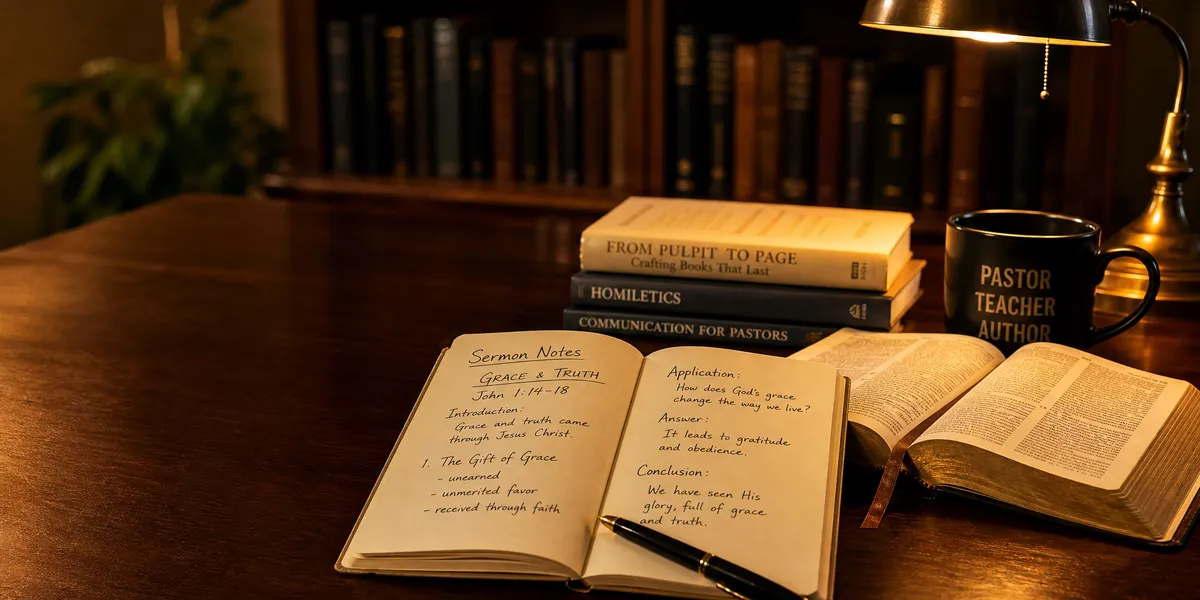
You can turn your sermons into a published book — even if you have never written anything longer than a Sunday message. Pastors and speakers already have the raw material. The process is about reshaping spoken content for the page.
In this guide, you’ll learn:
- How to select and organize sermons into a book-worthy structure
- The step-by-step process for adapting spoken messages to written chapters
- How to edit sermon transcripts into polished prose
- Which publishing path works best for ministry-focused authors
Here is the complete process from pulpit to published book.
Why Turn Your Sermons Into a Book?
A sermon book extends your ministry beyond Sunday morning. It reaches people who will never visit your church, creates a lasting resource for your congregation, and establishes your authority on the topics you preach most.
Faith-based publishing showed steady growth heading into 2026, with hardback religious book sales up more than 10% year-over-year. Devotionals and pastor-authored nonfiction are among the fastest-growing segments.
A sermon book also creates additional ministry income. Many pastors use book sales to fund outreach programs, supplement staff salaries, or support missions work. The book becomes a tool — not just a product.
How to Choose Which Sermons to Include
Not every sermon belongs in a book. The strongest sermon books are built around a unified theme rather than a random collection of greatest hits.
Ask yourself these questions:
- Which sermon series got the strongest response from your congregation?
- Which messages do people ask you to repeat or share copies of?
- Which topics align with your core ministry calling?
- Which sermons address a universal need beyond your local church?
Pick a series, not scattered singles
A 6-to-12 part sermon series on marriage, grief, spiritual disciplines, or leadership already has a natural book structure. Each sermon becomes a chapter. The series arc becomes the book’s narrative arc.
If you want to compile standalone sermons, group them by theme. Five sermons on prayer, four on faith during hardship, and three on parenting can become a three-part book — but only if you write connective tissue between sections.
Validate your topic has an audience
Check whether people are actively searching for your topic. A sermon series on “finding purpose after retirement” has a built-in audience of millions. A series on a hyper-specific theological debate within your denomination may not.
The sweet spot is where your passion meets a genuine reader need. If your sermons address a common life challenge through a faith lens, you likely have a viable book topic.
How to Structure a Sermon Book
A sermon book is not a transcript collection with a cover slapped on it. You need a clear structure that gives readers a reason to turn pages.
The chapter-per-sermon model
The simplest structure maps one sermon to one chapter. For a 10-sermon series, you get 10 chapters plus an introduction and conclusion. Each chapter follows this pattern:
- Opening hook — a story, question, or bold statement (adapted from your sermon opening)
- Teaching section — the core biblical content and application
- Practical steps — what the reader should do with this information
- Reflection questions — 2-3 questions for personal study or small groups
The thematic model
If your sermons cover a broad theme from different angles, organize by subtopic rather than delivery order. Group related messages under part headings:
- Part 1: Understanding the Problem (3-4 chapters)
- Part 2: Biblical Foundations (3-4 chapters)
- Part 3: Practical Application (3-4 chapters)
This model works well when you are pulling from multiple sermon series that overlap thematically.
Ideal book length for sermon books
Most sermon books land between 40,000 and 60,000 words (roughly 160-240 pages). If your typical sermon runs 3,000-4,000 words, a 12-sermon series gives you 36,000-48,000 words of raw material before you add introductions, transitions, and expanded content.
That puts you right in the target range. You will likely need to add 20-30% new material to fill gaps between sermon points and provide additional context for readers.
How to Transform Sermon Transcripts Into Written Chapters
This is where most pastors struggle. Spoken communication and written communication follow different rules. A sentence that sounds powerful from the pulpit can read as awkward or repetitive on the page.
Step 1: Get your transcripts
Start with written transcripts of each sermon. You have three options:
- Use your existing manuscripts if you preach from full scripts
- Record and transcribe using AI tools like Otter.ai or Rev
- Write from your outlines expanding bullet points into full paragraphs
If you preach from notes rather than manuscripts, the outline-expansion method often produces better written content than transcription. Transcripts of extemporaneous preaching tend to be wordy and repetitive.
Step 2: Remove oral cues
Spoken sermons include elements that do not translate to the page:
- Repetition for emphasis — you might repeat a phrase three times for effect in speaking. On the page, say it once.
- Filler phrases — “Now, I want you to hear me on this…” or “Let me say that again.” Cut them.
- Congregational interactions — “Somebody say amen” or “Turn to your neighbor and say…” Remove these entirely.
- Real-time transitions — “Before I move on, let me recap.” Written chapters do not need this.
- Vocal cues — pauses, volume changes, and tonal shifts need to be replaced with formatting, paragraph breaks, or more precise word choices.
Step 3: Add what’s missing
Sermons assume a shared context. Readers do not have it. You need to add:
- Scripture quotations in full — you may reference verses casually from the pulpit, but readers need the complete text
- Background information — historical context, word studies, or cultural notes you assumed your audience already knew
- Transitions between points — spoken sermons can jump between ideas with a pause. Written chapters need bridging sentences.
- Expanded illustrations — a story you tell in 30 seconds from the stage may need 300 words on the page to land properly
Step 4: Restructure for reading flow
Listeners process information differently than readers. Restructure each chapter:
- Move your strongest point to the opening (readers decide quickly whether to keep reading)
- Break long paragraphs into 2-3 sentence chunks
- Add subheadings every 300-400 words
- Include bulleted or numbered lists for processes and key takeaways
- End each chapter with a clear takeaway — not a cliffhanger for next Sunday
How to Write Your Introduction and Conclusion
Your book needs content your sermon series never had: a proper introduction that frames the entire journey, and a conclusion that sends readers off with a final charge.
Writing the introduction
Your introduction should answer:
- Who is this book for?
- What problem does it address?
- What will readers gain by the final page?
- Why are you the right person to write about this topic?
Keep it short — 1,500 to 2,000 words maximum. Share a personal story that connects to the book’s theme. Explain how the sermon series came about. Give readers a roadmap of what each section covers.
Writing the conclusion
Your conclusion is not a summary. It is a commissioning. Send your reader out with:
- A final story or illustration that captures the book’s core message
- A challenge or call to action
- A prayer (if appropriate for your audience)
- Next steps — where do they go from here?
How to Edit a Sermon Book
Editing a sermon book requires a specific approach because you are converting between two formats, not just polishing prose.
Self-editing pass 1: Content and structure
Read the entire manuscript asking:
- Does each chapter stand alone while contributing to the whole?
- Are there gaps where a reader would feel lost?
- Do chapters build on each other in a logical progression?
- Have I repeated the same illustration or point in multiple chapters?
Repetition is the biggest issue in sermon-to-book conversions. You may have used the same anchor illustration across a 10-week series for continuity. In a book, that repetition becomes tedious. Keep it in one chapter and reference it briefly elsewhere.
Self-editing pass 2: Voice and readability
Read every sentence asking:
- Does this sound like writing or like speaking?
- Is this paragraph too long for comfortable reading?
- Would a reader outside my congregation understand this reference?
- Am I using insider church language that needs translation?
Replace phrases like “the body of Christ” with “the church community” on first use, then use the theological term after you have defined it. Your readers may include new believers or spiritual seekers who do not know church vocabulary.
Professional editing
After your self-edit, hire a professional editor. For sermon books, look for editors who specialize in Christian nonfiction or religious publishing. They understand both the theological and commercial expectations.
Expect to pay $0.02-$0.05 per word for developmental editing, and $0.01-$0.03 per word for copy editing. A 50,000-word manuscript costs roughly $1,000-$2,500 for a full professional edit.
How to Use AI to Speed Up Your Sermon Book
AI tools can dramatically accelerate the sermon-to-book process without sacrificing your authentic voice.
Our Pick — Chapter
Chapter helps nonfiction authors turn ideas and outlines into full book drafts. For pastors, you can feed in your sermon outlines or transcripts and get structured chapter drafts that maintain your teaching style while adapting the content for reading.
Best for: Pastors who want to expand sermon outlines into full chapters quickly Pricing: $97 one-time (nonfiction) Why we built it: Over 10,000 authors have used Chapter to write books, including faith-based nonfiction authors who need to transform teaching content into publishable manuscripts.
What AI handles well in sermon book writing
- Expanding sermon outlines into full paragraphs with proper transitions
- Rewriting oral content into written prose (removing filler, improving flow)
- Generating discussion questions and reflection prompts for chapter endings
- Writing transitions between sections that did not exist in the sermon series
- Drafting introductions and conclusions based on your book’s theme
What you still need to do yourself
- Theological accuracy review — AI does not understand doctrine nuances
- Personal stories and illustrations — your authentic experiences matter
- Biblical interpretation — verify every scripture reference and context
- Voice consistency — ensure the final draft sounds like you, not a machine
You can learn more about using AI for nonfiction in our guide on how to write a book with AI.
How to Publish Your Sermon Book
You have three publishing paths, each with different tradeoffs for ministry authors.
Self-publishing (recommended for most pastors)
Self-publishing through Amazon KDP or IngramSpark gives you full control over content, pricing, and distribution. You keep 35-70% of royalties depending on format and pricing.
Advantages for pastors:
- You control the timeline (publish in weeks, not years)
- You keep full rights to your content
- You set the price (important for ministry-subsidized distribution)
- You can order bulk copies at cost for church bookstores and conferences
- No theological gatekeeping by secular publishers
Learn more about this path in our self-publishing guide and publishing cost breakdown.
Hybrid publishing
Hybrid publishers handle design, distribution, and marketing while you retain rights and invest upfront. For sermon books, companies specializing in Christian content (like Lucid Books or Xulon Press) understand the faith market.
Expect to invest $3,000-$10,000 upfront. You receive higher royalties than traditional publishing (40-70%) and more creative control.
Traditional Christian publishing
Publishers like Baker Books, Thomas Nelson, and Zondervan accept sermon-based manuscripts. However, they typically want authors with an established platform — a large congregation, speaking circuit, podcast, or social media following.
If your church has fewer than 2,000 weekly attendees and you do not have a significant online presence, self-publishing or hybrid is likely your faster path to a published book.
How to Format Your Sermon Book for Readers
Formatting matters more than most pastors realize. Your readers are used to well-designed books from major publishers. A poorly formatted self-published book signals amateur work — even if the content is exceptional.
Essential formatting elements
- Chapter title pages with consistent styling
- Pull quotes for key scripture verses or memorable lines
- Subheadings every 300-500 words for scannability
- Discussion questions at chapter ends (boxed or styled differently from body text)
- Scripture references consistently formatted (choose one Bible version and stick with it)
- Endnotes rather than footnotes for cleaner page layouts
For formatting tools and services, see our guide to book formatting.
Front and back matter for sermon books
Front matter: Title page, copyright page, dedication, table of contents, foreword (ask a fellow pastor or mentor), acknowledgments, introduction.
Back matter: Conclusion, appendix (sermon outlines, study guide, or small group curriculum), bibliography, about the author, other books.
The appendix is a secret weapon for sermon books. Include a 6-week or 12-week small group study guide. This makes your book a church-wide resource — and churches buy in bulk for small groups.
How to Market a Sermon Book
Sermon books have a built-in advantage: you already have a captive audience. Your congregation is your launch team.
Launch strategy for pastors
- Announce the book 8 weeks before release from the pulpit and through church communications
- Pre-sell copies through your church bookstore or website
- Plan a sermon series tie-in — preach the book’s content leading up to launch week
- Host a book signing after Sunday services on launch weekend
- Ask your small group leaders to use the book for their next study cycle
- Send review copies to pastor friends and ask them to share with their congregations
- Create a free companion resource (study guide PDF, video series) that drives book purchases
Beyond your church walls
- Submit to Christian book review sites and podcasts
- Guest preach at other churches and bring copies
- Write guest articles for Christianity Today, Church Leaders, or Relevant Magazine
- Post sermon clips on YouTube and link to the book
- Pitch yourself as a conference speaker on your book’s topic
For more marketing strategies, read our book marketing guide.
Common Mistakes to Avoid
- Publishing raw transcripts — spoken content must be substantially rewritten for reading. Every paragraph needs reworking.
- Including too many sermons — 8-12 chapters is the sweet spot. A 30-sermon compilation overwhelms readers and dilutes your message.
- Keeping insider language — “sanctification,” “eschatology,” or “missional living” need definitions for general readers.
- Skipping professional editing — your congregation forgives verbal stumbles. Readers do not forgive grammatical errors.
- Rushing to publish — allow 3-6 months for the full process. Your book represents your ministry permanently.
- Neglecting the cover — invest $300-$500 in a professional cover. Ministry books with amateur covers do not sell.
How Long Does It Take to Write a Sermon Book?
A sermon book typically takes 3 to 6 months from sermon selection to published manuscript. If you already have transcripts or detailed outlines, you can compress this to 8-12 weeks with focused effort. Using AI tools like Chapter to expand outlines can cut your drafting time significantly.
Here is a realistic timeline:
| Phase | Timeline |
|---|---|
| Sermon selection and planning | 1-2 weeks |
| Transcription and initial drafts | 3-4 weeks |
| Rewriting and expansion | 4-6 weeks |
| Self-editing | 2-3 weeks |
| Professional editing | 3-4 weeks |
| Formatting and cover design | 2-3 weeks |
| Publishing and distribution setup | 1-2 weeks |
Can You Write a Sermon Book Without a Series?
Yes — you can write a sermon book without a pre-existing sermon series. Many pastors write original books that draw on years of preaching experience without directly converting specific sermons. Start with your book outline and write fresh chapters informed by decades of teaching. The process is slower since you are creating from scratch rather than converting existing content, but it gives you complete creative freedom.
Do You Need Permission to Quote Scripture?
Most Bible translations allow quotation of up to 500 verses without formal permission, as long as the quoted material does not make up more than 25% of your total book content. Check the copyright page of your preferred translation for specific guidelines. The NIV, ESV, and NLT each have slightly different policies. Always include a permissions statement in your copyright page noting which translation you used.
FAQ
How do I turn my sermons into a book?
To turn your sermons into a book, select 8-12 sermons with a unified theme, transcribe them, remove oral cues and repetition, add transitions and expanded context for readers, then edit the manuscript for written clarity. The process takes 3-6 months from selection to publication.
How many sermons do I need for a book?
You need 8 to 12 sermons to create a standard-length book of 40,000-60,000 words. Each sermon typically produces one chapter of 3,000-5,000 words after expansion. Fewer than 8 sermons may result in a book that feels too short, while more than 12 can overwhelm readers.
Should I hire a ghostwriter for my sermon book?
Hiring a ghostwriter is optional but helpful if you struggle with written communication. Many pastors work with Christian ghostwriters or book coaches who interview you about each sermon and write chapters in your voice. Expect to pay $5,000-$25,000 depending on the writer’s experience and book length. Alternatively, AI writing tools can help you draft chapters at a fraction of the cost.
How much does it cost to publish a sermon book?
Self-publishing a sermon book costs $1,500-$5,000 for professional editing, cover design, formatting, and initial marketing. Hybrid publishing runs $3,000-$10,000. Traditional publishing costs you nothing upfront but requires a literary agent and established platform. Most pastors find self-publishing offers the best combination of speed, control, and cost.
Can I sell my sermon book at church?
Yes — you can sell your sermon book at church through a bookstore, resource table, or online church store. Many pastors offer copies at cost or slightly above to maximize distribution within their congregation. Check your denomination’s policies on pastoral income from book sales, and consider donating a portion of proceeds to a ministry cause for transparency.