A synopsis is a complete summary of your book that reveals every major plot point, character arc, and the ending. Whether you are querying a literary agent, submitting to a publisher, or preparing a book proposal, you need one — and it needs to be good.
The problem is that most writers find synopses agonizing. You spent months building a rich, layered story and now you have to flatten it into one or two pages. This guide gives you a repeatable process, ready-to-use templates, and real-world examples so you can write a synopsis that works.
What a Synopsis Actually Is (and Is Not)
A synopsis is a professional document for publishing industry readers — agents, editors, and contest judges. It summarizes your entire book from beginning to end in clear, neutral prose.
It is not a blurb. A blurb teases. A synopsis tells the whole truth, including every twist and the ending. If you catch yourself withholding your ending to create suspense, you are writing a blurb, not a synopsis.
| Synopsis | Blurb | Query Letter | |
|---|---|---|---|
| Purpose | Prove your story works structurally | Convince readers to buy | Pitch an agent on your concept |
| Reveals ending? | Yes, always | Never | No |
| Length | 500-1,000 words | 150-200 words | 250-350 words |
| Tone | Clear and professional | Enticing and emotional | Compelling and concise |
| Audience | Agents, editors, judges | Book buyers | Literary agents |
Understanding these distinctions before you start writing saves you from the most common synopsis mistake: accidentally writing marketing copy.
When You Need a Synopsis
You will need a synopsis in several situations throughout your publishing journey.
Traditional publishing submissions. Most literary agents request a synopsis alongside your query letter and sample chapters. According to industry data, agents typically receive thousands of queries per year and use the synopsis to quickly assess whether a manuscript is structurally sound before committing to a full read.
Contest entries. Many writing competitions require a synopsis as part of the submission package. Contest judges use it to evaluate your narrative structure.
Book proposals. Nonfiction authors include a synopsis (or detailed chapter breakdown) in their proposal. This is the document that sells the book before the manuscript is complete.
Self-publishing planning. Even if you are self-publishing, writing a synopsis forces you to evaluate your story’s structure before you invest in editing, design, and production.
How Long Should a Synopsis Be?
The standard length is one to two single-spaced pages, roughly 500 to 800 words. However, agents sometimes request specific lengths.
Best practice: prepare two versions.
- Short synopsis: 1 page, 500-600 words. This is your default submission version.
- Long synopsis: 3-5 pages, 1,000-1,500 words. Send this only when an agent specifically requests a longer version.
Always check the specific agent’s submission guidelines before sending. Some agents want one page. Others want five. Ignoring their stated preference signals that you do not follow directions — not the first impression you want to make.
Synopsis Format Guidelines
Formatting conventions are simple, but ignoring them marks you as an amateur.
- Tense: Present tense, even if your book is written in past tense
- Point of view: Third person, even if your book is first person (memoir writers may use first person)
- Font: Standard 12-point serif font (Times New Roman or similar)
- Spacing: Single-spaced for most submissions (check guidelines — some agents want double-spaced)
- Character names: Capitalize in ALL CAPS the first time a character appears, then use normal capitalization
- Paragraphs: Standard paragraph breaks, no subheadings unless your book has a non-linear structure
- Header: Your name, book title, and genre at the top
How to Write a Synopsis: Step-by-Step Process
Here is the process that makes synopsis writing manageable instead of overwhelming.
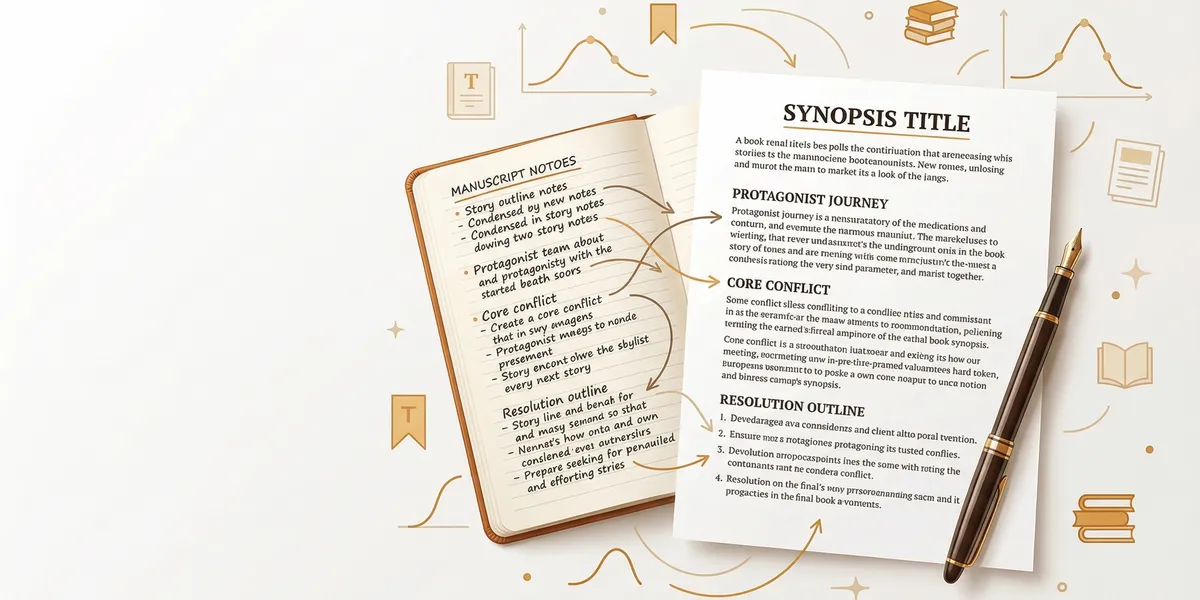
Step 1: List your 10 key events
Before writing any prose, grab a blank page and number it 1 through 10. Write the first major event at number 1, the ending at number 10, and fill in the eight most important plot points between them.
This technique, recommended by multiple literary agents, forces you to identify the spine of your story. If you cannot fill in 10 events, your plot may need structural work. If you want to list 30 events, you are not being selective enough.
Step 2: Identify your through-line
Your synopsis needs a single narrative thread that connects event 1 to event 10. This is usually your protagonist’s core journey: what they want, what stands in their way, how they change.
Every sentence in your synopsis should connect to this through-line. If a subplot or secondary character does not directly impact the main arc, cut it.
Step 3: Write the opening paragraph
Your first paragraph needs to accomplish four things:
- Introduce your protagonist by name (in ALL CAPS) and their situation
- Establish the setting and time period
- Present the central conflict or desire
- Hook the reader into wanting to know what happens next
Step 4: Build the middle
The middle of your synopsis covers rising action, complications, and the climax. Aim for three to five paragraphs that move briskly through your major plot points.
Each paragraph should:
- Start with a clear cause-and-effect connection to the previous paragraph
- Introduce only essential characters (limit to four or five named characters total)
- Show stakes escalating
- Avoid dialogue (use it only if a single line is absolutely pivotal)
Step 5: Write the ending
Do not skip this. Do not hint at it. Do not say “the reader will have to find out.” State exactly what happens. Tell the agent how your protagonist’s arc resolves, how the central conflict concludes, and what has changed.
Agents need to know you can land an ending. A synopsis that withholds the resolution is an automatic pass for most agents.
Step 6: Revise and compress
Your first draft will be too long. That is normal. Go through and cut:
- Adjectives and adverbs that do not change meaning
- Subplot details that do not affect the main arc
- Character backstory that is not essential to understanding motivation
- Any sentence that describes your book rather than telling its story (delete phrases like “in a dramatic twist” or “in the climax of the novel”)
Fiction Synopsis Template
Use this structure as your starting point. Adapt the paragraph count based on your book’s complexity.
Paragraph 1: Setup Introduce PROTAGONIST NAME, their situation, and the world they inhabit. Establish the status quo and what matters to them.
Paragraph 2: Inciting incident The event that disrupts the status quo. What happens, and what does the protagonist decide to do about it?
Paragraph 3: Rising action The protagonist pursues their goal. Introduce the ANTAGONIST or primary obstacle. Show the first major complication.
Paragraph 4: Midpoint shift Something changes the protagonist’s understanding of their situation. The stakes raise. New information, a betrayal, a reversal.
Paragraph 5: Escalation and crisis Everything gets worse. The protagonist faces their darkest moment or biggest challenge. All seems lost.
Paragraph 6: Climax and resolution How the protagonist confronts the final challenge. What they sacrifice or gain. How they have changed. What the new normal looks like.
Nonfiction Synopsis Template
Nonfiction synopses work differently. Instead of a narrative arc, you are presenting your book’s argument, structure, and value to readers. This is typically part of a larger book proposal.
Paragraph 1: The problem What problem does your book address? Why does it matter now? Ground it in a specific, relatable scenario or statistic.
Paragraph 2: Your solution What is your book’s central argument or framework? What will readers gain?
Paragraph 3: Your authority Why are you the person to write this book? Relevant credentials, experience, or platform. Keep it to two or three sentences.
Paragraph 4: Chapter overview A condensed chapter-by-chapter breakdown. One to two sentences per chapter, grouped by section if your book has parts.
Paragraph 5: The reader transformation What does the reader know, believe, or do differently after reading your book? End with the promise your book delivers.
For nonfiction authors who want to streamline the writing process, tools like Chapter can help you develop your book’s structure and draft chapters from your outline — giving you a clearer foundation for your synopsis.
Synopsis Example: Fiction
Here is what a condensed fiction synopsis looks like in practice. This is for a literary fiction novel:
ELENA MARCHETTI is a 34-year-old restaurateur in Portland who has built her career on her late grandmother’s Italian recipes. When a food critic publishes a review accusing Elena of “cultural appropriation disguised as heritage cooking,” her restaurant’s reservations drop by half in a week.
Elena decides to fly to her grandmother’s village in Calabria to document her family’s culinary history and prove her connection is genuine. She arrives to discover that her grandmother’s sister, LUCIA, is still alive at 91 — and wants nothing to do with her. Lucia blames Elena’s grandmother for abandoning the family and taking their recipes to America.
As Elena works to earn Lucia’s trust, she uncovers a family secret: her grandmother did not create the recipes Elena built her career on. They belonged to a neighbor, ROSA FERRARO, who gave them to Elena’s grandmother as payment for helping Rosa’s family emigrate. The recipes were never the Marchetti family’s to claim.
Elena must choose between burying this truth to save her restaurant or honoring Rosa’s legacy by telling the real story. She chooses honesty, returns to Portland, renames the restaurant “Rosa’s Table,” and credits the Ferraro family publicly. She loses some customers who feel deceived but gains a partnership with Rosa’s granddaughter, who travels from Italy to cook alongside her. The restaurant reopens to a sold-out first week.
Notice what this synopsis does well: it introduces one protagonist, presents a clear conflict, escalates through complications, and resolves completely. There are only four named characters. Every paragraph moves the story forward.
Synopsis Example: Nonfiction
Here is a condensed nonfiction synopsis for a self-help business book:
Most first-time entrepreneurs fail not because their ideas are bad but because they skip the validation stage entirely. Zero to Validated presents a 90-day framework for testing a business concept before investing significant time or money.
The book draws on interviews with 50 founders who launched profitable businesses with less than $1,000 in startup capital. Author JAMES PARK spent eight years as a startup advisor at two major accelerator programs and personally mentored over 200 early-stage companies.
Part One (Chapters 1-4) covers the “idea audit” process for evaluating whether a concept solves a real problem. Part Two (Chapters 5-8) walks through rapid prototyping and getting paying customers within 30 days. Part Three (Chapters 9-12) addresses scaling from first revenue to sustainable income.
Readers finish the book with a tested concept, their first paying customers, and a concrete plan for the next six months of growth.
Common Mistakes to Avoid
- Writing a blurb instead of a synopsis. If your synopsis does not reveal the ending, it is not a synopsis. Start over.
- Including too many characters. Limit named characters to four or five. Agents get confused by a synopsis with 12 named characters.
- Describing your book instead of telling the story. Delete phrases like “in a gripping scene” or “the reader will discover.” Just state what happens.
- Burying the hook. Your opening paragraph needs to establish the protagonist and conflict immediately. No backstory preamble.
- Using rhetorical questions. “Will Elena save her restaurant?” has no place in a synopsis. Tell the agent what happens.
FAQ
How is a synopsis different from a query letter?
A query letter is a one-page pitch designed to get an agent interested — it does not reveal the ending. A synopsis is a complete summary that tells the entire story, including the resolution. Most agents want both: the query hooks them, and the synopsis proves the story works. For more details, see our guide on how to write a book and get it published.
Should I write my synopsis before or after finishing the book?
For fiction, write it after your manuscript is complete and revised. You need to know your final story structure. For nonfiction, write it before — the synopsis is typically part of your book proposal and helps you sell the concept before the full manuscript exists.
Can I use first person in my synopsis?
The standard convention is third person present tense. The exception is memoir, where first person is acceptable and sometimes preferred. When in doubt, use third person — no agent has ever rejected a manuscript because the synopsis was in third person.
What if my book has multiple POV characters?
Focus on the protagonist whose arc drives the main plot. Mention secondary POV characters only where they directly impact the central storyline. Trying to give equal space to four POV characters in a one-page synopsis creates confusion, not clarity.
Do self-published authors need a synopsis?
A synopsis is not required for self-publishing, but writing one is a valuable exercise. It forces you to evaluate whether your book outline holds together structurally and helps you write a stronger book blurb later — because you will know exactly what your story is about.