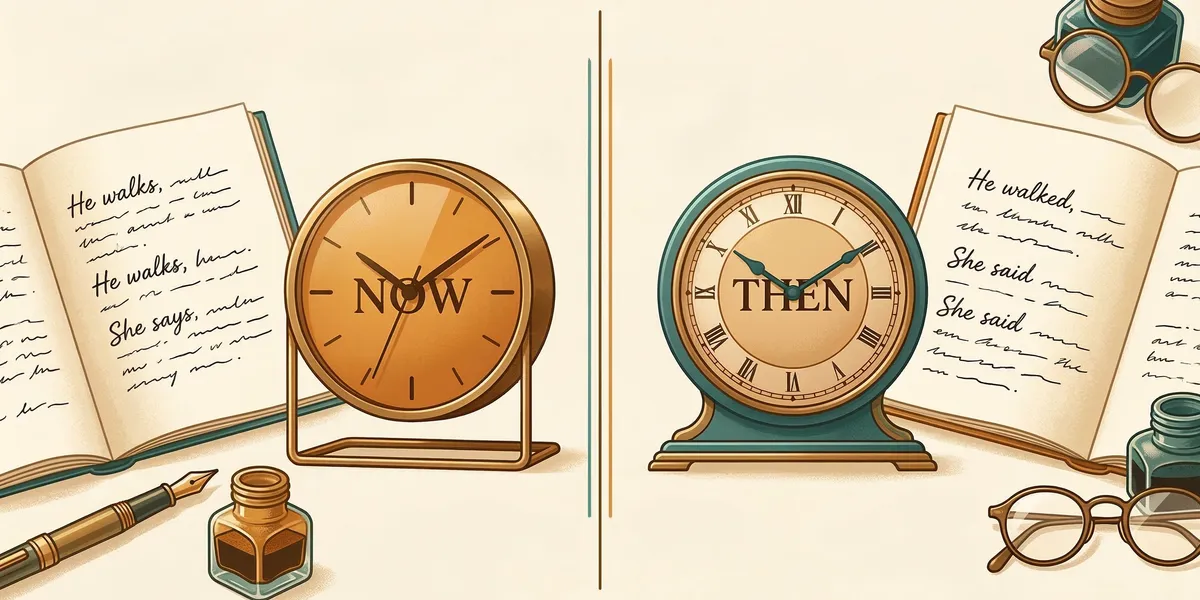
Present tense puts the reader inside the moment: I walk into the room and see her standing by the window. Past tense places the reader just behind it: I walked into the room and saw her standing by the window. The difference is one letter, one verb form — and it changes how the entire story feels.
What Each Tense Sounds Like
Past tense is the default of English-language fiction. It is how most people naturally tell stories aloud (“So I went to the store, and this guy walked up to me…”). It creates a sense of a narrator looking back on events — someone who survived the story and is now recounting it. There is an implied distance, a frame, a sense that the tale has already happened and the teller knows how it ends.
Present tense removes that distance. The narrator is not looking back. They are living it as the reader reads it. Events unfold in real time. There is no guarantee the narrator will survive, because the narrator does not yet know what comes next. The effect is immediacy — the reader is not hearing about events but witnessing them.
Here is the same moment in both:
Past: The door opened. A man stepped inside, carrying a gun that looked too heavy for his wrist. I reached for the phone, but he was already shaking his head.
Present: The door opens. A man steps inside, carrying a gun that looks too heavy for his wrist. I reach for the phone, but he is already shaking his head.
The past-tense version feels like a story being told. The present-tense version feels like a story happening.
When Present Tense Works
Present tense thrives in specific contexts. It is not a universally better choice — it is a tool that suits particular kinds of stories.
Young adult fiction — The YA genre has embraced present tense more than any other. The immediacy matches the emotional intensity of adolescent experience. Katniss Everdeen narrates The Hunger Games in present tense because her survival is uncertain and her emotions are raw. The reader is meant to feel the arena alongside her, not hear about it afterward.
Thrillers and suspense — Present tense creates a relentless forward momentum. The reader cannot relax into the comfortable distance of past tense. Every sentence is happening now, which naturally generates tension. If your story depends on the reader feeling unsafe, present tense amplifies that feeling.
Literary fiction — Many contemporary literary novels use present tense for its sense of interiority and presence. It can make mundane moments feel vivid and observed. When the prose itself is the experience — not just the delivery mechanism for plot — present tense keeps the reader inside each sentence.
First-person immediacy — Present tense pairs naturally with first person because it eliminates the implied survival of the narrator. In past tense, a first-person narrator is, by definition, someone who lived to tell the tale. In present tense, that guarantee disappears. The stakes increase.
When Past Tense Works
Past tense is the workhorse of fiction for good reason. It is flexible, familiar, and invisible — readers barely notice it, which means it never gets in the way of the story.
Most genres — Fantasy, science fiction, historical fiction, mystery, horror, romance, literary realism — the vast majority of published fiction across all genres uses past tense. Readers expect it. It does not draw attention to itself. This invisibility is an asset: the reader focuses on the story, not the tense.
Stories with complex timelines — Past tense makes it easier to move between time periods. You can shift from the narrative present to a flashback and back again without confusing the reader, because past tense already implies a temporal frame. In present tense, flashbacks require a shift to past tense — which can feel jarring if not handled carefully.
Longer novels — Present tense can feel exhausting over 100,000 words. The relentless immediacy that works in a tight thriller or a 300-page YA novel can become fatiguing in an 800-page epic. Past tense has a natural breathing rhythm that accommodates lengthy narratives.
Omniscient or third-person narration — While present tense can work in third person, it is more natural in first. Third-person present tense (She walks to the door. She opens it.) can feel clinical or screenplay-like. Third-person past tense (She walked to the door. She opened it.) feels like traditional storytelling.
The Pros and Cons
Present tense advantages:
- Urgency and immediacy — the reader lives the moment
- Natural tension — uncertainty about the narrator’s survival
- Freshness — it feels modern and energetic
- Emotional closeness — the reader is inside the character’s present experience
Present tense disadvantages:
- Can feel exhausting over long stretches
- Flashbacks require tense-shifting, which is tricky
- Some readers actively dislike it and will put the book down
- It limits the narrator’s ability to reflect — they cannot look back on events with perspective, because events have not happened yet
- It can feel mannered or self-conscious in the wrong context
Past tense advantages:
- Natural storytelling rhythm — readers barely notice it
- Flashbacks and time shifts are easier to manage
- Works in every genre and at every length
- Allows for reflection — the narrator can comment on events with the wisdom of hindsight
- Readers never complain about past tense
Past tense disadvantages:
- Less immediate — the reader is told about events rather than living them
- The narrator’s survival is implied, which can reduce tension
- It can feel distant for stories that need emotional intimacy
The Consistency Rule
Whatever tense you choose, maintain it. Tense shifts are one of the most common amateur mistakes in fiction, and they are immediately visible to editors and experienced readers.
A tense shift occurs when the narrative slips from one tense to another without purpose:
I walk into the room and see her standing by the window. She turned to face me and her eyes were red.
That passage starts in present and shifts to past mid-paragraph. The reader’s internal narrator stumbles. The story’s temporal reality becomes unreliable — not in an interesting way, but in a confusing one.
Intentional tense shifts are a different matter. Many present-tense novels shift to past tense for flashbacks, and this works because the shift is purposeful and consistent. The present-tense scenes are “now.” The past-tense scenes are “then.” The reader understands the system and follows it.
The rule: choose a tense and commit to it. If you shift, shift deliberately and consistently, not accidentally.
How to Handle Flashbacks in Present Tense
This is the trickiest craft challenge of present-tense fiction. If your narrative is in present tense, how do you step backward in time?
The standard technique is to shift to past tense for flashback sequences. The present tense establishes the narrative’s “now,” and the past tense signals “before.” When the flashback ends, you return to present tense, and the reader re-enters the current moment.
Keep flashbacks short. In a present-tense narrative, every departure from the present tense breaks the immediacy that is the whole point of the choice. A one-paragraph flashback is a brief dip. A five-page flashback risks losing the reader’s temporal footing entirely.
Signal the transition clearly. A white space break, a triggering object or memory, a shift in the prose’s rhythm — give the reader markers so they know when they have left “now” and when they have returned.
Famous Examples
Present tense: The Hunger Games by Suzanne Collins. Bright Lights, Big City by Jay McInerney (present tense and second person — you walk into the room). All the Light We Cannot See by Anthony Doerr. The Time Traveler’s Wife by Audrey Niffenegger (alternating).
Past tense: Harry Potter by J.K. Rowling. 1984 by George Orwell. The Great Gatsby by F. Scott Fitzgerald. To Kill a Mockingbird by Harper Lee. The Lord of the Rings by J.R.R. Tolkien.
The pattern is clear: past tense dominates the canon, but present tense has produced some of the most acclaimed and commercially successful fiction of the past four decades.
How to Choose
Ask yourself three questions:
What is the emotional distance between the reader and the character? If you want the reader pressed against the character’s skin, feeling every sensation in real time, present tense. If you want the reader to observe the character with some narrative breathing room, past tense.
How does your narrator relate to the events? If the narrator is living through the events without knowing the outcome, present tense creates that experience authentically. If the narrator is reflecting on events with the perspective of time — even subtly — past tense is the honest choice.
What does your genre expect? This is not about following rules blindly. It is about understanding reader expectations. A YA novel in present tense will feel natural to its audience. An epic fantasy in present tense will feel unusual, which may be exactly what you want — or it may be a barrier.
Writing Exercise
Take a scene from your current project — or write a new one — and draft it in both tenses. Read each version aloud. Notice where present tense creates energy and where it feels strained. Notice where past tense feels natural and where it feels distant. The right tense for your story will become obvious in the reading. Trust your ear.
Tense is not a rule. It is a lens. It determines how the reader experiences time inside your story — whether they are watching from a window or standing in the room. Neither is inherently better. Both have produced masterpieces. The craft is in matching the lens to the story you need to tell.