Kobo Writing Life vs Amazon KDP is not really an either-or choice. KDP is where most of your sales will come from, and it’s the only one of the two that prints paperbacks. Kobo Writing Life pays better on cheap and expensive ebooks, never asks for exclusivity, and reaches readers Amazon doesn’t. Most authors start on KDP. The real decision is whether you lock your ebook into KDP Select or add Kobo.
In this comparison, you’ll get:
- Ebook royalties side by side, with worked examples from $0.99 to $19.99
- How Kobo Plus and Kindle+ pay you, and why you can’t have both for the same ebook
- Payment timing, print, audiobooks, libraries and promotion tools
- The AI content rules on each platform, and an honest section on where both beat Chapter, the tool we build
Who wrote this: Chapter’s team. Chapter is an AI book writing tool, not a store or distributor, so it competes with neither platform. Every Kobo and KDP figure below links to their own help pages, checked on November 29, 2026.
Here’s the quick version first.
Kobo Writing Life vs Amazon KDP at a Glance
Kobo Writing Life (KWL) is Rakuten Kobo’s free self-publishing portal for ebooks and audiobooks. Amazon KDP (Kindle Direct Publishing) is Amazon’s free platform for Kindle ebooks, paperbacks and hardcovers.
| Feature | Kobo Writing Life | Amazon KDP |
|---|---|---|
| Cost to publish | Free | Free |
| Ebook royalty | 70% at $2.99 USD and up, no price cap | 70% at $2.99–$12.99 on Amazon.com, minus delivery fee |
| Below the 70% band | 45% | 35% |
| Above the 70% band | Still 70% | 35% |
| Delivery fee | None listed | $0.15 per MB on Amazon.com (70% option) |
| Print books | No | Paperback and hardcover |
| Subscription program | Kobo Plus, paid per minute read | Kindle+, paid by share of pages read |
| Exclusivity | Never required | Only if you enroll the ebook in KDP Select |
| Payment timing | 45 days after month end | About 60 days after month end |
| Minimum payout | CAD $50 | None for direct deposit |
| Libraries | OverDrive, 50% of library price | No ebook library channel listed |
| AI-generated books | Declined | Allowed, with disclosure |
That table settles most questions. The sections below cover the details that change the decision.
Which Pays a Higher Ebook Royalty, Kobo or KDP?
Kobo pays a higher ebook royalty at every price we tested. Kobo’s earnings page pays 70% of list price on original ebooks priced at $2.99 USD or more, and 45% below that. It lists a minimum for the 70% rate but no maximum, and no delivery fee.
KDP’s 70% option has a ceiling. Amazon’s list price requirements put the 70% band on Amazon.com at $2.99–$12.99, effective July 7, 2026. Price outside the band and you earn 35%. The digital pricing page adds a delivery cost of $0.15 per megabyte on Amazon.com.
Here’s what one ebook sale pays on each platform, assuming a 2 MB file sold in the US:
| Ebook list price | Kobo Writing Life | Kobo rate | Amazon KDP | KDP rate |
|---|---|---|---|---|
| $0.99 | $0.45 | 45% | $0.35 | 35% |
| $2.99 | $2.09 | 70% | $1.79 | 70% minus $0.30 |
| $4.99 | $3.49 | 70% | $3.19 | 70% minus $0.30 |
| $9.99 | $6.99 | 70% | $6.69 | 70% minus $0.30 |
| $14.99 | $10.49 | 70% | $5.25 | 35% |
| $19.99 | $13.99 | 70% | $7.00 | 35% |
The gap is small between $2.99 and $12.99. It gets large at the edges. A 99-cent series starter earns about 29% more per copy on Kobo, and a $19.99 box set earns roughly double.
Kobo’s no-cap rule is built for box sets
Kobo says so directly. Its exclusivity FAQ points out that Kobo has no price cap and suggests a bundle or box set “might be worth offering to your Kobo readers only.” On Amazon, the same $19.99 bundle drops to the 35% rate.
Per-copy royalty isn’t total income
KDP almost always earns more in total, because Amazon sells far more ebooks. A higher Kobo rate on a book that sells ten copies won’t beat a lower Amazon rate on a book that sells a hundred. Use Kobo’s rate to set your pricing, not to choose your main store. Our guide to pricing a self-published ebook covers where most genres land, and the KDP pricing guide goes deeper on Amazon’s bands.
Kobo Plus vs Kindle+: How Do the Subscriptions Pay?
Kobo Plus pays for minutes read, and Kindle+ pays for pages read. Both split a monthly pool among authors, but the rules around them are very different. The biggest difference is exclusivity: Kobo Plus asks for none, while Kindle+ only includes books enrolled in KDP Select.
How Kobo Plus pays
Kobo divides each month’s Kobo Plus subscription revenue by the total minutes subscribers spent reading. KWL authors earn 60% of that per-minute value for every minute spent in their book, according to Kobo’s Kobo Plus payment page.
Kobo’s Kobo Plus overview adds three details that matter:
- No exclusivity. Kobo states that “no exclusivity” is required to join.
- Every minute counts, including re-reads and books a reader abandons early.
- You pick territories. Kobo lists 34 countries, including the US, UK, Canada and Australia, and you can opt each book in or out per country.
How Kindle+ pays
Kindle+ is Amazon’s reading subscription, the program long known as Kindle Unlimited. KDP’s Kindle+ help page says books enrolled in KDP Select are automatically included. You earn from the KDP Select Global Fund based on your share of total pages read.
Kindle+ now includes audiobooks too, but KDP notes these are available in the US marketplace only for now. Our KDP Select guide explains how page reads are counted, and Kindle Unlimited pros and cons still applies under the new name.
The subscription trade-off
Kindle+ can be the bigger opportunity for genre fiction, because it sits inside Amazon’s much larger store. The price is exclusivity. Kobo Plus is smaller, but you can join it while selling on every other store.
Does KDP Select Stop You Publishing on Kobo?
Yes, KDP Select stops you selling the same ebook on Kobo. Amazon’s KDP Select enrollment rules say that during each 90-day term, your Kindle ebook “can only be distributed through KDP and public libraries.” Enrollment renews automatically unless you turn it off.
Your print editions can still go elsewhere. That doesn’t help with Kobo, though, because Kobo sells only ebooks and audiobooks.
So your realistic options are:
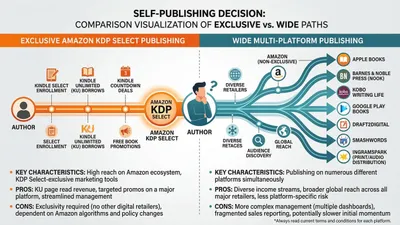
- Exclusive: ebook in KDP Select (Kindle+, Countdown Deals, Free Book Promotions), no Kobo ebook
- Wide: ebook on KDP without Select, plus Kobo, Apple Books, Google Play Books and others
- Split catalog: some titles in Select, others wide
A split catalog can work well: you might keep a new series in Select while it builds, and put older or standalone titles wide. Our wide vs exclusive on KDP breakdown walks through that decision in detail.
Leaving Select to go wide
Turn off automatic renewal in your KDP Bookshelf and wait for the current 90-day term to end. Only then upload the ebook to Kobo. Publishing on Kobo mid-term breaks the exclusivity terms you agreed to.
How Do Payments Compare?
Kobo pays sooner, but KDP has no minimum for direct deposit. That difference matters most when you’re just starting out and your monthly earnings are small.
Kobo’s payment page says it pays 45 days after the end of each monthly sales period, on the 15th, once your earnings reach CAD $50. Smaller amounts roll forward until you cross the threshold. Ebooks, audiobooks, Kobo Plus minutes, library sales and partner-store sales all count toward it.
KDP’s payment timing page says payment comes about 60 days after the end of the month in which the sale was reported. Only wire and check payments need a minimum balance.
In practice: January earnings arrive around March 15 from Kobo if you’ve reached CAD $50, and around the start of April from Amazon. A new author on Kobo may wait several months for a first payment.
Print, Audiobooks and Libraries: Where Each Platform Fits
KDP covers print, and Kobo covers libraries. Each platform reaches a format the other doesn’t, which is the strongest argument for using both.
Print books: KDP only
Kobo’s own about page is clear: Kobo offers “only eBooks and audiobooks” and no print-on-demand. KDP prints paperbacks and hardcovers one copy at a time.
KDP’s paperback royalty page pays 60% of list price minus printing at $9.99 and up on Amazon.com, and 50% at $9.98 and below. Expanded Distribution to other retailers pays 40% minus printing. If you want print outside Amazon too, our IngramSpark vs KDP comparison covers the main alternative.
Audiobooks: both, on different terms
Kobo pays 45% of list price on à la carte audiobook sales at $2.99 USD and up, 35% below that, and 32% on subscription token purchases, per its earnings page. It accepts AI-narrated audiobooks if you list the narrator as a synthesized voice.
KDP now offers audiobooks narrated with Amazon’s virtual voice, and enrolled audiobooks can join Kindle+ alongside the ebook. Human-narrated audiobooks for Amazon typically go through ACX.
Libraries: Kobo’s quiet advantage
Kobo distributes to libraries through OverDrive and pays 50% of your library price when a library buys your book. Libraries can also pay 10% of your library price for a single checkout. KDP’s help pages list no comparable ebook library channel, though KDP Select’s terms do allow public library distribution.
Marketing Tools: Amazon Ads vs the Kobo Promotions Tab
KDP gives you far more ways to market your book. You get Amazon Ads, A+ Content and Author Central, and with Select, Kindle Countdown Deals and Free Book Promotions. Our guides to Amazon Ads for authors and running a Kindle Countdown Deal cover how they work.
KDP Select also unlocks the 70% rate in Japan, India, Brazil and Mexico, according to the KDP Select page. Wide books earn 35% in those four stores.
Kobo’s main tool is the Promotions tab in your dashboard. Kobo’s promotions page describes two cost models: a flat fee, or an extra percentage of what you earn during the sale. Kobo says its most common percentage fee is 10%, and if nothing sells, you pay nothing.
Promotions include promo-code discounts, price drops and multi-buy deals. Kobo’s own example: a $10 book at 30% off pays you $4.90 instead of $7.00. There’s one catch for AI users. Submitting a book to a promotion means you verify it was not “authored by LLMs.”
What Are the AI Rules on Kobo and KDP?
Kobo is much stricter about AI than Amazon. Kobo’s rejection guidelines list books that are “Wholly or partially AI generated” among the reasons a title is declined. Its content policy also bars content generated primarily by automated tools that lacks genuine human effort.
KDP allows AI-generated books but asks you to say so. Its content guidelines require you to disclose AI-generated text, images or translations when you publish. You don’t have to disclose AI-assisted work, which KDP defines as content you created yourself and then edited or refined with AI tools.
What this means for you: if you draft with AI, KDP is the safer home. Kobo hasn’t published where it draws the line between light help and heavy generation. A book you substantially rewrote and shaped yourself is in a different position from one published as generated, but that’s our reading, not Kobo policy. Our guide to Amazon KDP’s AI rules covers the Amazon side.
Can You Use Both Kobo Writing Life and KDP?
Yes, and most wide authors do. Kobo never requires exclusivity, so you can sell the same ebook on Kobo and KDP at the same time, as long as that ebook isn’t enrolled in KDP Select.
Two setup details save trouble:
- Don’t double-distribute to Kobo. Kobo’s exclusivity FAQ asks authors not to send books through another distributor if they upload directly. If an aggregator like Draft2Digital or IngramSpark also ships to Kobo, switch off its Kobo channel.
- Keep your ebook price at least 20% below print on Amazon. KDP’s digital pricing page requires this for the 70% rate whenever a physical edition exists.
A typical wide setup looks like this: ebook and paperback on KDP, ebook direct on Kobo, and other ebook stores either direct or through an aggregator. Our Kobo Writing Life review covers Kobo’s dashboard, its reach and who should skip it, and our KDP review does the same for Amazon.
Where Kobo Writing Life and KDP Beat Chapter
Chapter writes books. It isn’t a store, a printer or a distributor, so neither platform is a direct competitor. Both still do real jobs that Chapter doesn’t, and on a few points they’re simply the better choice.
Where KDP beats Chapter
- It sells your book. KDP lists your book on Amazon, takes every order and pays royalties. Chapter’s writing software puts nothing on sale.
- It prints on demand. KDP prints paperbacks and hardcovers with no inventory. Chapter doesn’t print.
- It’s free. KDP costs nothing until you sell. Chapter costs $97 one time and has no free tier or trial.
- It brings buyers. Amazon search, Kindle+ and Amazon Ads put your book in front of readers. Chapter has no storefront and no audience of its own.
Where Kobo Writing Life beats Chapter
- It reaches readers outside Amazon. Kobo’s stores, partner retailers, Kobo Plus and OverDrive libraries reach readers who never shop on Amazon.
- It costs nothing to join. You can upload a finished ebook to Kobo in an afternoon for $0.
- It suits fully human-written books best. Kobo’s AI rules favor books written by people. If you want no question marks over AI policy at Kobo, writing every word yourself is the safest route, and Chapter can’t offer that.
A shared limit
Neither platform writes, outlines or edits a word for you. You upload a finished, formatted file. If the manuscript isn’t done, neither one can help.
Why We Recommend Chapter for Writing the Book First
Our Pick — Chapter
Kobo and KDP both start at the same place: a finished manuscript. Chapter gets you there. You bring the idea, your expertise or a half-finished draft, approve the plan, and Chapter writes and edits the complete book, for nonfiction or fiction. Then you publish it on KDP, and on Kobo once you’ve rewritten it in your own voice.
Best for: authors who want to publish but don’t have a finished manuscript yet Pricing: $97 one time, 2 books included (fiction or nonfiction), 30-day money-back guarantee Why we built it: most authors comparing publishing platforms are stuck one step earlier, on the writing
More than 10,000 authors have used Chapter, and it has been featured in USA Today and The New York Times. You keep 100% of the rights, so you can publish wherever you want. Our guide on how to write a book with AI shows the process, and our Chapter review covers what it does and doesn’t do.
Be honest with yourself about Kobo, though. Chapter’s output is AI-drafted, and KDP will ask you to disclose that. If Kobo is a key store for you, plan real rewriting time before you upload, and read Kobo’s policy yourself.
If you want help with the publishing side too, Chapter’s Publishing AI ($997 a year as of November 2026) handles editing, covers, ISBNs and your Amazon listing, then wider store distribution. You publish from your own Amazon account, and Chapter isn’t the publisher of record.
The Verdict: Which Should You Choose?
Choose Amazon KDP first if you want the most sales, a paperback or hardcover, Kindle+ page-read income or Amazon Ads. For most indie authors, Amazon is where the readers are.
Add Kobo Writing Life if you publish wide, price ebooks under $2.99 or over $12.99, sell box sets, want library income through OverDrive, or want readers in Kobo’s stores and partner retailers. It’s free, so the only cost is setup time.
Stay KDP-only with Select if your income depends on Kindle+ page reads, as it often does in romance and long series fiction. Re-check that choice each 90-day term. For the bigger picture on publishing, see our guide on how to self-publish a book, or compare a third store in Barnes & Noble Press vs KDP.
Kobo and KDP sell the book, but neither one writes it. If you still need the manuscript, Chapter for nonfiction and Chapter for fiction write the complete book for $97 one time, with 2 books included, no subscription and a 30-day money-back guarantee.
FAQ
Is Kobo Writing Life better than Amazon KDP?
Kobo Writing Life is not better than Amazon KDP overall, but it beats KDP on some terms. Kobo pays 70% on ebooks from $2.99 with no price cap, 45% below that, and never requires exclusivity. KDP wins on sales volume, print books and marketing tools, so most authors publish on KDP first and add Kobo.
Can you publish on Kobo Writing Life and KDP at the same time?
Yes, you can publish on Kobo Writing Life and KDP at the same time. Kobo is non-exclusive. The only conflict is KDP Select, which keeps your ebook exclusive to Amazon for each 90-day term. To sell the ebook on Kobo, leave Select first and let the current term end.
What is the Kobo royalty rate compared to KDP?
The Kobo Writing Life royalty rate is 70% on ebooks priced at $2.99 USD or more and 45% below that, with no upper limit or delivery fee. KDP pays 70% on ebooks priced $2.99–$12.99 on Amazon.com, minus a delivery fee of $0.15 per MB, and 35% outside that band.
Is Kobo Plus exclusive like Kindle+?
No, Kobo Plus is not exclusive. You can opt a book into Kobo Plus and still sell it on Amazon, Apple and Google. Kindle+ only includes books enrolled in KDP Select, which requires ebook exclusivity to Amazon. Kobo Plus pays per minute read; Kindle+ pays by share of pages read.
Does Kobo Writing Life accept AI-generated books?
Kobo Writing Life declines books that are wholly or partially AI generated, according to its rejection guidelines, and its promotions require you to confirm a book was not authored by LLMs. Amazon KDP accepts AI-generated books but requires you to disclose AI-generated text, images or translations when you publish.