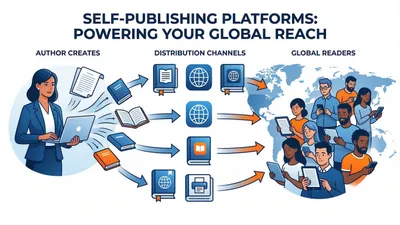
Lulu and Amazon KDP are the two most popular print-on-demand platforms for self-published authors — but they solve completely different problems. KDP dominates Amazon sales. Lulu wins on print quality and wide distribution.
In this comparison, you’ll learn:
- Which platform pays higher royalties (and when)
- Where each platform beats the other on print quality, formats, and speed
- The smartest strategy for using both platforms together
- How to write your book faster before you even choose a platform
Here’s how they stack up in 2026.
At a Glance: Lulu vs KDP Comparison
| Feature | Amazon KDP | Lulu |
|---|---|---|
| Best For | Amazon sales, ebooks, speed | Premium prints, wide distribution, direct sales |
| Publishing Speed | 24–72 hours | 3–7 days |
| Ebook Publishing | Excellent (Kindle ecosystem) | Limited |
| Paperback Quality | Good (standard) | Better (heavier paper stock) |
| Hardcover Options | Basic casewrap | Casewrap, dust jacket, more trim sizes |
| Distribution | Amazon-only (primary) | Amazon, Barnes & Noble, libraries, global retailers |
| Direct Sales | No | Yes (Shopify/WooCommerce integration) |
| Royalty Rate | 60% list minus print cost | 80% direct, variable via distribution |
| ISBN | Free (Amazon-restricted) | Free (wider distribution) |
| Print Cost (150pp B&W) | ~$2.80 | ~$5.26 |
| Setup Cost | Free | Free |
What Is Amazon KDP?
Amazon KDP (Kindle Direct Publishing) is Amazon’s self-publishing platform that lets you publish ebooks and print-on-demand paperbacks and hardcovers directly on the world’s largest bookstore.
KDP is where most self-published authors start — and for good reason. You get instant access to Amazon’s massive customer base, Prime eligibility, and the Kindle ecosystem. Publishing takes 24–72 hours, and there are zero upfront costs.
The trade-off? KDP is Amazon-centric. Your print books primarily sell on Amazon, and you don’t get customer data or direct sales options. If you want to learn the full platform, check out our complete KDP guide.
What Is Lulu?
Lulu is a print-on-demand platform and global distribution service that focuses on print quality, format flexibility, and selling beyond Amazon.
Founded in 2002, Lulu offers heavier paper stocks, more hardcover options, specialty formats (spiral-bound, photo books, calendars), and direct sales through its Shopify and WooCommerce integrations. Distribution runs through Ingram’s network, reaching bookstores, libraries, and retailers worldwide.
The trade-off? Slower processing, higher print costs, and limited ebook capabilities compared to KDP.
Print Quality: Lulu Wins
This is where Lulu genuinely outperforms KDP.
Lulu uses 60# paper stock as standard — heavier than KDP’s variable 50–61# range. You’ll notice the difference when you hold both books. Lulu’s pages feel more substantial.
For color printing, Lulu has a clear edge. If you’re publishing children’s books, cookbooks, or art books with color interiors, Lulu produces better color fidelity and consistency. KDP handles standard black-and-white paperbacks well, but color quality can vary between print runs.
Lulu also offers premium black-and-white printing — an option KDP doesn’t provide. For authors who care about the physical reading experience, this matters.
The caveat: Lulu’s higher quality comes at a higher price. A standard 150-page black-and-white paperback costs roughly $5.26 on Lulu versus $2.80 on KDP. That difference directly affects your margins. Compare this to IngramSpark’s pricing in our KDP vs IngramSpark breakdown.
Format Options: Lulu Offers More Flexibility
KDP covers the basics well — standard paperbacks and basic casewrap hardcovers in common trim sizes. For most fiction and nonfiction authors, that’s enough.
Lulu goes further:
- Hardcovers: Both casewrap and dust jacket options with more trim sizes
- Spiral binding: Perfect for workbooks, cookbooks, and anything that needs to lie flat
- Photo books and calendars: Specialty formats KDP doesn’t support
- Square formats: Available on Lulu, not on KDP
- 80# and 100# paper: For photo books, magazines, and premium products
If you’re publishing a standard novel or nonfiction book, KDP’s format options are perfectly fine. But if you need premium hardcover options, Lulu gives you more to work with.
Distribution: Different Strengths
This is where the platforms diverge most.
KDP’s Distribution
KDP puts your book on Amazon — the world’s largest bookstore. That means:
- Instant access to millions of active book buyers
- Prime eligibility for print books
- Full algorithmic ranking and recommendation support
- Kindle Unlimited access (if you enroll in KDP Select)
The limitation? KDP distribution is Amazon-centric. Many brick-and-mortar bookstores and library systems won’t stock KDP-printed books. You can enable “expanded distribution,” but it’s limited and pays lower royalties.
Lulu’s Distribution
Lulu distributes through Ingram’s global network, which means:
- Barnes & Noble, both online and in-store ordering
- Library systems worldwide
- Independent bookstores
- International retailers
Important caveat: If you use Lulu to distribute to Amazon, your book won’t get Prime eligibility, won’t rank as well in Amazon’s algorithm, and you’ll earn less due to the wholesale discount. For Amazon sales specifically, KDP always wins.
For a deeper look at this strategic decision, read our guide on wide vs exclusive publishing.
Royalties and Pricing: It Depends on Where You Sell
Neither platform charges upfront fees. Both are free to use. The difference is in how they calculate what you earn.
KDP Royalties
KDP pays 60% of list price minus printing costs for paperbacks sold on Amazon. For ebooks, you get up to 70% royalty (on books priced $2.99–$9.99).
Example: A $14.99 paperback with a $2.80 print cost earns you roughly $6.19 per sale on Amazon.
KDP pays via direct deposit, 60 days after the end of the month in which the sale occurred.
Lulu Royalties
Lulu’s direct sales pay 80% of retail price minus print cost. When selling through distribution (bookstores, Amazon via Ingram), the retailer takes a cut first — typically 40–55% of list price.
Example: That same $14.99 paperback with a $5.26 print cost earns roughly $6.73 through Lulu direct sales — but only $1.48 through distribution after the retailer’s 55% cut.
Lulu pays via PayPal monthly, with a one-month delay (May sales pay at the end of June, minimum $5 threshold).
Bottom line: KDP pays more on Amazon. Lulu pays more on direct sales. Your earnings depend entirely on where your readers buy. For most authors, Amazon is where the volume is. To understand the full financial picture, see our breakdown of self-publishing costs.
Ebooks: KDP Wins Easily
This isn’t close. KDP gives you access to the Kindle Store — the world’s dominant ebook marketplace — plus Kindle Unlimited enrollment for page-read royalties.
Lulu offers ebook distribution through third-party channels, but it’s not competitive with KDP for ebook sales. If you want to sell ebooks outside Amazon, platforms like Draft2Digital or Smashwords are better options than Lulu.
For ebooks, publish on KDP. Full stop. Our guide to publishing on Amazon for free walks you through the entire ebook setup process.
Speed: KDP Is Faster
KDP publishes your book to Amazon within 24–72 hours after approval. For authors who publish frequently or need to move fast, this speed is unbeatable.
Lulu’s processing takes longer — typically 3–7 days before your book is available, and distribution to external retailers can take additional weeks to propagate.
If you’re launching a book on Amazon with a time-sensitive marketing plan, KDP’s speed gives you tighter control over your launch window.
ISBNs: Both Offer Free Options
Both platforms provide free ISBNs, but with different restrictions:
- KDP’s free ISBN ties your book to Amazon’s imprint, limiting distribution elsewhere
- Lulu’s free ISBN allows wider distribution but still lists Lulu as the publisher of record
For maximum control and professional appearance, buying your own ISBN from Bowker (US) or your national agency is the better play. Your own ISBN lets you list your publishing imprint and distribute anywhere without platform restrictions.
If you’re serious about self-publishing as a business, owning your ISBNs is worth the investment.
Customer Support: Mixed Reviews for Both
Neither platform is known for stellar support.
KDP offers automated ticket-based support with responses within 24–72 hours. Getting a human who understands your specific issue can take multiple rounds. The KDP Community forums are often more helpful than official support.
Lulu provides email support and a knowledge base. Response times are generally slower than KDP, but authors report more personalized responses when they do hear back.
Can You Use Both Platforms?
Yes — and most successful self-published authors do exactly this.
The smartest strategy is:
- Publish ebooks and paperbacks on KDP for Amazon sales, Kindle Unlimited, and Prime eligibility
- Use Lulu for hardcovers and premium formats that KDP can’t match
- Use Lulu’s direct sales integrations for selling from your own website
- Use Lulu’s Ingram distribution for bookstores and libraries
Critical rule: Don’t publish the same paperback format on both platforms for Amazon distribution. If you sell a paperback on KDP and also distribute the same paperback to Amazon through Lulu, you’ll create competing listings and lose KDP’s algorithmic advantages.
Keep each platform in its lane. KDP owns Amazon. Lulu owns everything else. For a full comparison of all your distribution options, check our best self-publishing platforms guide.
Write Your Book First — Then Choose a Platform
Platform debates only matter after you have a manuscript. The biggest bottleneck for most authors isn’t choosing between Lulu and KDP — it’s finishing the book.
Our Pick — Chapter
Chapter is an AI writing assistant built specifically for book authors. It helps you outline, draft, and refine a full-length book — not just generate random text. Over 2,147 authors have used Chapter to create 5,000+ books, and the platform has been featured in USA Today and the New York Times.
Best for: Authors who want to go from idea to publishable manuscript faster Pricing: $97 one time, 2 books included (fiction or nonfiction), 30-day money-back guarantee Why we built it: Most authors stall during the writing phase, not the publishing phase. Chapter helps you get to a finished draft so you can actually use platforms like KDP and Lulu.
Once your manuscript is ready, you can format and publish on both KDP and Lulu the same week. Our self-publishing tools guide covers the full toolkit you’ll need.
The Verdict: KDP for Amazon, Lulu for Everything Else
Choose KDP if you want maximum Amazon visibility, fast publishing, strong ebook sales, and the highest volume of readers. KDP is the default choice for most self-published authors — especially fiction writers who rely on Kindle Unlimited and Amazon’s recommendation engine.
Choose Lulu if you need premium print quality, hardcover flexibility, bookstore and library distribution, or direct sales from your own website. Lulu is the better choice for authors selling premium editions, specialty formats, or building a direct-to-reader business.
Choose both if you’re serious about maximizing reach. The winning strategy is KDP for Amazon and ebooks, Lulu for hardcovers, wide distribution, and direct sales. Most successful self-published authors use a multi-platform approach.
FAQ
Is Lulu Better Than KDP?
Lulu is better than KDP for premium print quality, hardcover options, and wide distribution to bookstores and libraries. KDP is better for Amazon sales, ebook publishing, and publishing speed. Most authors use both platforms — KDP for Amazon and ebooks, Lulu for hardcovers and wide distribution.
Is Lulu Print on Demand Free?
Yes, Lulu’s print-on-demand service is completely free to use. You pay no upfront fees — Lulu deducts printing costs from each sale. You only pay for books when they sell or when you order author copies at print cost. The same is true for KDP.
Can You Sell Lulu Books on Amazon?
You can distribute Lulu books to Amazon through Lulu’s Global Distribution network (powered by Ingram). However, these books won’t qualify for Prime shipping, won’t rank as well in Amazon’s algorithm, and you’ll earn lower royalties due to the wholesale discount. For Amazon sales, publishing directly on KDP is always the better option.
What Is the Best Self-Publishing Platform for Beginners?
The best self-publishing platform for beginners is Amazon KDP because of its zero upfront cost, fast setup, and access to the world’s largest book marketplace. You can publish your first book on Amazon for free and start earning royalties within days.
Should I Use Lulu or IngramSpark for Wide Distribution?
Both Lulu and IngramSpark distribute through Ingram’s network, but they differ on pricing and control. Lulu charges no setup fees and is simpler to use. IngramSpark offers more granular control over distribution settings and discount structures. For a full comparison, see our IngramSpark vs KDP breakdown — many of the distribution differences apply to Lulu as well.