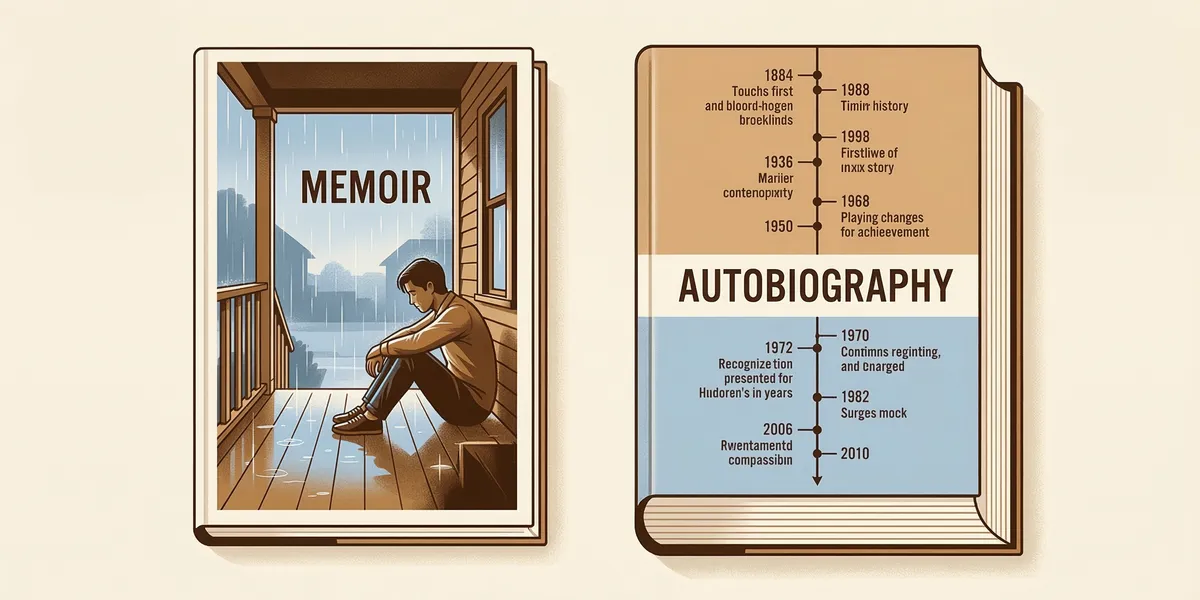
A memoir focuses on a specific theme or period of your life, while an autobiography covers your entire life story from beginning to present. That single distinction shapes everything else — structure, tone, scope, and who typically writes each form.
Both fall under the umbrella of life writing, but they serve different purposes and read very differently. Here is how they compare.
Memoir vs Autobiography at a Glance
| Memoir | Autobiography | |
|---|---|---|
| Scope | One theme, period, or relationship | Entire life, birth to present |
| Structure | Thematic, nonlinear | Chronological, sequential |
| Focus | Emotional truth and meaning | Factual record of events |
| Tone | Personal, reflective, literary | Authoritative, documentary |
| Length | 50,000–80,000 words typical | 80,000–150,000+ words typical |
| Who writes them | Anyone with a compelling story | Usually public figures |
| Reads like | A novel | A historical account |
What Is a Memoir?
A memoir is selective by design. Rather than documenting every year of your life, it zeroes in on a specific theme — addiction, family, identity, a particular era — and explores it deeply.
The best memoirs read like novels. They use scene, dialogue, and narrative arc to pull readers through a focused story. The writer is both the narrator and a character shaped by the events on the page.
Emotional truth matters more than encyclopedic accuracy. A memoirist might compress timelines, omit entire decades, or rearrange events slightly to serve the story’s emotional logic. The goal is meaning, not a comprehensive record.
Notable memoir examples
- Educated by Tara Westover — growing up in a survivalist family and pursuing education
- The Glass Castle by Jeannette Walls — a childhood defined by eccentric, neglectful parents
- Born a Crime by Trevor Noah — race and identity in apartheid-era South Africa
- When Breath Becomes Air by Paul Kalanithi — a neurosurgeon facing terminal illness
- Wild by Cheryl Strayed — grief and self-discovery on the Pacific Crest Trail
Notice the pattern. Each book takes one slice of life and goes deep rather than wide.
What Is an Autobiography?
An autobiography is a comprehensive, chronological account of a person’s entire life, typically written by the subject themselves. It starts at the beginning — birth, childhood, formative years — and moves forward through each major chapter of the person’s life.
The tone is more documentary than literary. Autobiographies prioritize factual accuracy and historical context over emotional arc. They often include dates, names, places, and verifiable details that situate the personal story within a broader public record.
Autobiographies are most commonly written by people whose entire lives are the story — political leaders, cultural icons, historical figures. The assumption is that readers want the full picture, not just one chapter.
Notable autobiography examples
- Long Walk to Freedom by Nelson Mandela — from rural childhood through presidency
- The Autobiography of Malcolm X (as told to Alex Haley) — a complete life transformed by faith and activism
- I Know Why the Caged Bird Sings by Maya Angelou — the first of seven volumes covering her full life
- The Diary of a Young Girl by Anne Frank — a real-time autobiographical account of life in hiding
The Lines Blur More Than You Think
Here is where the distinction gets interesting. Many books marketed as autobiographies are actually memoirs — and vice versa.
Becoming by Michelle Obama is a good example. Publishers and bookstores often shelve it as an autobiography, and it does move chronologically through her life. But it reads like a memoir. It is thematic, reflective, and selective about what it includes. It focuses on identity, ambition, and public service rather than cataloging every event.
The reverse also happens. Some memoirs span so much of a person’s life that they functionally become autobiographies.
The publishing industry does not enforce strict boundaries between the two. What matters is the writer’s approach: Are you capturing the full record, or are you finding the story within the record?
Which Should You Write?
Write a memoir if:
- You have a specific story, theme, or period that shaped who you are
- You want the freedom to write with literary style and emotional depth
- Your audience does not already know your life story
- You are drawn to showing what an experience meant, not just what happened
Write an autobiography if:
- Your entire life arc is the story people want to hear
- You are a public figure and readers expect the full account
- You want to create a comprehensive historical record
- Chronological completeness matters to your purpose
For most writers, the answer is memoir. You do not need to be famous to write a powerful one. You need a compelling theme and the willingness to go deep.
If you are ready to start writing either form, Chapter.pub’s nonfiction software helps you organize and draft your life story with AI-assisted structure — whether you are building a focused memoir or a full autobiography.
Frequently Asked Questions
Can a book be both a memoir and an autobiography?
In practice, yes. The categories exist on a spectrum. A book that covers most of someone’s life but does so through a thematic lens sits somewhere between the two. Publishers choose the label that fits the marketing, but the writing itself does not always fall neatly into one box.
Is a memoir fiction or nonfiction?
A memoir is nonfiction. It is based on real events from the author’s life. However, memoirs use literary techniques borrowed from fiction — scene-setting, dialogue, narrative arc — which is why they often read like novels. The events are real; the craft is storytelling.
Do you need to be famous to write a memoir?
No. Memoirs are for anyone with a story worth telling. Most bestselling memoirs are written by people who were unknown before the book. What makes a memoir compelling is the specificity and emotional honesty of the story, not the author’s prior fame.