An omniscient narrator is a narrative voice that knows everything — every character’s thoughts, the past, the future, and events happening simultaneously in different locations. It is the oldest and most expansive point of view in fiction, the voice of a storyteller who sees the entire world of the story at once.
What Makes a Narrator Omniscient
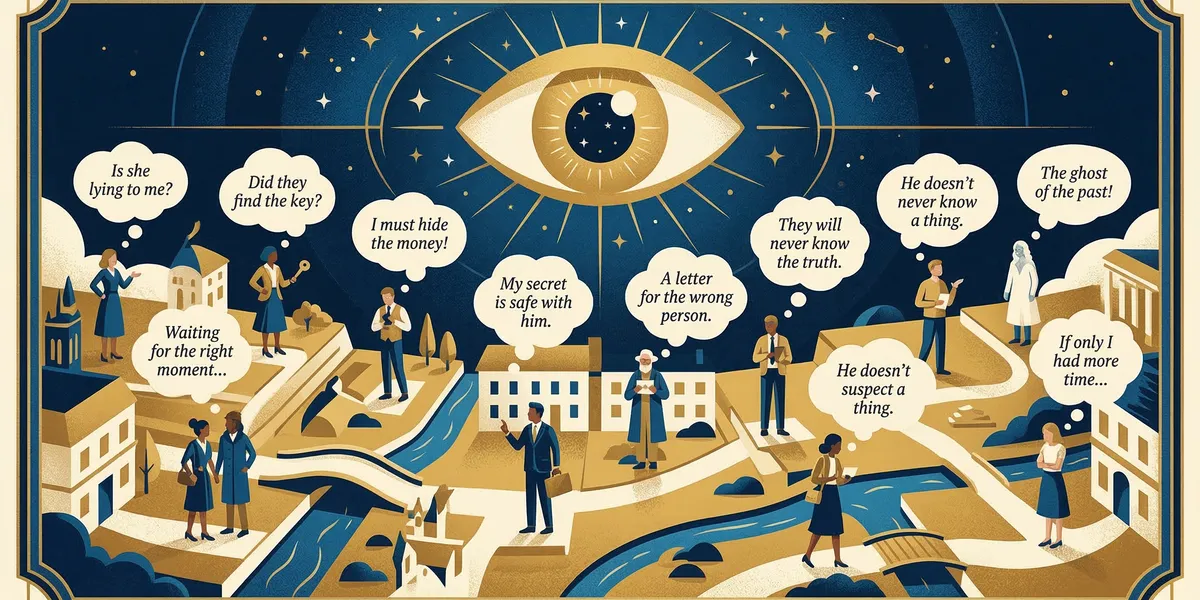
The word “omniscient” means all-knowing, and that is exactly what this narrator is. Unlike a first-person narrator locked inside one character’s skull, or a third-person limited narrator tethered to a single perspective, the omniscient narrator moves freely. It can reveal what the hero is thinking, then cross the continent to show what the villain is planning, then pull back to describe what neither of them knows yet.
This narrator has authority. It can summarize years in a sentence. It can comment on events. It can tell the reader things no character in the story could possibly know. That authority is the defining feature — not just access to multiple characters’ thoughts, but the power to interpret, judge, and shape the reader’s understanding of the story from a position above it.
Types of Omniscient Narration
Not all omniscient narrators work the same way. The voice can range from invisible to deeply opinionated.
Third-Person Omniscient (Classic)
This is the “god-like” narrator. It sees everything, reports everything, and moves between characters and timelines with complete freedom. The narrator does not draw attention to itself. It simply knows.
Tolkien uses this in The Lord of the Rings. The narrator follows Frodo into Mordor, then cuts to Aragorn at Helm’s Deep, then describes the history of a kingdom that fell three thousand years ago. The voice is authoritative but restrained — a chronicler with perfect knowledge.
Limited Omniscient
This narrator knows everything but chooses to stay close to one character at a time. It differs from strict third-person limited because the narrator retains editorial authority. It can pull back, offer a wider perspective, or make observations the focal character would never make.
Think of it as a camera that usually sits on one character’s shoulder but occasionally rises to give an aerial view. The narrator is not trapped in any single consciousness — it simply prefers proximity.
Intrusive Omniscient
Here the narrator has opinions and is not shy about sharing them. It comments on the characters, addresses the reader directly, and makes judgments about the events of the story. The narrator becomes a character in its own right — not a participant in the plot, but a presence with personality.
Dickens is the master of this. The opening of A Tale of Two Cities — “It was the best of times, it was the worst of times” — is pure narrator, pure opinion, delivered with theatrical authority before a single character appears on the page.
Famous Examples
The Lord of the Rings — J.R.R. Tolkien
Tolkien’s narrator commands an enormous scope. It tracks dozens of characters across multiple storylines, drops into Elvish history without warning, and describes landscapes no character is present to observe. The voice is calm, measured, and deeply knowledgeable — a historian recounting events of great importance.
Pride and Prejudice — Jane Austen
Austen’s omniscient narrator is one of the most famous in English literature, largely because of its irony. “It is a truth universally acknowledged, that a single man in possession of a good fortune, must be in want of a wife.” The narrator knows this is not actually a universal truth. The narrator knows the reader knows. That knowing distance — the gap between what the characters believe and what the narrator reveals — is what makes Austen’s voice so distinctive.
Her narrator moves between characters’ perspectives but always maintains its own dry, perceptive authority. It is a perfect example of the omniscient narrator as an unreliable guide — not because it lies, but because its irony forces the reader to think critically about what is being said.
A Tale of Two Cities — Charles Dickens
Dickens uses the intrusive omniscient narrator to its fullest. His narrator moralizes, philosophizes, and addresses the reader with the confidence of a stage performer. The voice is inseparable from the story’s emotional power. Remove the narrator’s commentary and you lose half the novel.
The Hitchhiker’s Guide to the Galaxy — Douglas Adams
Adams proves that omniscient narration is not limited to serious literary fiction. His narrator is absurd, digressive, and cosmically detached — describing the destruction of Earth with the same casual tone it uses to discuss towels. The narrator’s voice is the primary source of comedy. The characters are almost secondary to the narrator’s observations about the universe.
Omniscient vs Third-Person Limited
This is the distinction that trips up most writers, so it is worth being precise.
A third-person limited narrator is confined to one character’s perception. It can only report what that character sees, hears, thinks, and feels. If the character does not notice the gun on the table, the narrator cannot mention it.
An omniscient narrator has no such restriction. It can mention the gun, tell the reader who put it there, describe what three other characters in three other rooms are thinking about it, and then note that the gun will not actually matter until chapter twelve.
The key difference is authority. A limited narrator is a lens. An omniscient narrator is a voice — one that exists independently of any character and can do things no character can do: summarize decades, compare characters who have never met, foreshadow events, and offer judgments.
Some writers use what looks like omniscience but is actually “head-hopping” — jumping between characters’ points of view without any narrative authority connecting them. This is not omniscience. It is uncontrolled POV shifting, and it reads as a mistake. True omniscience requires a consistent, authoritative narrative voice that governs the transitions.
When to Use an Omniscient Narrator
Omniscient narration works best in specific situations.
Epic scope. If your story spans continents, centuries, or large casts, omniscience gives you the freedom to cover all of it without artificial constraints. Fantasy sagas, historical epics, and multigenerational family stories benefit from a narrator who can be everywhere at once.
Ensemble casts. When no single character is the clear protagonist — when the story belongs to a group — omniscience lets you give each character fair treatment without committing to one perspective.
When the narrator’s voice is the appeal. Some stories work because of how they are told, not just what happens. If your narrator has a distinctive voice — witty, philosophical, warmly ironic — omniscience gives that voice room to breathe.
Historical and saga fiction. Stories that need to contextualize events within a larger historical framework benefit from a narrator who can step back and provide that context without it feeling forced.
The Challenges of Omniscient Narration
Omniscience is powerful, but it comes with real difficulties.
Maintaining intimacy. The closer a narrator is to a character, the more the reader feels that character’s emotions. Omniscience, by its nature, creates distance. The narrator knows everything, which means it is not experiencing anything for the first time alongside the reader. Building emotional connection requires deliberate effort — zooming in on specific moments, slowing down during critical scenes, and letting the reader sit with one character’s feelings before pulling back.
Avoiding head-hopping. The difference between omniscient narration and head-hopping is control. An omniscient narrator transitions between characters’ thoughts with clear signals — a paragraph break, a shift in focus, a narrative bridge. Head-hopping bounces between minds within the same paragraph with no transition, leaving the reader disoriented. The solution is not to avoid entering multiple characters’ thoughts. It is to make every transition deliberate.
Keeping the voice consistent. An omniscient narrator is a character, even if it never appears in the plot. It has a tone, a vocabulary, a way of seeing the world. If that voice shifts randomly — formal in one chapter, casual in the next — the reader loses trust in the narrator. Decide who your narrator is before you start writing, and hold to that voice throughout.
Tips for Writing Omniscient Narration
Establish the narrator’s presence early. The first paragraph should make it clear that this story has a narrator with authority beyond any single character. If you open in close third and switch to omniscient in chapter three, the reader will feel the ground shift beneath them.
Use transitions when shifting focus. When you move from one character’s thoughts to another’s, give the reader a signal. A new paragraph. A line of narrative summary. A physical description that reorients the reader in space. The transition does not need to be heavy-handed — it just needs to exist.
Let the narrator have personality. The best omniscient narrators are not neutral. They have opinions, preferences, a sense of humor, a way of noticing details. Tolkien’s narrator is reverent and elegiac. Austen’s is sharp and ironic. Adams’s is cheerfully nihilistic. A bland omniscient narrator is just a camera, and cameras are boring. Give the voice something that makes it worth listening to.
Earn your distance. Every time you pull back to a wide view — summarizing time, describing events from above — you spend some of the reader’s emotional investment. Earn it back by zooming in. Show a character’s hands shaking. Describe the specific thought that crosses someone’s mind at the worst possible moment. The power of omniscience is the ability to move between the cosmic and the intimate. Use both.