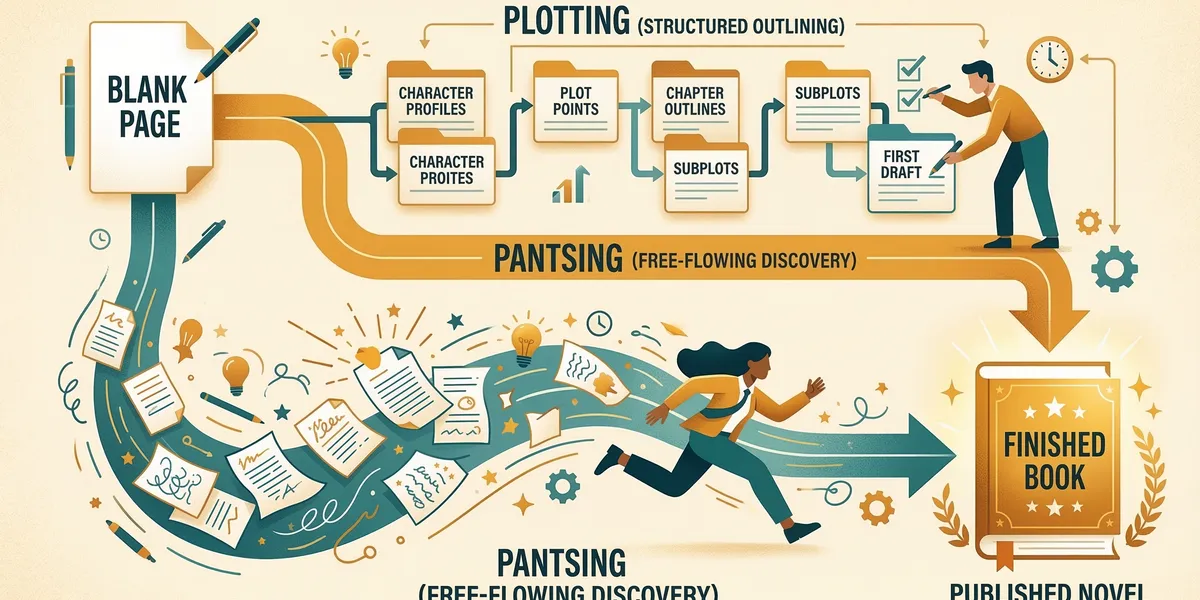
Pantsing vs plotting is the writing world’s oldest methodological divide. Pantsers write by the seat of their pants, discovering the story as they go. Plotters outline every chapter before writing a single scene. Most successful authors land somewhere in between.
Neither method is objectively better. The right one depends on how your brain works, what genre you’re writing, and what gets you to “The End” consistently.
What Is Pantsing?
Pantsing — also called discovery writing or intuitive writing — means starting with an idea, a character, or a scene and letting the story unfold organically. There’s no outline. No beat sheet. You sit down, write, and find out what happens next alongside your characters.
Stephen King is the most famous pantser alive. In On Writing, he describes his process as uncovering a fossil — the story already exists, and his job is to dig it up carefully without knowing the full shape. Margaret Atwood has described similar instincts, letting characters lead her through drafts rather than following a predetermined map.
Discovery writers often report that their best scenes are the ones they never planned. The surprise of a plot turn hits the writer first, which translates into genuine surprise for the reader.
Pros of Pantsing
- Creative freedom. No outline means no guardrails. You can follow any thread that excites you.
- Authentic character voice. Characters develop organically because you’re reacting to them in real time rather than forcing them into pre-determined roles.
- The thrill of discovery. Many pantsers describe writing as reading a book they haven’t read yet. That energy often translates to the page.
- Lower barrier to start. No weeks of pre-work. Open a document and go.
Cons of Pantsing
- Structural problems. Without a roadmap, it’s easy to write 40,000 words before realizing your plot doesn’t work.
- Heavy revision. First drafts from pantsing typically require more structural editing than plotted drafts.
- Getting stuck. When you don’t know where the story is going, it’s possible to write yourself into a corner with no exit.
- Pacing issues. Subplots can balloon or fizzle without a plan keeping them proportional.
What Is Plotting?
Plotting means creating a structured plan for your story before you write the prose. That plan might be a one-page synopsis, a chapter-by-chapter outline, a detailed beat sheet following a framework like Save the Cat or the three-act structure, or a massive Scrivener cork board covered in index cards.
J.K. Rowling is a legendary plotter. Her hand-drawn spreadsheets tracking character arcs, timeline events, and clue placement across all seven Harry Potter books are famous for a reason — the series’ intricate foreshadowing required it. John Grisham outlines extensively before writing. Brandon Sanderson plans his magic systems and plot structures with near-architectural precision.
Plotters know where they’re going. The writing process becomes execution rather than exploration.
Pros of Plotting
- Structural confidence. You know the beginning, middle, and end before you start. Plot holes get caught in the outline phase, not 60,000 words in.
- Faster drafting. When each chapter has a purpose already defined, you’re not staring at a blank page wondering what comes next.
- Cleaner first drafts. Less structural revision needed because the architecture was built before the writing began.
- Better foreshadowing. Knowing the ending lets you plant seeds from chapter one.
Cons of Plotting
- Outline paralysis. Some writers spend months perfecting an outline and never start the actual book.
- Loss of spontaneity. If you already know every beat, writing can start to feel like filling in a coloring book rather than creating art.
- Rigid characters. Characters forced to follow a pre-set plan can feel like puppets rather than people.
- Front-loaded effort. The outlining phase can feel like a lot of work with nothing “real” to show for it.
Pantsing vs Plotting: Side by Side
| Factor | Pantsing | Plotting |
|---|---|---|
| Planning time | Minimal | Significant |
| First draft speed | Slower (more exploration) | Faster (clear direction) |
| Revision needed | Heavy structural editing | Mostly line-level editing |
| Risk of getting stuck | Higher | Lower |
| Creative surprise | High | Lower |
| Character authenticity | Often stronger | Requires intentional effort |
| Foreshadowing | Added in revision | Built in from the start |
| Best for beginners | Good for finding your voice | Good for finishing your book |
The Plantser Middle Ground
Here’s what the pantsing vs plotting debate usually misses: most working authors are plantsers — a hybrid of both methods.
A plantser might know the beginning and the ending but discover the middle. They might outline the first act in detail and pants the rest. They might write character backstories but not plot summaries. The spectrum between pure pantsing and pure plotting is wide, and the sweet spot is different for every writer.
Nora Roberts has described outlining loosely — knowing the major turning points but finding the scenes between them. George R.R. Martin calls himself a “gardener” rather than an “architect,” but even he keeps notes and tracks his sprawling cast. The labels are less binary than the internet makes them seem.
How Plantsing Works in Practice
- Know your ending (even loosely). Having a destination prevents the aimless wandering that derails pantsers.
- Outline the skeleton. Major turning points, the midpoint shift, and the climax. Leave everything else open.
- Write freely between tent poles. Let scenes surprise you within a structure that keeps you on track.
- Revise with structure in mind. After the discovery draft, apply story structure principles to tighten what you found.
Which Genres Favor Which Method?
Genre isn’t destiny, but some genres lean toward one approach.
Plotting tends to work better for:
- Thrillers and mysteries. Clue placement, red herrings, and pacing require architectural planning. You need to know whodunit before planting the clues.
- Epic fantasy and sci-fi. World-building, magic systems, and multi-POV political intrigue benefit from advance mapping.
- Series fiction. Continuity across multiple books demands tracking — even if individual scenes are discovery-written.
Pantsing tends to work better for:
- Literary fiction. Character-driven narratives that prioritize voice and interiority often emerge more naturally from discovery.
- Memoir and personal essay. The meaning of a memory often reveals itself through the writing process rather than through pre-planning.
- Short fiction. A short story’s compressed scope means there’s less structural risk in discovery writing.
The key word is “tends.” Plenty of thriller writers pants their way through drafts, and plenty of literary novelists outline meticulously. The genre tendencies are starting points, not rules.
5 Practical Tips for Pantsers
- Set a daily word count goal. Discovery writing needs momentum. 500-1,000 words a day keeps the story alive in your head.
- Keep a running “story bible.” As you discover characters, locations, and timeline details, write them down. Future-you will thank present-you.
- Give yourself permission to write badly. Pantsing first drafts are messy. That’s the point. The magic happens in revision.
- If you’re stuck, skip ahead. Write the scene that excites you, even if it’s chapters away. You can connect the dots later.
- Do a structural pass before line editing. After the discovery draft, map out what you actually wrote using story arc principles, then fix the architecture before polishing prose.
5 Practical Tips for Plotters
- Leave room for surprise. Outline the beats, not the sentences. If a scene goes somewhere unexpected during writing, follow it.
- Don’t over-outline. If your outline reads like a finished draft, you’ve gone too far. Leave enough unknowns to keep yourself engaged.
- Test your outline with the “so what” question. For every beat, ask: does this advance the plot or deepen a character? If neither, cut it.
- Write the outline in order, but be willing to rearrange. Outlines aren’t sacred. If Act Two feels weak, restructure it before writing prose.
- Start writing before the outline feels “done.” Perfecting an outline is a form of procrastination. At some point, you need to write the actual book.
Why the Debate Is Overblown
The pantsing vs plotting debate generates enormous energy in writing communities — and almost none of it is productive. Writers argue about methodology like it’s a moral stance when it’s actually just a preference.
The goal is finishing a book. Not winning a methodology war.
Stephen King writes bestsellers as a pantser. Brandon Sanderson writes bestsellers as a plotter. The method doesn’t determine the quality of the output. Consistency, craft, and revision do.
If you’ve never finished a draft, try the opposite method. Pantsers who can’t finish might need a loose outline. Plotters who can’t start might need to write a scene without a plan. The only wrong method is the one that stops you from writing.
The best writing process is the one that reliably gets you from blank page to completed manuscript. Everything else is preference.
How to Find Your Method
If you’re unsure where you fall, try this experiment with your next project:
- Write the first three chapters with no plan. Just a premise and a character. See how it feels.
- Then stop and outline the rest. Map the remaining story based on what you discovered in those first chapters.
- Write chapters 4-7 from the outline. Notice whether the outline helps or constrains you.
Your emotional response to each phase will tell you everything. If the outlined chapters felt mechanical, lean toward pantsing. If the unplanned chapters felt aimless, lean toward plotting. If both had strengths, congratulations — you’re a plantser.
The point isn’t to pick a team. It’s to understand your own creative wiring well enough to write a book that actually gets finished. Experiment, pay attention, and trust the process that works for you.