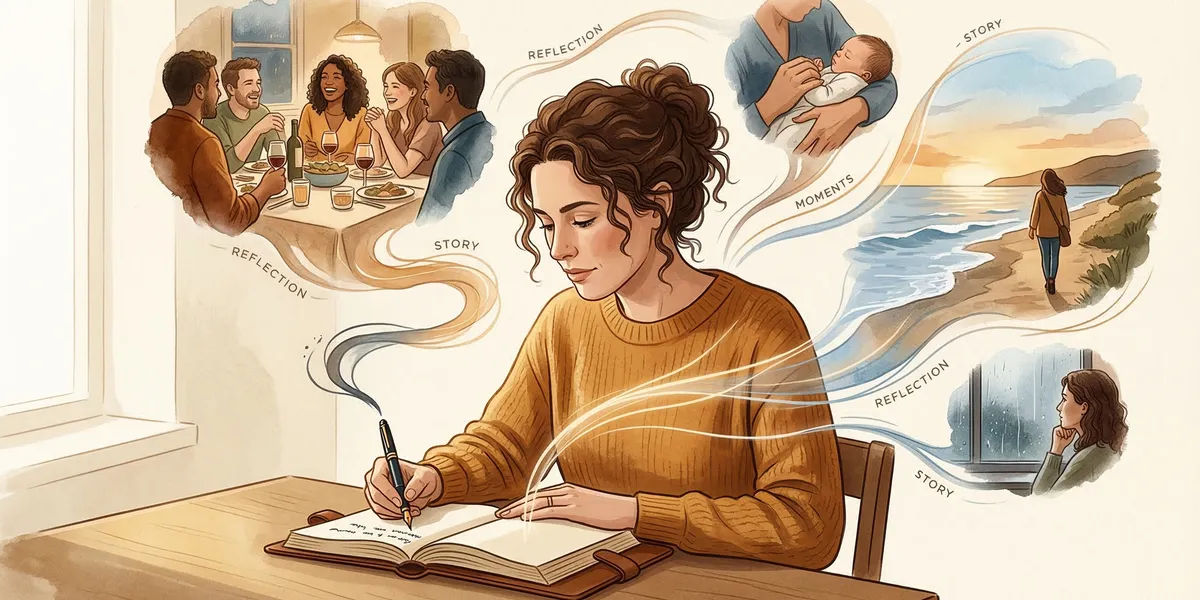
A personal narrative is a true story from your own life, told in first person, focused on a specific event or experience. It is not a summary of everything that happened to you. It is one moment, one memory, one turning point — written with enough detail that a reader can see it, feel it, and understand why it mattered.
Personal narratives show up everywhere. College application essays, memoir chapters, creative writing classes, therapy exercises, blog posts. The form is simple: something happened to you, and you are going to tell us about it in a way that means something.
The best way to learn how to write one is to read a few. Here are five personal narrative examples, each tackling a different kind of experience.
5 personal narrative examples
1. The marble I lost at recess
I kept my best marble in my left coat pocket for three weeks before I lost it. It was a cat’s eye — swirled green and gold, the size of a grape, cool against my fingers whenever I reached in to check that it was still there.
My grandfather had given it to me the weekend before he went into the hospital. He pulled it from a coffee can on his workbench and said, “This one’s a winner.” I did not know what he meant. I just liked the weight of it in my hand.
At recess one Tuesday, I set it on the blacktop for a game I was losing anyway. Tommy Hale flicked his shooter and my cat’s eye spun across the asphalt, bounced off the curb, and dropped through a storm drain grate. I stood there staring at the grate for the rest of recess while other kids played around me. I never told my grandfather it was gone. By the time I thought to, there was no one left to tell. Some losses are so small they do not seem worth mentioning until they are the only thing you have left.
2. The phone call that split my life in two
I was twenty-six and sitting in my car in a grocery store parking lot when my mother called and told me my father had been arrested. I remember the engine was off but the radio was still playing. I remember the plastic bags in the back seat shifting as I leaned forward.
For three years before that call, I had been building a version of my life that looked the way I wanted it to. Good job, new apartment, weekend dinners with friends who did not know my family’s history. That phone call cracked it open. I spent the next six months driving four hours each way to visit my father, sitting across from him in a room that smelled like floor cleaner, trying to understand how someone I loved could have done what he did.
I never fully answered that question. But I stopped pretending my past did not exist. The decision to show up — to drive those four hours, to sit in that room, to stop hiding — changed everything about how I move through the world. Some turning points do not feel like choices at the time. They feel like gravity.
3. The wrong bus in Bangkok
On my second day in Bangkok, I got on a bus going the wrong direction and rode it for forty-five minutes before I noticed. The signs were in Thai. The driver did not speak English. I had no data on my phone, just a paper map folded into a square so small I could not read the street names.
When I finally got off, I was standing on a street I could not pronounce, in front of a market stall where a woman was grilling skewers of something I could not identify. She looked at me, pointed to a plastic stool, and set a plate down without asking. I ate whatever it was — pork, maybe, with a chili sauce that made my eyes water — and she laughed at my face and handed me a bottle of water. She called her daughter over to translate, and between the three of us we figured out which bus I needed. Her daughter walked me to the stop.
I had read dozens of travel guides before that trip. None of them prepared me for the feeling of being completely lost and completely taken care of at the same time. That meal cost thirty baht, about a dollar. It is the only meal from that entire trip I remember clearly.
4. The presentation that fell apart
I was supposed to present our team’s quarterly results to the company’s executive board. I had rehearsed for a week. I had seventy-two slides. I wore new shoes that pinched my toes, which I thought would keep me sharp.
Four slides in, the projector died. I stood in front of fourteen vice presidents with a dead screen behind me and a clicker in my hand that did nothing. Someone from IT said it would take ten minutes to fix. The room went quiet.
I set down the clicker and started talking from memory. Not the polished version — the real version. I told them what actually happened that quarter: the client we almost lost, the product delay we fixed at the last minute, the team member who came up with a workaround at eleven on a Friday night. I talked for twelve minutes without a single slide. When the projector came back on, the COO told me to leave it off.
My boss said afterward that it was the best presentation our department had ever given. I learned something that morning that no rehearsal could have taught me: when you know the story, you do not need the slides. Failure does not always look the way you expect.
5. My grandmother’s kitchen
My grandmother cooked the same meal every Sunday for as long as I knew her. Roast chicken, mashed potatoes, green beans from a can, and rolls from a tube. It was not good food by any standard a chef would recognize. But the kitchen smelled like butter and onion, and the table had six chairs even though only four of us ever sat down.
The two empty chairs were for my grandfather, who died before I was born, and my uncle, who moved to Oregon and never called. My grandmother set their places anyway — plate, fork, glass of water. She never explained it. When I asked once, she said, “They might come back hungry.”
I did not understand that until I was older and had my own kitchen and my own empty chair. Love is not always a conversation. Sometimes it is just a place setting no one uses, week after week, because you are not ready to put it away. My grandmother taught me that without ever saying a word about it.
What makes these examples work
Each of those narratives does something specific that makes it effective. Here is what to look for.
Scene-setting that puts you there. The parking lot, the bus in Bangkok, the kitchen with six chairs. Strong personal narratives do not start with abstractions. They start with a place, a moment, a physical detail that grounds the reader in reality. You should be able to picture where the writer is standing.
Sensory detail that is specific, not generic. “A cat’s eye marble — swirled green and gold, the size of a grape.” Not just “a marble.” The chili sauce that made the writer’s eyes water. The floor cleaner smell of the visiting room. Specific sensory details make a story feel lived, not invented.
Reflection that earns its meaning. Every one of those narratives ends with the writer telling you what the experience meant. But the reflection works because it comes after the scene, not instead of it. “Some losses are so small they do not seem worth mentioning until they are the only thing you have left” lands because you watched the marble fall through the grate first.
Dialogue used sparingly. “This one’s a winner.” “They might come back hungry.” A single line of dialogue can carry more weight than a full conversation when it is placed at the right moment. In personal narratives, less spoken is almost always more.
A narrow focus. None of these examples try to cover an entire life. They cover one bus ride, one phone call, one Sunday dinner. The narrower the window, the deeper the reader can see through it.
Personal narrative structure
Most personal narratives follow a five-part structure, whether the writer plans it that way or not.
Opening hook. Start with a line that creates a question in the reader’s mind. “I kept my best marble in my left coat pocket for three weeks before I lost it.” You want to know what happened to the marble. That curiosity pulls the reader forward.
Setting and context. Ground the reader in the where, when, and who of the story. Give just enough background to understand what is at stake. Do not write a full biography — one or two sentences of context is usually enough.
Rising tension. Something changes, complicates, or threatens the situation. The marble goes into the game. The phone rings in the parking lot. The projector dies. This is where the story gains momentum.
Climax or key moment. The peak of the experience — the moment everything shifts. It does not need to be dramatic. Watching a marble drop through a grate is quiet, but it is the center of that entire narrative.
Reflection and meaning. What did this experience teach you? How did it change how you see the world? This is where a personal narrative separates itself from a simple anecdote. An anecdote says “this happened.” A personal narrative says “this happened, and here is why it mattered.”
If you are working on longer narratives — a full memoir or personal essay collection — this same structure repeats at the chapter level.
Tips for writing your own personal narrative
Be specific. “I was sad” tells us nothing. “I stood there staring at the storm drain grate for the rest of recess” tells us everything. Replace abstract emotions with concrete actions and images. Show the reader what sadness looked like in that particular moment.
Use scenes, not summaries. “My grandmother cooked dinner every Sunday” is a summary. “My grandmother set their places anyway — plate, fork, glass of water” is a scene. Scenes put the reader inside the moment. Summaries keep them outside it. When in doubt, zoom in.
Include your thoughts and feelings. A personal narrative is not a police report. The reader needs access to your interior life — what you were thinking, what you were afraid of, what you did not understand at the time. The gap between what you knew then and what you know now is often where the most interesting writing lives.
Start in the middle of the action. Do not begin with “I was born in 1994 in a small town.” Begin with the moment the story actually starts. You can fill in background later, a sentence at a time. The examples above all open with a specific scene, not a preamble.
End with insight, not a moral. A personal narrative is not a fable. You do not need to wrap it up with “and that is how I learned to be brave.” Instead, offer a genuine reflection — something you understand now that you did not understand then. Let the reader draw their own conclusions from there.
Write about what you cannot forget. If a moment has stayed with you for years, there is a reason. You do not need to understand the reason before you start writing. Often the writing itself is what reveals it. Start with the memory that will not leave you alone and follow it to the page.
If you are not sure what to write about, start with a question: what is the one moment you keep coming back to? That is your personal narrative.
Personal narrative vs essay vs memoir
These three forms overlap, but they serve different purposes.
| Personal Narrative | Personal Essay | Memoir | |
|---|---|---|---|
| Length | 500-2,000 words | 1,000-5,000 words | 40,000-100,000 words |
| Focus | One specific event or experience | An idea explored through personal experience | A theme explored across a period of life |
| Structure | Chronological storytelling | Argument or reflection with personal evidence | Multiple chapters, narrative arc |
| Purpose | Show what happened and what it meant | Explore a question or make a case | Tell a larger story through lived experience |
| Voice | First person, storytelling | First person, reflective/analytical | First person, literary |
A personal narrative is the building block. A personal essay uses personal experience to examine a bigger idea. A memoir weaves multiple personal narratives together into a book-length work.
If you find yourself writing personal narratives and wanting to develop them into something longer, that is a sign you might have a memoir in you. Chapter.pub’s nonfiction tools can help you organize those fragments into a full manuscript — structuring chapters, developing themes, and building the connective tissue between individual stories.
Start with one story
You do not need five examples. You need one. Pick the moment that won’t leave you alone, sit down, and write it the way you would tell it to someone you trust. Be honest. Be specific. Let the meaning arrive on its own.
Every memoir, every essay collection, every piece of creative nonfiction starts the same way: with one person deciding that one moment from their life is worth putting into words. Yours is, too.