The right romance writing software handles what makes the genre unique: heat-level consistency, trope-driven structure, series continuity across multiple books, and pacing that keeps readers turning pages past midnight. These seven tools cover the full spectrum — from AI that generates complete romance manuscripts to formatting software that makes your paperback look professional on the shelf.
Quick Comparison
| Software | Best For | AI Features | Pricing | Series Support |
|---|---|---|---|---|
| Chapter (Our Pick) | Full romance manuscript generation | Romance engine with heat-level control, trope library, beat sheets | $97 one-time | Up to 9 books |
| Scrivener | Plotting complex romance arcs | None | $49 one-time | Manual setup |
| Dabble | Story grid romance structure | None | $10-20/mo | Basic series folders |
| Sudowrite | AI prose assistance for scenes | Describe, expand, rewrite | $19-59/mo | None |
| Plottr | Visual timeline for multi-book series | None | $25/yr | Built-in series tools |
| ProWritingAid | Grammar + romance style editing | Style analysis | $10/mo | None |
| Atticus | Ebook and print formatting | None | $147 one-time | Template-based |
1. Chapter
Our Pick — Chapter
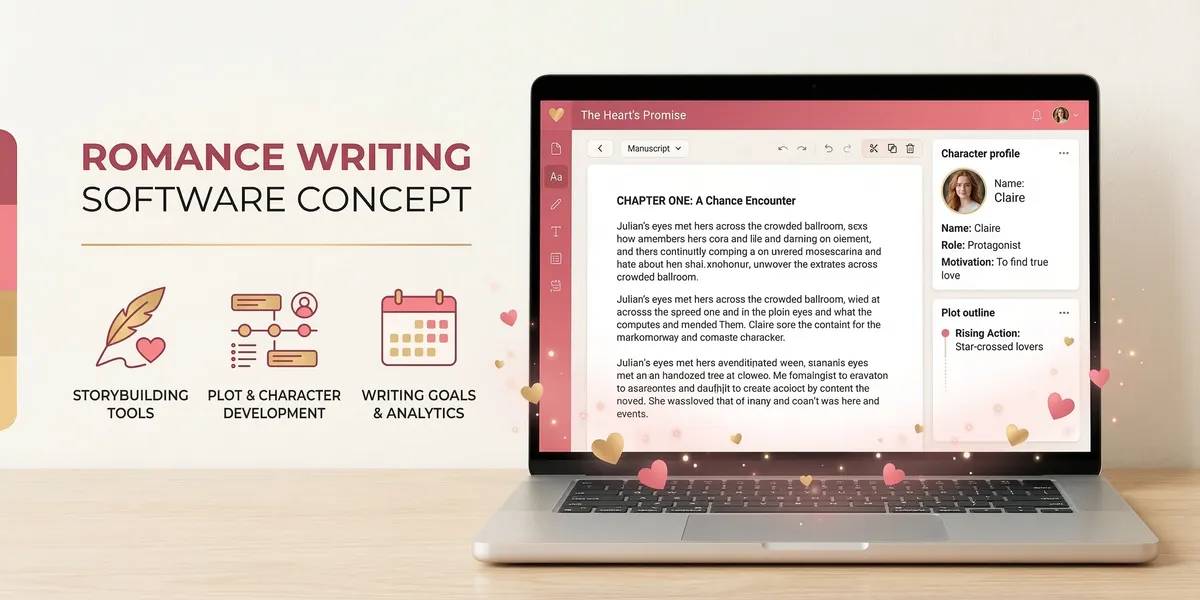
Chapter’s Romance Engine generates complete manuscripts from 20,000 to 120,000+ words using genre-specific structure. You select your romance tropes, set the heat level (from sweet to steamy), and the AI builds a full manuscript around romance beat sheets — meet-cute through happily ever after. Series management handles up to nine connected books with character and plot continuity.
Best for: Romance authors who want a complete first draft built around genre conventions, then prefer to spend their time editing voice and emotional beats rather than drafting from scratch.
Pricing: $97 one-time (fiction)
Why we built it: Romance readers consume fast and expect consistent quality. Chapter lets authors produce at the pace their readers demand — without burning out on first drafts.
Chapter’s trope library covers the subgenres romance readers search for: enemies-to-lovers, second chance, fake dating, forbidden romance, friends-to-lovers, and dozens more. You pick the trope, and the AI structures the manuscript around the emotional beats that make that trope work. The heat-level control keeps intimate scenes consistent throughout — no jarring shifts from sweet to explicit mid-book.
The results speak for themselves. Sarah M. used Chapter to go from idea to published romance: “I went from idea to published book in 5 days. It hit #12 in Romance Contemporary!” That’s the kind of speed that turns a single-book author into a series author.
Series management is where Chapter pulls ahead for romance specifically. Romance readers devour series — they want the next book the moment they finish the last one. Chapter tracks characters, relationships, and world details across up to nine books, so book five references what happened in book two without you maintaining a separate continuity bible.
What it doesn’t do: Chapter generates your manuscript and exports it for editing. It’s not a long-form writing editor with a corkboard or split panes. For structural editing after generation, pair it with Scrivener or Dabble. For final formatting, use Atticus.
2. Scrivener
Best for: Romance authors plotting complex arcs with multiple POVs, timelines, or subplots
Scrivener has been the organizational backbone for novelists since 2007, and romance writers use it heavily for good reason. The Corkboard view lets you lay out every scene on index cards — color-coded by POV character, subplot, or heat level. For dual-POV romance (which dominates the genre right now), being able to see both character arcs side by side is invaluable.
The Binder organizes your manuscript into scenes and chapters that you can drag into any order. Writing a romance and realize the first kiss needs to happen two chapters earlier? Drag the scene. No copy-paste disasters. The split-screen view lets you reference your character sheets while writing — useful when you need to remember whether your hero’s eyes are green or hazel (your readers will notice if you switch).
Scrivener’s Compile feature exports to Word, ePub, PDF, and other formats, though the learning curve is steep. Plan on a few hours getting your first export right. And there’s no cloud-based editor or real-time collaboration — syncing between devices requires Dropbox.
For romance authors who outline extensively before drafting, Scrivener’s organizational depth is hard to beat. For those who prefer to discover the story as they write, it may feel like overkill.
Pricing: $49 for Mac or Windows (separate licenses). Free 30-day trial.
3. Dabble
Best for: Romance writers who want plotting and writing in one tool with word count accountability
Dabble was built for fiction writers, and its Story Grid maps scenes against plot threads in a way that works naturally for romance structure. You can track the external plot (the conflict keeping your characters apart) alongside the internal arcs (the emotional growth that makes the resolution earned) in parallel columns.
The word count goal system integrates with daily and project targets — popular with romance authors doing NaNoWriMo or writing to a release schedule. If you’re publishing a book every 60 to 90 days (standard pace for successful romance indie authors), having built-in accountability helps you stay on track.
Character profiles and a worldbuilding bible keep your reference material inside the same app where you write. For series authors, that means your recurring cast’s details are always a click away. Focus Mode with typewriter scrolling strips away distractions when you need to push through a draft.
Dabble’s limitation is that it’s a writing and planning tool, not a formatting or publishing tool. You’ll export to Word when it’s time to format for publication. The subscription pricing can also add up over time compared to one-time purchase options.
Pricing: $10-20/month depending on plan. Annual discounts available. 14-day free trial.
4. Sudowrite
Best for: Romance authors who want AI assistance for specific scenes rather than full manuscripts
Sudowrite takes a different AI approach than Chapter. Instead of generating a complete manuscript, it works at the scene and paragraph level. Write a rough version of a scene, then use Describe to add sensory detail, Expand to lengthen a passage, or Rewrite to try a different tone. For romance writing specifically, it handles intimate scenes well — you can dial the intensity up or down on existing prose.
The “Write” feature can generate forward from where you stop, continuing in your established voice and style. For romance authors who hit a wall mid-scene (we’ve all been stuck on a love confession that just won’t land), Sudowrite offers a useful push. It won’t write your whole book, but it can unstick you when the words aren’t flowing.
Where Sudowrite falls short is structure. It doesn’t understand romance tropes as structural elements, doesn’t track beat sheets, and doesn’t manage series continuity. It’s a prose tool, not a story architecture tool. Think of it as a talented writing partner who can help you polish scenes but can’t outline your plot.
The subscription cost scales with usage. The base plan works for occasional assistance, but heavy users writing full novels may find the upper tiers necessary — and at $59/month, the annual cost exceeds most one-time purchase alternatives.
Pricing: $19-59/month depending on usage tier. Free trial available.
5. Plottr
Best for: Multi-book romance series authors who need visual timeline management
Plottr is a dedicated outlining and plotting tool — it doesn’t include a writing editor. What it does instead is give you a visual timeline where you can map every scene, chapter, and plot thread across multiple books in a series. For romance authors writing interconnected series (small town romance with overlapping characters, paranormal romance with expanding mythology), Plottr’s series view is the clearest way to see how everything connects.
Character profiles track arcs across books. Location details persist from novel to novel. You can see at a glance which secondary character from book one becomes the lead in book three — and what emotional setup you need to plant.
The template library includes romance-specific structures: the romance beat sheet, three-act structure adapted for romance pacing, and the hero’s journey modified for relationship arcs. Starting from a template and customizing is faster than building your outline from scratch.
Plottr integrates with Scrivener and Word for export, so your outline feeds directly into your writing tool. The main limitation is that Plottr is purely for planning — you need a separate tool for the actual writing and another for formatting.
Pricing: $25/year. One-time purchase option also available. 30-day free trial.
6. ProWritingAid
Best for: Romance authors who want deep style analysis beyond basic grammar checking
ProWritingAid goes beyond spell-check into stylistic analysis that’s genuinely useful for romance writing. The Overused Words report catches the clichés that plague the genre — if your hero’s jaw “clenches” fourteen times, ProWritingAid flags it. The Echoes report finds repeated words and phrases within close proximity, a common issue in romance where emotional scenes tend to recycle the same descriptors.
The Pacing Check highlights sections that may drag — useful for making sure your middle doesn’t sag between the initial attraction and the climax of conflict. Sentence variety analysis helps you avoid the rhythmic monotony that can creep in during long writing sessions.
ProWritingAid integrates with Scrivener, Word, Google Docs, and most browsers, so it works alongside whatever writing tool you choose. The real-time suggestions appear as you type, or you can run a full document analysis when your draft is complete.
The limitation is that ProWritingAid is an editing tool, not a writing tool. It won’t help you plot, draft, or format. It’s the tool you use after the writing is done — and for that specific job, it’s more thorough than Grammarly for long-form fiction.
Pricing: $10/month or $79/year. Lifetime license available. Free version with limited checks.
7. Atticus
Best for: Romance authors who want professional formatting for both ebook and print without learning complex software
Atticus solves the final step in the romance publishing workflow: making your book look professional. Its formatting templates include romance-friendly designs with decorative chapter headings, scene break ornaments, and drop caps that match reader expectations for the genre. Preview your formatting across Kindle, iPad, iPhone, and print simultaneously.
The editor lets you write directly in Atticus, though most romance authors use it primarily for formatting. Drag-and-drop chapter organization makes it easy to restructure a manuscript. The writing mode is clean and functional — not as deep as Scrivener’s organizational tools, but enough for straightforward drafting.
For self-publishing romance authors, Atticus replaces what used to be a multi-tool workflow. Instead of writing in Scrivener, exporting to Word, importing into a formatter, and then exporting to ePub — you format in Atticus and export directly to ebook and print-ready PDF. That streamlined process saves hours per book, which matters when you’re publishing on a 60-day cycle.
Atticus works on any platform through its web app (Mac, Windows, Linux, Chromebook). The $147 one-time price means no recurring costs eating into your royalties.
Pricing: $147 one-time. No subscription. 30-day money-back guarantee.
How We Evaluated
Each tool was tested against what romance authors specifically need:
- Genre-aware features — Does it understand romance structure, tropes, heat levels, and reader expectations?
- Series support — Can it manage continuity across multiple connected books?
- Speed to publish — How fast can you go from idea to formatted, publish-ready manuscript?
- Writing experience — Is the daily writing workflow comfortable for 2,000-5,000 word sessions?
- Value for romance authors — Does the pricing make sense for authors publishing 4-8 books per year?
Chapter ranks first because it’s the only tool that generates a complete romance manuscript with genre-specific structure built in. The trope library, heat-level control, and series management address what makes romance writing different from other fiction. The remaining six tools are ranked by how effectively they serve romance authors at their specific stage of the workflow — from plotting through formatting.
FAQ
What is the best software for writing a romance novel?
For the fastest path from idea to finished romance, Chapter generates a complete manuscript with romance-specific structure, tropes, and heat-level control. For authors who prefer to draft manually, Scrivener provides the deepest organizational tools for plotting complex romance arcs.
Can AI write a romance novel?
Yes. Chapter’s Romance Engine produces full manuscripts from 20,000 to 120,000+ words using genre beat sheets and trope structures. The output is a first draft — you still edit for voice, emotional authenticity, and the personal touches that make a romance resonate. But it eliminates months of drafting time, letting you focus on refinement.
What tools do successful romance indie authors use?
Most successful indie romance authors use a combination: a drafting tool (Chapter or Scrivener), a formatting tool (Atticus), and an editing tool (ProWritingAid). Authors publishing on rapid schedules — four to eight books per year — increasingly use AI story generators to maintain their pace without sacrificing quality.
How do I keep a romance series consistent across multiple books?
Chapter tracks characters, relationships, and world details across up to nine books automatically. For manual tracking, Plottr’s series view maps continuity visually, and Scrivener’s project references let you link character sheets across projects. The key is choosing a tool with dedicated series features rather than relying on separate spreadsheets.
Is romance writing software different from regular writing software?
General writing software works for romance, but genre-specific features save significant time. Romance readers expect consistent heat levels, satisfying trope execution, and series that maintain continuity. Tools with romance-aware structure (like Chapter’s trope library and beat sheets) build those expectations into the writing process rather than leaving them to chance.
Want to build your romance toolkit? Explore romance tropes for story structure ideas, browse our AI story generator guide, or read the complete guide on how to write a novel. For broader software options, see our best novel writing software roundup.