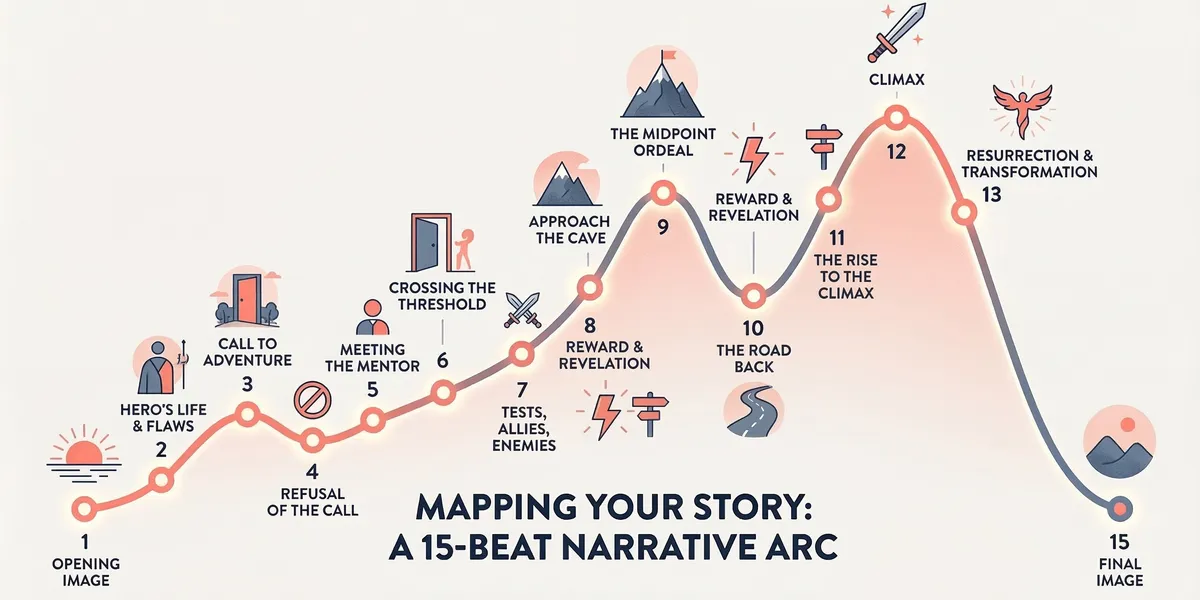
The Save the Cat beat sheet is a 15-beat story structure created by screenwriter Blake Snyder in Save the Cat! The Last Book on Screenwriting You’ll Ever Need (2005). Jessica Brody later adapted it for novelists in Save the Cat! Writes a Novel (2018). It maps every major turning point a story needs, with specific page targets for each beat.
It is the most prescriptive popular story framework, and for many writers, that precision is exactly what makes it useful.
All 15 beats of the Save the Cat beat sheet
The percentages below are approximate targets based on total word count. For a 80,000-word novel, 1% is roughly 800 words.
1. Opening Image (0-1%)
A snapshot of the protagonist’s world before the story changes it. This is the “before” photo. It should establish tone, setting, and the protagonist’s current state.
Example: In The Hunger Games, we see Katniss waking in District 12, sharing a bed with her sister, preparing to hunt. Poverty, survival, protectiveness, all established in a few pages.
2. Theme Stated (5%)
Someone, usually not the protagonist, states the story’s thematic question or lesson. The protagonist does not understand it yet. They will by the end.
Example: In The Hunger Games, Gale’s comment about what would happen if everyone refused to watch the Games plants the seed of rebellion as theme.
3. Set-Up (1-10%)
The first 10% establishes the protagonist’s world, flaws, relationships, and what needs to change. Introduce the main characters. Show what is missing in the protagonist’s life.
Example: We meet Katniss’s family, see her relationship with Gale, understand her distrust of the Capitol, and feel the weight of the upcoming reaping.
4. Catalyst (10%)
The inciting incident. The single event that knocks the protagonist’s world off its axis.
Example: Prim’s name is called at the reaping.
This beat should be unmistakable. If a reader cannot point to your Catalyst, it is not strong enough.
5. Debate (10-20%)
The protagonist reacts to the Catalyst. They question, resist, prepare, or debate what to do. This is the “should I go?” phase.
Example: Katniss volunteers, says goodbye to her family, boards the train, and grapples with what the Games will demand of her. She is not yet in the arena. She is deciding who she will be when she gets there.
6. Break into Two (20%)
The protagonist makes a choice that propels them into Act 2. They leave the old world and enter the new one. This is crossing the threshold.
Example: Katniss arrives at the Capitol. She is no longer in District 12. The Games are real.
7. B Story (22%)
A new character or relationship enters, usually carrying the theme. In romances, this is the love interest. In other genres, it might be a mentor, ally, or foil.
Example: Katniss’s relationship with Peeta deepens. He represents a different kind of survival, one based on staying human rather than staying alive.
8. Fun and Games (20-50%)
The “promise of the premise.” This is what the audience came for. If your book is about a wizard school, this is where they attend classes and cast spells. If it is a thriller, this is the investigation and the chases.
Example: Training scores, interviews with Caesar Flickerman, sponsor strategy, the opening moments of the arena. This is The Hunger Games delivering on its premise.
9. Midpoint (50%)
A midpoint reversal that raises the stakes. Either a false victory (things seem great but are about to collapse) or a false defeat (things seem terrible but a new path opens).
Example: The rule change announcement: two tributes from the same district can win. Katniss now has a reason to find Peeta and fight alongside him instead of alone.
10. Bad Guys Close In (50-75%)
Internal and external pressure intensifies. Enemies regroup. Allies falter. The protagonist’s flaws resurface. Whatever was gained at the Midpoint begins to erode.
Example: The Careers hunt Katniss and Peeta. Rue dies. The arena becomes more dangerous. The Capitol tightens control. Trust frays.
11. All Is Lost (75%)
The lowest point. A death (literal or metaphorical) occurs. The protagonist loses something they cannot get back. This beat should feel like the story’s dark night of the soul.
Example: The rule change is revoked. Only one tribute can win. Everything Katniss fought for alongside Peeta is ripped away.
12. Dark Night of the Soul (75-80%)
The emotional aftermath of All Is Lost. The protagonist sits in despair, grief, or hopelessness. This is the “whiff of death” that makes the finale meaningful.
Example: Katniss faces the reality that she might have to kill Peeta, or die herself, and neither option is acceptable.
13. Break into Three (80%)
A realization, often sparked by the B Story, gives the protagonist a new plan. They synthesize everything they have learned.
Example: Katniss decides that neither she nor Peeta will die by the Capitol’s rules. She chooses defiance. The nightlock berries become her weapon.
14. Finale (80-99%)
The protagonist executes their plan. They confront the antagonist using the lessons learned in Act 2. All story threads converge.
Example: Katniss and Peeta threaten joint suicide with the berries. The Capitol blinks. Both are declared victors. Katniss has beaten the system, but the system will remember.
15. Final Image (99-100%)
The “after” photo. It mirrors the Opening Image but shows how the protagonist has changed. The distance between the two images is the story.
Example: Katniss returns to District 12, but she is not the same girl who left. She is a symbol of rebellion whether she wants to be or not.
The beats at a glance
| Beat | When | Purpose |
|---|---|---|
| 1. Opening Image | 0-1% | The “before” snapshot |
| 2. Theme Stated | ~5% | Plant the thematic question |
| 3. Set-Up | 1-10% | Establish world and characters |
| 4. Catalyst | ~10% | Inciting incident |
| 5. Debate | 10-20% | React and prepare |
| 6. Break into Two | ~20% | Enter Act 2 |
| 7. B Story | ~22% | Introduce thematic relationship |
| 8. Fun and Games | 20-50% | Deliver the premise |
| 9. Midpoint | ~50% | Raise the stakes |
| 10. Bad Guys Close In | 50-75% | Pressure intensifies |
| 11. All Is Lost | ~75% | Lowest point |
| 12. Dark Night of the Soul | 75-80% | Emotional rock bottom |
| 13. Break into Three | ~80% | New plan emerges |
| 14. Finale | 80-99% | Execute and confront |
| 15. Final Image | 99-100% | The “after” snapshot |
Why Save the Cat works for novelists
Blake Snyder wrote for screenwriters, but the beats translate directly to novels because they solve the same problem: where does my story go next?
The beat sheet is particularly useful for writers who:
- Know their premise but cannot find the middle
- Write strong beginnings and endings but sag in Act 2
- Need concrete page targets rather than abstract advice
- Want to diagnose why a draft is not working
The percentages are not rigid. A literary novel might stretch the Set-Up. A thriller might compress the Debate. But the sequence of beats is remarkably consistent across genres.
How Save the Cat connects to other structures
The 15 beats map onto the three act structure: Beats 1-5 are Act 1, Beats 6-12 are Act 2, and Beats 13-15 are Act 3. The Catalyst is the inciting incident. The Midpoint aligns with the three act midpoint. The All Is Lost / Dark Night sequence is the second turning point.
Save the Cat is essentially the three act structure with more granular waypoints. It also shares DNA with the story beats concept, as each of Snyder’s 15 beats is a major story beat that shifts the narrative.
Chapter uses the Save the Cat beat sheet as one of its core fiction writing templates, guiding you through each of the 15 beats so your novel hits every structural milestone.