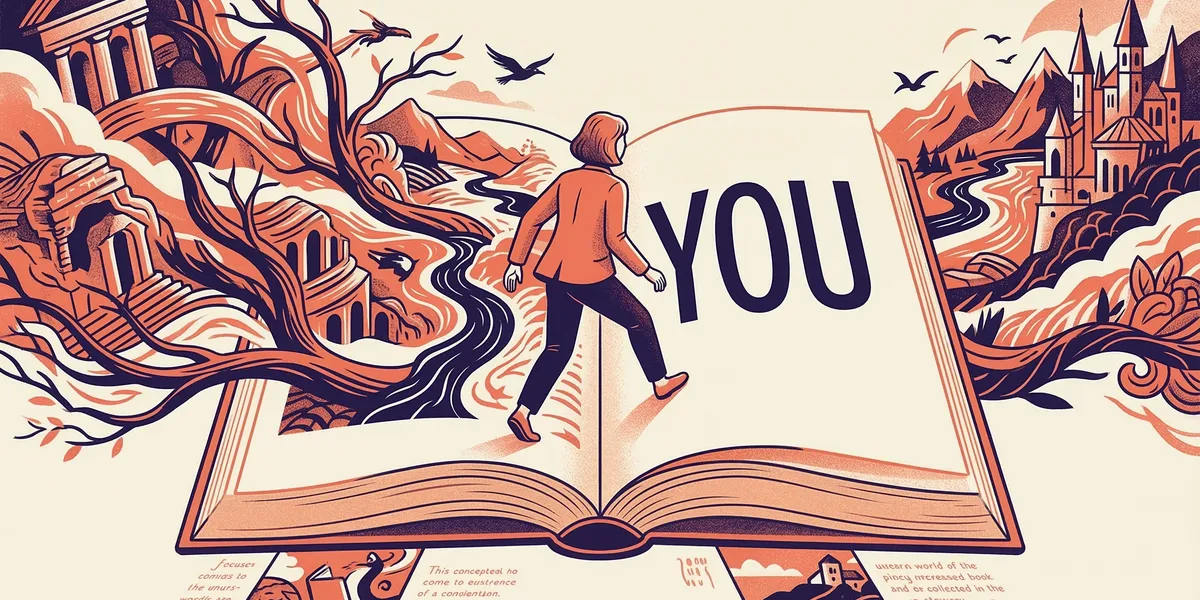
Second person point of view is the narrative perspective that addresses the reader directly as “you,” placing them inside the protagonist’s skin and making them an active participant in the story.
It is the rarest of the three main points of view in fiction, and for good reason. When it works, nothing else creates the same electric sense of immediacy. When it fails, it feels like a stranger telling you what you had for breakfast. Understanding the difference between those two outcomes is the whole game.
What Second Person Looks Like
Here is a short passage in second person so you can feel the effect:
You walk into the bar and the music hits you like a wall. The bass vibrates in your chest. You order a drink you do not want because it gives your hands something to do. The woman at the end of the counter looks up, and you realize she has been watching you since you came in.
Notice how different that feels from “He walked into the bar” or “I walked into the bar.” The reader has no distance from the action. There is no character to observe from the outside. There is only you, standing in that bar, feeling the bass in your chest.
Famous Examples of Second Person
Second person is rare in published fiction, which makes the books that pull it off all the more remarkable.
Bright Lights, Big City by Jay McInerney is the most cited example of a second person novel. The entire book unfolds in present tense second person, following “you” through the cocaine-fueled nightlife of 1980s Manhattan. McInerney chose the perspective deliberately. The protagonist is in denial, and second person creates the feeling of watching yourself from a slight remove, narrating your own bad decisions as they happen.
If on a winter’s night a traveler by Italo Calvino opens with one of the most famous second person passages in literature: “You are about to begin reading Italo Calvino’s new novel.” The entire frame narrative addresses the reader directly, collapsing the boundary between the person holding the book and the character in the story.
Choose Your Own Adventure books used second person for a purely practical reason. When the reader decides what happens next, “you” is the only pronoun that makes sense. These books taught millions of young readers what second person feels like before they ever learned the term.
Present tense literary fiction has also embraced second person in short form. Writers like Lorrie Moore (in “How to Become a Writer” and the collection Self-Help) used second person with an instructional, almost sardonic tone that became a hallmark of the style.
When Second Person Works
Second person is not a gimmick if you deploy it where it has genuine advantages.
Creating immediacy. No other point of view drops the reader so directly into a scene. If you want the reader to feel a physical sensation, an emotional reaction, or the pressure of a decision, second person closes the gap between page and experience.
Experimental and literary fiction. Short stories and novellas that aim to challenge the reader’s expectations benefit from second person’s strangeness. It signals that the story is doing something deliberate with form, not just telling a tale.
Choose-your-own-adventure and interactive fiction. Any narrative where the reader makes choices requires second person. This includes interactive fiction, text-based games, and branching storylines.
Instructional and self-help writing. Second person is the natural voice for teaching. “You open the document. You select the first paragraph.” It works because the reader is meant to follow along and act.
Short-form fiction and flash fiction. The intensity of second person is easier to sustain over a few pages than a few hundred. Many of the best second person works are short stories.
When to Avoid It
Second person has real limitations, and ignoring them will cost you readers.
Novel-length fiction is exhausting. Sustaining “you” for 80,000 words puts enormous pressure on the reader. Most people instinctively resist being told what they think, feel, and do for that long. The novels that succeed at this length (like Bright Lights, Big City) tend to be short and propulsive.
It can feel gimmicky. If the only reason you are writing in second person is that it seems interesting or different, the reader will sense it. The perspective needs to serve the story. Ask yourself: would this narrative lose something essential if I switched to first or third person?
Character interiority is harder. In first person, the narrator can reflect freely on their own thoughts and memories. In second person, extended internal monologue can feel like the author lecturing the reader about their own feelings.
Some readers simply dislike it. A percentage of your audience will bounce off second person no matter how well you execute it. If you are writing for a broad commercial audience, this is worth weighing.
Second Person vs First and Third Person
| Feature | First Person | Second Person | Third Person |
|---|---|---|---|
| Pronoun | I, me, my | You, your, yours | He/she/they, him/her |
| Reader distance | Close (narrator’s filter) | Closest (reader is the character) | Variable (close to distant) |
| Commonality | Very common | Rare | Most common |
| Best for | Voice-driven stories, memoir | Immediacy, experimental fiction | Flexibility, multiple POVs |
| Main risk | Narrator can feel unreliable | Can alienate readers | Can feel detached |
| Sustained length | Any length | Hard past novella length | Any length |
For a deeper look at the alternatives, see the guides on first person point of view and third person point of view.
Tips for Writing in Second Person
Ground the reader in sensory detail early. Because second person is unfamiliar, the reader needs physical anchors. Describe what “you” see, hear, and feel in the first few sentences so the reader has something concrete to inhabit.
Use present tense. Second person pairs naturally with present tense. “You walk” feels immediate. “You walked” feels like someone narrating a memory that is not yours. Present tense reinforces the sense that the reader is living the story in real time.
Give the “you” character a strong situation, not a strong personality. The reader needs room to step into the role. If “you” has extremely specific opinions and quirks, some readers will resist. If “you” is in a situation anyone can understand, pressure, desire, confusion, the perspective works harder.
Keep it short, at least the first time. Write a scene or a short story in second person before you commit to a novel. You will learn quickly whether the voice energizes your prose or exhausts it.
Read it aloud. Second person reveals its problems out loud faster than on the page. If a sentence sounds like an accusation or an instruction manual, revise it.
Know why you chose it. The strongest second person fiction exists in that perspective for a reason the story could not achieve any other way. Before you begin, write one sentence explaining why this story must be told as “you.” If you cannot, consider whether first person or third person would serve the work better.
Second person point of view is a sharp tool. It is not the right choice for most stories, but for the right story, nothing else comes close. The key is knowing the difference, and that only comes from reading widely and writing your first pages with honest intention.