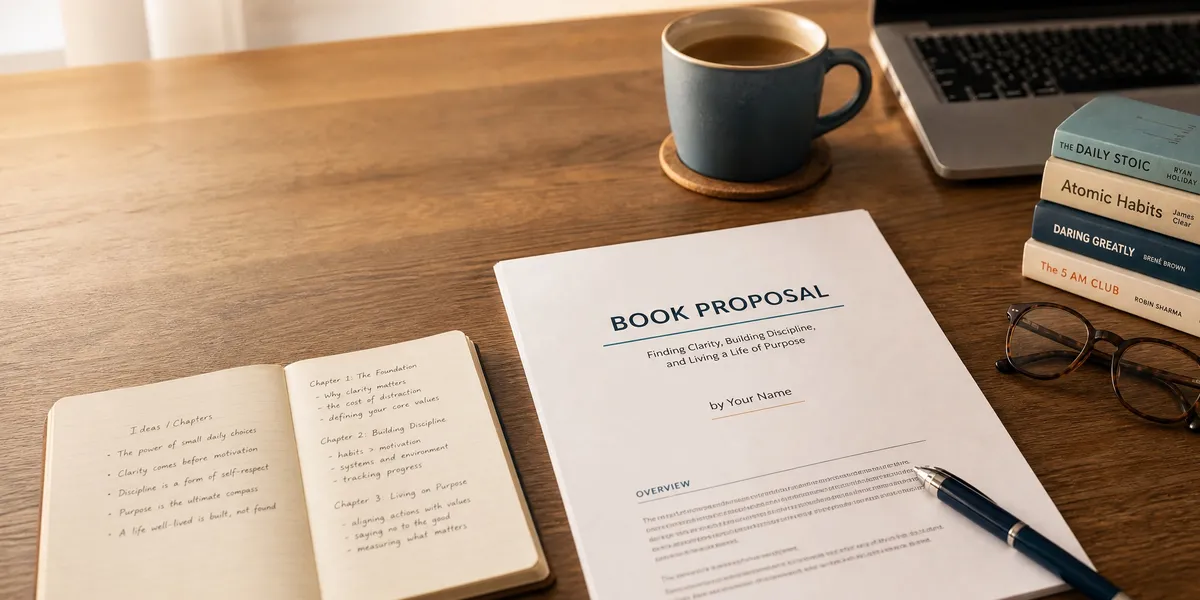
You can pitch your self-help book to literary agents and publishers using a proven proposal template — and the proposal is the single document that decides whether your book gets a deal.
In this guide, you’ll learn:
- The 9 sections every self-help book proposal needs (with fill-in prompts)
- How to position your credibility when you’re not a therapist or PhD
- What makes self-help proposals different from other nonfiction proposals
- The marketing plan structure that agents actually want to see
Here’s the complete self-help book proposal template, section by section.
What Is a Self-Help Book Proposal?
A self-help book proposal is a 20-to-50-page document that sells your personal development book to literary agents and publishers before you write the full manuscript. It proves you have a marketable concept, a defined audience, and the authority to deliver a book that changes lives.
Self-help proposals work differently from other nonfiction categories. In memoir, your writing quality sells the book. In academic nonfiction, your credentials do. In self-help, your platform and methodology carry the most weight. Agents want to know you have a framework readers can follow — and an audience ready to buy.
According to the Nonfiction Authors Association, a strong promotion plan is often the most important section of a nonfiction proposal, followed by the overview and author bio. That’s doubly true in self-help, where publishers expect authors who can drive sales through speaking, coaching, or an online following.
If you’re writing a self-help book for the first time, the proposal forces you to clarify your concept, validate your market, and plan your content — all before spending months on the manuscript.
How Is a Self-Help Proposal Different From a General Book Proposal?
A self-help book proposal shares the same basic structure as any nonfiction book proposal, but three things change significantly.
1. Methodology matters more than credentials. A general nonfiction book can rely on research or reporting. Self-help books need a proprietary framework — a step-by-step system, a set of principles, or a transformation model your reader will follow. Agents look for this immediately.
2. Platform weight is heavier. Publishers expect self-help authors to have an existing audience. Your social media following, email list, speaking engagements, coaching clients, and podcast appearances all factor into whether an agent takes you on. The Association of Authors’ Representatives notes that platform is a top consideration for agents evaluating self-help proposals.
3. The sample chapter must demonstrate transformation. While other nonfiction sample chapters can inform or entertain, your self-help sample chapter needs to show a reader moving from problem to solution. It should include exercises, reflection prompts, or actionable steps.
The 9 Sections of a Self-Help Book Proposal Template
Every self-help book proposal follows a standard structure. Skip a section and agents notice. Here’s what to include — and what to write in each one.
1. Title Page
Your title page sets the first impression. Keep it clean and professional.
Include:
- Working title and subtitle
- Your name (and pen name, if applicable)
- Contact information (email, phone, website)
- Date submitted
- Agent name (if submitting to a specific agent)
Self-help title formula: Combine a memorable hook with a clear benefit subtitle. The title signals what the book is about. The subtitle tells the reader what they’ll get.
Fill-in prompt:
[Hook Title]: [Benefit-Driven Subtitle] A Book Proposal by [Your Name] [Email] | [Website] [Month Year]
2. Overview (The Most Important Page)
The overview is your proposal’s sales pitch. Agents read this first — and often decide within the first paragraph whether to keep reading. Write 2-3 pages that answer: What is this book? Why now? Why you?
Structure your overview in four parts:
The Hook — Open with a compelling statistic, question, or story that illustrates the problem your book solves.
The Concept — Describe your book in 2-3 paragraphs. Name your methodology. Explain how the book transforms the reader.
The Market Moment — Why does this book need to exist right now? What cultural trend, emerging research, or gap in existing books makes your timing perfect?
The Credentials Bridge — One paragraph connecting your personal experience or professional background to this topic.
Fill-in prompt:
[Statistic or story that illustrates the problem]
Book title is a [word count]-word [category] book that teaches readers how to [core transformation]. Using my [methodology name] framework, readers will learn to [specific outcome 1], [specific outcome 2], and [specific outcome 3].
This book arrives at a moment when [market trend or cultural shift]. While existing titles like [Comp Title 1] focus on [their angle], [Your Title] is the first book to [your unique angle].
3. Target Audience
Who is your reader — specifically? Generic descriptions like “anyone who wants to improve” won’t work. Self-help publishers want precision.
Define your audience in layers:
- Primary audience — The specific person most likely to buy. Age range, gender skew (if any), life stage, profession, or situation.
- Secondary audience — Who else would benefit? Therapists assigning it to clients? Corporate trainers? Book clubs?
- Market size — Back it up with numbers. Use industry reports, relevant subreddit sizes, hashtag volumes, or Google Trends data.
Fill-in prompt:
The primary audience for Book Title is [specific demographic] who are experiencing [specific problem]. This includes [example persona 1] and [example persona 2].
The self-help and personal development category generated [$X billion] in sales in [year], according to [source]. Within this category, [your subtopic] is growing at [rate/trend].
Being specific doesn’t shrink your audience — it makes your pitch more credible. An agent would rather see “professional women aged 30-45 navigating career burnout” than “everyone who’s stressed.”
4. Competitive Title Analysis
List 5-7 published books that your self-help book would sit next to on the shelf. For each one, explain how your book differs.
This section proves you’ve done your homework. It also tells the agent which successful books your title can ride alongside.
Format each entry like this:
Fill-in prompt:
[Comp Title] by [Author] ([Publisher], [Year]) — [1-2 sentences on what it covers]. Unlike [Comp Title], my book [your differentiator — methodology, audience, angle, or depth].
Tips for strong comp titles:
- Choose books published within the last 3-5 years
- Pick titles that actually sold well (check Amazon BSR or publishers you recognize)
- Avoid comparing yourself to massive outliers like Atomic Habits unless your angle is genuinely distinct
- Show how your book fills a gap rather than replaces what exists
If you’re not sure which books to compare against, browse the best self-help books in your subtopic and look for what’s missing from the current shelf.
5. About the Author
This section answers the agent’s biggest question: Why are you the right person to write this book?
Self-help is one of the hardest categories for first-time authors precisely because of this section. Publishers want proof you can both write the book and sell the book.
Cover three areas:
Professional credentials — Degrees, certifications, years of practice, client results. If you’re a coach, therapist, or consultant, this is straightforward. If you’re not, focus on lived experience and the results your framework has produced.
Platform and reach — Social media followers, email subscribers, podcast listeners, speaking engagements, media appearances, existing client base. Be specific with numbers.
Writing experience — Prior publications, guest articles, blog posts, newsletters. If you’ve written for recognizable outlets, name them.
Fill-in prompt:
[Your Name] is a [title/role] who has [key credential or experience]. Over the past [timeframe], [he/she/they] has helped [number] of [clients/readers/students] to [specific outcome].
[Your Name]‘s work has been featured in [publications or media]. [He/She/They] speaks regularly at [types of events] and maintains an email list of [number] subscribers and a combined social media following of [number].
What if you don’t have a big platform? Focus on what you do have. A small but engaged email list, a local speaking circuit, a professional practice with client testimonials, or a growing podcast all count. Pair a modest platform with a strong action plan in the marketing section.
6. Chapter-by-Chapter Outline
Provide a one-page-per-chapter breakdown of your entire book. Each chapter summary should be 150-300 words and cover what the reader learns, the key exercises or frameworks introduced, and the transformation that chapter delivers.
Structure each chapter summary like this:
Fill-in prompt:
Chapter [Number]: [Chapter Title] In this chapter, readers learn [core lesson]. The chapter opens with [hook — story, case study, or surprising fact], then introduces the [framework or principle name]. By the end, readers will be able to [specific skill or mindset shift].
Key sections include:
- [Section topic 1]
- [Section topic 2]
- [Exercise or reflection prompt]
If you’ve already created a self-help book outline, this section translates directly from that work. Use a self-help book outline template if you need a structure to start from.
Self-help-specific tip: Show a progression arc. Your chapters should build on each other — the reader at Chapter 10 should be meaningfully different from the reader at Chapter 1. Agents want to see a clear transformation journey, not a random collection of tips.
7. Sample Chapters
Include 1-2 fully written chapters that demonstrate your voice, your methodology, and your ability to deliver the book’s promise. Most agents recommend submitting your strongest chapter — not necessarily Chapter 1.
What makes a strong self-help sample chapter:
- Opens with a relatable story or case study
- Introduces a framework, model, or principle with a clear name
- Includes at least one exercise, worksheet, or reflection prompt
- Ends with a takeaway the reader can apply immediately
- Runs 3,000-5,000 words (matching your target chapter length)
Choose a chapter that:
- Best demonstrates your unique methodology
- Contains your most compelling client story or personal narrative
- Showcases the middle of your transformation arc (not setup, not conclusion)
Your writing quality in this section determines whether the agent believes you can write a full manuscript. Edit it heavily. Read it aloud. Consider hiring a professional editor just for these sample chapters.
8. Marketing and Promotion Plan
This is the section that separates published self-help authors from rejected ones. Publishers want to know how you’ll sell books — because in self-help, the author’s platform drives sales more than any other factor.
Cover these areas:
Existing platform — Repeat your key numbers from the About the Author section, then expand on engagement rates and audience demographics.
Pre-launch plan — How will you build buzz before publication? Include email campaigns, social media strategy, advance reader copies, and pre-order incentives.
Launch strategy — Describe your first-month plan. Book launch events, podcast tour, social media blitz, email sequences, and any partnerships.
Ongoing promotion — Speaking engagements, workshops, course tie-ins, corporate training opportunities, media pitching strategy, and how the book supports your broader business.
Fill-in prompt:
Existing platform:
- Email list: [number] subscribers ([growth rate])
- Social media: [platform] ([number] followers), [platform] ([number] followers)
- Podcast/YouTube: [name] ([downloads/views per month])
- Speaking: [number] events per year, [types of organizations]
Launch plan:
- [Tactic 1 with timeline]
- [Tactic 2 with timeline]
- [Tactic 3 with timeline]
If your platform is small, compensate with an ambitious and realistic marketing plan. Show the agent you understand book marketing. A strong book marketing plan paired with a growing audience signals that you’re investable even without 100,000 followers.
9. Endorsements and Advance Praise
List 5-10 people who could provide endorsements, forewords, or advance praise for your book. Include their name, title, and your connection to them.
Three tiers of endorsement contacts:
- Confirmed — People who’ve already agreed to endorse (strongest signal)
- Warm leads — People you have a relationship with who are likely to agree
- Aspirational — High-profile names you plan to approach (be honest about the connection level)
You don’t need endorsements locked in before submitting. But showing a realistic list of potential endorsers tells the agent you can generate social proof.
Self-Help Book Proposal Template: Complete Fill-In Version
Here’s the complete template you can copy and adapt for your own proposal. Each section includes the fill-in prompts from above, organized in submission order.
Page 1: Title Page
A Book Proposal by [Your Name] [Email] | [Phone] | [Website] [Date]
Pages 2-4: Overview
[Hook — statistic, question, or story]
Book Title is a [word count]-word [category] book that teaches readers to [core transformation] using the [Methodology Name] framework.
[Market moment — why this book, why now]
[Credentials bridge — why you]
Page 5: Target Audience
Primary: [Specific demographic + problem] Secondary: [Adjacent audiences] Market size: [Data points]
Pages 6-8: Competitive Titles
[5-7 comp titles with differentiators]
Pages 9-10: About the Author
[Credentials + platform + writing experience]
Pages 11-20: Chapter Outline
[150-300 words per chapter, showing transformation arc]
Pages 21-35: Sample Chapters
[1-2 fully written chapters]
Pages 36-38: Marketing Plan
[Platform + pre-launch + launch + ongoing]
Page 39: Endorsements
[5-10 potential endorsers with connection level]
Total length: 30-50 pages, depending on chapter count and sample chapter length.
How to Write Your Self-Help Book Proposal With AI
You can speed up the proposal writing process significantly by using AI to draft each section — then refining with your own voice, stories, and data.
Our Pick — Chapter
Chapter helps nonfiction authors write and structure entire books using AI. You can use it to draft your proposal overview, generate chapter outlines, and refine your sample chapters — all within a guided workflow.
Best for: Self-help authors who want to move from idea to polished proposal in days instead of months. Pricing: $97 one-time (nonfiction) Why we built it: Over 10,000 authors have used Chapter to create books — and a strong proposal is the first step for those pursuing traditional publishing.
Here’s how to use AI for writing book proposals:
-
Draft your overview — Feed AI your book concept, target audience, and key differentiators. Use the output as a starting point, then layer in your personal stories and voice.
-
Generate your chapter outline — Use a nonfiction book outline template as the structure, then have AI flesh out each chapter summary with the transformation arc publishers expect.
-
Refine your comp title analysis — AI can help you identify comparable titles and articulate what makes your book different from each one.
-
Polish your sample chapters — Write the first draft yourself (this section needs your authentic voice), then use AI to tighten prose, improve pacing, and catch structural issues.
The key is using AI as a drafting accelerator, not a replacement for your authentic expertise. Agents can tell when a proposal is entirely AI-generated — and they’ll reject it.
Common Self-Help Book Proposal Mistakes to Avoid
1. Leading with credentials you don’t have. If you’re not a therapist, don’t pretend to be one. Focus on your lived experience, your methodology, and the results your framework has produced. Authenticity beats borrowed authority.
2. Writing a vague overview. “This book will help people live better lives” tells an agent nothing. Name your framework. Specify the transformation. Describe the reader before and after.
3. Choosing comp titles that are too big. Comparing your debut self-help book to The 7 Habits of Highly Effective People doesn’t prove market fit — it proves you don’t understand your actual competitive landscape. Choose recent, successful titles in your specific niche.
4. Skipping the marketing plan. This is the most common reason self-help proposals get rejected. Publishers will not invest in an author who expects them to handle all promotion. Even a small platform with a clear growth strategy beats no plan at all.
5. Writing a sample chapter that reads like a lecture. Self-help readers want to do something, not just be told things. Your sample chapter must include exercises, prompts, or actionable steps. Show the agent that your book delivers transformation, not just information.
How Long Should a Self-Help Book Proposal Be?
A self-help book proposal should be 30-50 pages total, including sample chapters. Without sample chapters, the core proposal sections (overview through marketing plan) typically run 15-25 pages.
Here’s a typical page breakdown:
| Section | Pages |
|---|---|
| Title Page | 1 |
| Overview | 2-3 |
| Target Audience | 1-2 |
| Competitive Titles | 2-3 |
| About the Author | 1-2 |
| Chapter Outline | 5-10 |
| Sample Chapters | 10-15 |
| Marketing Plan | 2-3 |
| Endorsements | 1 |
| Total | 25-40 |
Some agents prefer shorter proposals (20-30 pages). Others want comprehensive packages exceeding 50 pages. Always check submission guidelines from the specific agent or publisher before sending. Finding the right literary agent first ensures you format your proposal to their preferences.
How Long Does It Take to Write a Self-Help Book Proposal?
Writing a self-help book proposal takes 4-8 weeks when you’re starting from scratch, including research time for competitive titles and market data. If you’ve already written your self-help book outline, you can cut that to 2-3 weeks since your chapter structure is already done.
The sample chapters take the longest — expect 1-2 weeks just for writing and editing those. The marketing plan requires honest audience data gathering, which adds a few days.
Using AI tools like Chapter can compress the drafting timeline significantly. Authors who use AI-assisted workflows report cutting their proposal drafting time by 50-70%, though you’ll still need time for personal revision and polishing.
What Happens After You Submit Your Proposal?
Once your proposal is complete, you’ll submit it to literary agents — not directly to publishers. Here’s the typical timeline:
-
Query letter — Send a one-page pitch email alongside your proposal. If you need help, check our guide on how to get published for the full agent submission process.
-
Agent response — Expect to wait 4-12 weeks to hear back from a literary agent. Many agents accept simultaneous submissions, so query multiple agents at once.
-
Revision requests — If an agent is interested, they’ll often request revisions before signing you. This is normal and a good sign.
-
Publisher submissions — Your agent submits the polished proposal to editors at publishing houses. This stage adds another 2-6 months.
-
Book deal — If a publisher makes an offer, your agent negotiates the advance and contract terms.
If traditional publishing feels too slow, you can also self-publish your self-help book directly. Many successful self-help authors build their audience through self-publishing first, then approach traditional publishers with proven sales data.
FAQ
What Should a Self-Help Book Proposal Include?
A self-help book proposal should include nine core sections: title page, overview, target audience, competitive title analysis, about the author, chapter-by-chapter outline, sample chapters, marketing plan, and endorsements. The overview and marketing plan carry the most weight — agents use these sections to decide whether your book is commercially viable.
How Long Should a Self-Help Book Proposal Be?
A self-help book proposal should be 30-50 pages including sample chapters. The core proposal sections without sample chapters run 15-25 pages. Always check individual agent submission guidelines before sending, as requirements vary by agent and publisher.
Can You Write a Self-Help Book Proposal Without a Platform?
You can write a self-help book proposal without a large platform, but you’ll need to compensate with a detailed marketing growth plan. Focus on your professional credentials, client results, and a realistic strategy for building your audience before and during publication. Some agents sign authors with small but highly engaged audiences.
Do You Need a Literary Agent for a Self-Help Book Proposal?
You need a literary agent to submit your self-help book proposal to major publishing houses. Most Big Five publishers don’t accept unsolicited proposals directly. However, smaller independent publishers and university presses sometimes accept direct submissions. Finding the right literary agent dramatically increases your chances of landing a deal.
How Long Does It Take to Get a Book Deal From a Proposal?
Getting a book deal from a self-help book proposal typically takes 6-18 months from first query to signed contract. This includes agent search (1-3 months), agent revisions (1-2 months), publisher submissions (2-6 months), and contract negotiation (1-2 months). Using a polished book proposal template from the start reduces revision time significantly.