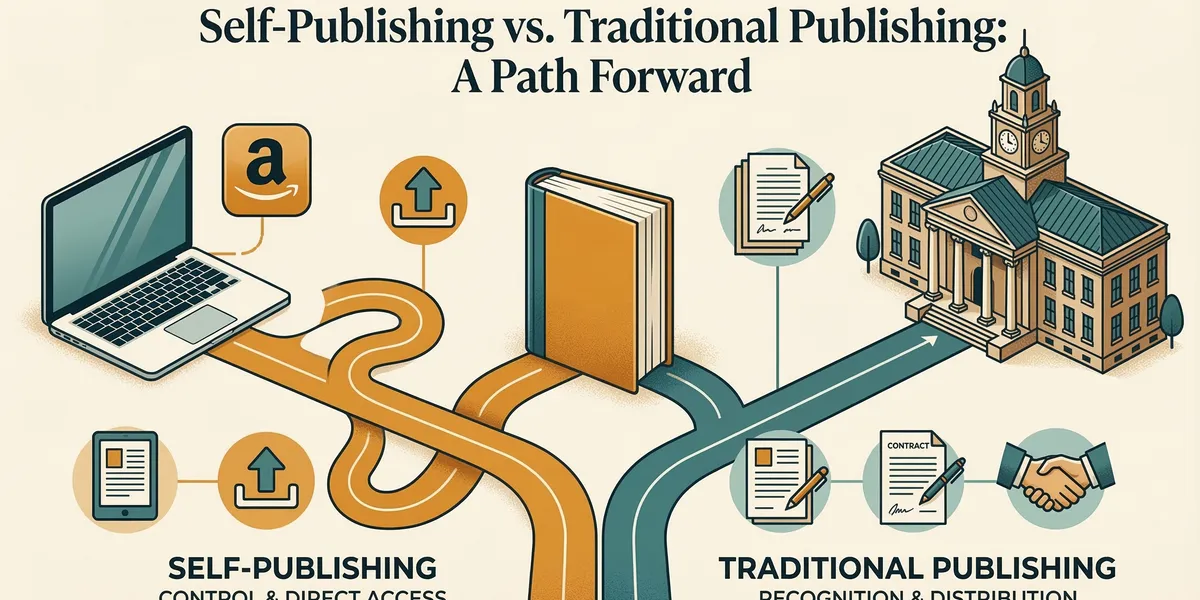
Neither self-publishing nor traditional publishing is universally better. Self-publishing gives you control, speed, and higher per-book income. Traditional publishing gives you prestige, bookstore distribution, and an advance check. The right choice depends entirely on what you want your book to do for you.
This comparison breaks down every meaningful difference — royalties, timelines, costs, creative control, and marketing — so you can stop guessing and make a decision you won’t regret.
At a Glance: Self-Publishing vs Traditional Publishing
| Factor | Self-Publishing | Traditional Publishing |
|---|---|---|
| Timeline | 1–8 weeks | 1–3 years |
| Upfront Cost | $1,000–$5,000 (editing, cover, marketing) | $0 (publisher pays) |
| Royalties | 35–70% per sale | 8–15% per sale |
| Creative Control | 100% yours | Publisher decides |
| Distribution | Online-focused (Amazon, IngramSpark) | Bookstores, libraries, airports |
| Prestige | Growing, but stigma lingers | High — recognized by industry |
| Marketing | You handle it (or hire help) | Publisher provides budget (varies) |
| Rights | You keep all rights | Publisher controls rights for years |
Both paths produce real books that readers can buy and hold. The difference is who controls the process, who takes the financial risk, and who collects the bigger share of revenue.
Self-Publishing Pros
Higher Royalties
This is the number that changes everything. Self-published authors on Amazon KDP earn 35–70% per ebook sale and roughly 60% minus printing costs on paperbacks. Traditional publishing pays 8–15% of list price for print books and 25% of net for ebooks — which often works out to less than $2 per copy sold.
On a $14.99 ebook, a self-published author earns roughly $10.49 at the 70% rate. A traditionally published author earns roughly $2.62 (25% of the publisher’s net, which is typically about 75% of list price). You need to sell four times as many copies through a traditional deal to match self-publishing income.
Full Creative Control
You choose the title, cover design, interior layout, pricing, and publication date. No one tells you your cover needs to look different, your title is wrong for the market, or your book needs to be 30% shorter. For nonfiction authors building a personal brand, this control is essential — your book needs to match your message, not a publisher’s interpretation of it.
Speed
A self-published book can go from finished manuscript to live on Amazon in a matter of weeks. Traditional publishing takes 1–3 years from the moment a publisher accepts your manuscript. That timeline doesn’t include the months or years spent querying agents and waiting for responses. If your book covers a trending topic or you want it ready for a specific launch date, self-publishing is the only realistic option.
You Keep Your Rights
When you self-publish, you own your book completely. You can pull it from sale, update it, release a new edition, sell foreign rights, or license it for film — all without asking permission. Traditional contracts typically lock up your rights for the life of the copyright (your lifetime plus 70 years). Getting rights back from a publisher is possible but difficult and slow.
No Gatekeepers
Traditional publishing rejects roughly 98–99% of submissions. Agents receive hundreds of queries per week and say yes to a handful. Self-publishing removes that bottleneck entirely. If you have a manuscript, you can publish it. This doesn’t mean quality doesn’t matter — it matters more, because readers become the gatekeepers — but it means your book’s future isn’t decided by one person’s taste on one afternoon.
Self-Publishing Cons
Upfront Costs
Self-publishing isn’t free if you want a professional result. Developmental editing runs $1,000–$3,000. Cover design costs $300–$1,500. Copyediting and proofreading add another $500–$1,500. Marketing and advertising can cost anything from $500 to $5,000+ for a launch. You’re investing $1,000–$5,000 before you sell a single copy, and that money comes out of your pocket.
You Handle Everything
Publishing, marketing, distribution, accounting — it all falls on you. You are the CEO of a one-person publishing company. You need to learn about book metadata, Amazon categories, keyword optimization, ad platforms, and email list building. Some authors thrive on this. Others find it overwhelming enough to abandon writing altogether.
Tools like Chapter.pub can speed up the writing process significantly — its AI-powered writing tools help you produce a polished draft faster — but you still need to manage the publishing and marketing side yourself.
Limited Bookstore Presence
Most physical bookstores won’t stock self-published books. Barnes & Noble and independent stores order through traditional distribution channels, and they want returnability — the ability to send unsold copies back to the publisher for a refund. Self-published print-on-demand books typically aren’t returnable. IngramSpark offers a returnable option, but bookstores still favor traditionally published titles from publishers they know.
Stigma (Fading but Real)
The self-publishing stigma has shrunk dramatically since the early Kindle days. Authors like Andy Weir, E.L. James, and Hugh Howey proved that self-published books can reach millions of readers. Still, some literary reviewers, award committees, and industry professionals treat self-published books as second-tier. If winning a National Book Award or getting reviewed in The New York Times matters to your goals, traditional publishing provides a clearer path.
Traditional Publishing Pros
Advance Payment
Traditional publishers pay an advance against royalties — money you receive before your book earns a single dollar in sales. First-time advances typically range from $5,000 to $25,000 for most genres. Established authors or high-demand topics can command $50,000 to $100,000+. Celebrity and politician memoirs have hit seven figures. This upfront payment reduces your financial risk to zero. Even if the book sells poorly, you keep the advance.
Bookstore Distribution
Traditional publishers have established relationships with Barnes & Noble, independent bookstores, airport shops, libraries, and international retailers. Your book shows up on physical shelves where casual readers browse. This kind of distribution is nearly impossible to replicate as a self-published author. For genres where physical browsing drives discovery — children’s books, cookbooks, literary fiction — this advantage is significant.
Professional Team at No Cost to You
A traditional deal includes a team of editors, designers, and marketers — all paid by the publisher. You get developmental editing, copyediting, proofreading, cover design, interior layout, and often a publicist for your launch window. The quality of this support varies by publisher, but at minimum it covers the $3,000–$5,000 you’d spend out of pocket self-publishing.
Marketing Budget (Sometimes)
Major publishers allocate marketing budgets for titles they believe will sell. This can include review copies to media outlets, placement in bookstore displays, social media promotion, and author tour support. The caveat: most of this budget goes to lead titles and established authors. If you’re a debut author at a Big Five publisher, you might get a modest push. At a small press, you might get almost nothing.
Prestige and Credibility
A traditionally published book carries institutional credibility. It means an agent believed in your work, a publisher invested money in it, and an editorial team refined it. This credibility matters for speaking engagements, media appearances, academic careers, and professional authority. “Published by Penguin Random House” opens doors that “published on Amazon” doesn’t — at least not yet.
Traditional Publishing Cons
Painfully Slow
The traditional publishing timeline is brutal. Writing a query letter, finding an agent, and getting a deal can take 6 months to 2 years by itself. Once a publisher acquires your book, it typically takes another 12–18 months before it hits shelves. That’s 1–3 years from finished manuscript to publication. Markets shift, topics go stale, and your momentum dies while you wait.
Low Royalties
Traditional ebook royalties land at 25% of net — which after retailer discounts works out to roughly 12–17% of list price. Print royalties range from 8% for paperbacks to 15% for hardcovers, based on list price. You earn significantly less per copy than a self-published author. Most traditionally published books never earn out their advance, which means most traditionally published authors never see a royalty check beyond that initial payment.
Loss of Creative Control
Your publisher chooses your cover. Your publisher picks the title. Your editor decides what stays and what gets cut. You can push back, but the publisher has final say on nearly every creative decision. Many authors have been horrified by covers that don’t match their vision or titles that feel wrong for their book. If your book is part of your personal brand, handing over creative control is a real risk.
Extremely Hard to Break In
Only 1–2% of queried manuscripts land an agent. Of those, only a fraction secure a publishing deal. The math is discouraging: if you send 100 queries, you might get 1–2 partial or full manuscript requests, and the odds of those converting to a deal are slim. The process requires persistence, thick skin, and often years of rejection before a yes arrives — if it arrives at all.
You Give Up Rights
Traditional publishing contracts grant the publisher control over your book’s rights — print, digital, audio, foreign translation, and sometimes film/TV. These rights are tied up for the life of the copyright unless you negotiate reversion clauses. If your publisher lets your book go out of print, getting those rights back requires navigating contract language and legal processes. Many authors have found their backlist trapped with publishers who aren’t actively selling it.
Hybrid Publishing: A Middle Ground
Hybrid publishing sits between self-publishing and traditional. You pay a publisher to provide professional editing, design, and distribution services, while retaining higher royalties and more creative control than a traditional deal. Reputable hybrid publishers are selective — they don’t accept every manuscript — and charge $3,000–$20,000 for their services.
The risk with hybrid publishing is the gray area between legitimate services and vanity presses. A real hybrid publisher rejects manuscripts that aren’t ready. A vanity press accepts everyone who can pay. Before signing with any hybrid publisher, check that they’re a member of the Independent Book Publishers Association (IBPA) and meet the IBPA’s hybrid publisher criteria.
How to Decide: The Framework
Forget which path is “better.” Ask which path matches your specific goals.
Choose Self-Publishing If You Want:
- Speed — Your book live in weeks, not years
- Maximum per-book income — 35–70% royalties instead of 8–15%
- Creative control — Your cover, your title, your pricing, your timeline
- A book as a business tool — If your book drives consulting, coaching, courses, or speaking engagements, self-publish 100% of the time. You need full control over pricing, bundling, and updates.
- To build a catalog — Prolific authors who write multiple books per year earn more self-publishing because each new title compounds the income from previous titles
Choose Traditional Publishing If You Want:
- Bookstore distribution — Physical shelf space in Barnes & Noble and independents
- An advance — Guaranteed money upfront regardless of sales
- Prestige — The credibility of a recognized publisher’s name on your spine
- A professional team — Editing, design, and marketing handled for you
- Award eligibility — Many major literary awards only consider traditionally published titles
Choose Self-Publishing If Your Book Is a Business Tool
This one deserves its own section because it’s the clearest decision in the entire debate. If your book exists to generate leads, establish authority, or support a business, self-publish. You need the ability to price it at $0.99 for promotions, give away free copies at events, update the content as your business evolves, and control every word of the messaging. A traditional publisher will never give you that flexibility.
How to Self-Publish Today
The process is more accessible than it’s ever been. Here’s the practical path:
- Write your manuscript — Use Chapter.pub to write your book with AI-powered assistance. It helps you structure, draft, and polish your manuscript faster than starting from a blank page. Over 2,100 authors have used it to create more than 5,000 books.
- Edit professionally — Hire a developmental editor for structure and a copyeditor for polish. Don’t skip this.
- Design your cover — Hire a professional cover designer or use a service like 99designs. Your cover is your most important marketing asset.
- Format for publishing — Tools like Vellum (Mac) or Atticus handle ebook and print formatting.
- Publish on Amazon KDP — Upload your ebook and paperback to Amazon KDP. It’s free and gives you access to the world’s largest book marketplace. For a detailed walkthrough, see our guide on how to publish a book on Amazon.
- Go wide (optional) — Use IngramSpark or Draft2Digital for distribution beyond Amazon. Check our comparison of the best self-publishing platforms to find the right fit.
- Market your book — Build an email list, run Amazon ads, and leverage social media. For a complete start-to-finish process, read how to self-publish a book.
FAQ
Can you do both self-publishing and traditional publishing?
Yes. Many authors self-publish some titles and traditionally publish others. You could self-publish a nonfiction book for your business while pursuing a traditional deal for a novel, or self-publish your backlist after rights revert from a traditional contract. The paths aren’t mutually exclusive — they’re different tools for different goals.
Do self-published books sell as well as traditionally published books?
Some do, most don’t — and the same is true for traditionally published books. The median self-published book sells fewer than 250 copies. The median traditionally published book sells about 3,000 copies in its first year and less than 300 per year after that. Top performers in both categories sell millions. Success depends more on the book’s market fit and the author’s marketing effort than on the publishing path.
Is self-publishing still stigmatized?
Less every year. Readers generally don’t check (or care) who published a book. They care about the cover, the description, and the reviews. Industry professionals — agents, reviewers, award judges — still favor traditional publishing in some contexts. But the stigma is a fraction of what it was a decade ago, and it continues to shrink as more high-quality self-published books reach mainstream audiences.
How much money do you need to self-publish?
A bare-minimum ebook with basic editing and a premade cover can cost as little as $500. A professional-quality paperback or hardcover with developmental editing, custom cover design, and interior formatting typically runs $2,000–$5,000. Marketing and advertising costs vary widely — from $0 if you rely on organic reach to $5,000+ for a paid launch strategy. Most successful self-published authors invest $1,000–$3,000 in their first book and reinvest profits into subsequent titles.
The most important step is writing a book worth publishing. Whether you choose self-publishing or traditional, the quality of your manuscript determines everything that follows. Start with the writing — you can decide on the publishing path once you have something worth putting into the world. If you’re ready to begin, Chapter.pub can help you write your book faster than you thought possible.