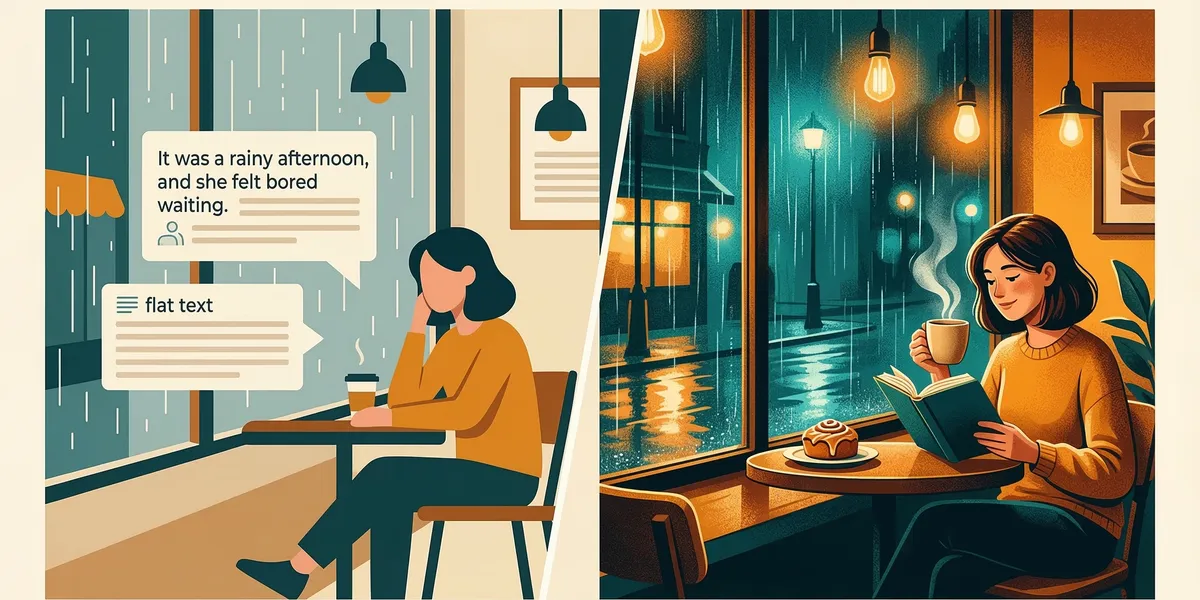
Show, don’t tell means using action, sensory detail, and dialogue to convey emotion and information instead of stating it directly. It is the most common piece of writing advice — and the most frequently misunderstood.
“Telling” names a fact. “Showing” creates an experience. The difference is not about good writing versus bad writing. It is about choosing the right tool for the right moment.
What Showing Actually Looks Like
The concept is easier to understand through examples than through definitions. Here are five before-and-after pairs that illustrate the difference.
Example 1: Emotion
Telling: She was angry.
Showing: She slammed the door hard enough to rattle the picture frames. The glass of water on the hall table trembled, then went still.
The telling version labels the emotion. The showing version lets the reader feel it through physical consequences. The reader concludes “she’s angry” on their own — and that conclusion lands harder because they reached it themselves.
Example 2: Character Trait
Telling: He was a generous man.
Showing: He left a forty-dollar tip on a twenty-dollar meal, then stopped on the sidewalk to hand his umbrella to a stranger standing in the rain.
Two concrete actions replace one abstract adjective. The reader sees generosity in motion rather than being told it exists.
Example 3: Setting and Mood
Telling: The house was creepy.
Showing: The porch light flickered twice and went dark. Something skittered across the roof — too heavy to be a squirrel, too fast to be a cat. The front door hung open three inches, swaying in air that had no wind.
“Creepy” is a judgment. The showing version provides sensory evidence and lets the reader make the judgment. The unease is earned, not assigned.
Example 4: Relationship
Telling: They were no longer in love.
Showing: He poured coffee into two mugs, set hers on the far end of the counter, and took his to the living room without a word. She waited until she heard the television before she picked it up.
The physical distance between the mugs, the silence, the television as a barrier — these details communicate the state of the relationship without naming it. The reader feels the coldness because they observe it.
Example 5: Backstory
Telling: She had a difficult childhood.
Showing: When the neighbor’s kid scraped his knee and started crying, she flinched before she could stop herself. Loud crying still made her shoulders tense, still made her scan the room for exits.
Instead of summarizing years of experience in a single sentence, the showing version reveals the residue of that experience through a present-moment physical reaction. The reader infers the backstory from the behavior.
Why Showing Works
The power of showing comes from a simple psychological principle: conclusions the reader reaches on their own feel more true than conclusions handed to them.
When you write “she was terrified,” the reader processes it as information. When you write “her hands shook so badly she could not turn the key in the lock,” the reader experiences a moment of vicarious terror. The second version engages empathy, imagination, and sensory processing. The first engages only comprehension.
Anton Chekhov put it most directly: “Don’t tell me the moon is shining; show me the glint of light on broken glass.” The glint on glass is specific, visual, and alive. “The moon is shining” is a weather report.
When Telling Is Actually Better
Here is the part that most writing advice leaves out: telling is not always wrong. In fact, trying to show everything is one of the most common mistakes intermediate writers make.
Transitions and Time Skips
Showing: Three pages describing every moment of a six-hour drive from New York to Boston.
Telling: “The drive took six hours.”
The drive is not the story. Skip it. Showing mundane transitions wastes the reader’s time and kills pacing.
Minor Details
Not every fact needs to be dramatized. “The restaurant was on the corner of Fifth and Main” does not need to be shown through a character observing street signs. State it and move on.
If a detail is functional — establishing location, noting the passage of time, providing context — telling is efficient and appropriate.
Pacing Control
A thriller in its final act cannot pause for three paragraphs of sensory detail every time a character feels fear. At high speed, telling keeps the momentum: “He was terrified. He ran.”
Showing slows a scene down. Telling speeds it up. Both are pacing tools, and skilled writers shift between them intentionally.
Already-Established Emotions
If you have already shown a character’s grief through behavior and detail across multiple scenes, you can occasionally tell: “The grief was still there, but duller now, like a bruise turning yellow.” The reader has earned the direct statement because they have already experienced the emotion with the character.
The Balance: You Need Both
The best writing is neither pure showing nor pure telling. It is a rhythm — a mix of scenes (showing) and summary (telling) that keeps the reader engaged without exhausting them.
Think of it this way:
- Show the moments that matter emotionally — turning points, revelations, conflicts, moments of connection or loss.
- Tell the connective tissue — transitions, minor details, time passage, context that does not need dramatization.
Ernest Hemingway showed the action and told the transitions. Donna Tartt shows emotion in exquisite detail and tells backstory in crisp summary. Neither approach is more correct. The choice depends on what the moment demands.
Common Mistakes When Trying to Show
Purple Prose
Trying too hard to show leads to overwrought description. “The crystalline tears cascaded down her porcelain cheeks like tiny rivers of sorrow” is showing gone wrong. It draws attention to the writing instead of the emotion.
Good showing is precise and restrained. “Her eyes filled. She turned away before he could see” does more with less.
Showing What Does Not Matter
Not every moment deserves the full showing treatment. If a character walks into a coffee shop to meet someone, you do not need to describe the barista’s tattoos, the acoustic guitar music, the scent of dark roast beans, and the texture of the wooden table. Show what is relevant to the scene’s emotional stakes. Tell or skip the rest.
Relying on Body Language Cliches
“Her heart raced.” “His stomach dropped.” “She clenched her fists.” These are so overused that they function as telling in disguise. The reader does not actually feel anything — they just recognize the code.
Find fresher physical details. Instead of “her heart raced,” try something specific to the character and the moment: “She pressed her tongue against the roof of her mouth and counted to three, the way she did before every exam, every interview, every conversation she knew she could not take back.”
Showing Through Adverbs
“He said angrily” is not showing. It is telling with an adverb attached to a dialogue tag. If you need the reader to know a character is angry, show it through what they say, how they say it, or what they do — not through an adverb.
Practical Exercises
Want to sharpen your showing skills? Try these.
The emotion test. Pick an emotion — jealousy, relief, shame, joy. Write a paragraph where a character feels that emotion without ever naming it. The reader should be able to identify the emotion from behavior and detail alone.
The adjective audit. Take a page of your current draft and circle every adjective. For each one, ask: can I replace this with a specific detail? “The old house” becomes “the house with the sagging porch and the mailbox that no longer closed.” Not every adjective needs replacing — but the exercise trains you to reach for specifics.
The dialogue check. Find a scene where a character states their feelings in dialogue. Rewrite it so they say something else entirely — but the reader still understands how they feel. This is subtext, and it is showing through dialogue.
The Real Rule
“Show, don’t tell” is not actually a rule. It is a reminder to engage the reader’s senses and imagination rather than handing them pre-digested conclusions.
Show the moments that matter. Tell the moments that serve the story but do not need dramatization. The skill is knowing which is which — and that comes from reading widely, writing regularly, and paying attention to what makes you feel something on the page.
For more on writing craft, explore our guides on character development, writing dialogue, and how to write a novel.