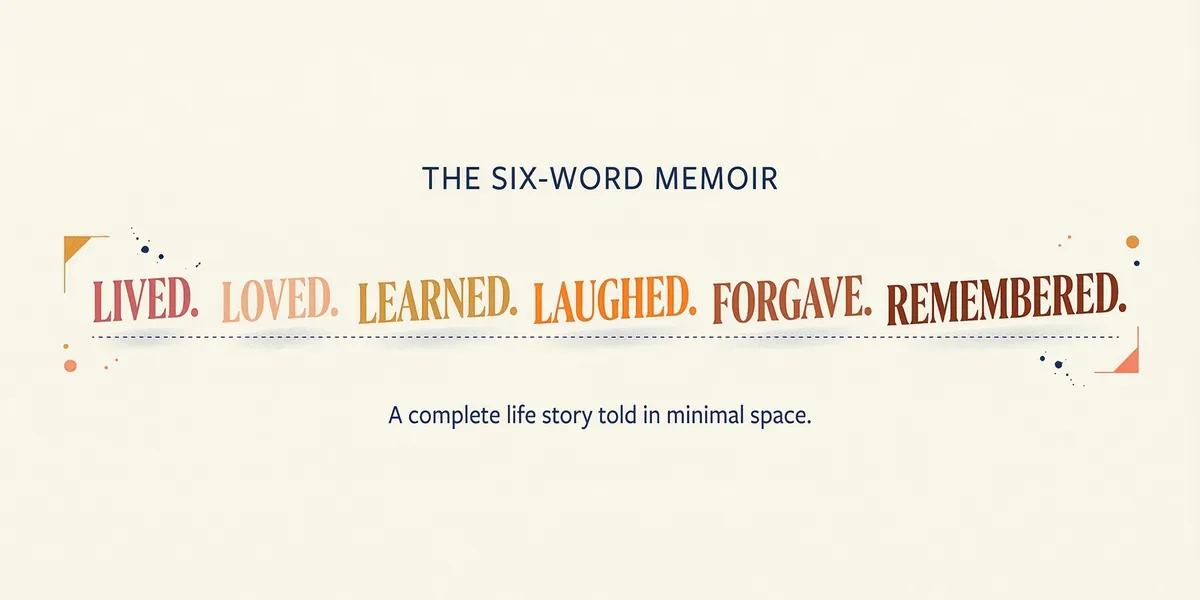
A six-word memoir distills an entire life story or experience into exactly six words. It is one of the most demanding and rewarding exercises a writer can attempt — forcing you to find the single sentence that says everything.
What Is a Six-Word Memoir?
The six-word memoir is a form of flash memoir that captures the essence of a person’s life, a pivotal experience, or a defining truth in precisely six words. No more, no less.
The concept was popularized by Smith Magazine, which launched the Six-Word Memoir project in 2006. Readers were invited to tell their life stories in exactly six words. The response was staggering — hundreds of thousands of submissions poured in, leading to a bestselling book series and a global writing movement.
What makes the form work is the constraint. Six words is short enough that every syllable matters, but long enough to hold genuine meaning. The best six-word memoirs read like the title of an autobiography you desperately want to open.
The Hemingway Origin Story
The six-word memoir traces its inspiration to a famous story about Ernest Hemingway. As the legend goes, Hemingway was challenged at a dinner party to write a complete story in just six words. He scribbled on a napkin:
“For sale: baby shoes, never worn.”
The tale is almost certainly apocryphal. No verifiable record of this dinner party exists, and the anecdote only surfaced decades after Hemingway’s death. Scholars at Snopes and the Hemingway Foundation have found no evidence linking it to Hemingway directly.
But the story endures because it illustrates a real truth about writing: brevity is its own kind of power. Those six words contain an entire narrative arc — hope, preparation, loss — without stating any of it outright. Whether Hemingway wrote them or not, they became the spark that launched a modern literary form.
Famous Six-Word Memoir Examples
The best six-word memoirs hit instantly. Here are some of the most well-known.
- “Not quite what I was planning.” — the title of Smith Magazine’s bestselling collection
- “Born in the desert, still thirsty.”
- “Secretly, I still read fairy tales.”
- “Started small, dreamed big, landed somewhere.”
- “Cursed with cancer. Blessed with friends.” — Hannah Davies
- “The misfortune of knowing too much.”
- “I still make coffee for two.” — Zak Nelson
- “Married by Elvis, divorced by Friday.”
- “Found true love, married someone else.”
- “After Harvard, had baby, got fired.”
- “Took scenic route. Got lost. Stayed.”
- “Catholic school survivor. Still have guilt.”
- “Living in the wreckage, planting flowers.”
- “Revenge is living well, without you.” — Joyce Carol Oates
- “I was the smart, ugly one.”
- “Big house. Small lives. Quiet escape.”
- “Thought I would have more time.”
- “Never finished what I” — anonymous, from SmithMag
- “Brought scissors to a word fight.”
- “Mom died. Dad left. Still standing.”
- “Was father. Was husband. Was happy.”
Each one reads like a door cracked open. You glimpse just enough of the life behind it.
Six-Word Memoirs by Category
Funny
- “Allergic to mornings. Addicted to coffee.”
- “Wanted world domination. Got a cubicle.”
- “Married my high school sweetheart’s roommate.”
- “Diet starts Monday. Every single Monday.”
- “Survived childhood. Adulthood is the sequel.”
- “Plan A failed. Currently on Plan G.”
- “Born genius. School ruined it. Thanks.”
Sad
- “She left. The dog stayed. Enough.”
- “I still hear you saying goodbye.”
- “Wrote her number. Lost the napkin.”
- “The silence after the last heartbeat.”
- “Empty chair at every holiday table.”
- “Loved deeply. Lost deeply. Loved again.”
- “He promised forever. Forever was short.”
Hopeful
- “Started over. Again. Getting better, though.”
- “Rock bottom became the solid foundation.”
- “Closed the chapter. Found the sequel.”
- “Broken crayons still color the world.”
- “Tomorrow I become who I am.”
- “Finally learning the song was mine.”
- “Small seeds. Patient gardener. Beautiful mess.”
Career
- “Quit law school. Became a baker.”
- “Corporate ladder. Wrong wall. Climbed down.”
- “Dream job existed. Had to build it.”
- “Wrote resume. Burned resume. Wrote novel.”
- “Teacher by accident. Teacher by calling.”
- “Followed passion. Ate ramen. Worth it.”
Love
- “Met online. Married offline. Still surprised.”
- “She laughed. I knew. That’s all.”
- “Wrong person. Wrong time. Right lessons.”
- “Two toothbrushes. One sink. Finally home.”
- “Love letters never sent. Regret persists.”
- “His hand found mine. World shrank.”
Regret
- “Should have said yes. Didn’t. Can’t.”
- “Burned the bridge. Miss the view.”
- “Played it safe. Missed the adventure.”
- “Apology written, sealed, stamped, never sent.”
- “Spent years earning, not enough living.”
- “Chose comfort. Wonder about the alternative.”
Family
- “Mom’s recipe. My kitchen. Her ghost.”
- “Four siblings. Five versions of childhood.”
- “Became my mother. Not entirely sorry.”
- “Dad never said it. I knew.”
- “Raised by wolves. Turned out fine.”
- “Inherited stubbornness. Applied it to everything.”
How to Write a Six-Word Memoir
Writing six words sounds simple. It is not. Here is how to approach it.
1. Start with a theme
Pick one thread of your life: a relationship, a career change, a regret, a triumph, a personality trait. Trying to capture everything at once will produce something vague. Narrowing down produces something true.
2. Brainstorm freely
Write twenty or thirty attempts without judging them. Some will be terrible. That is fine. The goal is volume. Your best six-word memoir will almost never be your first attempt.
Try completing these sentence starters:
- “I always…”
- “I never…”
- “I thought… but…”
- “They said… I…“
3. Cut ruthlessly
Look at each draft and ask: does every single word earn its place? Can you replace a two-word phrase with one sharper word? Can you cut an adjective and let the noun carry the weight?
The difference between a good six-word memoir and a great one is usually one word swap.
4. Test the emotional impact
Read your memoir to someone without context. If they pause, lean forward, or ask a question — you have something. If they nod politely, keep revising.
The strongest six-word memoirs provoke a reaction. They make the reader feel something specific: a pang of recognition, a laugh, a lump in the throat.
5. Make every word do double duty
The best six-word memoirs use words that carry more than their surface meaning. “Never worn” in Hemingway’s famous six words does not just mean unworn shoes. It means a child who never existed in the life of the parents who prepared for them.
Look for words in your draft that can work on two levels — literal and emotional.
Why Six-Word Memoirs Matter
The six-word memoir is more than a parlor trick. It teaches skills that improve every kind of writing.
Economy of language. Most writers use too many words. The six-word constraint forces you to weigh every syllable. That discipline carries over into longer work — tighter paragraphs, sharper dialogue, leaner prose.
Emotional precision. When you only have six words, you cannot hide behind vague language. You must identify exactly what you feel and find the exact words for it. This is the core skill of strong memoir writing.
Story structure in miniature. A great six-word memoir contains a beginning, middle, and end. “Quit law school. Became a baker.” has a full narrative arc in six words. Practicing this teaches you how story structure works at its most fundamental level.
Accessibility. You do not need an MFA or a publishing deal to write one. It is one of the most democratic forms of creative writing — anyone with a life can write a six-word version of it.
If you are looking for more ways to practice, our list of things to write about offers hundreds of starting points for every kind of writer.
Try It Yourself
Here is a writing exercise you can do right now.
Set a timer for ten minutes. Write as many six-word memoirs as you can. Do not stop to edit. Do not judge. Just write.
When the timer runs out, circle the three that feel most true. Then spend another ten minutes refining only those three. Swap a word. Rearrange the order. Read them out loud.
Pick your single strongest one. Write it somewhere you will see it — a sticky note, a phone wallpaper, a notebook cover.
That is your six-word memoir. For now. The beautiful thing about this form is that it changes as you do. The six words that define your life today will not be the same six words five years from now.
Write the next draft then.