A story arc is the overall shape of a story’s emotional trajectory from beginning to end. It traces how a character’s fortunes rise and fall across the narrative — the pattern of change that gives a story its feeling of movement and meaning.
What Is a Story Arc
Every story creates an emotional path. A character starts in one condition, passes through a series of changes, and ends in another. The shape of that path — when it climbs, when it drops, how many times it reverses — is the story arc.
The concept is distinct from plot structure, though the two are deeply connected. Plot structure is the mechanical framework: exposition, rising action, climax, falling action, denouement. It tells you where the parts go. A story arc tells you what it feels like to move through them. Two stories can share an identical plot structure and have completely different arcs — one ending in triumph, the other in ruin.
Think of plot structure as the skeleton. The story arc is the posture.
Kurt Vonnegut was the first to articulate this clearly. In a famous lecture (and later a rejected master’s thesis), he argued that stories have shapes — simple, graphable shapes that track a character’s fortune over time. Decades later, researchers at the University of Vermont used computational analysis to scan thousands of novels and confirmed his intuition. They found six core emotional arcs that account for the vast majority of stories ever told.
The 6 Story Arc Shapes
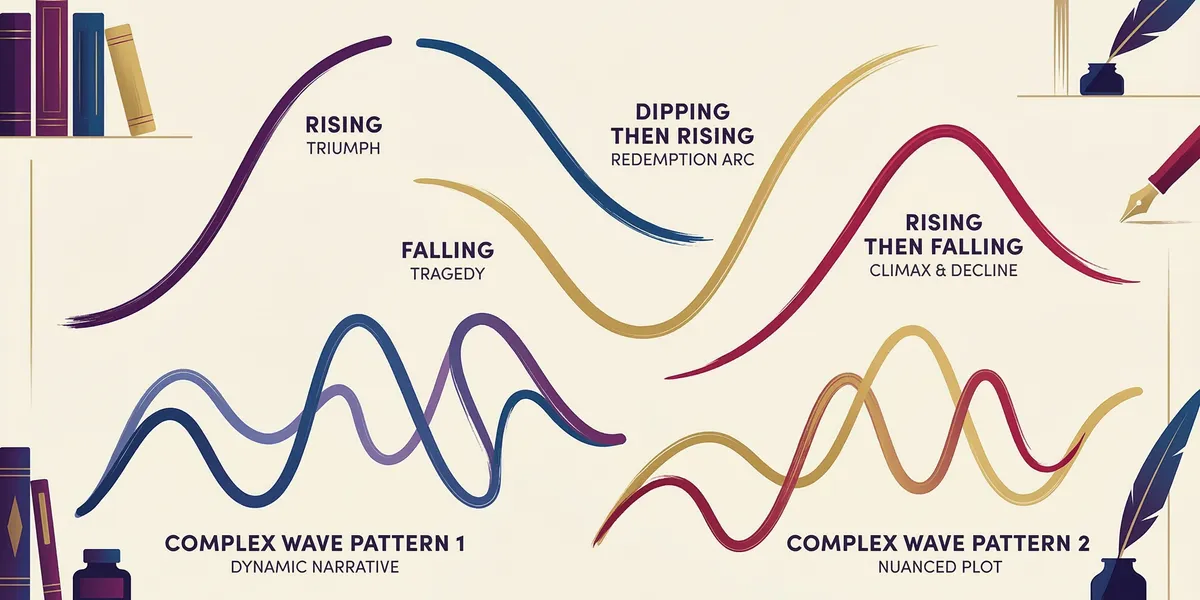
Here are the six arcs. Each one describes the emotional trajectory a story follows — the rise and fall of a character’s fortune from beginning to end.
| Arc | Shape | Movement | Classic Example |
|---|---|---|---|
| Rags to Riches | ↗ | Steady rise | Jane Eyre |
| Riches to Rags | ↘ | Steady fall | 1984 |
| Man in a Hole | ↘↗ | Fall, then rise | Die Hard |
| Icarus | ↗↘ | Rise, then fall | Macbeth |
| Cinderella | ↗↘↗ | Rise, fall, rise | Harry Potter |
| Oedipus | ↘↗↘ | Fall, rise, fall | Hamlet |
Rags to Riches (Rise)
The simplest upward arc. A character begins in a low state — poor, powerless, unloved, ignorant — and steadily ascends. The trajectory is one of accumulation and growth, and the ending is better than the beginning.
Jane Eyre follows this arc almost perfectly. An orphaned, mistreated child gradually gains education, independence, love, and finally an inheritance. The line moves upward with few major reversals.
The aspirational energy of The Great Gatsby borrows from this shape too, though Fitzgerald ultimately subverts it. Gatsby’s belief in the rags-to-riches arc is part of his tragedy.
This arc dominates memoirs, bildungsromans, and underdog sports stories. It appeals to the reader’s desire to see effort rewarded.
Riches to Rags (Fall)
The inverse. A character starts in a position of comfort, power, or happiness and loses it — gradually or suddenly. The trajectory is one of decline, and the ending is worse than the beginning.
1984 is a pure fall. Winston Smith begins with a small spark of rebellion and hope. The novel systematically extinguishes both. By the final page, he loves Big Brother. There is no recovery.
Breaking Bad follows this arc across its full run. Walter White begins as a sympathetic, underestimated chemistry teacher and ends as a man who has destroyed everything he claimed to be protecting.
Tragedies live here. So do cautionary tales, dystopian fiction, and literary novels about moral decay.
Man in a Hole (Fall, Then Rise)
The most popular arc in Western fiction. A character falls into trouble — a “hole” of some kind — and then climbs out. The ending is positive, but the character had to suffer first.
Vonnegut named this one directly. “Somebody gets into trouble, gets out of it again. People love that story.”
Die Hard is the Hollywood version. John McClane arrives at a Christmas party, terrorists take over the building, and he spends two hours in a hole — literally and figuratively — before clawing his way to victory. Most romantic comedies follow the same pattern: the couple meets, something drives them apart, they find their way back.
This arc works because the low point creates contrast. The eventual rise feels earned because the reader watched the character struggle. It is the emotional shape of perseverance.
Icarus (Rise, Then Fall)
A character ascends — gaining power, success, confidence, or forbidden knowledge — and then crashes. The rise makes the fall devastating. The higher they climb, the harder the landing.
Macbeth is the textbook case. A loyal general receives a prophecy, murders his way to the throne, and is destroyed by the consequences. The first half is ascent. The second half is disintegration.
The Wolf of Wall Street follows the same trajectory. So does Scarface. So does every story about someone who flew too close to the sun.
The Icarus arc is a warning. It says: this kind of ambition, pursued this way, ends here. The rise is seductive. The fall is the point.
Cinderella (Rise, Fall, Rise)
The most emotionally complex of the upward-ending arcs. A character rises, loses everything (or nearly everything), and then rises again — higher than before. The middle reversal is what separates this from a simple rags-to-riches story.
Harry Potter traces this shape across the full series. Harry escapes the Dursleys and discovers the wizarding world (rise). He loses Sirius, Dumbledore, and nearly everything he loves (fall). He defeats Voldemort and builds the life he was denied (rise). The second rise carries more weight because of what was lost in between.
Classic fairy tales invented this shape — Cinderella herself goes from ashes to the ball, back to ashes when the clock strikes midnight, and finally to the palace for good.
This arc generates the deepest reader satisfaction because it combines hope, loss, and redemption. The character does not just succeed — they succeed after proving they can endure failure.
Oedipus (Fall, Rise, Fall)
The darkest arc. A character falls into adversity, appears to recover or gain ground, and then falls again — this time permanently. The false recovery in the middle is what makes it devastating. The reader is given hope, then has it taken away.
Hamlet follows this pattern. The prince learns of his father’s murder (fall), devises a plan and seems to regain agency through the play-within-a-play (rise), then spirals into a bloodbath that kills nearly everyone, including himself (fall).
Requiem for a Dream executes this arc with brutal precision. Each character experiences a brief period where their dreams seem achievable before the final act destroys them completely.
Of Mice and Men does the same. George and Lennie find work, build hope for their farm, and then the dream collapses with Lennie’s unintentional violence.
This arc is rare in commercial fiction because it denies the reader comfort. But when it works, it produces some of the most haunting stories ever written.
Story Arc vs Plot Structure
These terms get used interchangeably, but they describe different things.
Plot structure is the mechanical framework — the sequence of narrative events. Exposition sets the stage. Rising action builds complications. The climax delivers the turning point. Falling action shows the consequences. The denouement ties up loose ends. This is the engineering of a story.
Story arc is the emotional shape — how the reader feels as they move through those events. Is the character’s fortune rising or falling? Is the overall trajectory hopeful or devastating?
A thriller and a romance can share the same three-act plot structure but produce completely different arcs. The thriller might follow an Oedipus arc (things get worse, briefly improve, then collapse). The romance might follow a Man in a Hole arc (couple meets, separates, reunites). Same skeleton, different posture.
They work together. Plot structure determines where your scenes go. The story arc determines what those scenes do to the reader. The best writers are conscious of both — building scenes that hit the right structural beats while maintaining the emotional trajectory they have chosen.
How to Choose Your Arc
Your arc should serve your story’s theme and meet your genre’s expectations.
Start with theme. If your novel is about resilience, the Man in a Hole or Cinderella arc makes the theme visible in the story’s shape. If your novel is about the corrupting nature of power, the Icarus arc embodies that idea structurally. The arc should be the emotional argument for your theme.
Consider genre conventions. Romance readers expect a positive ending — Rags to Riches, Man in a Hole, or Cinderella. Literary fiction tolerates (and sometimes demands) Riches to Rags or Oedipus. Thrillers often use Man in a Hole. Horror frequently uses Icarus or Oedipus. You can subvert these expectations, but do it deliberately, not accidentally.
Think about your character’s starting point. If your protagonist begins in a strong position, the Riches to Rags and Icarus arcs become available. If they begin in a weak position, Rags to Riches and Man in a Hole are natural fits. The character’s starting condition limits which shapes feel organic.
Decide what you want the reader to feel at the end. Satisfaction and hope point toward arcs that end on a rise. Devastation and unease point toward arcs that end on a fall. The final emotional note is not just a consequence of your arc — it is the reason to choose it.
Tips for Crafting a Compelling Arc
Let the Character Drive It
The arc should emerge from who your character is, not from events imposed on them. A Man in a Hole arc is strongest when the character falls into the hole because of their own flaw and climbs out because of their own growth. External events create the situations. Character development creates the arc.
Track Your Emotional High and Low Points
Before you revise, map the emotional trajectory of your draft. Mark the moments where the character’s fortune is at its highest and lowest. If the highs and lows do not form a clear shape — or if they form a flat line — you have a pacing problem.
The most powerful arcs have one clear high point and one clear low point, with the distance between them as large as possible. Contrast is what makes an arc feel dramatic.
Make the Ending Feel Inevitable
The best story arcs do not surprise the reader with their destination — they surprise the reader with how they got there. An Icarus arc should end in a fall the reader can see coming but cannot look away from. A Cinderella arc should end in a rise that feels earned by everything the character endured.
If your ending feels arbitrary, the arc is broken. Go back to your character’s core desire and flaw, and make sure the ending grows directly from both.
Do Not Fight the Shape
Once you have chosen an arc, commit to it. The middle of a draft is where writers most often lose their nerve — pulling a tragic character back from the edge, or sabotaging a hopeful character’s progress for cheap drama. If you chose a Riches to Rags arc, let the decline continue. If you chose a Cinderella arc, let the second rise happen.
This does not mean the arc cannot have texture. Within a Man in a Hole arc, there can be small rises and falls — moments of false hope during the descent, minor setbacks during the climb. But the overall direction should stay true to the shape you chose.
Study the Arc in Everything You Read
Once you start seeing story arcs, you cannot stop. Every novel, every film, every television season follows one of these six shapes or a combination of them. Train yourself to identify the arc while you read. Ask: where is the character’s fortune right now? Is it rising or falling? What shape is this story making?
The writers who control their arcs most skillfully are the ones who studied them most carefully in the work of others.