A story plot is the sequence of causally connected events that make up a narrative — not just what happens, but why it happens and what it leads to. Plot is the engine that turns a collection of scenes into a story worth reading.
Plot vs Story
These two words get used interchangeably, but they mean different things.
A story is the raw events in chronological order. A plot is how you arrange and connect those events to create meaning.
E.M. Forster drew the classic distinction: “The king died and then the queen died” is a story. “The king died and then the queen died of grief” is a plot.
The difference is causation. Story gives you sequence. Plot gives you consequence. In a story, things happen one after another. In a plot, things happen because of one another.
This distinction matters because readers do not stay engaged by a list of events. They stay engaged by wanting to know what happens next — and that desire only exists when events feel connected. Plot is the connective tissue.
The 5 Elements of Plot
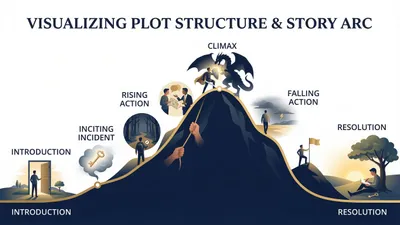
Most plots follow a five-part structure, often visualized as Freytag’s Pyramid. Each element plays a specific role.
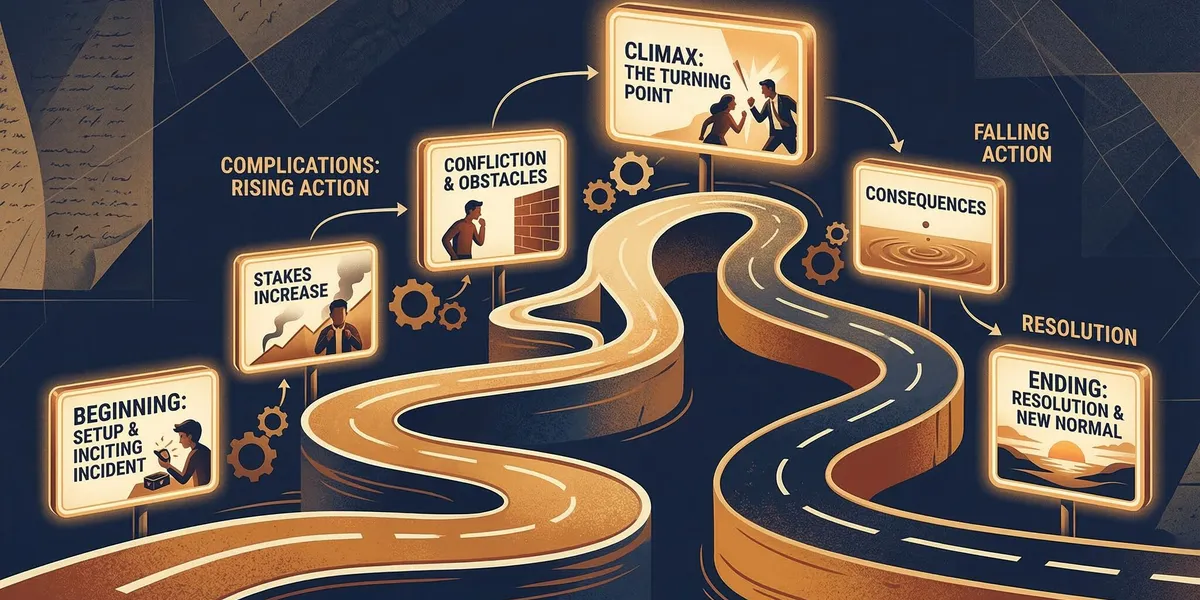
Exposition introduces the characters, setting, and situation before the conflict begins. It is the foundation the rest of the plot builds on.
Rising action is where complications begin. The protagonist pursues a goal and meets resistance. Each obstacle raises the stakes. This is usually the longest section of a story and the part where readers become invested.
Climax is the turning point — the moment of highest tension where the central conflict reaches its peak. Everything in the plot has been building toward this scene.
Falling action follows the climax. The consequences of the turning point play out, subplots begin to close, and the story moves toward its conclusion.
Resolution (sometimes called the denouement) ties up remaining threads and shows what the story’s events have changed. The conflict is settled, for better or worse.
These five elements are not a formula. They are a map of how tension naturally builds and releases in a narrative. You can find them in everything from literary novels to thrillers to fairy tales. For a deeper look at how these pieces fit together, see our guide to plot structure.
The 7 Basic Plots
In The Seven Basic Plots, Christopher Booker argued that all stories fall into seven fundamental patterns. Whether or not you agree with that claim, the categories are a useful way to think about what kind of plot you are building.
Overcoming the Monster. A hero confronts a great evil and defeats it. Beowulf, Jaws, Star Wars.
Rags to Riches. A modest or overlooked character rises to prominence. Cinderella, Jane Eyre, The Pursuit of Happyness.
The Quest. A hero and companions journey toward a crucial goal. The Lord of the Rings, The Odyssey, Finding Nemo.
Voyage and Return. A character travels to an unfamiliar world, faces challenges there, and returns transformed. Alice in Wonderland, The Wizard of Oz, The Hobbit.
Comedy. Confusion, misunderstanding, and entanglement resolve in harmony and union. A Midsummer Night’s Dream, Bridget Jones’s Diary, The Importance of Being Earnest.
Tragedy. A protagonist’s flaws lead to their downfall. Macbeth, The Great Gatsby, Breaking Bad.
Rebirth. A character trapped in a dark state is redeemed through the intervention of another force — often love. A Christmas Carol, Beauty and the Beast, Groundhog Day.
Most stories blend elements of more than one pattern. A quest can contain a tragedy. A rebirth can include rags to riches. These archetypes are starting points, not boundaries.
How to Build a Plot
A plot does not start with events. It starts with a character who wants something.
Start with desire. Every strong plot grows from a character with a clear goal. They want to survive, to find love, to solve a mystery, to escape, to prove themselves. The want does not need to be noble. It needs to be urgent.
Create obstacles. A character who gets what they want immediately is not a plot — it is a wish. The plot begins when something stands between the character and their goal. Obstacles can be external (a villain, a natural disaster, a social system) or internal (fear, guilt, self-destructive behavior). The best plots use both.
Raise the stakes. Each obstacle should matter more than the last. If your character fails in chapter three, they lose something. If they fail in chapter fifteen, they lose everything. Escalation keeps the reader leaning forward.
Force difficult choices. The most memorable plot points are not random events — they are moments where a character must choose between two imperfect options. These choices reveal character and create consequences that drive the plot forward.
Deliver a satisfying resolution. Satisfying does not mean happy. It means earned. The ending should feel like the natural result of every choice and event that preceded it. If your character’s decisions do not shape the outcome, the plot will feel hollow no matter how dramatic the finale is.
A practical approach: write a single sentence that captures your plot. “A detective with a secret investigates a murder that leads back to his own family.” If you cannot state your plot in one sentence, the structure may not be clear enough yet.
Plot-Driven vs Character-Driven
This is one of the most common distinctions in fiction, and it is less rigid than it sounds.
In a plot-driven story, external events propel the narrative. The emphasis is on what happens — mysteries, battles, heists, escapes. Thrillers, action novels, and most genre fiction tend to be plot-driven. The story asks: What will happen next?
In a character-driven story, internal change propels the narrative. The emphasis is on who the protagonist becomes. Literary fiction, coming-of-age stories, and character studies tend to be character-driven. The story asks: Who will this person become?
The distinction is one of emphasis, not exclusion. Plot-driven stories still need compelling characters, or the reader will not care about the events. Character-driven stories still need things to happen, or the reader will lose interest.
The question is not which approach is “better.” It is which approach serves your story. If your premise is “a heist gone wrong,” plot is your engine. If your premise is “a woman reckoning with her mother’s death,” character is your engine. Many of the best novels — The Great Gatsby, Gone Girl, The Road — balance both.
Common Plot Problems
Even experienced writers run into these. Knowing what to watch for makes them easier to fix.
The sagging middle. The beginning hooks the reader. The ending delivers the payoff. The middle is where plots go to die. If your second act drags, you likely need more complications, a subplot that intersects with the main plot, or a midpoint reversal that reframes everything the reader thought they knew.
Predictability. If the reader can see every beat coming, tension evaporates. This does not mean you need constant twists. It means you need to occasionally subvert expectations — let a plan fail, let a trusted character betray someone, let the obvious solution turn out to be wrong.
Deus ex machina. When a problem is solved by something that was never set up — a sudden inheritance, a previously unmentioned power, a coincidence that saves the day — the reader feels cheated. Every solution in your plot should be rooted in something established earlier. If your hero needs a sword in chapter twenty, put a sword on the wall in chapter five.
Plot holes. These are logical gaps where the story contradicts itself or leaves a crucial question unanswered. A character who knows something they should not know. A locked room that was never locked. A timeline that does not add up. Plot holes break the reader’s trust. The fix is straightforward: read your draft like a skeptic and ask “but how?” at every major turn.
Coincidence as resolution. Coincidence can start a plot — many great stories begin with an unlikely encounter. But coincidence should never resolve one. If the central conflict is solved by luck rather than by the character’s actions and choices, the plot has not earned its ending.
Every one of these problems has the same root cause: the writer lost track of causation. In a strong plot, each event causes the next. When that chain breaks, the reader feels it — even if they cannot articulate why.
The best plots are not the most complex or the most surprising. They are the ones where every piece connects, every choice matters, and the ending feels like it could not have gone any other way.