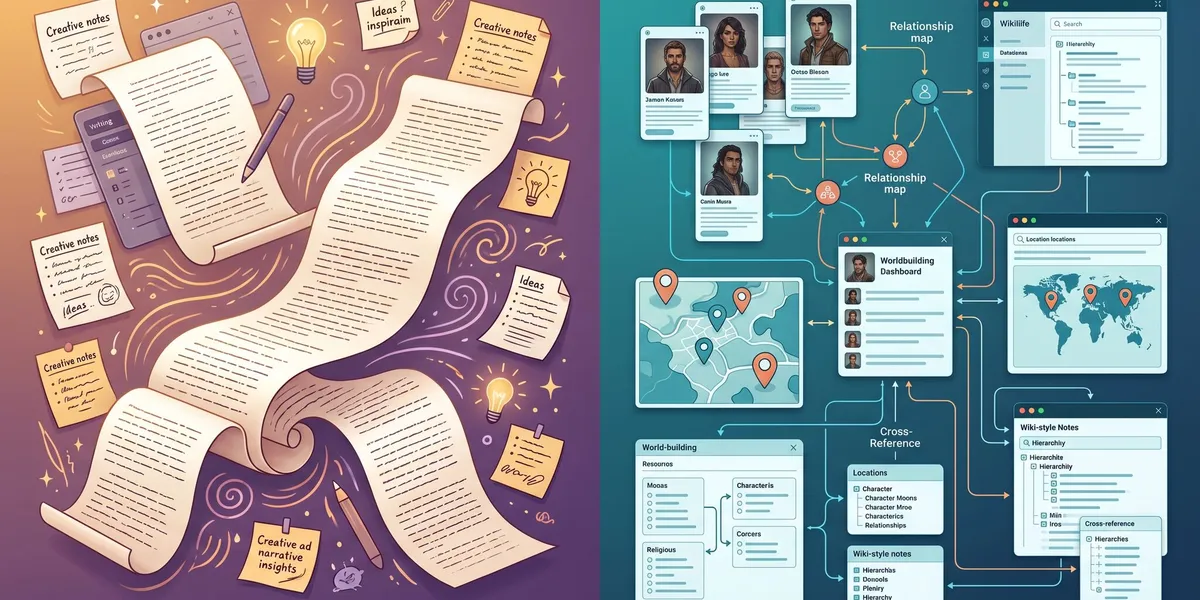
Sudowrite is better for prose generation and creative discovery. NovelCrafter is better for worldbuilding and structural control. But if you want a complete, publish-ready manuscript without managing credits or API keys, Chapter produces full novels from a single workflow for a one-time price.
In this comparison, you’ll learn:
- How Sudowrite and NovelCrafter differ in AI approach, features, and pricing
- Which tool fits your writing style — pantser vs. plotter
- Where both tools fall short for writers who want finished books
- Why a third option might be the better pick for most fiction authors
Here’s the full side-by-side breakdown.
Sudowrite vs NovelCrafter at a Glance
| Feature | Sudowrite | NovelCrafter |
|---|---|---|
| Best for | Prose generation and creative discovery | Worldbuilding and structural planning |
| AI model | Muse 1.5 (proprietary) + GPT-4, Claude, Mistral | BYOK — OpenAI, Claude, Mistral, local LLMs (300+) |
| Pricing | $10-$59/month (credits included) | $4-$20/month + separate API costs |
| Full manuscript generation | Partial (Story Engine 3.0) | No — scene-by-scene beats |
| Worldbuilding | Story Bible + Canvas | Codex (structured wiki with auto-injection) |
| Prose quality | Excellent — Muse trained on published fiction | Depends on your chosen model |
| Learning curve | Moderate (4-6 hours) | Steep (requires API setup + system learning) |
| Free trial | 10,000 credits, no time limit | 21-day full-feature trial |
| Collaboration | No | Yes (Specialist tier) |
How Does Sudowrite’s AI Compare to NovelCrafter’s?
Sudowrite and NovelCrafter take fundamentally different approaches to AI-powered fiction writing, and understanding that difference matters more than any feature checklist.
Sudowrite built its own fiction-specific model called Muse 1.5. This model was trained on published novels and short stories, so it understands pacing, dialogue rhythm, genre conventions, and scene structure at the sentence level. When you use Sudowrite’s Write tool, the output reads like fiction — not like a chatbot trying to write fiction. You also get access to GPT-4, Claude, and other models on every plan.
NovelCrafter doesn’t include AI at all on its base tier. Starting at the Hobbyist plan ($8/month), you connect your own API keys from providers like OpenAI, Anthropic, or OpenRouter. This means you choose which model generates your prose, and you can swap between 300+ options. The upside is total flexibility. The downside is that you’re paying for AI tokens separately, managing API credentials, and the prose quality depends entirely on which model you pick and how well you prompt it.
For writers who want to sit down and generate quality fiction immediately, Sudowrite’s bundled Muse model wins on convenience and output quality. For writers who want to experiment with different models or use cutting-edge options the moment they launch, NovelCrafter’s BYOK approach gives you more control.
Which Is Better for Worldbuilding?
NovelCrafter wins the worldbuilding comparison decisively with its Codex system — a structured wiki where you define characters, locations, factions, magic systems, species, items, and custom categories with interconnected entries and relationship maps.
The Codex’s best feature is automatic context injection. When you write a scene involving a character, NovelCrafter pulls that character’s Codex entry into the AI prompt automatically. Your AI “knows” that your protagonist has a scar on her left hand and distrusts authority figures without you re-explaining it every chapter. For writers managing complex worldbuilding across a fantasy series or sci-fi universe, this solves the biggest problem with AI-assisted long fiction: context loss.
Sudowrite counters with its Story Bible and Canvas 2.0. The Story Bible tracks characters, locations, and plot threads, giving the AI persistent context during generation. Canvas provides a visual brainstorming board where you place notes and character cards in spatial relationships. Both are functional, but they lack the structured, relational depth of NovelCrafter’s Codex.
Bottom line: If your novel involves ten named characters and a magic system with rules, NovelCrafter’s Codex keeps the AI consistent. If your story is character-driven with a simpler world, Sudowrite’s Story Bible handles it fine.
Which Has Better Writing and Drafting Tools?
Sudowrite has the edge for actual prose generation. Its toolset was designed around the writing act itself.
Sudowrite’s drafting tools:
- Write continues your scene in your voice and style
- Expand deepens pacing, adds sensory detail, and extends thin passages
- Describe generates sensory-rich prose from summary-style writing
- Tone adjustment shifts prose mood — more suspenseful, lighter, more poetic
- Shrink Ray compresses chapters into beat summaries for pacing analysis
- Story Engine 3.0 generates full chapters from beat sheet outlines
NovelCrafter’s drafting tools:
- Scene Beats let you write directorial instructions for each beat, then generate prose per beat
- Workshop Chat (Artisan tier, $14/month) lets you brainstorm with AI using your Codex as context
- Custom AI prompts — you design your own generation commands
- Multi-model switching mid-project for different writing tasks
Sudowrite’s approach is faster. You write, highlight, and click a tool. NovelCrafter’s approach gives you more granular control but requires more setup and directing per chapter. Think of it this way: Sudowrite is a co-writer who takes initiative. NovelCrafter is a team of specialists you manage.
For writers who enjoy the drafting process and want AI as a creative partner, Sudowrite feels more natural. For writers who want to direct every beat and maintain tight control over output, NovelCrafter’s scene-by-scene approach works better.
Sudowrite vs NovelCrafter Pricing Breakdown
Pricing is where these tools diverge the most — and where the real cost surprises live.
Sudowrite Pricing (2026)
| Plan | Monthly | Annual (per month) | Credits | Best for |
|---|---|---|---|---|
| Hobby & Student | $19/mo | $10/mo | 225,000 | Short fiction, testing |
| Professional | $29/mo | $22/mo | 1,000,000 | Active novelists |
| Max | $59/mo | $44/mo | 2,000,000 (rollover) | Heavy users, multiple projects |
All plans include full feature access. The difference is credit volume. Using Muse — the model you actually want — burns credits faster than budget alternatives. Expect the Professional plan to cover one to two novels per month with moderate editing use.
NovelCrafter Pricing (2026)
| Plan | Monthly | Annual (per month) | AI Included? | Key addition |
|---|---|---|---|---|
| Scribe | $4/mo | ~$3.33/mo | No | Editor + Codex only |
| Hobbyist | $8/mo | ~$6.67/mo | BYOK | Scene beats, character extraction |
| Artisan | $14/mo | ~$11.67/mo | BYOK | Workshop chat, review tools |
| Specialist | $20/mo | ~$16.67/mo | BYOK | Collaboration, team features |
NovelCrafter looks cheaper on paper, but you pay for AI tokens separately through your API provider. A typical novel-length project using Claude 3.5 Sonnet through the API costs $15-$40 in tokens depending on how heavily you generate and revise. Add that to NovelCrafter’s subscription, and your monthly cost for the Hobbyist tier is closer to $25-$50 — similar to Sudowrite’s Professional plan.
The key difference: NovelCrafter’s AI costs scale with usage. Write one novel and pay less. Write three and pay proportionally more. Sudowrite’s credits cap your output but bundle everything into one predictable bill.
The Real Cost Comparison
| Scenario | Sudowrite (Annual) | NovelCrafter (Annual + API) |
|---|---|---|
| Light use (1 novel/year) | $120-$264/year | $80-$120/year |
| Moderate use (3-4 novels/year) | $264-$528/year | $180-$360/year |
| Heavy use (6+ novels/year) | $528/year | $300-$600+/year |
Neither option is cheap for a serious fiction writer. Both require ongoing payments that add up over years. That’s where one-time pricing models become attractive.
Can You Write a Full Novel With Either Tool?
Neither Sudowrite nor NovelCrafter generates a complete, structurally sound manuscript from a single workflow. Both require you to guide the AI chapter by chapter.
Sudowrite’s Story Engine 3.0 gets the closest. You provide a premise, characters, genre, and style preferences. It produces a beat sheet outline, then expands each beat into chapters. But you’re still making decisions at every stage, editing for consistency, and stitching scenes together. It’s a co-writing experience, not a book generator.
NovelCrafter is even more manual. Scene Beats give you control over every story beat, but you’re writing directorial instructions for each one and generating prose incrementally. It’s a powerful writing workshop, not a manuscript factory.
For writers who enjoy the process of building a novel piece by piece, both tools work. For writers who want to go from outline to finished draft in a streamlined workflow, both fall short of dedicated book writing platforms.
A Better Option: Chapter for Complete Novels
Our Pick — Chapter
Chapter takes a different approach entirely. Instead of giving you AI tools to co-write with, Chapter generates complete novels from your creative direction using genre-specific frameworks.
Best for: Writers who want a finished manuscript, not a co-writing tool Pricing: One-time purchase (no subscription, no API keys, no credits) Why we built it: Because fiction writers kept telling us they wanted a book, not a toolkit
Here’s what makes Chapter different from both Sudowrite and NovelCrafter:
- Full manuscript generation — from outline to complete draft in one workflow
- Genre frameworks — Save the Cat, Three Act, Romance Beat Sheet, Hero’s Journey structures built in
- No credit system — write as much as you want without watching a meter
- No API keys — you never touch a settings page or manage tokens
- Consistency across chapters — character voices, plot threads, and world details maintained automatically
- 2,147+ authors have used Chapter to write over 5,000 books, including titles featured in USA Today and the New York Times
Sudowrite and NovelCrafter are both legitimate tools for writers who want AI assistance during their writing process. But if your goal is a finished, publishable novel — and you’d rather spend your time on creative decisions than credit management or API configuration — Chapter gets you there faster.
| Feature | Sudowrite | NovelCrafter | Chapter |
|---|---|---|---|
| Full manuscript | Partial | No | Yes |
| Pricing | $10-$59/mo | $4-$20/mo + API | One-time |
| AI setup required | None | API keys needed | None |
| Genre frameworks | Basic | None | Save the Cat, Three Act, Romance Beat Sheet, Hero’s Journey |
| Output length | Credit-limited | Token-limited | 20,000-120,000+ words |
Who Should Pick Sudowrite?
Pick Sudowrite if you enjoy the drafting process and want an AI creative partner that generates quality fiction prose out of the box. Sudowrite is the right choice when you:
- Write fiction and want the best prose quality without configuring AI models
- Prefer a “pantser” workflow where you discover the story as you write
- Want visual brainstorming tools like Canvas for plotting
- Don’t mind a monthly subscription with predictable costs
- Value built-in features over customization
Sudowrite works best as a co-writing assistant. You bring the vision; it helps you execute at the sentence and scene level. Read our full Sudowrite review for a deeper look at every feature.
Who Should Pick NovelCrafter?
Pick NovelCrafter if you’re a plotter who builds detailed story worlds and wants tight control over how AI interacts with your established lore. NovelCrafter is the right choice when you:
- Write fantasy, sci-fi, or any genre with complex worldbuilding
- Want a structured story bible that feeds directly into AI generation
- Prefer choosing your own AI models and managing costs at the API level
- Plan to write series where character and lore consistency across books matters
- Want collaboration features for co-authors or editors
NovelCrafter works best as a writing workshop. You build the world, set the rules, and direct the AI scene by scene. Read our full NovelCrafter review for the complete breakdown.
The Verdict
For prose quality and ease of use: Sudowrite wins. Muse 1.5 produces better fiction than most models you’ll access through NovelCrafter’s BYOK system, and the interface requires less setup.
For worldbuilding and structural control: NovelCrafter wins. The Codex system is the best story bible in any AI writing tool, and the scene beat workflow gives you granular control.
For finishing an actual book: Neither wins — and that’s the honest answer. Both are excellent co-writing tools that help you write fiction. Neither is a complete book writing solution. If your primary goal is a finished manuscript, Chapter handles the full workflow for a one-time price.
Most fiction writers fall into one of three camps:
- Discovery writers who want creative AI assistance → Sudowrite
- World-builders who want structured AI control → NovelCrafter
- Authors who want a finished book → Chapter
Pick the tool that matches what you actually need, not what sounds most impressive on a feature list.
FAQ
Is Sudowrite better than NovelCrafter?
Sudowrite is better than NovelCrafter for prose generation and creative discovery writing. Its proprietary Muse 1.5 model produces higher-quality fiction output than most models available through NovelCrafter’s BYOK system. However, NovelCrafter is better for structured worldbuilding and giving the AI consistent context through its Codex system.
How much does Sudowrite cost vs NovelCrafter?
Sudowrite costs $10-$59 per month depending on your plan, with AI credits included in the price. NovelCrafter costs $4-$20 per month for the platform, but you pay for AI usage separately through your own API keys — adding roughly $15-$40 per novel in token costs. Total monthly costs end up comparable for active writers.
Can you use NovelCrafter without an API key?
You can use NovelCrafter without an API key on the Scribe plan ($4/month), which gives you access to the editor, Codex, and planning tools — but no AI features. For AI-assisted writing, you need the Hobbyist plan ($8/month) or higher plus your own API key from a provider like OpenAI, Anthropic, or OpenRouter.
Is there a free alternative to Sudowrite and NovelCrafter?
ChatGPT’s free tier lets you experiment with AI fiction writing at no cost, though it lacks both tools’ specialized features. For a dedicated AI writing tool with no ongoing subscription, Chapter offers one-time pricing that eliminates monthly costs entirely while providing full manuscript generation.
Which is better for writing a novel series?
For a novel series with complex lore, NovelCrafter’s Codex is the strongest option — it maintains character details, world rules, and plot threads across multiple books through its structured wiki. Sudowrite’s Story Bible handles series-level context but with less structural depth. For generating complete manuscripts in a series, Chapter’s genre frameworks maintain consistency across full books.