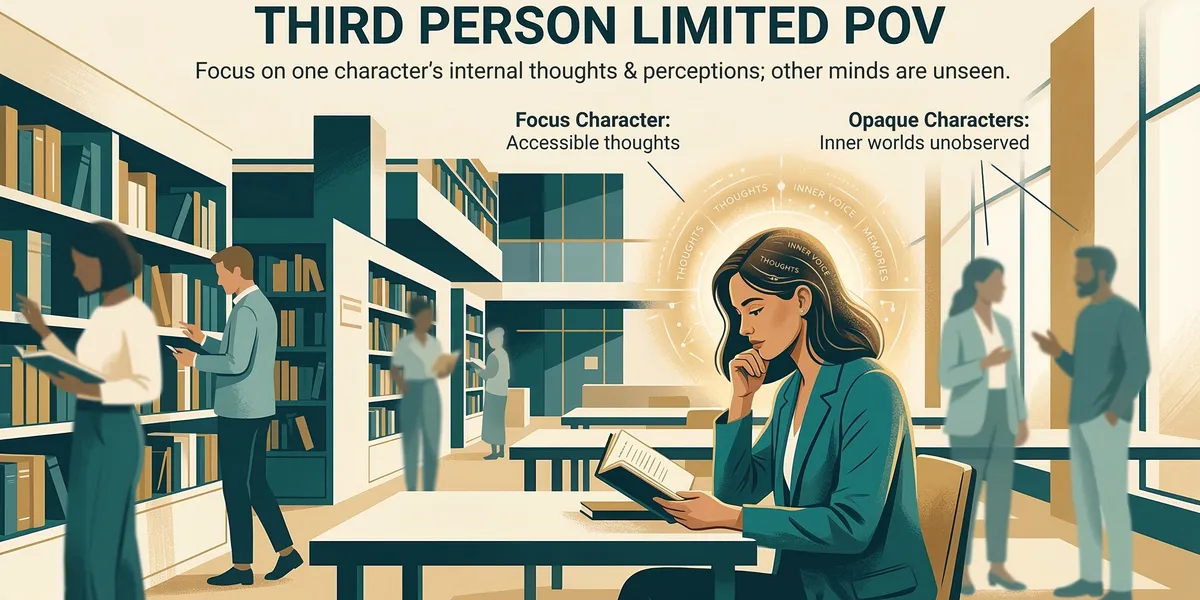
Third person limited is a point of view in which the narrator refers to characters as he, she, or they while staying inside only one character’s mind at a time. The reader experiences the story through that single character’s thoughts, feelings, and perceptions — everyone else remains opaque, known only through what they say and do.
It is the most widely used POV in modern fiction, and for good reason. It offers the intimacy of first person with the flexibility of third person.
How Third Person Limited Works
The narrator has access to one character’s interior life per scene or chapter. That character is the POV character. Everything the reader learns passes through their filter:
- Thoughts: She wondered if he was telling the truth.
- Feelings: His chest tightened with something close to dread.
- Perceptions: The room smelled like dust and old paper.
What the narrator cannot do is dip into another character’s head. If your POV character is sitting across the table from someone, the reader sees that person’s expression, hears their words, and watches their hands — but never knows what they are thinking. The gap between what the POV character observes and what is actually happening in someone else’s mind is where tension lives.
This constraint is not a limitation. It is a storytelling engine.
Famous Examples
Harry Potter series (J.K. Rowling) — Nearly every chapter filters through Harry’s perspective. The reader knows what Harry sees, feels, and suspects, but never gets direct access to Dumbledore’s plans or Snape’s motives. The mysteries of the series depend on this restriction.
The Hunger Games (Suzanne Collins) — Written in third person present tense limited, locked tightly to Katniss. Every alliance, every threat, every moment in the arena is filtered through her survival instincts. The reader is as uncertain as she is.
A Game of Thrones (George R.R. Martin) — Each chapter is named after its POV character: Eddard, Catelyn, Daenerys, Tyrion, and others. Martin uses rotating third person limited, switching whose head the reader occupies chapter by chapter while never breaking the rule within a chapter.
Third Person Limited vs Omniscient
The difference comes down to one question: how many minds can the narrator enter?
Third person limited locks the narrator to one character’s consciousness at a time. The reader knows only what that character knows. Other characters are understood from the outside — through dialogue, action, and body language.
Third person omniscient gives the narrator godlike access to every character’s thoughts and feelings, sometimes within the same paragraph. The narrator can also editorialize, offering judgments or information no character possesses.
Limited creates suspense through restricted knowledge. Omniscient creates depth through panoramic awareness. Most contemporary fiction leans toward limited because readers tend to bond more deeply with a character when they share that character’s blind spots.
Single vs Rotating POV
Third person limited comes in two main forms.
Single POV follows one character for the entire novel. The reader never leaves their perspective. This works well for tightly focused stories — mysteries, coming-of-age narratives, survival tales. Harry Potter and The Hunger Games both use single POV.
Rotating POV switches between multiple characters, typically by chapter or section break. Each chapter is still strictly limited to one mind. A Game of Thrones is the classic example. Rotating POV suits sprawling stories with multiple plotlines, political intrigue, or ensemble casts.
The key rule for rotating POV: never switch perspective within a scene. Each chapter or section belongs to one character. If you break this rule, you have slipped into omniscient territory — and the reader will feel the ground shift under them.
Tips for Writing Third Person Limited
Stay in one head per scene. This is the fundamental discipline. If your POV character is Anna, every sensory detail, every emotional reaction, every thought belongs to Anna. The moment you write Meanwhile, across the room, Jake felt a pang of guilt, you have broken the POV.
Show other characters through behavior, not thoughts. Since the reader cannot access other characters’ minds, you reveal those characters through what they do and say. A clenched jaw. A pause before answering. A lie the POV character catches — or misses. This is more compelling than simply reporting someone’s internal state.
Use deep POV for intimacy. Deep POV strips away the narrator’s presence and puts the reader directly inside the character’s experience. Compare these:
- Filtered: She thought the house looked abandoned.
- Deep POV: The house looked abandoned.
In deep POV, you drop thought tags (she thought, he realized, she noticed) and let the character’s perception speak for itself. The line between narrator and character dissolves.
Let the POV character be wrong. One of the great advantages of limited perspective is the unreliable filter. Your character can misread a situation, misjudge a person, or miss a clue entirely. The reader may catch what the character does not — and that dramatic irony is powerful.
Choose the right character for each scene. In rotating POV, ask: who has the most at stake in this scene? Who knows just enough to create tension but not so much that the suspense evaporates? The answer determines your POV character.
Third person limited endures because it mirrors how people actually experience the world — from inside one mind, interpreting everyone else from the outside. Master it, and you give readers the most natural way into your story.