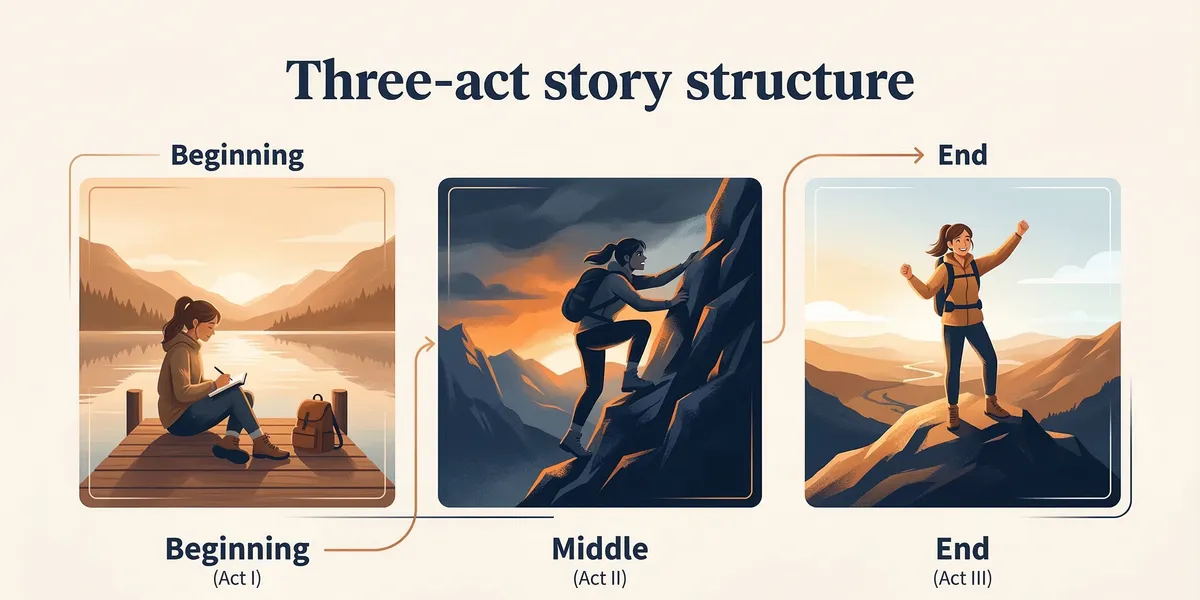
The three act structure divides a story into three parts: setup (25%), confrontation (50%), and resolution (25%). It is the oldest and most widely used narrative framework in fiction, dating back to Aristotle’s Poetics, and it still drives nearly every successful novel, screenplay, and stage play written today.
If you understand three acts, you understand the skeleton of story.
What is the three act structure?
The three act structure is a narrative model that organizes a story into a beginning, middle, and end. Each act serves a distinct purpose, and the transitions between them are marked by turning points that shift the story’s direction.
Here is the basic breakdown:
| Act | Portion | Purpose | Key Event |
|---|---|---|---|
| Act 1: Setup | ~25% | Introduce characters, world, and stakes | Inciting incident |
| Act 2: Confrontation | ~50% | Escalate conflict, test the protagonist | Midpoint shift |
| Act 3: Resolution | ~25% | Climax and resolve the central conflict | Climax |
These proportions are flexible. A literary novel might linger in Act 1. A thriller might compress it to a single chapter. The ratio is a guideline, not a law. But stories that stray dramatically from it tend to feel imbalanced. Audiences sense the proportions instinctively, even when they cannot name them.
Act 1: Setup (the first 25%)
Act 1 does three things. It establishes the protagonist’s ordinary world, introduces the central conflict, and gives the reader a reason to care.
The ordinary world shows us who the protagonist is before the story happens to them. In The Hunger Games, Katniss hunts to feed her family in District 12. In Pride and Prejudice, Elizabeth Bennet navigates a household obsessed with finding husbands. The ordinary world is not filler. It is the baseline that makes everything after it meaningful.
The inciting incident is the event that disrupts the ordinary world. It is the moment that launches the story. Katniss volunteers as tribute. Mr. Darcy arrives at the Meryton ball. Without this disruption, there is no story.
The first turning point closes Act 1. The protagonist commits to the story’s central problem. They cross a threshold they cannot uncross. Katniss enters the arena. Elizabeth’s pride clashes with Darcy’s prejudice in a way that can only resolve through the full arc of the novel.
Common Act 1 mistakes
- Spending too long on backstory before the inciting incident arrives
- Failing to establish what the protagonist wants and what stands in their way
- Opening with action that has no emotional grounding (explosions without context)
Act 2: Confrontation (the middle 50%)
Act 2 is the longest section and the one most writers struggle with. Its job is to test the protagonist, escalate the stakes, and build toward the climax. This is where the “saggy middle” lives if you let it.
The key to a strong Act 2 is rising action. Each scene should raise the stakes or deepen the conflict. The protagonist tries to solve their problem and encounters obstacles. They gain allies and enemies. They learn things that change their understanding of the situation.
The midpoint splits Act 2 in half and prevents the middle from sagging. It is a major shift. In The Empire Strikes Back, Luke learns Darth Vader is his father. In Gone Girl, the narrative perspective shifts and the entire story reframes. The midpoint changes the protagonist from reactive to proactive, or delivers a revelation that redefines the conflict.
The second turning point closes Act 2 and propels the story into Act 3. This is often the “dark night of the soul,” the moment where the protagonist hits rock bottom. All seems lost. In Harry Potter and the Deathly Hallows, Harry walks into the Forbidden Forest believing he must die. In The Lord of the Rings, Frodo is captured and Sam is left alone at Cirith Ungol.
The Act 2 toolkit
Successful novelists use several techniques to keep Act 2 compelling:
- Subplots that mirror or contrast the main conflict
- Reversals that flip the protagonist’s situation
- Ticking clocks that create urgency
- Escalating obstacles where each problem is harder than the last
- Character reveals that deepen our understanding of the cast
Act 3: Resolution (the final 25%)
Act 3 begins after the protagonist hits bottom and decides to fight one last time. It contains the climax, the falling action, and the denouement.
The climax is the peak confrontation where the central conflict is resolved. Elizabeth and Darcy finally speak honestly. Katniss defies the Capitol in the arena. Frodo stands at Mount Doom. The climax should feel both surprising and inevitable, the logical result of everything the story has built.
The falling action shows the immediate consequences of the climax. Battles are won or lost. Relationships settle into their new shape. Loose ends tie up.
The denouement is the final image, the new ordinary world. It mirrors Act 1’s opening but shows how the protagonist has changed. Katniss returns to District 12. Elizabeth and Darcy marry. The reader sees the distance traveled.
What makes Act 3 work
- The climax resolves the central conflict, not a side plot
- The protagonist’s character arc culminates in the climactic moment
- The resolution feels earned, not convenient (no deus ex machina)
- The final image echoes the opening image with meaningful change
Famous three act structure examples
The Great Gatsby (F. Scott Fitzgerald)
- Act 1: Nick arrives in West Egg, meets Gatsby, learns of his obsession with Daisy
- Act 2: Gatsby and Daisy reconnect, tensions build with Tom, the affair becomes unsustainable
- Act 3: Confrontation at the Plaza, Myrtle’s death, Gatsby’s murder, Nick’s disillusionment
Star Wars: A New Hope (George Lucas)
- Act 1: Luke on Tatooine, finds droids, learns of the Force, his family is killed
- Act 2: Rescues Leia, escapes the Death Star, loses Obi-Wan
- Act 3: Death Star assault, Luke trusts the Force, destroys the station
To Kill a Mockingbird (Harper Lee)
- Act 1: Scout’s world in Maycomb, Atticus takes Tom Robinson’s case
- Act 2: The trial, the town’s racism, the children’s growing understanding
- Act 3: The verdict, Bob Ewell’s attack, Boo Radley’s intervention, Scout’s maturation
The three act structure and other frameworks
The three act structure is the foundation that other story frameworks build on. Save the Cat’s 15 beats map directly onto three acts. The Hero’s Journey follows a three-act arc with mythological layering. Story beats are the smaller units that fill each act.
Understanding three acts is not limiting. It is the grammar of narrative. You can break the rules, but you need to know them first.
Chapter uses the three act structure as one of its core fiction writing templates, breaking each act into guided scenes so you can build your novel within the framework rather than staring at a blank page.
How to apply it to your novel
- Write a one-sentence summary of your story’s central conflict
- Identify your inciting incident and place it within the first 15% of your word count
- Plan your midpoint so Act 2 has a clear pivot
- Define your climax as the moment the central question is answered
- Check your proportions (roughly 25/50/25) and adjust if any section drags
The three act structure is not a formula. It is a map. The terrain of your story is yours to shape, but knowing the landscape keeps you from wandering in circles.