Understanding the different types of books helps you find what to read next, position your own writing, and speak the language of publishers and booksellers. Whether you’re a reader browsing for your next pick or a writer choosing a genre, this guide covers every major category.
The types of books break down into three layers: fiction vs. nonfiction (the broadest divide), genre (the subject or style category), and format (the physical or digital form). We’ll cover all three.
Fiction vs. Nonfiction: The Core Divide
Every book falls into one of two camps:
- Fiction: Imagined stories. Characters, events, and settings are invented by the author, even when inspired by real life.
- Nonfiction: Factual content. The information, events, and people are real (or presented as real).
Some books blur this line — creative nonfiction, autofiction, and historical fiction all mix real and imagined elements. But for shelving, marketing, and reader expectations, the fiction/nonfiction split still governs everything.
Fiction Genres
Fiction genres are defined by their subject matter, tone, setting, and reader expectations. Most novels fit primarily into one genre, though many cross boundaries.
| Genre | Description | Example Authors |
|---|---|---|
| Literary Fiction | Character-driven stories focused on prose style and thematic depth | Toni Morrison, Kazuo Ishiguro |
| Mystery | A crime or puzzle drives the plot; the reader follows the investigation | Agatha Christie, Tana French |
| Thriller | High-stakes, fast-paced tension; the protagonist faces danger | Lee Child, Gillian Flynn |
| Romance | Central love story with an emotionally satisfying ending | Nora Roberts, Ali Hazelwood |
| Science Fiction | Speculative settings involving technology, space, or future societies | Isaac Asimov, N.K. Jemisin |
| Fantasy | Imagined worlds with magic, mythology, or supernatural elements | Brandon Sanderson, Ursula K. Le Guin |
| Horror | Designed to frighten, unsettle, or create dread | Stephen King, Shirley Jackson |
| Historical Fiction | Set in a past time period with attention to historical accuracy | Hilary Mantel, Anthony Doerr |
| Western | Set in the American frontier, often 1800s | Cormac McCarthy, Larry McMurtry |
| Adventure | Action-driven plots involving journeys, quests, or exploration | Patrick O’Brian, Clive Cussler |
| Dystopian | Set in oppressive future societies | Margaret Atwood, George Orwell |
| Young Adult (YA) | Written for readers aged 12–18 with teen protagonists | Suzanne Collins, Angie Thomas |
| Children’s | Written for readers under 12, from picture books to middle grade | Roald Dahl, Katherine Applegate |
| Graphic Novel | Long-form visual storytelling combining art and text | Art Spiegelman, Marjane Satrapi |
Sub-genres Worth Knowing
Most major genres have sub-genres that define reader expectations more precisely:
Mystery sub-genres: Cozy mystery (low violence, often amateur sleuth), police procedural, noir, locked-room mystery, legal thriller.
Romance sub-genres: Contemporary romance, paranormal romance, romantic suspense, historical romance, romantic comedy (rom-com).
Fantasy sub-genres: Epic/high fantasy, urban fantasy, dark fantasy, fairy tale retellings, magical realism.
Science fiction sub-genres: Hard sci-fi (science-heavy), space opera, cyberpunk, cli-fi (climate fiction), military sci-fi.
For a deeper breakdown of fiction categories, see our complete book genres guide.
Nonfiction Genres
Nonfiction covers everything from academic textbooks to personal memoirs. The key distinction: the content is grounded in facts, real events, or genuine expertise.
| Genre | Description | Example Authors |
|---|---|---|
| Memoir | Personal narrative drawn from the author’s life | Mary Karr, Tara Westover |
| Biography | The story of a real person’s life, written by someone else | Walter Isaacson, Robert Caro |
| Autobiography | The author’s own life story told in full | Maya Angelou, Malcolm X |
| Self-Help | Practical advice for personal improvement | James Clear, Brene Brown |
| Business | Strategy, leadership, management, and entrepreneurship | Peter Drucker, Eric Ries |
| History | Accounts and analysis of past events | Erik Larson, Doris Kearns Goodwin |
| Science | Scientific topics explained for general or specialist readers | Carl Sagan, Mary Roach |
| True Crime | Factual accounts of real crimes and investigations | Truman Capote, Michelle McNamara |
| Travel | Accounts of journeys and exploration of places | Bill Bryson, Paul Theroux |
| Health & Wellness | Nutrition, fitness, mental health, and medical topics | Matthew Walker, Andrew Huberman |
| Philosophy | Exploration of fundamental questions about existence and ethics | Marcus Aurelius, Simone de Beauvoir |
| Religion & Spirituality | Faith traditions, spiritual practices, and theological inquiry | C.S. Lewis, Thich Nhat Hanh |
| Cookbooks | Recipes and culinary instruction | Julia Child, Yotam Ottolenghi |
| Education & Reference | Textbooks, guides, dictionaries, and encyclopedias | Various |
| Essay Collections | Curated sets of essays on related or varied topics | Joan Didion, David Sedaris |
Creative Nonfiction
Creative nonfiction applies literary techniques — narrative structure, vivid description, dialogue — to factual content. It includes:
- Narrative nonfiction: True events told like a novel
- Personal essays: Reflective first-person explorations of a topic
- New journalism: Immersive reporting with a subjective perspective
- Literary journalism: Long-form reporting with narrative craft
This category has grown significantly over the past two decades and dominates bestseller lists in memoir, true crime, and popular science.
Book Formats
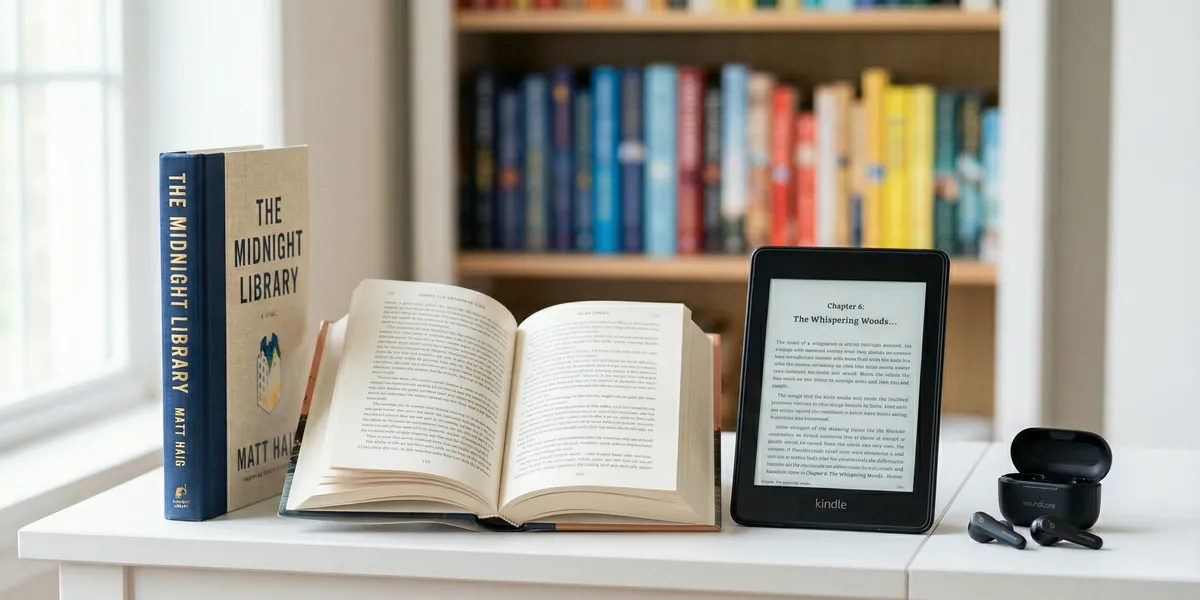
Format describes how a book is physically or digitally delivered. The same title often exists in multiple formats simultaneously.
| Format | Description | Typical Price Range |
|---|---|---|
| Hardcover | Rigid board cover, sewn binding, dust jacket | $20–$35 |
| Trade Paperback | Flexible paper cover, standard size | $12–$20 |
| Mass Market Paperback | Smaller, cheaper paper stock, often genre fiction | $7–$10 |
| Ebook | Digital file read on devices (Kindle, tablet, phone) | $2–$15 |
| Audiobook | Narrated recording, either human or AI-read | $10–$30 or subscription |
| Large Print | Larger font size for accessibility | $15–$25 |
| Board Book | Thick cardboard pages, designed for babies and toddlers | $6–$10 |
| Graphic Novel / Comic | Visual format with panels, art, and sequential storytelling | $12–$30 |
The Rise of Ebooks and Audiobooks
Ebooks exploded in popularity after Amazon launched the Kindle in 2007. They now account for roughly 20% of all book sales in the U.S., according to the Association of American Publishers.
Audiobooks are the fastest-growing format. The Audio Publishers Association reports that audiobook revenue has grown every year for over a decade, driven by platforms like Audible, Spotify, and Libro.fm.
Print isn’t going anywhere, though. Physical book sales have been stable or growing since 2013, with many readers preferring print for certain genres (coffee table books, children’s picture books, cookbooks).
Hybrid and Emerging Book Categories
The traditional genre boundaries keep shifting. Several categories have grown significantly in recent years:
Autofiction. Novels that blend autobiographical material with fictional elements. The author is the protagonist, but events may be altered, compressed, or invented. Karl Ove Knausgaard’s My Struggle series popularized the form, and it has become one of the most discussed categories in contemporary literary fiction.
Romantasy. A mashup of romance and fantasy that dominates BookTok and bestseller lists. Authors like Sarah J. Maas and Rebecca Yarros write in this space, combining epic worldbuilding with central love stories. Traditional publishers now actively acquire in this category.
Cozy fantasy. Fantasy without the violence, war, or high-stakes battles. Think small-town settings, found family, and low-conflict storylines in magical worlds. Travis Baldree’s Legends & Lattes demonstrated massive demand for this sub-genre.
Book-to-screen adaptations. While not a genre, the pipeline from book to film/TV has reshaped the market. Books with screen adaptation potential — strong visual elements, ensemble casts, and episodic structure — attract both publishers and agents who see them as dual-revenue opportunities.
Prescriptive nonfiction. Self-help and business books built around a single framework or method. Atomic Habits by James Clear is the model: one core idea, expanded with research and practical application. This format consistently outsells more general advice books because it gives readers a clear system to implement.
Narrative podcasts turned books. Podcast-first content adapted into book form. True crime podcasts, investigative journalism series, and interview-based shows increasingly spawn companion books and original titles. The audience is pre-built, which reduces the marketing challenge significantly.
How Genres and Formats Intersect
A single book can be:
- A mystery novel (genre) in audiobook format
- A self-help book (genre) in hardcover format
- A romance (genre) as a mass market paperback
Genre defines the content. Format defines the delivery. Readers often have format preferences tied to context: audiobooks for commuting, ebooks for travel, hardcovers for home libraries.
How Book Classification Works in the Industry
When publishers, retailers, and libraries organize books, they use formal classification systems that go beyond casual genre labels.
BISAC codes (Book Industry Standards and Advisory Committee) are the standard in North America. Every commercially published book receives one or more BISAC codes that determine where it gets shelved — both physically in bookstores and digitally on retail sites. There are over 4,000 BISAC codes, grouped into 50+ major categories. For example, BISAC code FIC022000 is “Fiction / Mystery & Detective / General.” Self-published authors on Amazon KDP select these through category choices during the publishing process.
Thema codes are the international equivalent, used widely in Europe and gaining adoption globally. Thema provides even more granular classification than BISAC, with over 2,500 subject codes plus qualifier codes for geography, language, time period, and audience.
Library of Congress Classification is used by academic and research libraries. It organizes books by subject using a system of letters and numbers (e.g., PR for English Literature). Public libraries more commonly use the Dewey Decimal System, which groups nonfiction into ten broad classes.
Why does this matter for writers? Because your book’s classification directly affects its discoverability. Choosing the wrong BISAC code can bury your book in a category where your target readers never browse. Choosing the right one can put you in front of exactly the readers who want what you’ve written. Most self-publishing platforms like Amazon KDP let you select up to three categories, and you can request additional ones through support.
Choosing Your Genre as a Writer
If you’re deciding what type of book to write, consider three factors:
What you read. You’ll write best in genres you know deeply as a reader. If you’ve consumed hundreds of thrillers, you instinctively understand pacing, twists, and tension.
Market demand. Some genres have larger, more active readership. Romance is the highest-selling fiction genre in the U.S. Self-help and business dominate nonfiction. That doesn’t mean you should write exclusively for market demand — but awareness helps.
Your natural voice. Literary fiction rewards lyrical prose. Thrillers reward tight, propulsive writing. Business books reward clarity and frameworks. Match your genre to how you naturally communicate.
For help structuring your book in any genre, Chapter.pub provides genre-specific templates and AI-assisted outlining that adapts to fiction and nonfiction formats.
Related Guides
- Book genres — Deep dive into fiction and nonfiction categories
- How to write a book — Full process from idea to publication
- Self-publishing guide — Getting your book to readers
- How to write a novel — Fiction-specific craft guide
Understanding types of books is the first step. The next step is picking the one you want to write — or read next.